
Forecasting the vegetable powder market in 2030! An explanation of growth fields and the latest trends

Summary of this article
野菜パウダー市場のトレンドを、Agritureが京都拠点の受託加工会社として実際に観察している動きに基づいて整理します。需要が伸びる3用途(業務用・機能性飲料・ベビー/ペット)、健康志向と機能性ニーズの細分化、モリンガ・よもぎ・アスパラ茎・加賀野菜・京都産柚子といった注目素材、日清食品・貝印Chefon・日本製紙クレシア・クボタ・じげんなど大手との協業事例、オフィス八百屋などB2B2Cの新サービス、OYAOYAの海外展開まで解説。公的統計が整備されていない領域のため、検証できない数値を羅列するのではなく、自社観察と試作実績ベースでトレンドを捉えます。
The market for vegetable powder has broadened significantly over the past few years—spanning commercial raw materials, health foods, functional beverages, baby food, pet food, and even collaboration-product development. Inquiries from food makers like “we want to use non-standard vegetables,” “we’re looking for vegetable ingredients usable in health management and employee benefits,” and “we want to commercialize a rare local vegetable” are increasing, and the scope of product development centered on vegetable powder has clearly widened.
In this article, without forcing conclusions where figures aren’t publicly settled, we organize vegetable-powder trends based on the market movements Agriture actually observes as a Kyoto-based contract processor of dried vegetables and powders, the tendencies in prototyping requests, real collaboration cases with major food makers, and notable new ingredients. The items handled and specifications are the product page for commercial vegetable powder.

TOC
An overview of the market and the structure of its growth
The vegetable-powder market is a latecomer category compared with fresh and frozen vegetables, but against the backdrop of three tailwinds—more efficient food manufacturing, health consciousness, and food-loss reduction—it’s becoming established as a raw-material option for new products. Inquiries to Agriture now arrive from a wide range of businesses—major food makers, regional cooperatives, D2C brands, agricultural corporations, and restaurant chains.
| Tailwind factor | Impact on the market |
|---|---|
| More efficient food manufacturing | Room-temperature storage and lighter weight cut logistics costs; stable specs improve yield |
| The establishment of health consciousness | Expanded adoption as a raw material for foods with functional claims, health teas, supplements, and smoothies |
| The call for food-loss reduction | Demand for upcycling non-standard vegetables; adoption in a sustainability context |
| D2C and small-lot production | Drawing attention as a raw material that’s easy to launch from small-lot prototyping |
| Commercialization of regional specialties | Adoption in a regional-heirloom-vegetable, regional-revitalization context |
Since data that can definitively state market size is limited to public statistics, this article centers on the movements Agriture observes in the field of contract processing rather than listing figures.
The 3 growing uses
Classifying the content of inquiries to Agriture, vegetable-powder needs concentrate largely in three uses. Since each need has a different background, it serves as a reference when deciding on a product-development angle.
① For commercial raw materials and food makers
In instant noodles, retort foods, sweets, bread, frozen foods, and the like, there’s growing demand to slot “non-standard vegetable powder” into existing products to satisfy both social-issue appeal and nutritional fortification. A representative example is the Food Loss Reduction Day collaboration in which we developed a dried-vegetable set matched to each of Nissin Foods’ six Ra-Oh flavors. With a major instant-food product officially adopting non-standard vegetables, there’s room for it to ripple out to competitors.
② Health foods and functional beverages
Adoption as a raw material for aojiru, smoothies, functional teas, soups, and nutritional supplements is expanding. Kale, Moringa, spinach, beetroot, Mugwort and other ingredients that can tell a nutritional story are central. Agriture has prototyping results with Kagoshima-grown moringa・and Japanese-grown mugwort powder・Japanese-grown kale, both of which are seeing increased inquiries from health-food makers and projects mindful of functional claims.
③ Baby food, care food, and pet food
Demand for “additive-free, Japanese-grown, reassuring ingredients” is clearly growing in the baby-food, care-food, and pet-food fields too. Lotus root Powder’s water solubility (it thickens when dissolved in water) is used in baby food and care food, leading up to full production of lotus-root powder beginning. In the pet field, use-specific high-value-added products are being launched, such as One’s Daily (dried sticks of Nagano-grown non-thinned apples) and and Buddy’s Farm (dried processing of pesticide-free green papaya).
FOR BUSINESS
乾燥野菜のOEM・受託加工を承ります
国産の野菜・果物の乾燥、100メッシュ相当までの粉砕、10g以上の小袋充填までをお受けしています。小ロットの試作から量産までご相談ください。寄せられた相談の実例は OEM・卸のご相談 に掲載しています。
乾燥品の賞味期限は、出荷日から6ヶ月程度を目安にご案内しています。
Movements in health consciousness and functional needs
Health consciousness is segmenting into concrete appeals like “diet, beauty, immunity, gut care, sleep,” and appealing simply to “vegetables” is becoming harder to differentiate. Vegetable powder is an ingredient that can raise its appeal by combining any of functional components, regional story, or scarcity.
| Appeal axis | Ingredients to pair | Product examples |
|---|---|---|
| Beauty and skin | Carrot, beetroot, tomato | Smoothies, beauty drinks |
| Gut care and dietary fiber | Lotus root, burdock, pumpkin | Soups, furikake, health foods |
| Immunity and antioxidants | Kale, broccoli, moringa | Aojiru, functional teas |
| Iron supplementation | Spinach, komatsuna, beetroot | Baby food, pre-pregnancy foods |
| Relaxation and sleep | Mugwort, pumpkin, ginger | Herbal soups, caffeine-free teas |
| Detox and cleanse | Kale, spinach, beetroot | Juices, fasting foods |
Foods with functional claims and vegetable powder
Attempts at foods with functional claims are also increasing. Since the content of functional components needs to be stabilized, it’s a field where precision in drying-condition and particle-size management is tested, and on the OEM side, submission of test reports and tighter lot management are advancing. Designs mindful of functional components (lycopene, lutein, GABA, anthocyanins, etc.)—like the dried processing of the Phytorich series with Takii Seed—lead to functional-claim notifications and to raw-material supply for function-appealing products.
Notable items and new ingredients
In addition to standard vegetable powders (spinach, carrot, pumpkin, tomato, etc.), prototyping requests for regional-specialty and functional vegetables are increasing. Over 20 prototype ingredients published since the start of 2026 line up on Agriture’s news page, and the outline of the “next ingredient” the market is seeking is coming into view.
Notable regional-specialty and heirloom-vegetable ingredients
- Ishikawa’s Kaga vegetables (Kaga lotus root, etc.) dried processing
- 京都産の柚子パウダー
- Domestic Shimonita negi dried product
- Okinawa-grown dried fruit
- Nara’s Yamato vegetables (purple pepper powder)
Notable functional and wellness ingredients
- Kagoshima-grown moringa dried / powdered
- and Japanese-grown mugwort powder
- Japanese-grown kale dried product
- Japanese-grown asparagus-stalk powder (use of a part previously discarded)
- Japanese-grown garlic sprouts dried
The parallel trend of dried fruit
Alongside vegetable powder, cases where prototyping requests for dried fruit (Kiwi・lemon slices, etc.) come in as a set are increasing. In contexts like confectionery, gifts, granola, and health drinks, combination products of vegetable powder and dried fruit are also easy to launch.
The spread of regional collaboration and bring-your-own-material processing
Movements linking vegetable powder to regional industry are gradually emerging in various places. In projects Agriture is involved in as well, a flow has taken hold in which agricultural corporations, regional cooperatives, and seed companies bring in raw materials they’ve grown themselves to have them powdered.
| Case study | Angle |
|---|---|
| Sakura lotus root (Chiba) | Bringing in their own lotus root grown without chemical fertilizer to be powdered → made into an agricultural corporation’s PB |
| Nara Prefecture Miwa Somen Industrial Cooperative | Yamato-vegetable purple-pepper powder as a raw material for a new somen product |
| Takii Seed (Kyoto) | Drying and powdering 7 items of the “Phytorich series” vegetables containing functional components |
| Kubota (agricultural-machinery maker) | Drying tomatoes from its own farm “Kubota Farm” for internal business use |
| Buddy’s Farm (Kanagawa) | Drying and milling pesticide-free green papaya as a pet-supplement raw material |
Regional collaboration like this aligns with consumers’ shifting preference for “where and by whom something was made,” and functions as a raw material for PB and D2C products where a brand story is easy to tell.
Trends in manufacturing technology and processing
While drying methods themselves have not changed dramatically, the field is being asked for small-lot support, custom particle size design and flexibility with client-supplied raw materials. In particular, whether a company can handle everything through small-lot small-bag filling in one stop has become a point of difference in partnerships with D2C and regional brands.
| Technology/service | Changes happening in the field |
|---|---|
| Using drying methods selectively | Optimizing hot-air, freeze, and vacuum by ingredient |
| Particle-size design | Made-to-order from fine powder for supplements to coarse for furikake |
| Bring-your-own raw material processing | Accommodating brought-in raw materials from agricultural corporations, regional cooperatives, and majors’ own farms |
| Small-lot filling | Small-bag filling service from 500 bags and other small-lot prototyping and test-sales support |
| Original blend | Custom-blend OEM from over 30 kinds of dried vegetables |
Industry players and collaboration movements
The vegetable-powder market is spreading through cross-industry collaboration—not just existing dried-vegetable makers, but seed companies, agricultural-machinery makers, major food brands, paper-product makers, agricultural corporations, D2C brands, sports teams, and more.
Collaboration cases with major companies
| Company | Collaboration angle |
|---|---|
| Nissin Foods | Development of a non-standard-vegetable set for the six “Nissin Ra-Oh” flavors (Food Loss Reduction Day collaboration) |
| Kai (Chefon) | Produced 8 recipe videos supervised by a Michelin one-star chef-owner |
| Nippon Paper Crecia | An OYAOYA 8-variety set as a prize for the “Action for Smile” campaign |
| Kubota | Making dried tomatoes from its own farm’s vegetables for internal employee business use |
| Zigen (TSE Prime) | Development of Kyoto-vegetable novelties for a 3×3 basketball team |
Movements in new businesses and services
Born from the collaboration between the Kai Group and Agriture, Office Yaoya (OFFICE YAOYA) is a B2B2C service that keeps dried vegetables on hand at the office as an employee benefit. In a context that solves three things at once—health management, employee benefits, and food-loss reduction—new outlets for vegetable powder and dried vegetables are emerging.
On the platform side too, Shokuhin OEM no Madoguchi has launched a joint initiative with Ggrow for SEO and LLMO customer acquisition, advancing the development of matching infrastructure suited to the AI-search era.
The spread of overseas expansion
Not only domestically, but expansion into overseas markets is also beginning to move. Agriture Group’s OYAOYA has sales results in Germany, New York, Hong Kong, and Taiwan, and also exhibited at FBIF2025 held in Shanghai. Japan-born angles like upcycling non-standard vegetables, Japanese-grown ingredients, and low-temperature drying have high affinity with overseas natural-food and health-conscious markets, and inquiries for export projects are increasing too.
We have materials available to help you understand dried processing OEM
Agriture OEM, flexibly handling everything from small lots to large lots
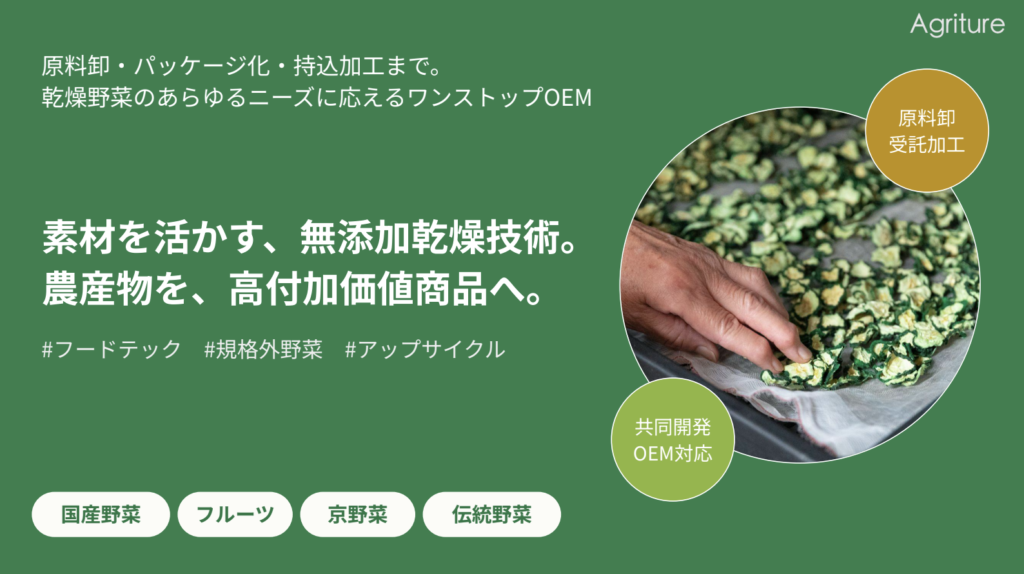
- OEM available from small lots of 10 kg
- Drying of brought-in raw materials also possible
- Support from processing to filling in one place
FOR BUSINESS
乾燥野菜のOEM・受託加工を承ります
国産の野菜・果物の乾燥、100メッシュ相当までの粉砕、10g以上の小袋充填までをお受けしています。小ロットの試作から量産までご相談ください。寄せられた相談の実例は OEM・卸のご相談 に掲載しています。
乾燥品の賞味期限は、出荷日から6ヶ月程度を目安にご案内しています。
FAQ
Will the vegetable-powder market keep growing going forward?
It’s a field where public market-size statistics aren’t established, but the three tailwinds of health consciousness, food-loss reduction, and small-lot production continue. Agriture’s own contract-project count and inquiry count are increasing year by year, and at least as a raw-material option for food makers, vegetable powder’s presence is set to keep rising.
What kinds of items look likely to grow going forward?
定番のほうれん草・にんじん・かぼちゃ・トマトに加えて、モリンガ・よもぎ・ケール・ビーツなどの機能性訴求ができる素材、加賀野菜・京都産柚子・大和野菜などの地域特産素材の引き合いが増えています。アスパラ茎・Garlic sprouts—are also expanding.
How are major food makers actually adopting it?
Nissin Foods’ adoption of non-standard vegetables in “Nissin Ra-Oh,” Nippon Paper Crecia’s adoption of OYAOYA for a campaign prize, culinary supervision at Kai Chefon, collaboration with Kubota’s own farm—majors’ adoption patterns are converging into three directions: “slotting into existing products,” “campaign prizes,” and “collaboration videos and content.”
Is overseas expansion possible?
Yes. Agriture Group’s OYAOYA has sales results in Germany, New York, Hong Kong, and Taiwan, and also exhibited at FBIF2025 (Shanghai). The axes of upcycling non-standard vegetables, Japanese-grown ingredients, and additive-free tend to have high affinity with overseas natural-food markets.
How can I keep up with market movements?
Agriture's on the news page updates prototype ingredients, new services, major collaborations, and more as they happen. Since Shokuhin OEM no Madoguchi also lets you follow maker trends and new entrants by industry, combining multiple sources makes it easier to grasp market movements.
Summary | 5 issues that will shape the next 3 years
Within the range Agriture actually observes in the field of contract processing, we organize into five the issues likely to shape the next three years of the vegetable-powder market.
- Upcycling non-standard vegetables becomes a standard option for food makers
- Powdering regional-specialty vegetables ties into regional revitalization and hometown-tax donations
- More sophisticated lot management as a raw material for foods with functional claims and supplements
- New outlets in B2B2C (employee benefits, health management) expand
- Matching infrastructure for overseas markets and the AI-search era is established
Agriture, based in Kyoto, supplies commercial powder made from 100%-Japanese-grown vegetables, and does contract processing and small-lot OEM with brought-in raw materials. Items handled and specifications are the product page for commercial vegetable powder, and the latest prototype ingredients and services are updated as they happen at on the news page. For product development and raw-material consultations, Agriture's page on Food OEM no Madoguchi.
Download the OEM contract processing materials
We will send the materials to your email address based on the information you provide.
If you are considering product development with off-spec or your own farm's vegetables:From planning to processing, materials, package printing and novelties, you can consult us through a single point of contact. → Learn more about one-stop product development
- Medicinal tea OEM is a system that lets you plan and sell health teas combining tea leaves, crude drugs, and medicinal-cuisine (yakuzen) materials—based on the theories of the four qi and five flavors, meridian tropism, and qi-blood-body fluids in Traditional Chinese Medicine—without your own facilities. This article explains the difference between medicinal tea and herbal or health tea, the four product types of seasonal, constitutional, symptom, and vegetable-yakuzen, the practicalities of raw material selection and blend design, how to choose an OEM manufacturer, 7 leading companies handling medicinal tea and health tea OEM, the manufacturing process and lead time, and sales strategies for mail-order and cafés—delivered by Kyoto-born dried vegetable OEM company Agriture, drawing on its insights from operating a yakuzen media outlet.
- The Health Effects of Dried Fruit: A Summary of Benefits, Nutrition, and Cautions on Sugar
Author of this article
Related articles
-
 Original coffee marketing strategy | Ways to grow sales
 -
 ベジタリアンとは?国の規格が分けている4つの区分と食べられないもの
 -
 長ねぎと白ねぎは同じもの?ねぎの種類と呼び名を国の資料で確かめる
 -
 柚子の種類は何種類あるのか、公の資料で名前が残る系統を数えた
 -
 ゆずの時期は年に二度、青ゆずは7月から黄ゆずは10月から
 -
 ゆずの産地は高知が半分を占め、二位は徳島から愛媛に変わった
 -
 Preventing Food OEM Failures: Common Failure Cases and Countermeasures for Success
 -
 How to find a food OEM | How to efficiently find the best manufacturing partner