
How to source commercial vegetable powder in small lots, and how to use it
Novelties
Raw materials & ingredients
Powder
Recipes & uses
Raw material sales
Food OEM
Commercial ingredients
Non-standard vegetables

Summary of this article
A thorough explanation of how to source commercial vegetable powder in small lots of 100 g to 5 kg. A complete guide for restaurants and small manufacturers, covering the background of sourcing needs, the types and features of powder, five sourcing routes (manufacturer direct sales, food wholesalers, distributors, matching, and contract processing), per-kg price benchmarks by lot (100 g to over 100 kg), sourcing checkpoints, six pitfalls (unit price, inventory, lot-to-lot quality variation, delivery time, shipping cost, certificates), utilization ideas by business type, five steps to start from a small lot, small-lot-capable manufacturers, and real Agriture examples.

TOC
The background to small-lot sourcing needs
Vegetable powder was conventionally distributed in units of 100 kg to tons as a commercial raw material for major food manufacturers. In the past few years the situation has changed, and the needs of businesses wanting to source small quantities—new menu prototyping at restaurants, launching D2C brands, coloring uses at craft confectionery workshops, health services for offices—are rapidly increasing.| Business type | Reason for sourcing | Assumed lot |
|---|---|---|
| Restaurants and cafes | Menu prototyping, coloring, time-saving | 1〜10kg |
| Confectionery workshops and bakeries | Kneading into dough, coloring | 2〜20kg |
| D2C brands and EC | Launching small-lot private brands | 10〜50kg |
| Food manufacturers | New-product prototyping, functionality verification | 10〜100kg |
| Pet food and baby products | Adopting small quantities as a safe material | 5〜30kg |
Types and features of vegetable powder
Before choosing a supplier, organizing whether what you need is a "single-vegetable powder" or a "mixed powder," and which manufacturing method it uses, makes negotiation smoother.Single powder and mixed powder
| Category | Features | Suited use |
|---|---|---|
| Single-vegetable powder | Powdering only one kind of vegetable. Allergen confirmation is easy | Baby food, nursing-care food, specific-function appeal |
| Mixed powder | Blending multiple vegetables. Supplements nutritional balance effortlessly | Soup, cup-noodle topping, office-oriented health food |
Differences by manufacturing method
| Production method | Temperature range | Cost | Suited use |
|---|---|---|---|
| Hot-air drying | 60〜90℃ | Low | Soups, sauces, and kneading in |
| Freeze-dried | Reduced pressure below freezing | High | Coloring for confectionery, coloring for beverages |
| Vacuum drying | 30 to 60C plus reduced pressure | Medium | Raw materials where you want to protect functional components |
Small-lot sourcing | Five methods
There are broadly five routes to secure commercial vegetable powder in small lots. Each has its own strong areas and price range, so choosing the method that fits your requirements is efficient.| Method | Minimum lot | Price | Customizability | Businesses it suits |
|---|---|---|---|---|
| Direct from a specialist manufacturer | 1〜10kg | Medium | Medium | Restaurants and confectionery ateliers that use it continuously |
| Commissioning an OEM contract manufacturer | 10〜50kg | Medium to high | High | Businesses that want to differentiate with an original formulation |
| Wholesalers and trading houses | 5〜20kg | Medium | Low | Businesses that want to consolidate multiple items with one company |
| B2B matching sites and commercial e-commerce | Can filter by conditions | Medium | Medium | Developers who want to compare multiple candidates (including trade-show discovery) |
| In-house processing (supplying your own raw material) | From 50 kg of raw material | Processing-fee basis | Highest | Agricultural corporations with their own farms or contract farmers |
(1) Direct from a specialist manufacturer
A method where you can buy ready-made vegetable powder in units of 1 to 10 kg. Because you choose from the items in the catalog, customizability is moderate. Price and lead time are stable, and if you use it as a standard restaurant ingredient, it's the easiest option. On Agriture's commercial vegetable powder page as well, you can order shiitake・green pepper・beets,, lotus root, Manganji togarashi, and other ready-made lineup items in small lots.(2) Commissioning an OEM contract manufacturer
A method where you custom-order everything from raw-material selection, formulation, and particle size to packaging. The minimum lot is from around 10 to 50 kg. A fully original formulation incurs a prototyping fee (around 5,000 to 30,000 yen), but if you want to create a differentiated product, it's an essential option. The conversion of Sakura lotus root into lotus root powder that Agriture actually took on is a case where a raw material brought in by an agricultural corporation was OEM-processed with low-temperature drying plus particle-size adjustment.(3) Via a wholesaler or trading house
The benefit is being able to order multiple items together from one company. However, because it goes through a wholesaler, the per-kg unit cost tends to be 10 to 20% higher than sourcing directly from the manufacturer. In some cases it also takes time to obtain quality-certification (HACCP, Organic JAS, etc.) documents, so check the speed of the paperwork in advance.(4) Searching on B2B matching sites and commercial e-commerce
A method of inquiring with manufacturers directly via food OEM matching sites or commercial e-commerce. On a specialist platform like Food OEM Directory, you can narrow down candidates by conditions such as small-lot handling, Organic JAS, and powder processing. Trade shows (Food Ingredients & Development Exhibition, FOODEX, Food & Beverage OEM Expo, etc.) are also effective discovery channels, where you'll negotiate conditions individually after exchanging business cards.(5) In-house processing (supplying your own raw material)
A method of bringing in vegetables from your own farm or contract farmers to be turned into powder. Many manufacturers take this on from around 50 kg of raw material, quoting on a processing-fee basis. It's the method chosen when an agricultural corporation or regional cooperative launches its own brand, and Agriture also handles bringing in regional heirloom vegetables for processing, as in converting purple peppers into powder for the Nara Miwa Somen Industrial Cooperative.Sourcing checkpoints
Small lots tend to have higher unit costs, and because a wrong choice does major damage, careful advance confirmation is required.| Item | Details to confirm |
|---|---|
| Raw-material origin | Domestic or imported, and the disclosure range for prefecture and farmer names |
| Ingredient labeling | Whether it's 100% vegetable, and the presence of additives such as glucose or dextrin |
| Particle size | Whether mesh can be specified, and lot-to-lot variation |
| Quality certification | Status of HACCP, FSSC 22000, Organic JAS, etc. |
| Minimum lot | The labeled minimum vs. the practical operational minimum (including prototyping) |
| Lead time | The lead time from order to delivery (usually 2 to 6 weeks) |
| Prototyping cost | The number of prototype patterns and the cost per pattern |
| Well-matched use examples | The manufacturer's track record in product categories it specializes in |
Price and prototyping-fee benchmarks
- Ready-made powder per-kg cost: 2,000 to 8,000 yen is common. Domestic, freeze-dried, and vivid-coloring uses (beets, purple peppers, etc.) can run 10,000 to 20,000 yen/kg
- Original-formulation prototyping fee: 5,000 to 30,000 yen per pattern
- Packaging and small-pouch filling: 20 to 200 yen per pouch (varies by lot and pouch size)
- Shipping: about 5 to 10% of the per-kg cost as a guide (relatively cheap since no refrigeration is needed)
Ideas for using commercial powder
Typical uses for vegetable powder sourced in small lots. In the early stage of development, narrowing to one or two items and adding more while watching sales data reduces failures.| Business type | Usage ideas |
|---|---|
| Restaurants | Soup bases, coloring pasta, dressings, coloring for soft-serve and shaved ice |
| Confectionery workshops and bakeries | Kneading into cookies, macarons, and bread; sponge coloring for cakes |
| Cafes | Latte art, smoothies, differentiating seasonal menus |
| D2C brands | E-commerce sales of single-item powders, subscription sets, gift sets with recipes included |
| Food manufacturers | Instant soups, toppings for instant noodles, baby food, nursing-care food |
| Office services | Nutrient-boosting powder to add to cup noodles and soups, benefits sets |
Real examples of starting from a small lot
When handling commercial vegetable powder in small lots, the routes broadly split into two. The first is "sourcing a ready-made product in a small lot"; the second is "supplying your own raw material to have it turned into powder (bring-in processing)." Which suits you depends on whether your company has a raw-material source. We organize the patterns from three cases Agriture was actually involved in.Case 1: Sakura lotus root (Chiba Prefecture) | Bring-in type
A project where the client supplied lotus root they grew themselves, and Agriture turned it into powder with low-temperature drying plus particle-size adjustment. This is the pattern where Sakura lotus root -- which continues soil-building using only organic fertilizer, no chemical fertilizer -- chose lotus root powder as a new sales channel for its own raw material. The property of lotus root powder to develop thickness when dissolved in water is a strength that can also expand into the rice-porridge, weaning-food, and nursing-care-food markets. For businesses with their own farm or contract farmers, bring-in prototyping is an option that's easy to start in a small lot.Case 2: Nara Miwa Somen Industrial Cooperative | Bring-in type
A project where the cooperative of Miwa somen -- Japan's oldest somen production area -- supplied Yamato vegetable purple peppers, and Agriture handled powder processing specialized in color retention with low-temperature drying plus fine milling. It began with small-lot prototyping to powder a regional traditional ingredient, in the process of the cooperative developing a new product, "somen with Yamato vegetables." It's a useful reference as a pattern where a cooperative or manufacturer with regional-specialty raw materials tests small for new-material development.Case 3: Own D2C brand "OYAOYA" | Sourcing plus in-house-use type
, the Kyoto-born D2C brand Agriture itself launched, OYAOYA sources off-spec vegetables in northern Kyoto, processes them into dried vegetables, dried fruit, and vegetable powder, and sells them. Starting from a small lot and increasing SKUs while reflecting customer feedback, it now expands overseas as far as Germany, the U.S., Hong Kong, and Taiwan. It's a pattern combining the two directions of "sourcing in a small lot" and "bringing in raw material" within one company.The unit-cost structure of small-lot sourcing
When sourcing commercial vegetable powder in small lots, the unit cost varies greatly with lot scale. Grasping the per-kg price feel lets you decide the optimal order size from your monthly usage.| Lot scale | Per-kg cost benchmark | Suitable orderer |
|---|---|---|
| 100g〜500g | 20,000 to 50,000 yen/kg | Individual restaurants, prototype verification |
| 1〜3kg | 10,000 to 25,000 yen/kg | Small manufacturers, cafes |
| 5〜10kg | 7,000 to 18,000 yen/kg | Mid-size store chains |
| 20〜50kg | 5,000 to 12,000 yen/kg | Trial introduction before full mass production |
| 100 kg or more | 3,000 to 8,000 yen/kg | Mass-production manufacturers (OEM orders) |
TIP | The timing to switch from small prototyping to mass production
When your monthly usage exceeds 1 kg and that's in sight, switching to regular orders in units of 1 to 5 kg is the cost-efficient timing. Setting up an annual contract can bring a further 10 to 20% discount in some cases.
The pitfalls of small-lot sourcing
While small-lot sourcing is easy, there are six pitfalls that differ from mass-production-premised OEM orders. Knowing them in advance reduces failures from the first order.| Pitfall | Problem that occurs | Remedy |
|---|---|---|
| High unit cost | A per-kg cost 2 to 5 times that of mass production | Treat it as prototype verification and move to mass production after success |
| Using up inventory | Discarded for not being used up within the best-before date | Decide the volume after gauging your monthly usage |
| Quality variation between lots | Color and flavor change on reorder | Choose a manufacturer that can specify the same specifications and same origin |
| Variability in lead time | Priority can drop because it's a small-volume production | A manufacturer that handles stock items (standard products) is reassuring |
| High shipping burden | Light in weight, but shipping is fixed | Order multiple items together / use a regular-delivery plan |
| Test reports and certificates | Cases where they aren't issued for small lots | Request them in advance and agree on the cost if needed |
FOR BUSINESS
乾燥野菜のOEM・受託加工を承ります
国産の野菜・果物の乾燥、100メッシュ相当までの粉砕、10g以上の小袋充填までをお受けしています。小ロットの試作から量産までご相談ください。寄せられた相談の実例は OEM・卸のご相談 に掲載しています。
乾燥品の賞味期限は、出荷日から6ヶ月程度を目安にご案内しています。
Major manufacturers that handle small lots
From the companies featured on Food OEM no Madoguchi, we've compiled the major manufacturers that can take on commercial vegetable powder in small lots.| Company name | Base | Area of strength | Features |
|---|---|---|---|
| Agriture Inc.(Product page) | Kyoto | Contract processing of dried vegetables and powder | 100% domestic vegetables, off-spec use, no glucose, own-raw-material bring-in OK, small-pouch filling from 10 pouches Available |
| Okisu Co., Ltd. | Kanoya City, Kagoshima Prefecture | Vegetable drying and powder manufacturing | 20 ha own farm plus over 100 ha contract farms; a sixth-industry model for burdock, sweet potato, broccoli, etc. |
| Nikka Foods Co., Ltd. | — | Integrated hot-air drying and milling | Over 50 years of hot-air-drying track record, 40-plus dryer units, integrated from prototype to mass production |
| Yasai Yakuzen | Kyoto | Powders of vegetables x medicinal-diet ingredients | Supervised by a medicinal-diet specialist; can develop powdered dashi, caffeine-free tea, etc. |
We have materials available to help you understand dried processing OEM
Agriture OEM, flexibly handling everything from small lots to large lots
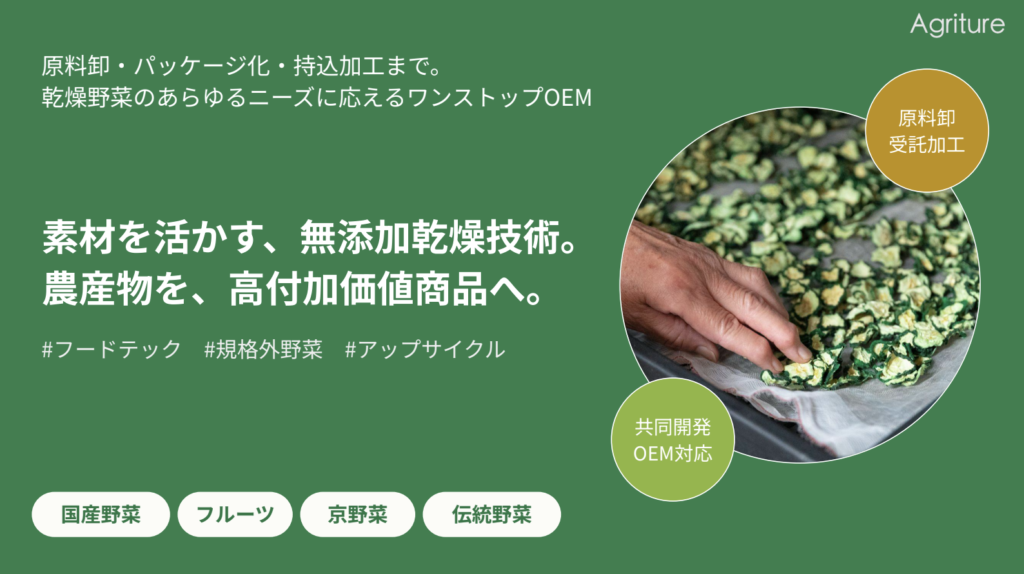
- OEM available from small lots of 10 kg
- Drying of brought-in raw materials also possible
- Support from processing to filling in one place
FAQ about small-lot sourcing
What's the minimum I can source, in kg?
For ready-made vegetable powder, many manufacturers handle from units of 1 kg, and Agriture handles small-pouch filling From 10 pouches as well. For a fully original formulation going into mass production, 10 to 50 kg is commonly the minimum line.
How much higher is the unit cost for small lots?
Ready-made products in 1 kg units commonly run 2,000 to 8,000 yen/kg. Compared with large lots (100 kg or more), the unit cost is often about 1.5 to 2 times higher, but factoring in raw-material loss, storage cost, and disposal risk, small-lot sourcing often keeps costs down in the early development stage.
How much is the prototyping cost for an original formulation?
5,000 to 30,000 yen per pattern is the guide. Prototyping 3 to 5 patterns in parallel totals tens of thousands to over a hundred thousand yen. The prototyping fee is commonly recovered by adding it onto the mass-production lot, and how the fee is handled differs by manufacturer, so confirm it before contracting.
How long does delivery take?
For ready-made products in stock, delivery is 1 to 2 weeks from order. For an original formulation, raw-material sourcing, prototyping, mass production, and inspection take 2 to 3 months. Special raw materials and Organic JAS projects take even longer, so plan a schedule with room, working back from your launch date.
Can unusual vegetable powders also be made in small lots?
Yes. Agriture has prototyping track records with ingredients rarely seen in general distribution, such as dried moringa and moringa powder、京都産の柚子パウダー、asparagus-stem powder、Mugwort powder, and more. If you have a way to obtain the raw material, you can consult us from the prototype stage.
Summary | Five steps to start from a small lot
With commercial vegetable powder, choosing the method that fits your company from among the five sourcing routes lets you create a well-differentiated product even in small lots. A phased approach -- first testing with 1 to 10 kg of a ready-made product, then moving to OEM with an original formulation once sales data becomes clear -- is the standard way to reduce failures. At Agriture, based in Kyoto, we offer 100% domestic-vegetable commercial powder both as ready-made products and via contract processing. You can check the items handled and their specifications at the product page for commercial vegetable powder. For consultations on small-lot prototyping, raw-material bring-in, or original-formulation design, Agriture's page on Food OEM no Madoguchi.Download the OEM contract processing materials
We will send the materials to your email address based on the information you provide.
If you are considering product development with off-spec or your own farm's vegetables:From planning to processing, materials, package printing and novelties, you can consult us through a single point of contact. → Learn more about one-stop product development
- How to Choose Commercial Kujo Negi: Comparing Fresh, Frozen, and Dried
- 長ねぎと白ねぎは同じもの?ねぎの種類と呼び名を国の資料で確かめる
Author of this article
Related articles
-
 Original coffee marketing strategy | Ways to grow sales
 -
 ベジタリアンとは?国の規格が分けている4つの区分と食べられないもの
 -
 長ねぎと白ねぎは同じもの?ねぎの種類と呼び名を国の資料で確かめる
 -
 柚子の種類は何種類あるのか、公の資料で名前が残る系統を数えた
 -
 柚子の皮の使い道は干すと広がる、果汁と種まで使い切る手順
 -
 ゆずの時期は年に二度、青ゆずは7月から黄ゆずは10月から
 -
 ゆずの産地は高知が半分を占め、二位は徳島から愛媛に変わった
 -
 Preventing Food OEM Failures: Common Failure Cases and Countermeasures for Success