Dried spinach


TOC
Product overview of dried spinach
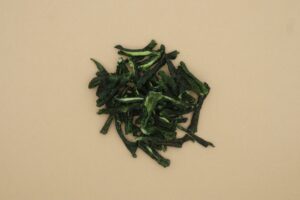
Known for its unique cultivar characteristics,Takii Seed's PhytoRich series "Bentenmaru"—a commercial dried spinach made using it. It is characterized by little of the harshness and astringency distinctive to spinach and a strong sweetness. The raw material grown by a partner farm in Kyotango, Kyoto Prefecture is dried at low temperature, separated into leaf and stem, firmly retaining color, flavor, and aroma.
Because the leaf and stem are dried separately in processing, specification designation such as "leaf only," "stem only," or "leaf-stem mix" is possible according to the application. For confectionery, prepared foods, retort, pet food, and more, you can choose the optimal specification according to the finish.
01 "Bentenmaru," a cultivar whose color and aroma remain deep
"Bentenmaru," a high-function cultivar developed by Takii Seed, originally features little harshness and strong sweetness. Even after drying, the green coloring is vivid, and because the risk of fading during heat processing is suppressed, the appearance does not waver even when folded into bread dough or pasta.
02 Two-stage drying separating leaf and stem
Because the leaf and stem differ in moisture content and fiber, drying them together tends to cause over-drying and uneven rehydration. We adjust the temperature and time separately for leaf and stem, achieving both a finish where the leaf rehydrates soft and the stem retains a crisp bite.
03 Year-round stable procurement through cultivation by a partner farm in Kyotango, Kyoto Prefecture
We grow it under an annual plan with cooperating farms in the fields of Kyotango, which has temperature swings. Because we take a multi-field system that disperses weather risk, it is a procurement setup that easily accommodates consolidated OEM orders on the order of 1 ton.
Product catalog showing the items we handle
Flexible support from small lots to large lots
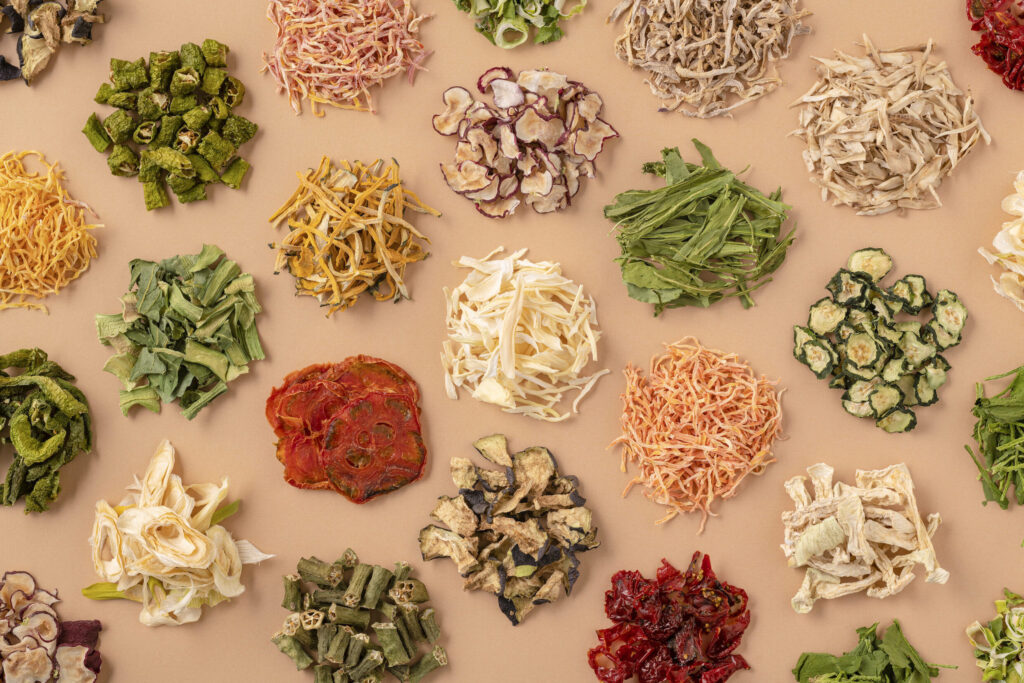
- Sold in small lots from 1 kg
- Handling heirloom vegetables from across Japan
- Dried fruits and herbs also supported
Features of commercial dried spinach
Grown in Kyotango, Kyoto Prefecture
Partnering directly with partner farms in Kyotango, in northern Kyoto Prefecture, we manage in an integrated way, through primary processing, the spinach grown in the cool climate and quality soil. A strength is that quality is stable even during the high-temperature period of summer, and we can secure a raw material of consistent quality year-round. As a commercial ingredient, it suits appeals that make use of the Kyoto-grown geographic brand.
"Bentenmaru," a cultivar whose color and aroma remain deep
Adopting Takii Seed's PhytoRich series "Bentenmaru," we make use of the property that the leaf's green is deep and resists fading. Because the coloring does not drop easily even when dried and powdered, and the color tone is maintained even in processed foods that go through a heating process, it suits products that value the finished appearance.
No glucose added
Without any soaking in glucose solution or sugar-coating processing, we seal in the raw material's inherent taste and aroma as they are. It is optimal for health-conscious products that want to keep carbohydrates down and OEM products that want a simple ingredient listing, and it can also meet additive-free appeals.
Cut separating leaf and stem
We offer three specifications—leaf only, stem only, and leaf-stem mix—enabling optimization of yield according to the application. The leaf can be used as a confectionery/powder ingredient, the stem as an ingredient for soups and stir-fries that make use of its crisp texture, and the mix widely as a general-purpose prepared-food ingredient.
Retaining flavor through low-temperature drying
To avoid losing the sweetness and fragrance distinctive to spinach, we process it with time-consuming low-temperature drying. As a raw material suited to product development that makes use of the material's own flavor, it can be used in a wide range of applications—prepared foods, confectionery, noodles, and more.
Color reproducibility
Because low-temperature drying suppresses the fading of chlorophyll, a vivid green revives when rehydrated. Because the color does not dull easily even when added to soups and prepared foods, it is a raw material easy to handle in commercial menus that value color.
Product specifications
Item | Details |
|---|---|
Raw material growing region | Kyoto Prefecture (partner farm) |
Specification | Cut and dried separating leaf and stem |
Storage method | Room temperature (store away from high heat and humidity) |
Best-before date | 6 months from the shipping date |
Minimum lot | From 10 bags / 100 g |
Powder | Available |
Manufacturing period | Except in summer |
Customization support
We accept consultations on cut form and specifications to match your product concept and the finish of the final product. The following is the main scope. Detailed conditions will be explained by your sales representative.
Item | Details |
|---|---|
Custom-size support (cut-thickness change, form adjustment) | Available for consultation from orders of 10kg or more |
OEM support | Available |
Manufacturing in large lots | Available (consultation required 3 months before the production period) |
Packaging consultation | Accepted |
POWDER
We also offer powder products
We also carry a powder product as "spinach powder." Retaining the material's flavor and nutrition, it can be used in a wide range of applications—folding into confectionery and bread dough, drinks, baby food, smoothies, and more. It is also optimal for development where you want to control both texture and coloring by combining it with the dried product.
Commitments to variety, grower, and growing region
Agriture's dried spinach emphasizes consistency from raw-material selection through cultivation and processing. Because the post-blend flavor and coloring tend to be questioned in confectionery ingredients and OEM uses, we make raw-material-stage information available in advance.
BRAND
Cultivar:We use "Bentenmaru," a PhytoRich cultivar bred by Takii Seed. Compared with conventional spinach, it has little harshness (oxalic acid) and strongly expresses sweetness and a vivid green. Because the distinctive astringency is unlikely to emerge even after heating and drying processes, it suits development that wants to use leafy vegetables as they are.
PRODUCER
Producer:Procured from a partner farm in Kyotango, Kyoto Prefecture. It is a producer that upholds agriculture kind to the environment and people and continues soil-building using homemade compost. Based on the field's soil-analysis results, we build up fertilization management and crop-rotation plans field by field.
REGION
Production area:The Kyotango area in northern Kyoto Prefecture has a distinctive climate where moist air from the Sea of Japan and inland temperature swings coexist. The day-night temperature difference draws out the leaf's sugar content and color, and the leaf flesh tightens in the environment exposed to sea breezes. It can be called a growing-region condition that easily draws out Bentenmaru's character.
CULTIVATION
Cultivation method:Based on soil-building with homemade compost and green manure, we avoid replant failure with rotation cultivation dividing the fields. Compared with conventional cultivation, we reduce the number of pesticide applications, and before shipment we conduct a viable-bacteria-count test. We carry a traceability-secured raw material to the processing plant.
* Reference: OYAOYA product page
Low-temperature drying technology and quality control
The harvested spinach is brought into the processing plant while kept fresh, and after preprocessing the leaf and stem are cut separately. Drying uses multiple temperature ranges differently, removing moisture in stages so as not to break down chlorophyll with sudden high heat. This suppresses color fading and aroma loss while making the finished moisture value consistent.
Before shipment, we conduct a moisture-value check, sensory inspection, and foreign-matter check, keeping records for each lot number. In contract-based OEM supply, because a design that suppresses lot-to-lot variation in color, aroma, and rehydration rate is important, we can also attach monthly inspection data to the delivery slip.
💡 TIPS | Drying-processing trivia
In drying processing, generally when the moisture value exceeds 13% it becomes a cause of mold and browning, and when it falls below 7% the texture tends to become too hard. For leafy items like spinach, around 7–9% is a well-balanced guide, and we adjust it with the combination of finishing temperature and drying time.
Use cases and adoption examples
Dried spinach is a raw material with diverse processing stages—beyond rehydrating and using it, you can fold it in as is or make it into powder. We organized how to use it by application.
For confectionery and bread-making
For confectionery and bread manufacturers and OEM brands, dried spinach powder is increasingly adopted as a natural material that can express green without relying on colorants. Unlike fresh leaves, it can be stored at room temperature, and just adding 2–3% of the ground powder to the dough makes color unevenness unlikely; because the coloring is stable even combined with sugar, butter, and fats, it can greatly reduce the work-hours of the production line. With a specification that can handle a wide range of items—scones, muffins, sandwich bread—and accepting procurement consultations from small lots, it can be used from the prototype stage of new-product development.
For retort, prepared foods, and frozen foods
As a spinach material for frozen gratin, retort soups, and prepared foods, it is a raw material easy to incorporate into a production line. Fresh spinach takes a certain amount of work for washing, cutting, and blanching after arrival, but a dried product allows consolidated room-temperature storage and quantitative measuring, greatly simplifying a factory's inventory and yield management. Because texture remains more easily than with canned materials and the color tone is easier to maintain after heating, it suits uses where you want to stabilize the visual quality of gratin and Western-style prepared foods.
Noodles, dashi, and bouillon
For noodle manufacturers and processed-food makers handling OEM manufacturing of instant noodles and pasta, it is a specification easy to adopt as a material to fold into noodle dough. Fresh spinach makes moisture management difficult and takes effort in the blend design of noodle dough, but a dried product can be stably incorporated into a powder-based blend, greatly reducing the work-hours of the production line. It can also be used for addition to dashi packs and seasoning bases, and because we also accept small-pack portioning and stick-type OEM, it can be used for original product development for EC brands and souvenirs.
For baby food and seniors
It is a material easy for baby-food and nursing-care-food makers to adopt as a stable-quality leafy ingredient. Fresh spinach requires an oxalic-acid harshness-removal or parboiling step, but if it is already dried, it can be made into a paste as is after rehydrating in water, greatly reducing the preprocessing work-hours on the production line. Because a cultivar with little harshness is used, it blends well into lightly seasoned menus, and we also accommodate consultations on form and specifications to match the product concept, such as grinding it and using it as a powder material.
An ingredient for aojiru and green smoothies
It is a use adoptable as a secondary material by supplement makers and health-food brands handling OEM manufacturing of aojiru and green smoothies. Fresh spinach makes stable procurement volume and freshness management difficult, and the process through grinding and drying becomes a burden on the production line, but powdered spinach allows room-temperature storage and quantitative blending, contributing to quality stability per production lot. Because it can simultaneously impart a vivid green and a flavor distinctive to leafy vegetables, it also has good material compatibility with PB products appealing to "domestic vegetables used" and EC brands' original beverages.
Commercial usage and rehydration
Basics of rehydrating in water: soaking in water or lukewarm water (room temperature to 40°C) for about 3–5 minutes returns it to its original state. Use a rehydration rate of about 8–10 times (80–100g after rehydration for 10g dried) as a guide. Because aroma components dissolve into the rehydration liquid, it can be used as is as a base for soups and simmered dishes.
Guide for folding-in uses: we recommend prototyping from an addition of about 1–3% relative to wheat flour or rice flour. Because the coloring changes by the gram, adjust it to match the color design of the final product. When making powder, making it a fine powder increases its dispersibility into dough and drinks.
Storage and handling after opening: ideally, use it up within 6 months at room temperature while unopened, and within 1–2 months after opening if sealed and kept in a cool, dark place. When portioning from a commercial large bag, we recommend adding a desiccant to avoid moisture absorption.
Related cases and articles
- Country-of-origin labeling rules for dried vegetables|An explanation of the raw material country-of-origin labeling system (OEM article)
- 10 dried-vegetable recipes | from miso soup to side dishes, solving vegetable shortage in a hurry (Column)
- A Vegetable Intake Guide for Expectant Mothers | How to Supplement Folate and Iron with Dried Vegetables (Column)
Product catalog showing the items we handle
Flexible support from small lots to large lots
- Sold in small lots from 1 kg
- Handling heirloom vegetables from across Japan
- Dried fruits and herbs also supported
Frequently asked questions (FAQ)
Q. What is the minimum lot?
A. For commercial OEM, we usually accommodate from 10 bags (in 100g units). Separately from prototype-stage samples, we will let you know the minimum lot for mass production, so please tell us your expected monthly order volume.
Q. Can the cut form or degree of drying be changed?
A. Adjustment of cut thickness, form, and moisture value is available from orders of 10kg or more. We accept specification consultations such as chopping it finely for folding in, or leaving it larger as an ingredient.
Q. Can you process it into powder?
Q. Please tell me the best-before date and storage conditions
A. Storage at room temperature (a cool, dark place away from heat and humidity) for 6 months from the manufacturing date is the basic. We can also accommodate refrigerated or frozen storage, but please be careful about condensation management.
Q. Do you provide samples?
A. For first transactions only, we accept paid provision of samples. Please state the quantity and delivery address and request it via the inquiry form.
Q. About how long is the lead time?
A. When there is a stock lot, consider 1–2 weeks from order as a guide, and for custom specifications about 3–4 weeks. For large lots (consultation required 3 months before the production period), it is built up from the cultivation plan.
RETAIL
For those looking to purchase in small packs
For prototype uses and personal consumption, on the online shop of the sister brand OYAOYA you can also buy small packs of dried spinach. Please use it for texture checks before product development and as procurement for in-house tasting.
Yakuzen-style properties (for fresh spinach)
In yakuzen, spinach is positioned as an ingredient that supplements blood, nourishes yin fluids (the moisture that hydrates the body), and cools heat trapped in the body. It is a representative green-and-yellow vegetable classified as "blood-supplementing" in Chinese medicine, and is said to suit those who tend toward anemia, those concerned about dry skin, and those prone to feeling flushed or hot.
Because it contains both iron and vitamin C, the plant-based iron is absorbed efficiently. It is in season from autumn to winter; the colder it gets, the thicker the leaves become and the more their sweetness and nutritional value increase.
💡 TIPS | Yakuzen trivia
In Chinese medicine, ingredients are grasped in three classifications—warming, neutral, and cooling—and spinach is classified as an ingredient leaning toward "cooling," which cools the body's heat. When those with a strong cold constitution eat a large amount, combining it with warming ingredients such as ginger and sesame oil is said to keep it from cooling the body too much, letting it be brought in with good balance.
It is thought that the basic nature of the yakuzen-style workings does not change greatly even after drying processing. Because Agriture's dried spinach suppresses component loss through low-temperature drying, adding it to soups, takikomi gohan, and dashi makes it a raw material easy to use as a recipe material from a yakuzen perspective too.
YAKUZEN
For those who want to know more about spinach from a yakuzen perspective
On the sister site that introduces recommended ingredients and yakuzen recipes by constitution, Yasai Yakuzen we explain spinach's properties and how to bring it in in even more detail.
Recommended reading
- Country-of-origin labeling rules for dried vegetables|An explanation of the raw material country-of-origin labeling system (OEM article)
- 10 dried-vegetable recipes | from miso soup to side dishes, solving vegetable shortage in a hurry (Column)
- A Vegetable Intake Guide for Expectant Mothers | How to Supplement Folate and Iron with Dried Vegetables (Column)
- Spinach powder
Download the product catalog
We will send the materials to your email address based on the information you provide.