Dried carrot


Made with tender, mild yellow carrots that look striking in cooking. Even raw, this variety is faintly sweet, and drying concentrates its rich natural sweetness further, yielding a flavor so rich you would not think it was a vegetable. The sweetness spreads the more you chew, giving it a gentle taste you can enjoy almost like a dessert. Cut into convenient julienne strips, it is a commercial raw material ideal for prepared dishes, rapee, sweets ingredients, and more.
TOC
Agriture's dried carrot: three points of care
01 Made with mild yellow carrots
Rather than ordinary orange carrots, Agriture uses tender, mild yellow carrots as the main raw material. Their vivid yellow color works as an accent, and their refined sweetness with little of the harsh note characteristic of carrots makes them easy to use across a wide range of product genres, from prepared dishes to sweets and bakery.
02 Rich sweetness drawn out by drying
Yellow carrots, faintly sweet even raw, gain concentrated sweetness when moisture is drawn out by low-temperature drying, becoming so rich in flavor you would not think it was a vegetable. Used in bakery and sweets, they are valued as a raw material that draws out natural sweetness without relying on sugar.
03 Easy-to-use julienne shape that meets time-saving needs
Prioritizing ease of use in the kitchen, we set the standard specification to a julienne cut. Because it can be used as-is in dishes that assume julienne, such as rapee, namul, and carrot salad, it greatly reduces prep work. It is a specification that fits the time-saving needs of commercial kitchens.
Product catalog showing the items we handle
Flexible support from small lots to large lots
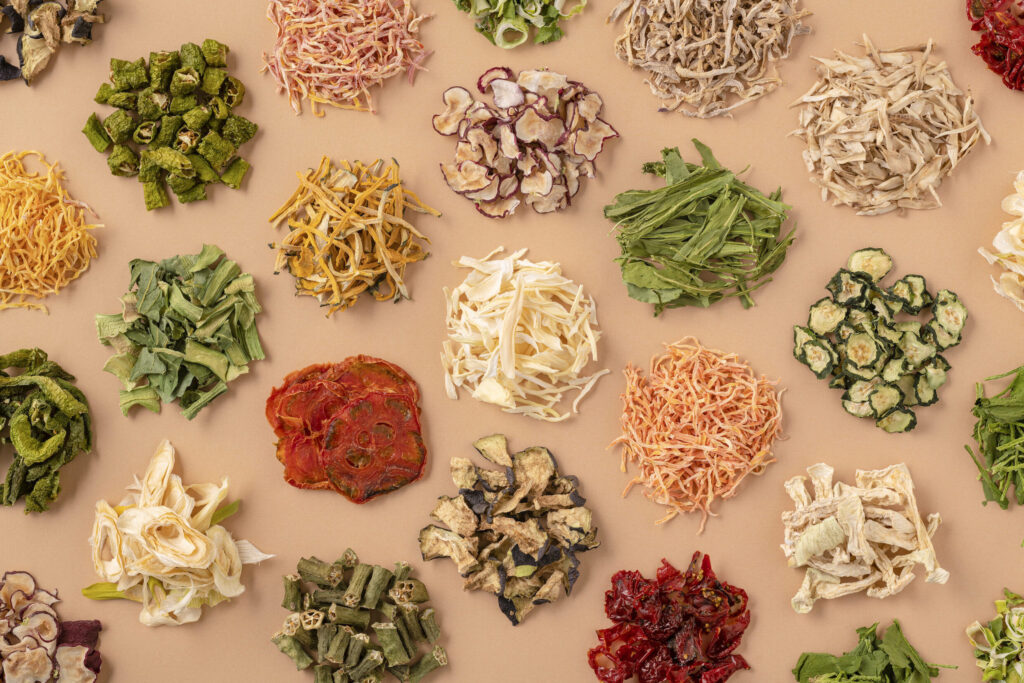
- Sold in small lots from 1 kg
- Handling heirloom vegetables from across Japan
- Dried fruits and herbs also supported
Features of commercial dried carrot
Vivid yellow
Its vivid yellow, unattainable with ordinary orange carrots, is a standout feature. In developing prepared dishes, salads, and sweets where you want to add flair, it can be used as a color-differentiating material.
Mild, refined sweetness
With little of the harshness or grassy note characteristic of carrots, it has a flavor readily accepted even by children and those who dislike carrots. It is an easy-to-handle material in settings such as school lunches, hospital meals, and nursing-care meals.
Sweetness concentrated by drying
As moisture is removed, sugar content concentrates and natural sweetness spreads the more you chew. It pairs well with recipes that aim to emphasize sweetness without relying on sugar or sweeteners, and is ideal for additive-free products.
Time-saving cooking with julienne
The standard specification is julienne. Because it can be rehydrated and used straight in dressed dishes and rapee, it greatly cuts prep time in commercial kitchens. Peeling and cutting fresh carrots become unnecessary.
No glucose added
We process the ingredient as-is, using no sugar coating or additives whatsoever. It can be adopted with confidence in product development that aims to highlight additive-free, domestically grown ingredients.
Long-term room-temperature storage of 6 months
Long-term storage of 6 months from the shipping date. This enables year-round supply, impossible with fresh carrots, and planned inventory management. It is prized by school-lunch centers and large commercial users.
Product specifications
|
Item |
Details |
|---|---|
|
Raw material growing region |
Kyoto Prefecture (partner farm) |
|
Specification |
Shredded slices |
|
Storage method |
Room temperature (store away from high heat and humidity) |
|
Best-before date |
6 months from the shipping date |
|
Minimum lot |
From 10 bags / 100 g |
|
Powder |
△ Possible depending on coarseness |
|
Manufacturing period |
December |
Customization support
At Agriture, cooperation with partner farms and our own processing facility achieve a stable raw material supply and high-quality manufacturing. We can flexibly handle OEM manufacturing and welcome consultations on specification changes and packaging. Custom-size handling (cut-thickness change, shape adjustment) is available for consultation from orders of 10 kg or more, and for large-lot manufacturing please consult us three months before the manufacturing period.
POWDER
Carrot powder is also available under our sister brand
Carrot powder, made by pulverizing dried carrot, can be used as a secondary ingredient for sweets, bakery, and beverages. Take a look if you want to make the most of the carrot's natural sweetness and vivid color.
Commitments to variety, grower, and growing region
The raw material used for our dried carrot is yellow carrots grown by partner farmers in Kyotango, Kyoto. Unlike ordinary orange carrots, they have a softer color and a refined flavor with little harshness. We process them all at once to coincide with the December harvest, building a system that supplies them year-round.
BRAND
Variety: Yellow carrot. A tender, mild variety, characteristically a touch sweet even raw. It is chosen for commercial recipes that want to make the most of both color and sweetness, offering a flavor distinct from ordinary orange carrots.
PRODUCER
Producer: Partner farmers in Kyotango, Kyoto. They work continuously at cultivating yellow carrots, and because they are near Agriture's processing facility, we have built a system that brings in raw material in a fresh state right after harvest.
REGION
Growing region: Kyotango, Kyoto. A land where the winter temperature swings draw out the sweetness of vegetables; we source yellow carrots with heightened sugar content to coincide with the December winter harvest. The temperature differences characteristic of the Sea-of-Japan-side climate create depth of flavor.
CULTIVATION
Cultivation method: Cultivation is carried out in coordination with partner farmers, with harvest timing and quality requirements discussed in advance before planting. We share information closely with growers to secure the specifications and sugar content suitable for raw material for food OEM.
Low-temperature drying technology and quality control
Because root vegetables like carrots have high moisture content, the drying process requires control of temperature and airflow. Drawing out moisture rapidly at high heat scorches the sugars into a caramel flavor and loses the carrot's characteristic bright sweetness. At Agriture, a dedicated drying program for root vegetables adjusts temperature and airflow in stages to achieve a finish that balances sweetness and color.
At our own factory, we manage the entire flow in one place, from washing, peeling, cutting, drying, and foreign-matter removal to packaging at raw-material intake. We also handle the issuance of analysis sheets and raw-material origin certificates for food OEM, so large orders for school-lunch and company-cafeteria use can be adopted with confidence.
💡 TIPS | Drying-processing trivia
By lightly blanching carrots before drying, oxidation of carotenoids can be suppressed and the color kept vivid. At Agriture, we use blanching or skip it depending on variety and application, drawing out the raw material's characteristics to the fullest.
Use cases and adoption examples
For prepared dishes, rapee, and salad menus
Because it is julienne-shaped, it can be rehydrated and used straight as rapee, namul, or carrot salad. As a secondary ingredient for convenience-store and supermarket prepared dishes, it is highly rated by commercial users for being usable without the trouble of prep.
As a bakery and baked-goods material
Making the most of the natural sweetness concentrated by drying, it is used as a secondary ingredient in breads, muffins, and pound cakes. It is ideal for carrot-cake-type products where you want to balance natural sweetness and color.
As a material for school and company cafeteria meals
In school lunches, company cafeterias, hospital meals, and nursing-care meals, it contributes to menu planning aimed at increasing vegetable intake. The key points are that it rehydrates easily and is well suited to large-scale cooking. Its mildness, readily accepted even by children who dislike carrots, is well received.
Sweets and topping uses
There is also demand for it as veggie-chip products and sweets toppings. Making the most of its natural sweetness and vivid yellow, it can be used as a material for photogenic sweets such as smoothie bowls and parfaits.
OEM product raw material and dried-veggie mixes
As a dried-veggie-mix and color material, it is also used in blends with other dried vegetables. There is demand for it as a base material for mixed-vegetable products such as soup ingredients, pilaf mixes, and risotto.
Commercial usage and rehydration
As a rule, dried carrot is used after soaking in water for about 5 to 10 minutes. Because of the julienne shape, rehydration time is short and it can be developed straight into dressed dishes, rapee, salads, and more. For heated cooking, it can be added directly to soups or stews without rehydrating, absorbing the broth to finish juicy.
For bakery use, kneading it half-rehydrated into the dough keeps the carrot's texture and color attractive even after baking. For cakes and muffins, rehydrating and then mincing it gives a more even distribution.
Related cases and articles
- Vegetable Broth × Dried Vegetables to Boost Umami: Pro Tips on Use and Selection (OEM article)
- How to Make Vegetable Broth | Straight from the Pros: Basics and Tips for Drawing Out Maximum Umami (OEM article)
- Benefits and Uses of Introducing Dried Vegetables for School and Company Cafeterias (OEM article)
Product catalog showing the items we handle
Flexible support from small lots to large lots
- Sold in small lots from 1 kg
- Handling heirloom vegetables from across Japan
- Dried fruits and herbs also supported
Frequently asked questions
Q. What is the minimum lot and prototype handling?
A. The minimum lot starts at 10 bags (in 100g units). OEM prototypes can be discussed from 10kg and up, where cut specification, packaging, and blend ratio can be considered together. We also handle simultaneous prototyping of multiple patterns, supporting you from the product-development stage.
Q. What is the price range?
A. Because yellow carrots are cultivated in smaller quantities than ordinary orange carrots, the unit price is somewhat higher, but they have value as a differentiating material. Since the unit price varies with lot size and specification, please consult us via the inquiry form for a specific quote.
Q. What is the lead time?
A. Stock items can be shipped 1 to 2 weeks after order. Carrots are produced in December, with batch processing timed to the winter harvest. For large lots, it helps to consult us 3 months before the production period.
Q. Can you issue a raw-material origin certificate?
A. We can issue a raw-material origin certificate for Kyotango, Kyoto. It can also be used when labeling the product package "made with Kyoto-grown carrots" or "made with domestically grown carrots." There is no problem meeting the Food Labeling Act.
Q. Can you submit pesticide residue results or analysis tables?
A. We can issue quality certificates such as microbiological test results and proximate analysis. We can meet the quality requirements demanded for school-lunch, company-cafeteria, and hospital-meal use, so please let us know the necessary documents in advance.
Q. Can you handle HACCP and export?
A. Our in-house processing facility in Kyoto supports submission of HACCP-compliant documentation. Export projects can also be discussed case by case, and we have a track record of handling OEM projects that roll out Japanese vegetables for overseas Japanese-food markets.
Q. Please tell me the OEM consultation flow
A. The flow is: inquiry → concept interview → sample delivery → paid prototyping → specification finalization → full production. For large orders aimed at school lunches and company cafeterias, we provide hands-on support that includes tastings and cooking tests from the prototype stage.
Recommended reading
- Vegetable Broth × Dried Vegetables to Boost Umami: Pro Tips on Use and Selection (OEM article)
- How to Make Vegetable Broth | Straight from the Pros: Basics and Tips for Drawing Out Maximum Umami (OEM article)
- Benefits and Uses of Introducing Dried Vegetables for School and Company Cafeterias (OEM article)
- Carrot powder
Download the product catalog
We will send the materials to your email address based on the information you provide.