
How to Make Vegetable Dashi and Vege-Broth: The Difference and Tips for Using Vegetable Scraps

Summary of this article
We lay out the basic way to make vegetable dashi, along with three tips for maximizing umami through temperature control, using dried vegetables, and combining ingredients. It covers an authentic mirepoix-based recipe, vegan and halal compliance, and know-how from Agriture's dashi dried tomatoes.
Vegetable dashi is a stock drawn only from the umami and aroma of vegetables, with no animal-derived ingredients. As the amino acids and sugars in onion, carrot, celery, and mushrooms dissolve out, a gentle sweetness and mild umami emerge. Because it contains no animal ingredients, it's a versatile stock usable in vegan, vegetarian, and halal cooking, and its use is spreading from home kitchens to commercial settings.
This article lays out, from the practical viewpoint of chefs and processors, the basic way to make vegetable dashi, the temperatures and ingredient choices that draw out the most umami, an authentic recipe using mirepoix, and the key points for plant-based compliance. It also touches on using dried vegetables and on commercial how to choose a vegetable dashi.

TOC
The difference between vegetable dashi and vegetable broth
「Vegetable broth" is a stock made by simmering the parts of vegetables usually thrown away, such as peels, tops, root ends, and seeds (vegetable scraps). It's easily confused with vegetable dashi, but strictly speaking there are differences like the following.
| Item | Vegetable dashi | Vegetable broth |
|---|---|---|
| Ingredients used | Vegetables in general (scraps and the main parts both work) | Mainly vegetable scraps (peels, tops, root ends) |
| Origin | Traditional Japanese and Western cooking methods | A newer term that spread in the context of food-loss reduction and SDGs |
| Purpose | An umami-based seasoning | Umami plus upcycling (using the parts you'd throw away) |
| Use | Soups, simmered dishes, seasoned rice, risotto | Same as above / home cooking with an eco, sustainable angle |
| How it's made | Cut and simmer / dried vegetables also work | Simmer the vegetable scraps as they are |
Conclusion: vegetable broth is a kind of vegetable dashi, a sustainable name that focuses on using vegetable scraps. The basics of making it are the same, so the vegetable-dashi tips in this article apply directly to vegetable broth too.
The basic way to make vegetable dashi (using vegetable scraps)
You can make vegetable dashi just by simmering the peels, tops, roots, and stems you'd otherwise throw away. Carrot, potato, and daikon peels, onion tops and skins, the green parts of green onion, mushroom stem ends, and pepper seeds and pith all work. Since it reuses the by-products of home cooking, it also has support in the food-loss-reduction context.
Ingredients and steps
| Item | Guideline |
|---|---|
| Vegetable scraps | Two handfuls (about 300g) |
| Water | 1,000ml |
| Number of vegetable types | Five or more gives depth |
| Heating temperature | 80-90°C (don't boil) |
| Heating time | 20 to 30 minutes |
| Storage | 2-3 days refrigerated in a clean container |
- Bitter gourd, peppers (seeded), and broccoli stems tend to turn bitter, so don't add too much
- Carrot and onion skins and shiitake stems bring out sweetness and pair well
- High heat breaks the vegetables down and clouds the stock, so keep the heat where the vegetables just barely dance
Three tips for drawing out the most umami
1. Temperature control (hold 80-90°C)
Boiling tends to draw off-flavors from the vegetable fibers and drives off umami compounds. Glutamate, guanylate, and aspartate extract best when held slowly in the 80-90°C range. When using mushrooms, the enzyme works at 45-60°C to generate guanylate, so raising the temperature gently from a low start is effective.
2. Concentrate umami with dried vegetables
Drying vegetables removes water and concentrates their umami compounds to several times that of fresh. The toasty notes of dried Onion, the sweetness of dried Carrot, and the aroma of dried green onion carry straight into the rehydrating liquid, so just adding them to the pot before it boils and simmering about 10 minutes yields a richly flavored stock. Agriture uses low-temperature drying in its dried-vegetable production, supplying ingredients that keep umami compounds from being driven off, for commercial and D2C use.
Comparing fresh vegetable scraps and dried vegetables
| Item | Fresh vegetable scraps | Dried vegetables |
|---|---|---|
| Umami strength | Medium (high water content) | Strong (water removed, concentrated) |
| Extraction time | 20 to 30 minutes | Around 10 minutes |
| Shelf stability | Use within 3 days refrigerated | 6 months to 1 year at room temperature |
| Lot variation | Varies with season and sourcing | Stable through lot management |
| Food-loss contribution | Reuses home by-products | Uses off-spec produce from growing regions |
3. Get synergy by combining vegetables
| Combination | Main umami compounds | Dishes it pairs with |
|---|---|---|
| Onion + carrot + celery | Glutamate and aspartate | Soup, stew, risotto |
| Mushrooms + kombu | Synergy of guanylate and glutamate | Japanese cuisine, clear soups |
| Dried tomato + onion | Concentrated glutamate | Pasta, curry, Western-style soups |
| Long onion + ginger + garlic | Aroma compounds and allicin | Chinese cuisine, hot pot |
An authentic vegetable dashi using mirepoix
Mirepoix is the basic aromatic vegetable mix of French cuisine, combining onion, carrot, and celery at a 2:1:1 ratio. Taking vegetable dashi on this base gives a Western-style depth, versatile as a foundation for soups, stews, risotto, and pasta. Note that "vegetable dashi (vegetable stock)" is the unseasoned ingredient, while adjusting it with salt or soy sauce makes it a "vegetable bouillon / soup"; when commercializing via OEM, clarifying which preparation you're making keeps the design from drifting.
An authentic vegetable-stock recipe (commercial, scaled to 8L of water)
The following is a commercial scale for restaurant prep. To try it at home, reduce everything to 1/8 and make it with 1L of water for the same ratios.
- Onion 200g, carrot 100g, celery 100g (mirepoix base)
- Kombu 100g, dried shiitake 60g, water 8 liters
- Burdock 70g, daikon 200g (to lift umami and aroma)
- To finish: 1.5 tbsp salt, 250cc light soy sauce, 250cc sake, 250cc mirin
Put water, kombu, burdock, and daikon in a pot and let it rest overnight; the next morning, add the soaking liquid from the rehydrated dried shiitake. Bring it to 60°C over 40 minutes on low heat, and pull out the kombu once bubbles start rising from it (going above 70°C draws off-flavors). Bring it to a brief boil, skim the scum, and simmer 10 minutes on low heat. Remove the vegetables, adjust with sake, mirin, and salt, and finish by setting the flavor with light soy sauce.
Vegan and halal plant-based dashi
Because vegetable dashi contains no animal ingredients, it's prized in vegan, vegetarian, and halal cooking. It's an area where adoption is growing amid expanding inbound demand and the spread of plant-based positioning in processed foods.
Characteristics by ingredient
| Material | Main role | Dishes it suits |
|---|---|---|
| Kombu | Glutamate base umami | Japanese cuisine in general, clear soups |
| Dried shiitake | Guanylate plus aroma | Simmered dishes, grated yam, clear soups |
| enoki | Mild and easy to use | Gentle dashi, vegetable-forward dishes |
| Dried tomato (large varieties) | Concentrated glutamate, balance of acidity and sweetness | Western-style soups, ramen, curry |
| Dried onion | Toasty notes, sweetness | Bouillon, Chinese soups |
Agriture's dashi dried vegetables and tomato
Agriture low-temperature dried large tomatoes (Momotaro variety, Kyotango-grown) to release dashi dried tomato in July 2024. What makes a fresh tomato suited to dashi is glutamate content rather than sugar, so fully ripe large varieties are best. We source "fully ripe fruit that rises in sugar content but can't ship to market" from Taniyoshi Farm and concentrate the umami through low-temperature drying, creating a dashi ingredient with depth despite using no animal ingredients.
We handle everything from blend design of vegetable powders and dried vegetables through commercial supply. For details, A commercial buyer's guide to vegetable dashi.
Uses and storage tips
- As a base for soups, miso soup, and simmered dishes. Even with restrained salt, the umami delivers satisfaction
- As a hidden flavor in curry, risotto, and pasta; it can also be used alongside animal-based dashi
- As a base for hot pot, blended with kombu and dried mushrooms into a vegetable stock
- Portioned and frozen in an ice-cube tray, it keeps for about a month (thaw only what you need, easy to handle in a commercial setting too)
We have materials available to help you understand dried processing OEM
Agriture OEM, flexibly handling everything from small lots to large lots
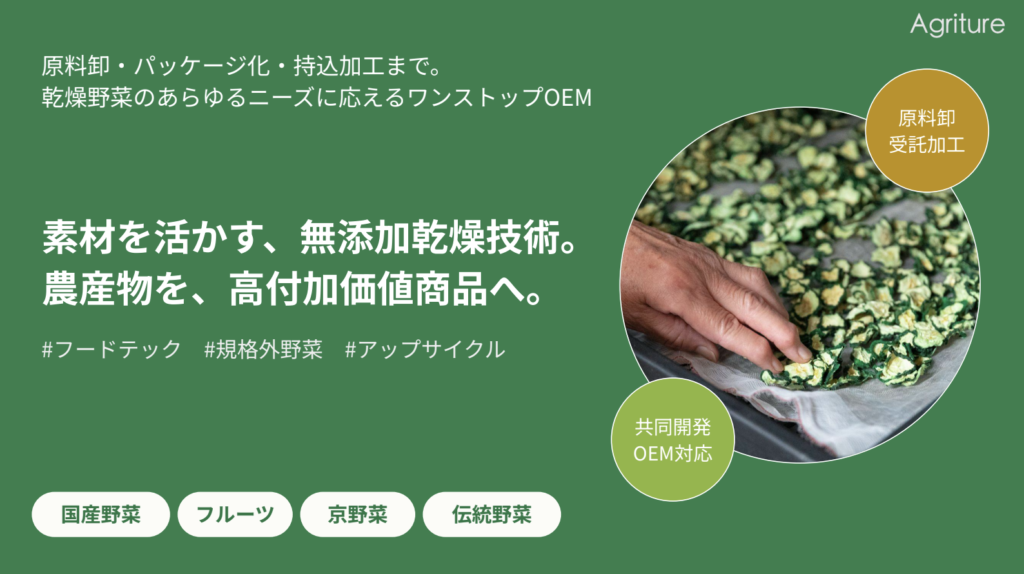
- OEM available from small lots of 10 kg
- Drying of brought-in raw materials also possible
- Support from processing to filling in one place
FAQ
How long does vegetable dashi keep?
Figure 2-3 days refrigerated and about a month frozen. Once brewed, cool it thoroughly and store in a clean container. Portioning and freezing it in an ice-cube tray is handy, since you can thaw just the amount each dish needs.
Which vegetables give a stronger umami?
The classic combination is onion, carrot, celery, mushrooms, kombu, and dried tomato. The synergy between glutamate (onion, tomato, kombu) and guanylate (mushrooms) multiplies the umami several times over. Combining five or more types gives the flavor depth.
What's the difference between vegetable dashi and kombu dashi?
Kombu dashi is a single-ingredient stock led by glutamate; vegetable dashi is a compound stock in which diverse amino acids and sugars dissolve out from multiple ingredients. Vegetable dashi has a balance of aroma, sweetness, and mild umami, which makes it easier to pair with Western, Chinese, and plant-based dishes.
Is dashi from dried vegetables tastier than from fresh?
The umami density is higher with dried. Removing water concentrates taste compounds like glutamate, which carry straight into the rehydrating liquid. Dried tomato and dried onion are especially suited to dashi and are also used as commercial time-saving ingredients.
I'm looking for a commercial vegetable dashi. Can I consult with you?
Yes. Agriture handles commercial supply of dashi dried tomatoes and dried-vegetable blends, plus formulation design for vegetable dashi OEM. Restaurants, processors, and PB developers can Agriture's page on Food OEM no Madoguchi.
Summary
Vegetable dashi ranges widely in use and preparation, from a home version using vegetable scraps, to an authentic mirepoix-based version, to a commercial version that concentrates umami with dried vegetables. Master three things, temperature control (80-90°C), ingredient combinations, and the use of dried vegetables, and you can draw out a deep umami without any animal ingredients.
For commercial vegetable dashi ingredients, or OEM of dashi dried tomatoes and dried-vegetable blends, A guide to choosing vegetable dashi and Agriture on the Food OEM Portal Please consult us.
Download the OEM contract processing materials
We will send the materials to your email address based on the information you provide.
If you are considering product development with off-spec or your own farm's vegetables:From planning to processing, materials, package printing and novelties, you can consult us through a single point of contact. → Learn more about one-stop product development
- Plant-Based Vegetable Dashi: An Introduction to Umami Compounds and Uses
- How to start a yakuzen tea OEM | A product development guide that makes use of the wisdom of Eastern medicine
Author of this article
Related articles
-
 柚子の皮の使い道は干すと広がる、果汁と種まで使い切る手順
 -
 Food OEM Market Trends 2026: A Growth Strategy Seen Through Small-Lot and Domestic-Ingredient Needs
 -
 How to Use OEM Matching Sites: Efficiently Finding the Optimal Manufacturing Partner
 -
 How to proceed with hometown-tax product development | OEM techniques that make the most of local ingredients
 -
 Creating a regional brand with a Kyoto-vegetable OEM | The complete flow from planning to sales
 -
 Kyoto ingredient processing OEM | How to make the most of Kyoto vegetables and quality control
 -
 How to source commercial vegetable powder in small lots, and how to use it
 -
 Heirloom vegetable OEM | A commercialization case guide using Kyoto vegetables and local ingredients