
Plant-Based Vegetable Dashi: An Introduction to Umami Compounds and Uses

Summary of this article
It covers the umami-compound design of vegetable dashi as a plant-based stock, synergy, reinforcing richness through roasting and fats, differences from Kayanoya-style retail products, and the commercial design of Agriture's dashi dried tomatoes. It also explains the design axes for vegan, halal, and shojin compliance.
Vegetable dashi as a plant-based stock is a stock drawn from the umami and aroma of vegetables, using no animal ingredients at all. The amino acids in onion, carrot, celery, mushrooms, and kombu (glutamate, aspartate), the nucleotide-based guanylate, and vegetable-derived sugars dissolve out, combining a gentle sweetness with a mild umami. It's an area where adoption is advancing as a base for vegan, vegetarian, and halal cooking, and for processed foods that hold down salt and additives.
This article lays out how the umami compounds in plant-based stock work and how to choose ingredients, home and commercial methods, the difference from major makers' retail dashi packs, and applications in processed foods like hamburg steak and seasoned rice, drawing on the knowledge gained from the commercial design of Kyotango-grown dried tomatoes. For the concrete steps, How to make vegetable dashi, and for commercial selection, How to choose commercial vegetable dashi.

TOC
The basics of plant-based stock and its umami compounds
Plant-based stock is built solely from the taste compounds of vegetables, mushrooms, and seaweed, using no animal ingredients. On top of the katsuo- and niboshi-led dashi culture cultivated in Japanese cuisine, vegan/halal compliance and the demand for MSG-free options overlap, and it has entered a practical stage as an option for commercial and processed foods. Agriture also supplies commercial plant-based stock ingredients for plant-based ramen built on Kyotango-grown large tomatoes, and we lay out the on-the-ground design axes across three systems.
The three umami systems and their main ingredients
The umami you can reproduce with plants comes to three systems in total: two amino-acid types and one nucleotide type. When Agriture builds a commercial plant-based stock, the first judgment is which ingredients to pick from these three systems and in what ratio.
| Component | Strain | Main plant ingredients | Role in the design |
|---|---|---|---|
| Glutamic acid | Amino-acid type | Kombu, tomato (large varieties), onion, napa cabbage | Base umami. The foundation of the flavor |
| Aspartate | Amino-acid type | Asparagus, carrot, celery, legumes | Sweetness and depth |
| Guanylic acid | Nucleotide type | Dried shiitake, maitake, enoki, porcini | Depth and lingering finish. The synergy partner |
A design that leans hard on synergy
Multiplying glutamate by the nucleotide guanylate produces a synergy that pushes umami intensity several times higher than either alone (the combination with inosinate is generally included too, but in plant-based work, guanylate from dried shiitake and the like is the lead). The ichiban dashi of Japanese cuisine (kombu × katsuo) is the classic case, and in plant-based form you can reproduce the same structure with kombu × dried shiitake.
- Kombu + dried shiitake: the go-to pair that reproduces the equivalent of Japanese ichiban dashi in plant-based form
- Dried large tomato + dried shiitake: for Western-style and ramen. A combination that pushes glutamate to the front
- Onion + maitake: for the base of Chinese dishes and curry. Adds sweetness with aspartate
Practical techniques to cover a "lack of richness"
For people used to animal-based dashi, vegetable dashi has the weakness of tasting thin on its own. What actually works in commercial recipes is two added steps: roasting and fat.
- Roasted vegetables (roasted vegetable stock): roast onion, carrot, and celery until browned before simmering, and the Maillard reaction adds toasty notes and richness
- Adding fat at the end: a few drops of white sesame oil, olive oil, or rice oil to finish. Fat-soluble aroma compounds ride on it, giving a satisfaction close to meat-based dashi
- Using fermented seasonings alongside: a small amount of miso, soy sauce, or shio-koji lifts the glutamate
How to take vegetable dashi and combine ingredients
With plant-based stock, the ingredient choices and combinations change the result significantly. From a basic home recipe to designs by ingredient direction, we lay out guidelines to suit the use.
A basic vegetable dashi recipe (for home)
This is a minimal vegetable stock built from just carrot, onion, and celery. Three steps, simmer from cold water → rest → re-simmer, draw the ingredient's taste out fully.
| Ingredient | Amount |
|---|---|
| Celery | 1 |
| Carrot | 1 |
| Onion | 1 |
| Water | 700ml |
Chop the vegetables finely, put them in a pot with cold water, and heat. Once it boils, drop to low heat and simmer 20 minutes, turn off the heat and rest 20 minutes, then finish with 5 minutes of re-simmering on high heat and strain. The resting step lets the taste seep out from the ingredients, so skipping it makes the flavor shallow in depth.
Design by ingredient direction
Swapping the ingredients to match the target cuisine changes the result significantly, even for the same "vegetable dashi." We've organized the combinations Agriture recommends for commercial use by direction.
| Direction | Base ingredients | Finish |
|---|---|---|
| Japanese | Cabbage, long onion, napa cabbage, kombu | A gentle, clear flavor |
| Western | Mirepoix (onion, carrot, celery 2:1:1) | A rich, bouillon-style base |
| Chinese | Long onion, ginger, garlic, dried shiitake | An aromatic base for soups |
| Deep umami | Dried large tomato, kombu, dried shiitake | A powerful umami from glutamate plus guanylate |
Lift the umami with frozen vegetables
Freezing vegetables once before simmering breaks the cell membranes so the taste compounds dissolve out more easily. Compared under the same conditions, dashi made from frozen vegetables tends to be sweeter and more aromatic than the fresh-vegetable version.
- Keep vegetable scraps portioned in the freezer, and even on a busy day you can take a rich umami dashi in 10-15 minutes
- High-moisture vegetables (onion, tomato, napa cabbage) show the taste-extraction effect of freezing more strongly
- Aroma-focused vegetables (celery, green onion) lose aroma more easily when frozen, so adding them fresh is the safer bet
Plant-based compliance and inbound demand
Behind the adoption of plant-based stock, several forces overlap: vegan, vegetarian, and halal compliance; a health-consciousness that wants to avoid MSG; and the diversifying eating habits of inbound visitors. A stock that uses no animal ingredients is drawing more interest at restaurants and processors as a versatile ingredient that clears all these constraints in one.
Scope and design points
"Plant-based" in a single phrase covers cases where the excluded ingredients differ by target audience. Locking down the scope before commercializing or building a menu keeps ingredient selection from drifting.
| Scope of support | Design point |
|---|---|
| Vegan | Excludes animal ingredients and honey. Alcohol allowed |
| Vegetarian | May allow dairy and eggs (lacto-ovo) |
| Halal | No alcohol or pork-derived ingredients. Certification presumes lot management |
| Gogun (garlic chives, green onion, garlic, wild rocambole, shallot)-free | For Taiwanese vegetarian, Japanese shojin cuisine, and Buddhist temples. Fully excluded from the formulation |
| MSG-free | Avoid added amino acids and the like, designing around the taste of vegetables, mushrooms, and seaweed |
Affinity with shojin cuisine and vegetarian fare
Gogun-free plant-based stock is extremely well suited to Japanese shojin cuisine and Taiwanese vegetarian fare. Excluding gogun narrows the options, but the traditional shojin ingredients of kombu, dried shiitake, daikon, and carrot can be used as they are, so existing recipes are easy to translate. If you're building a shojin-based menu for domestic inbound demand, locking in ingredients along this axis is the shortcut.
The difference from retail dashi packs and bouillon
When commercializing a plant-based stock, you need to be clear about what exactly sets it apart from the retail dashi packs and granulated bouillon sold by major makers. We lay it out as a decision axis for OEM design.
Choosing by format
For a dashi ingredient, the suited use changes with "which format you place at the outlet." In commercial product development, which of the formats below you design around is a design item to lock in early.
| Type | How the components are made | Suited use |
|---|---|---|
| Handmade vegetable dashi | Extracted from fresh or frozen vegetables | Cooked to order at restaurants or home |
| Dashi pack (powder) | Dried ingredients powdered and filled | Quick cooking, seasoned rice, miso soup |
| Granular bouillon | Extract granulated, with salt, sugar, and fat added | A versatile base. Complete, including salt design |
| Concentrated liquid | Brewing liquid vacuum-concentrated | A base for plant-based ramen and processed foods |
The finished-seasoning retail type versus the ingredient-brand type
The finished-seasoning retail plant-based stock is designed so that "the flavor is set the moment you open it," salt, sugar, and amino-acid seasonings included. An OEM product as an ingredient brand (the area Agriture works in), on the other hand, is best designed as a "base ingredient that leaves seasoning to the user," concentrating only the taste compounds; that's the key to differentiation.
| Axis | The finished-seasoning retail type | Ingredient brand (the Agriture type) |
|---|---|---|
| Flavor completeness | Complete with salt, sugar, and amino acids included | Taste only. Salt design is left to the user |
| Appeal axis | Time-saving, all-purpose, home-oriented | Origin, variety, drying method, reduced-salt design |
| Advantage in OEM commercialization | General consumer, all-purpose use | Restaurants, processors, reduced-salt positioning lines |
| Can it replace the finished-seasoning retail type? | — | Yes on the ingredient axis. Not suited to those who want the seasoning already done |
Commercial dashi made with dried vegetables and vegetable powder
For commercial and processed-food plant-based stock, making dried vegetables or vegetable powder the lead of the design makes it easier to balance lot stability, shelf life, and cost. Dried ingredients with the water removed concentrate the taste compounds, so a small amount delivers flavor, an ingredient that's easy to handle on the design side.
Dashi-suited dried-vegetable lineup
We've compiled the dashi-suited dried vegetables Agriture handles commercially, along with each one's design suitability. Knowing the taste traits of each ingredient makes it easier to build blends by flavor direction.
| Material | Taste characteristics | Use cases |
|---|---|---|
| Dried onion | Sweetness, toasty notes | Bouillon, Chinese soups, ramen |
| Dried large tomato (Momotaro) | Concentrated glutamate, balanced acidity | Plant-based ramen, pasta, curry |
| Dried carrot | Sweetness, depth | Miso soup, stews, seasoned rice |
| Dried Kujo green onion (Kyoto-grown) | Aroma compounds, lingering finish | Chinese cuisine, hot pot, plant-based ramen |
| Dried shiitake | Guanylic acid | Japanese cuisine in general, for synergy |
Agriture's dashi dried tomatoes (Kyotango, Momotaro)
In July 2024, Agriture released a dashi dried tomato to release. We source fully ripe fruit that rises in sugar content but can't ship to market from Taniyoshi Farm and concentrate the taste compounds through low-temperature drying.
- Variety-selection knowledge: what makes a tomato suited to dashi is glutamate content, not sugar, so we use large varieties (Momotaro)
- Low-temperature drying: designed to curb the loss of taste compounds, so flavor survives after rehydration
- Use: a base ingredient for plant-based ramen, vegan soups, and commercial processed foods
Commercial rollout in powders and dashi packs
Powdering dried vegetables widens the outlets to dashi packs, granulated bouillon, and soup bases. Powdering also opens time-saving uses like "add one pack to seasoned rice and the umami spreads throughout" or "work it directly into fish paste or hamburg steak in the design."
- Dashi packs: non-woven pouches filled with vegetable powder plus dried ingredients. A versatile format for home and commercial use
- Granules: finished with salt design included, to save cooking time at restaurants
- Powder for working in: blended directly into plant-based hamburg steak, tsukune, and patties
For filling and OEM of vegetable powder, Vegetable powder filling OEM laid out in detail on.
We have materials available to help you understand dried processing OEM
Agriture OEM, flexibly handling everything from small lots to large lots
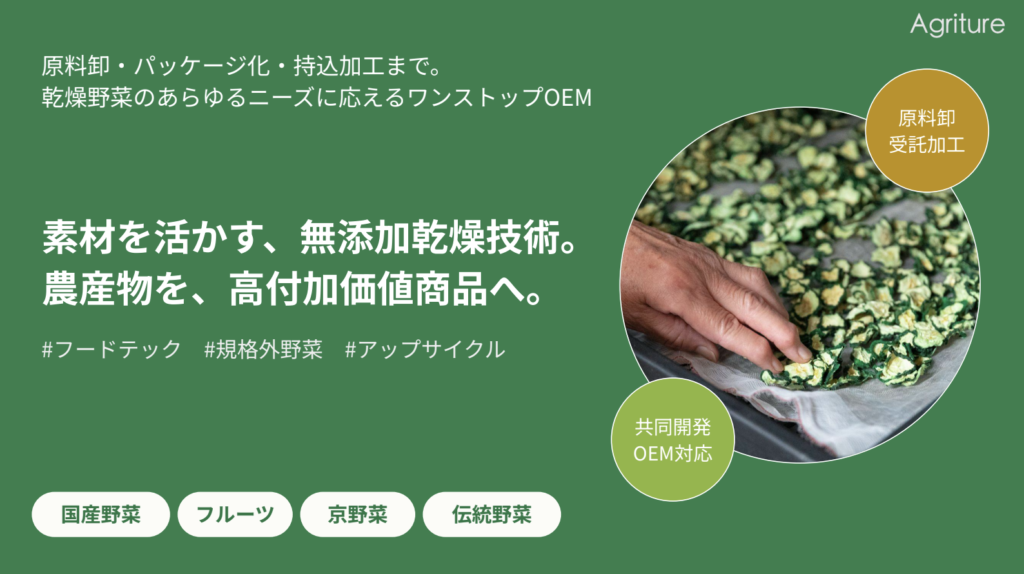
- OEM available from small lots of 10 kg
- Drying of brought-in raw materials also possible
- Support from processing to filling in one place
Case studies and the spread of recipes
Plant-based stock is adopted across a wide range of settings, from restaurants' new menus to processed-food design. We lay out cases by use.
Plant-based ramen and soups
Ramen that uses no animal ingredients is a dish where richness is hard to achieve unless you bring the glutamate to the fore. Compose a rich broth with dried large Tomato plus kombu plus dried shiitake plus dried Onion, and a few drops of white sesame oil to finish deliver a satisfaction close to meat-based ramen.
Seasoned rice and miso soup
Just add a vegetable dashi pack when cooking rice for seasoned rice where the umami spreads throughout, with no MSG. Because it's easy to lift the umami without over-adding salt, it also pairs well with reduced-salt home products. As a base for miso soup too, the synergy of kombu plus dried Carrot plus dried shiitake gives it depth.
Plant-based hamburg steak and fish-paste products
Work vegetable dashi powder into chickpea or soy-meat mince, and you can deliver satisfaction even from meat-free ingredients. The powder type, whose moisture design is hard to throw off, suits mass production and is a handy format for the formulation design of plant-based hamburg steak and tsukune.
Vegetable curry and soup curry
Add dried large tomato to a mirepoix base, and the sharp edges of the spices soften while richness is added. In designing vegan curry and soup curry, the point is to draw on the ingredient-derived amino acids to make a line that "doesn't feel lacking even without animal ingredients."
FAQ
How does plant-based stock differ from animal-based dashi?
How the components are made differs. Animal-based dashi is led by the inosinate of katsuo and niboshi, while plant-based stock builds synergy from the glutamate of kombu and tomato plus the guanylate of dried shiitake. The umami intensity leaps several times higher than either alone depending on the combination, so you can build a powerful dashi without using animal ingredients.
Can it substitute for the finished-seasoning retail type?
It can on the ingredient axis. The finished-seasoning retail type has its flavor complete, salt, sugar, and amino-acid seasonings included, so its strength is that "the flavor is set the moment you open it"; the Agriture-type ingredient brand concentrates only the taste and leaves seasoning to the user. If a restaurant or processor wants to design salt and sugar levels in-house, the ingredient brand is more advantageous.
Vegetable dashi feels short on richness on its own. What's the fix?
You can cover it with two things: roasted vegetables and fat. Roast onion, carrot, and celery until browned before simmering, and the Maillard reaction gives toasty notes and richness. A few drops of white sesame oil or olive oil to finish give a satisfaction close to meat-based dashi. Adding a small amount of miso or shio-koji also works in practice.
What are the key points for commercial use in powders and dashi packs?
A design that fixes the origin and variety of the raw materials to curb flavor drift across lots is essential. Because dried vegetables shift in taste with the season and sourcing, aligning the variety (e.g. Momotaro for large tomatoes) and drying conditions (e.g. low-temperature drying) governs the quality in any format, dashi pack, granule, or concentrated liquid.
I'd like to make vegetable dashi for OEM or commercial use. Can you help?
Agriture handles commercial supply of dried-vegetable blends, dashi dried tomatoes, and vegetable powder, plus vegetable-dashi formulation-design OEM. We have cases including plant-based ramen, dashi packs for seasoned rice, halal-compliant soup bases, and powder for plant-based hamburg steak. Food OEM no Madoguchi (Agriture) Please consult us.
Summary
Vegetable dashi as a plant-based stock has its flavor set by three things: ingredient design that keeps the synergy of glutamate, aspartate, and guanylate in mind; scope design for vegan, halal, gogun-free, and the like; and reinforcing richness through roasting and fat. Against the finished-seasoning retail type, it's an area you can differentiate by positioning the origin, variety, and drying method as an ingredient brand.
How to make it is in How to make vegetable dashi, and for commercial selection, How to choose commercial vegetable dashi. For OEM inquiries, Agriture on the Food OEM Portal.
Download the OEM contract processing materials
We will send the materials to your email address based on the information you provide.
If you are considering product development with off-spec or your own farm's vegetables:From planning to processing, materials, package printing and novelties, you can consult us through a single point of contact. → Learn more about one-stop product development
- How to Increase Food OEM Inquiries | A Practical Guide to Lead Acquisition and SEO Measures
- How to Make Vegetable Dashi and Vege-Broth: The Difference and Tips for Using Vegetable Scraps
Author of this article
Related articles
-
 柚子の皮の使い道は干すと広がる、果汁と種まで使い切る手順
 -
 Food OEM Market Trends 2026: A Growth Strategy Seen Through Small-Lot and Domestic-Ingredient Needs
 -
 How to Use OEM Matching Sites: Efficiently Finding the Optimal Manufacturing Partner
 -
 How to proceed with hometown-tax product development | OEM techniques that make the most of local ingredients
 -
 Creating a regional brand with a Kyoto-vegetable OEM | The complete flow from planning to sales
 -
 Kyoto ingredient processing OEM | How to make the most of Kyoto vegetables and quality control
 -
 How to source commercial vegetable powder in small lots, and how to use it
 -
 Heirloom vegetable OEM | A commercialization case guide using Kyoto vegetables and local ingredients