
Food OEM Market Trends 2026: A Growth Strategy Seen Through Small-Lot and Domestic-Ingredient Needs

Summary of this article
In the 2026 food-OEM market, demand for small-lot capability and domestic ingredients is expanding, and entrants from other industries are surging. This article explains practical points: the rise of makers that can handle from 100 bags or 10 kg of raw material, using matching sites like “Food OEM Madoguchi” as a third lead-generation route, the 890-billion-yen health-food market, overseas expansion and halal support, and how the speed of initial response sways the close rate.
The food-OEM market is at a turning point. Not only large companies but retailers, restaurants, and startups—entrants from other industries—are surging. Voices saying “I want to make my own brand product” or “I want to prototype a small run” are higher than ever. Behind this are diversifying consumer tastes and the presence of OEM makers with the capability to handle small-lot production.
With traditional trade shows and referrals alone, meeting companies with these new needs was difficult. But now, platforms like the matching site “Food OEM Madoguchi” are starting to solve that challenge. A mechanism that efficiently connects companies with strong intent to order and makers with technical capability is beginning to take shape.
TOC
Demand for small lots and domestic ingredients is moving the market
In discussing the 2026 food-OEM market, the strong demand for “small-lot capability” and “domestic ingredients” is unavoidable.
As health consciousness rises and the move to avoid additives accelerates, consumers have come to prioritize “where it was made” and “what's in it.” As a result, product development using additive-free, organic, and domestic ingredients has grown active. Especially in fields like dried fruit, smoothies, and health foods, the origin and quality of ingredients greatly affect a product's value.
Meanwhile, for new entrants and small businesses, mass production is a major risk. They want to hold down initial investment and respond flexibly while watching the market's reaction. OEM makers strong at small-lot capability answer that wish. More makers can handle from 100 bags, or from 10 kg of raw material, making it easier to commercialize from the prototype stage.
Domestic-ingredient capability has also become an important criterion for choosing a maker. For local brands drawing on regional specialties and hometown-tax-gift product development, cooperation with growing regions is essential. Kyoto-grown fruit, Ehime's mikan, Nagano-grown apples, and other product rollouts that draw on each ingredient's character are drawing attention.
How matching sites are changing the shape of sales
Matching sites like “Food OEM Madoguchi” are greatly changing traditional sales methods.
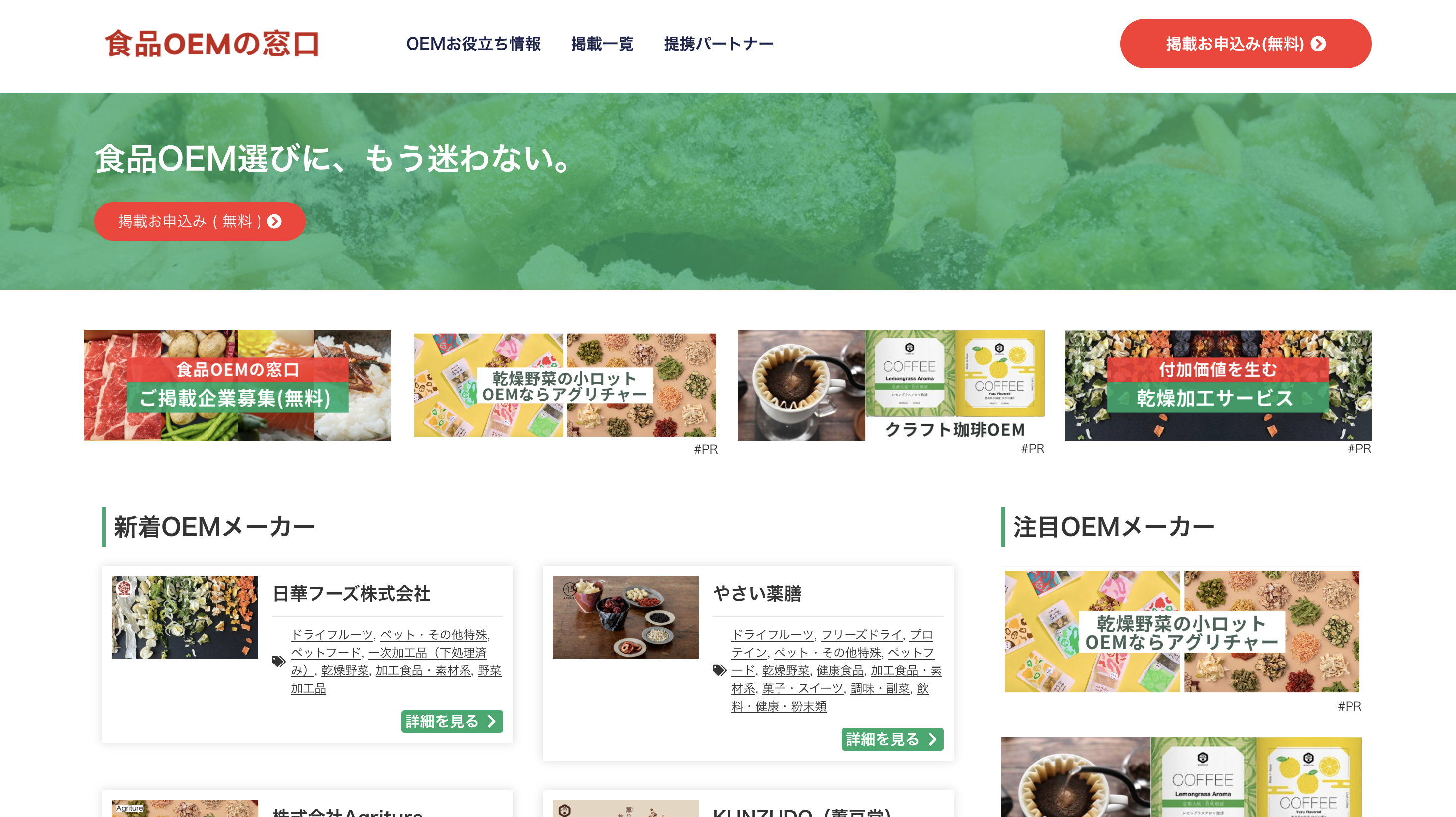
At trade shows and business-matching events, results were unstable relative to a rep's effort. But on a matching site, you can keep your information listed around the clock. Because you're displayed as the result of narrowing by concrete search criteria—“small lot,” “powder processing,” “domestic-ingredient capable,” “tea-bag filling”—the inquiries that reach you tend to be highly qualified.
You connect directly with prospects already considering an order. You could say it functions as a kind of online trade-show floor. It's not rare for a listing to lead to a new deal within just a few weeks. The ability to generate leads across region and industry is also a major draw.
Furthermore, the listing also functions as sales material. By organizing and clearly stating your minimum lot, scope of capability, processing equipment, and areas of strength, you convey your strengths objectively. The clearer it is “what kind of maker this is” and “what foods it's strong at,” the easier it is to earn ordering companies' trust and the higher the quality of inquiries.
Value as a mid- to long-term SEO asset
A matching-site listing has one more major benefit.
That's its value as a mid- to long-term SEO asset. In-site pages tend to rank high in search engines, and your company name gets exposure for keywords like “XX OEM” and “small-lot food processing.” Information reaches segments your own site can't, and combined with trade shows and business-matching events, it levels out lead generation.
Because you're displayed at search time by processing step and supported category, simply being on the comparison table is itself a sales opportunity. Ordering companies increasingly use matching sites when comparing multiple makers. If your information isn't there, you're not even in the running.
The health-food market maintained a scale of over 890 billion yen in fiscal 2024, with continued growth projected at an annual average of 6–7%. Attention to functional areas—immune support, gut health, sleep support, stress care—is also rising. For OEM makers that can support product development matched to these market trends, a big opportunity is opening up.
Concrete points for getting results
To get results on a matching site, there are a few points.
First, avoid vague expressions like “We can do anything” or “Please inquire for details.” It's effective to state specifics—the processing you can handle (drying, milling, filling, etc.), lot sizes, lead times, and uses (soup ingredients, tea, pet food, etc.). Adding photos and case examples makes it easier to earn ordering companies' trust.
The speed of initial response also greatly sways the close rate. When an inquiry arrives, reply as quickly as possible. This seems obvious yet many makers surprisingly fail to follow through. Ordering companies often inquire with several makers at once, and makers that respond fast tend to be chosen.
Putting your strengths into clear words is also essential. By making your difference from others clear—“strong in low-temperature drying,” “specializing in additive-free, domestic ingredients,” “good at small lots”—you stay in ordering companies' memory more easily. Place your information where it will be searched. That is the key to continuously increasing deals in the food-OEM business ahead.
To survive in the 2026 food-OEM market
The food-OEM market keeps expanding.
The contract-manufacturing market for health foods continues on a gradual expansion trend. Capturing overseas demand and price revisions against rising raw-material and processing costs are supporting market growth. On the other hand, domestic consumption has slowed somewhat, and challenges are also visible—contract projects for mail-order and drugstore channels are declining amid the impact of quality problems involving certain ingredients.
The growth strategy drawing attention is overseas expansion centered on Southeast Asia. Moves to open new markets—through halal support and the use of local subsidiaries and personnel—are growing active. The China market too shows signs of recovery, though competition is intensifying. Going forward, overseas development, technological innovation, and securing the effectiveness of price pass-through will be the management challenges.
The food-OEM matching site functions as a “third lead-generation route” alongside trade shows and referrals. As a way to meet high-probability projects while holding down cost, many food makers now adopt it. Put your strengths into clear words, and place your information where it will be searched. That is the key to continuously increasing deals in the food-OEM business ahead.
Summary: to become a maker that's chosen in a changing market
Having looked at food-OEM market trends, 2026 will be a year where demand for small-lot capability and domestic ingredients drives the market.
Platforms like the matching site “Food OEM Madoguchi” function as a powerful tool that complements traditional sales methods. By putting your strengths into clear words and showing your concrete scope of capability, you can win highly qualified inquiries. The speed of initial response and the fullness of your listing sway the close rate.
The growth of the health-food market, accelerating overseas expansion, attention to foods with function claims—the food-OEM industry holds many opportunities. On the other hand, headwinds exist too, such as the challenge of price pass-through and shrinking domestic consumption. To survive in this environment, you must keep honing your technical capability while also securing efficient lead-generation routes.
Trade shows, referrals, and matching sites. Using these three lead-generation routes in good balance to keep increasing deals—that will be the strategy for continued growth in the 2026 food-OEM market. Why not consider listing your company on “Food OEM Madoguchi” right away?

Recommended reading
Commercial dried vegetables / Drying processing service / Contract processing service / What are the health benefits of decaf coffee? Benefits and how to choose, explained / How to Choose Stick-Filled OEM Foods: 7 Points for Small-Lot Success That Won’t Fail
If you are considering product development with off-spec or your own farm's vegetables:From planning to processing, materials, package printing and novelties, you can consult us through a single point of contact. → Learn more about one-stop product development
FOR BUSINESS
乾燥野菜のOEM・受託加工を承ります
国産の野菜・果物の乾燥、100メッシュ相当までの粉砕、10g以上の小袋充填までをお受けしています。小ロットの試作から量産までご相談ください。寄せられた相談の実例は OEM・卸のご相談 に掲載しています。
乾燥品の賞味期限は、出荷日から6ヶ月程度を目安にご案内しています。
- Predicting the Dried Vegetable Market in 2030! An Explanation of Growth Fields and the Latest Trends
- How to Use OEM Matching Sites: Efficiently Finding the Optimal Manufacturing Partner
Author of this article
Related articles
-
 Original coffee marketing strategy | Ways to grow sales
 -
 ベジタリアンとは?国の規格が分けている4つの区分と食べられないもの
 -
 長ねぎと白ねぎは同じもの?ねぎの種類と呼び名を国の資料で確かめる
 -
 柚子の種類は何種類あるのか、公の資料で名前が残る系統を数えた
 -
 ゆずの時期は年に二度、青ゆずは7月から黄ゆずは10月から
 -
 ゆずの産地は高知が半分を占め、二位は徳島から愛媛に変わった
 -
 Preventing Food OEM Failures: Common Failure Cases and Countermeasures for Success
 -
 How to find a food OEM | How to efficiently find the best manufacturing partner