
The complete guide to powder-processing OEM in Kansai | Strengths by area and how to choose small-lot-friendly manufacturers

Summary of this article
We explain the points for choosing powder-processing OEM in the Kansai area. We introduce specifically, with examples such as Agriture: specialized fields by prefecture such as small-lot food OEM in Osaka, traditional-material processing in Kyoto, beverage OEM in Hyogo, and raw material processing in Shiga, Nara, and Wakayama; nutrient retention through low-temperature drying technology; differentiation with domestically grown vegetables; small-lot support from 100 kg; five criteria for selecting a supplier; and expansion cases into novelties, health foods, and the foodservice industry.
For those looking for powder-processing OEM in the Kansai area, we explain the characteristics of Kansai's food-processing bases, centered on Osaka, Kyoto, and Hyogo, and the points for selecting a manufacturer.
Kansai has been an area where the food manufacturing industry has clustered since ancient times. Processing technology represented by Osaka's konamon culture, brand power that makes the most of Kyoto's traditional ingredients, and raw material procurement power originating from Kobe's trading port—such regional characteristics enrich the options for powder-processing OEM.
There are many manufacturers that can handle small lots, an environment also suited to launching EC-oriented brands and test-manufacturing new products. This article compiles the information you should know when requesting powder-processing OEM in Kansai. From the support status by specific product category—vegetable powder, fruit powder, aojiru raw materials, stick-type powdered beverages—to how to choose an OEM manufacturer, we explain comprehensively.
TOC
Why the Kansai area is strong in powder-processing OEM
Why do so many companies look for powder-processing OEM in Kansai? Behind it are three strengths unique to the area.
| Area | Strength | Representative processing and materials |
|---|---|---|
| Osaka | A high density of clustered food OEM companies, strong in small-lot support and short lead times | Powdered beverages, baked goods, protein, prepared foods |
| Kyoto | Procurement power for regional brand materials such as Kyoto vegetables and matcha. Compatibility with the gift market | Vegetable powder, processed matcha products, dried vegetables |
| Hyogo / Kobe | Procurement power for imported raw materials leveraging the trading port. Companies with export-ready certifications too | Spice powder, nut processing, export-oriented products |
| Shiga・Nara・Wakayama | Close to the growing regions of agricultural produce, with an advantage in raw material freshness and transport cost | Fruit powder (yuzu, plum, etc.), tea-leaf processing |
Osaka: A cluster of food OEM companies
Osaka is one of Japan's leading food-manufacturing bases, gathering OEM manufacturers covering a wide range of genres such as powdered beverages, baked goods, prepared foods, and protein. It is strong in small-lot support, and a defining feature is that many companies have a track record of supporting the launch of EC-oriented brands. Since raw material makers and packaging-material makers are also concentrated here, there is the advantage of completing the entire supply chain nearby.
Kyoto: Regional brand materials and storytelling
Kyoto's strength is regional brand materials such as Kyoto vegetables and Uji matcha. Because the growing-region label "Kyoto-grown" itself carries brand value, it is superbly compatible with gift products, tourist souvenirs, and furusato tax donation return gifts. Based in Kyoto, Agriture carries out the low-temperature drying and powdering of domestically grown vegetables sourced from local farmers in an integrated way. Kujo green onion、Manganji togarashi、Shogoin daikon Vegetable powders using Kyoto vegetables such as these have the strength of being able to add "the growing region's story" to a product. The complete guide to Kansai OEM food manufacturing please also see.
Product categories that Kansai powder-processing OEM can handle
The products that can be manufactured with powder-processing OEM in the Kansai area are wide-ranging.
| Category | Product example | Assumed sales channels |
|---|---|---|
| Vegetable powder | Kyoto vegetable powder, kale powder, carrot powder | EC / commercial / school meals |
| Fruit powder | Strawberry, yuzu, apple, lemon powder | Confectionery / cafe / gifts |
| Blended powdered beverages | Aojiru, smoothie raw materials, Health tea | EC / drugstores |
| Stick-filled products | Powdered soup, protein, collagen | EC / novelties / subscriptions |
| Commercial powder materials | Dried vegetable mix, soup base | Foodservice chains / the ready-meal industry |
Products with storytelling that make the most of Kyoto's local character are rising in popularity as tourist gifts and furusato tax donation return gifts as well.
We have materials available to help you understand dried processing OEM
Agriture OEM, flexibly handling everything from small lots to large lots
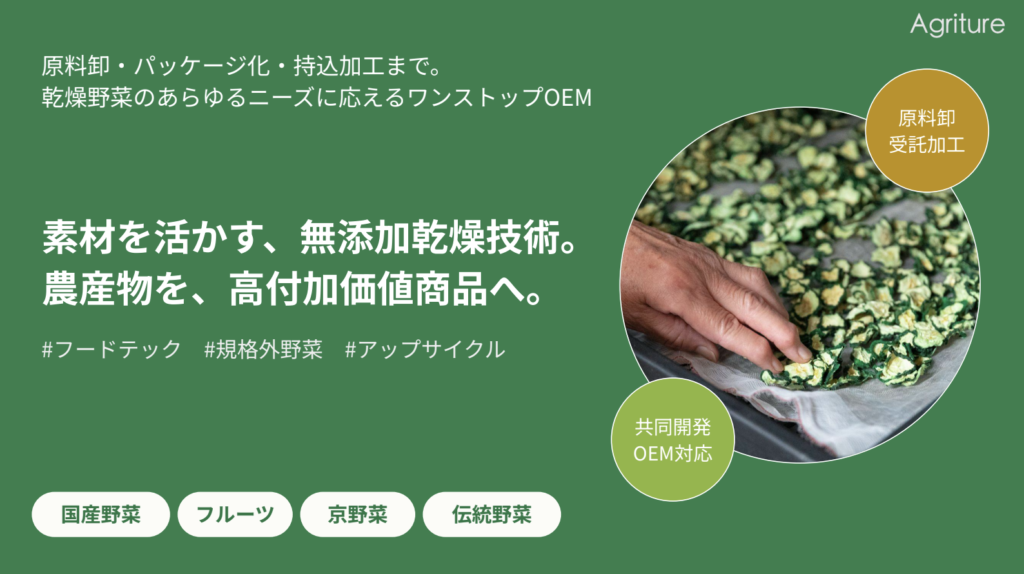
- OEM available from small lots of 10 kg
- Drying of brought-in raw materials also possible
- Support from processing to filling in one place
FOR BUSINESS
乾燥野菜のOEM・受託加工を承ります
国産の野菜・果物の乾燥、100メッシュ相当までの粉砕、10g以上の小袋充填までをお受けしています。小ロットの試作から量産までご相談ください。寄せられた相談の実例は OEM・卸のご相談 に掲載しています。
乾燥品の賞味期限は、出荷日から6ヶ月程度を目安にご案内しています。
Five points for choosing a powder-processing OEM manufacturer in Kansai
| Point | Details to confirm | Characteristics of the Kansai area |
|---|---|---|
| 1. Lot quantity / minimum quote | Whether the production scale suits your budget and sales plan | Some companies can handle from 100 kg |
| 2. Integrated processing capability | Whether it can handle drying → powdering → blending → filling → packaging | Many manufacturers offer one-stop support |
| 3. Material procurement routes | Procurement power for domestically grown, organic, and regional brand vegetables | Strong in sourcing regional materials such as Kyoto vegetables |
| 4. Quality control and certification | Status of certifications such as HACCP, ISO, and Organic JAS | Some companies are export-ready with FSSC 22000 certification |
| 5. Understanding of sales channels | Track record with assumed sales channels such as EC, gifts, foodservice, and commercial | Well versed in the tourism market and gift demand |
Especially important is "integrated processing capability." Requesting drying, grinding, blending, and filling from separate companies complicates quality control between processes and inflates costs. Choosing a manufacturer you can entrust from raw material procurement to final packaging in an integrated way lets you achieve both stable quality and cost efficiency.
Also, the speed of the prototyping stage becomes a factor in selection. A manufacturer that can quickly make prototypes can shorten the time to market.
The Kansai area has good access, just 2–3 hours from Tokyo by Shinkansen, a location that makes factory tours and meetings easy. For the first time, we recommend directly confirming the manufacturer's equipment and hygiene environment on-site.
Small-lot support and low-temperature drying: technical characteristics of Kansai OEM
Kansai's powder-processing OEM has two technical points worth noting.
Lowering the hurdle to new entry with small-lot support
With conventional OEM premised on mass production, the initial investment becomes large, but in the Kansai area there are also companies that can handle from around 100 kg. It is an environment that makes it easy to take a strategy of first checking market reaction in small quantities and then expanding in phases—such as launching an EC brand or developing a new menu for a foodservice chain. Some manufacturers can handle from a few kg at the prototyping stage, letting you find the optimal formulation while repeating fine recipe adjustments. The transition to mass production is smooth too, and since production scale can be expanded with the same equipment and process, quality variation can be minimized.
Protecting material quality with low-temperature drying technology
What determines the quality of vegetable powder is the drying technology. Compared with high-temperature drying, low-temperature drying loses fewer vitamins and minerals and can preserve the ingredient's natural color, aroma, and flavor. Agriture adopts this low-temperature drying technology and manufactures vegetable powder that retains natural color and aroma without using glucose.
Domestically grown materials cost more than imports, but differentiation is possible through the transparency of quality control and the brand value of "domestically grown" and "Kyoto-grown." In fact, Agriture's vegetable powders are adopted by food manufacturers and restaurants as ingredients for soups, granola, and smoothies. How to choose vegetable powder.
FOR BUSINESS
乾燥野菜のOEM・受託加工を承ります
国産の野菜・果物の乾燥、100メッシュ相当までの粉砕、10g以上の小袋充填までをお受けしています。小ロットの試作から量産までご相談ください。寄せられた相談の実例は OEM・卸のご相談 に掲載しています。
乾燥品の賞味期限は、出荷日から6ヶ月程度を目安にご案内しています。
FAQ about powder-processing OEM
Summary
The Kansai area is an environment suited to powder-processing OEM, combining three things: a high density of clustered food-processing companies, procurement power for regional brand materials, and the flexibility of small-lot support. When choosing a manufacturer, compare them against five points as criteria: lot quantity, integrated capability, material procurement, quality control, and understanding of sales channels.
We recommend starting with prototyping first and confirming material quality and responsiveness. Foodoem no Madoguchi to find a Kansai manufacturer you can also.

Download the OEM contract processing materials
We will send the materials to your email address based on the information you provide.
If you are considering product development with off-spec or your own farm's vegetables:From planning to processing, materials, package printing and novelties, you can consult us through a single point of contact. → Learn more about one-stop product development
- Kansai Food OEM: 6 Steps to Making a New Product and Subsidies
- The complete guide to succeeding at PB development with vegetable powder | Small lots supported
Author of this article
Related articles
-
 Original coffee marketing strategy | Ways to grow sales
 -
 ベジタリアンとは?国の規格が分けている4つの区分と食べられないもの
 -
 長ねぎと白ねぎは同じもの?ねぎの種類と呼び名を国の資料で確かめる
 -
 柚子の種類は何種類あるのか、公の資料で名前が残る系統を数えた
 -
 ゆずの時期は年に二度、青ゆずは7月から黄ゆずは10月から
 -
 ゆずの産地は高知が半分を占め、二位は徳島から愛媛に変わった
 -
 Preventing Food OEM Failures: Common Failure Cases and Countermeasures for Success
 -
 How to find a food OEM | How to efficiently find the best manufacturing partner