Dried Shogoin daikon


The Kyoto traditional vegetable "Shogoin daikon," born in the Shogoin district of Kyoto in the late Edo period. Its perfectly round, high-moisture, tender flesh is resistant to falling apart when simmered and is faintly sweet. Dry processing removes moisture, creating a springy, chewy texture and a refined richness and umami within the sweetness. A commercial dried vegetable whose appeal lies in firm bite and depth of flavor that its fresh state cannot express.
TOC
Agriture's dried Shogoin daikon: three points of care
01 A Kyoto traditional vegetable continuing since the late Edo period
Shogoin daikon is one of Kyoto's representative traditional vegetables, born in Kyoto's Shogoin district in the late Edo period. Unlike ordinary aokubi daikon, it is characterized by a perfectly round, large spherical shape, and as a Kyoto-brand ingredient it has appeal for tourism, souvenir, and premium products. The Kyoto character that ordinary daikon cannot express is a differentiating point for the raw material.
02 Thick cut for a springy, chewy texture
To make the most of Shogoin daikon's thickness, at Agriture we deliberately finish it in larger tanzaku strips. Drying removes moisture, changing it into a springy, chewy texture. Even after rehydration, it is a raw material with enough presence to take the lead in simmered dishes, oden, and takiawase.
03 Balancing sweetness and refined richness
Thick, fine-grained Shogoin daikon has its sugar content concentrated by drying, giving a faint, refined sweetness and deep richness. The richness of flavor unobtainable from ordinary daikon means many commercial users cannot let go of it once they use it, and it is a raw material with a high repeat rate from Japanese restaurants and high-end prepared-food shops.
Product catalog showing the items we handle
Flexible support from small lots to large lots
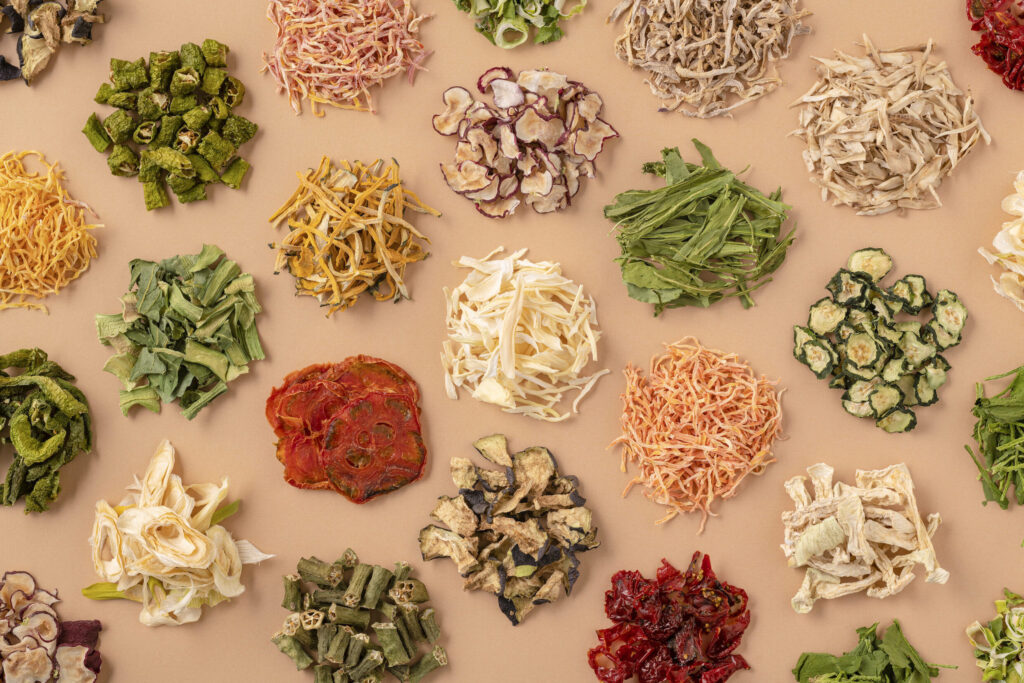
- Sold in small lots from 1 kg
- Handling heirloom vegetables from across Japan
- Dried fruits and herbs also supported
Features of commercial dried Shogoin daikon
A Kyoto traditional-vegetable brand
As a Kyoto traditional vegetable continuing since the late Edo period, a raw material that can appeal to the Kyoto brand. It is one reason it is chosen for tourism demand, gift products, and high-value-added OEM, with appeal on the product package.
Springy, chewy texture
Drying removes moisture, changing it into a springy, chewy texture. Even after rehydration, its texture asserts itself, giving presence as an ingredient. A raw material that can elevate daikon's role in Japanese menus.
Concentrated sweetness and richness
Thick Shogoin daikon has high sugar content, and drying concentrates the sweetness. Because a refined richness not found in ordinary daikon emerges, it is a material usable without discomfort even in upscale Japanese menus and high-end prepared dishes.
No glucose added
We process the ingredient as-is, performing no sugar coating or bleaching whatsoever. A raw-material design that can be adopted straight into additive-appeal products and products where you want to keep the ingredient list simple.
Six-month storage at room temperature
Room-temperature storage of 6 months from the shipping date is possible. Turning Shogoin daikon, whose main season is winter, into a dried form enables year-round supply, freeing you from the constraints of seasonal menus.
Cultivation by partner farmers in Kyotango
Uses raw material grown by partner farmers in Kyotango, Kyoto, processed all at once to coincide with the harvest. We maintain a system that supplies stable quality throughout the year.
Product specifications
Item | Details |
|---|---|
Raw material growing region | Kyoto Prefecture (partner farm) |
Specification | Tanzaku cut |
Storage method | Room temperature (store away from high heat and humidity) |
Best-before date | 6 months from the shipping date |
Minimum lot | From 10 bags / 100 g |
Powder | △ Possible depending on coarseness |
Manufacturing period | December |
Customization support
At Agriture, cooperation with partner farms and our own processing facility achieve a stable raw material supply and high-quality manufacturing. We can flexibly handle OEM manufacturing and welcome consultations on specification changes and packaging. Custom-size handling (cut-thickness change, shape adjustment) is available for consultation from orders of 10 kg or more, and for large-lot manufacturing please consult us three months before the manufacturing period.
POWDER
For those looking for daikon powder or other vegetable powders
We can also handle powdering of dried Shogoin daikon. We can propose uses tailored to powder demand, such as furikake, soup bases, and seasoning bases. Blend designs with other vegetable powders are also accepted.
Commitments to variety, grower, and growing region
The raw material used for our dried Shogoin daikon is Shogoin daikon grown by partner farmers in Kyotango, Kyoto. A traditional vegetable born in Kyoto's Shogoin district in the late Edo period, it is characterized by a perfectly round, large spherical shape and thick flesh. Higher in sugar than ordinary aokubi daikon and resistant to falling apart when simmered, its properties suit commercial applications.
BRAND
Variety: Shogoin daikon. A Kyoto traditional vegetable born in Kyoto's Shogoin district in the late Edo period, characterized by a perfectly round, large spherical shape and thick flesh. Being tender yet not falling apart when simmered, and faintly sweet, is its difference from ordinary daikon.
PRODUCER
Producer: Partner farmers. Aiming for agriculture kind to the environment and people, they grow crops using homemade compost. They also work continuously at cultivating Shogoin daikon, and we place our trust in them as growers who can stably supply high-quality raw material.
REGION
Growing region: Kyotango, Kyoto. With the large temperature swings of the Sea-of-Japan-side climate, Shogoin daikon with sugar content heightened by winter cold can be harvested. Batch processing timed to the December harvest turns it into raw material at its most flavorful state.
CULTIVATION
Cultivation method: Environmentally-conscious cultivation using homemade compost. A method that curbs chemical fertilizers and pesticides, emphasizing the soil's nutrient balance. It is the cultivation policy needed to draw out Shogoin daikon's natural sweetness and richness.
*Reference: OYAOYA product page
Low-temperature drying technology and quality control
Because Shogoin daikon is a thick root vegetable, time and temperature management in the drying process is even more important than for ordinary daikon. To evenly remove moisture from thick-cut pieces requires long-time drying while adjusting the temperature in stages; a high-heat, short-time drying method hardens only the surface and leaves moisture inside. At Agriture, we run a drying program dedicated to thick root vegetables, achieving processing that draws out moisture thoroughly to the interior while retaining a springy, chewy texture.
Production is at our own processing facility in Kyoto, managing the entire flow from raw-material intake to shipping in one place. We also handle the issuance of analysis sheets and raw-material origin certificates for food OEM, so it can be adopted as a raw material for high-value-added products as a Kyoto-vegetable brand.
💡 TIPS | Drying-processing trivia
For thick root vegetables like Shogoin daikon, because moisture leaves differently at the surface and interior, we process it while changing the airflow direction and adjusting the temperature partway. At Agriture, we perform multiple moisture-content checks during the drying process, aiming for an even finish.
Use cases and adoption examples
As a material for simmered dishes, oden, and takiawase
A use suited to Japanese menu development at restaurant chains and ready-meal / delica makers. Fresh Shogoin daikon involves large peeling and edge-trimming man-hours at prep, and seasonal supply stability is also a challenge, but a dried, cut product allows room-temperature bulk storage and year-round stable procurement, greatly reducing prep man-hours. Because it absorbs broth well and its Kyoto-vegetable-derived sweetness is concentrated, it also suits adoption in hotel Japanese cuisine and souvenir-oriented prepared-dish lines as a differentiating material for oden, takiawase, and simmered dishes.
As an ingredient for noodle dishes
A menu material adopted at ramen and udon specialty shops and restaurant chains for value-adding appeal of "made with Kyoto vegetables." Buying fresh Shogoin daikon whole involves large prep man-hours, and freshness management is also a burden on-site, but a dried, cut product allows room-temperature bulk storage and can be developed effortlessly just by adding it while rehydrating in the soup. Because it also handles cut shapes by application, such as thick slices and tanzaku, it can be considered from small lots as a differentiating material for specialty toppings and seasonal-limited menus.
For kiriboshi-daikon-style salads and prepared dishes
A use easy to adopt at prepared-food makers and mass-retail delica as a material to differentiate from existing kiriboshi daikon. Fresh Shogoin daikon poses challenges of fluctuating purchase volume and prep man-hours, but with the dried product, stable procurement at room temperature and using up only the needed amount are possible, contributing to leveling the production line. Because you can use it either softened by full rehydration or crisp by half rehydration, it can be developed across a wide menu line—salads, dressed dishes, and lightly-pickled-style prepared dishes.
OEM product raw material and dried root-vegetable mixes
Dried Shogoin daikon is a category with much adoption as a raw material for Kyoto-vegetable mixes, oden bases, and soup sets planned by food makers and souvenir brands. Unlike buying fresh raw material, room-temperature bulk storage is possible, making it easy to draw up stable production plans with little seasonal fluctuation, and blending with other dried root vegetables and dried leafy greens is also flexible. When considering developing a differentiated product built around the Kyoto-grown raw-material identity, feel free to consult us on specifications such as cut shape and blend ratio.
As a raw material for souvenir and gift products
Dried slices and diced Shogoin daikon are adopted as a base material for Kyoto brand souvenirs and department-store gift sets. With fresh raw material, shipping cost and freshness management are bottlenecks, but a dry-processed product allows wide-area room-temperature distribution and can meet the best-before-date requirements for gift products. Because we handle everything from small-lot prototyping, please consult us from the product-design stage, including package design and combinations with other Kyoto vegetables.
Commercial usage and rehydration
Dried Shogoin daikon is used after rehydrating in water for about 15 to 30 minutes. Because it is thick-cut, rehydration takes time, but using lukewarm water can shorten it. For simmered dishes, you can also add it straight to the broth without rehydrating and simmer it a long time, which absorbs the broth thoroughly for a juicy finish.
For oden and takiawase, rehydrating and then parboiling before the main cooking gives even flavor penetration. For kiriboshi-daikon-style prepared dishes, rehydrating, finely chopping, and simply mixing with seasoning liquid completes it, greatly shortening prep time.
Related cases and articles
- Shogoin Daikon: The Round, Sweet Standard-Bearer of Kyoto Vegetables (Kyoto vegetable column)
- Winter Kyoto vegetables: the deep umami of Shogoin daikon and Kujo green onion (Kyoto vegetable column)
- Shogoin Kabu: A Kyoto Vegetable with a Smooth, Refined Flavor (Kyoto vegetable column)
Product catalog showing the items we handle
Flexible support from small lots to large lots
- Sold in small lots from 1 kg
- Handling heirloom vegetables from across Japan
- Dried fruits and herbs also supported
Frequently asked questions
Q. What is the minimum lot and prototype handling?
A. Orders are accepted from 10 bags (in 100g units). OEM prototypes can be discussed from 10kg and up, and combinations of cut specification, blend, and packaging can be considered together. In developing souvenirs and high-value-added products themed on Kyoto vegetables, we provide hands-on support that runs alongside you from the prototype stage.
Q. What is the price range?
A. Because Shogoin daikon is a Kyoto traditional vegetable, the unit price is higher than dried products of ordinary aokubi daikon. However, it is a raw material that lets you raise the product unit price through its appeal as a Kyoto brand. Please consult us via the inquiry form for a specific quote.
Q. What is the lead time?
A. Stock items can be shipped 1 to 2 weeks after order. Shogoin daikon is produced in December, with batch processing timed to the winter harvest. If you want a large lot, consulting us by 3 months before the production period lets us respond with planned production.
Q. Can you issue a raw-material origin certificate?
A. We can issue a raw-material origin certificate for Kyotango, Kyoto. We can also handle labeling the product package "made with Kyoto-grown Shogoin daikon" or "made with a Kyoto traditional vegetable." We prepare all documents needed for appeal as a Kyoto-vegetable brand.
Q. Can you submit pesticide residue results or analysis tables?
A. We can issue quality certificates such as microbiological tests and proximate analysis. With a system able to meet the high quality requirements for raw materials in Kyoto-vegetable-brand products, we can provide the documents needed for OEM quality control.
Q. Can you handle HACCP and export?
A. Our processing facility supports submission of HACCP-compliant documentation. Export projects are handled case by case, but inquiries for overseas-oriented OEM products themed on Kyoto vegetables are also increasing. It can be used for overseas expansion aimed at Japanese restaurants and Japanese-food stores.
Q. Please tell me the OEM consultation flow
A. The flow is: inquiry → concept interview → sample delivery → paid prototyping → specification finalization → full production. In consultations for product development using Kyoto vegetables, there are also cases where we provide total support from brand-story design to product design.
RETAIL
For those looking to purchase in small packs
For prototype use or personal consumption, small-quantity packs can also be purchased at the online shop of our sister brand OYAOYA. It is recommended for those who want to check the flavor and texture with a small quantity before commercial use.
Medicinal-food properties (in the case of fresh daikon)
In the world of yakuzen, daikon is positioned as "an ingredient that regulates the flow of qi." In season in winter, daikon is known for its juicy texture and subtle sweetness, and is one of the vegetables essential to the Japanese table.
Because it has a cooling nature, it is also said to help cool a sensation of heat. People who tend to feel cold should avoid eating it raw and instead include it in cooked dishes such as simmered dishes and soups. The daikon leaves are also nutritious, and one appeal is that they can be used without waste, stir-fried or added to miso soup.
💡 TIPS | Yakuzen trivia
In the cold of winter, simmering it slowly lets you take in the benefits of daikon without chilling the body too much.
Because dried Shogoin daikon, unlike fresh daikon, has little moisture, its cooling action on the body is thought to become milder. Rather, by using it in long-simmered dishes such as simmered dishes and soups, it can be proposed as an ingredient useful for warming-conscious Japanese menus and for menu planning from a medicinal-food perspective.
YAKUZEN
For those who want to learn more about daikon from a medicinal-food perspective
On our sister site Yasai Yakuzen, which introduces recommended ingredients and medicinal-food recipes by constitution, we explain daikon's benefits and ways to include it in more detail. It also introduces seasonal ways to eat it and combinations of well-matched ingredients.
Recommended reading
- Shogoin Daikon: The Round, Sweet Standard-Bearer of Kyoto Vegetables (Kyoto Vegetable Column)
- Winter Kyoto vegetables: the deep umami of Shogoin daikon and Kujo green onion (Kyoto Vegetable Column)
- Shogoin Kabu: A Kyoto Vegetable with a Smooth, Refined Flavor (Kyoto Vegetable Column)
Download the product catalog
We will send the materials to your email address based on the information you provide.