
Shogoin Kabu: A Kyoto Vegetable with a Smooth, Refined Flavor

Summary of this article
Shogoin kabura is a traditional Kyoto vegetable brought from Katata in Omi to Shogoin in Kyoto's Sakyo Ward during the Kyoho era of the Edo period. At 15-20 cm in diameter and 2-4 kg in weight, it is one of the largest turnips in Japan. Today the main growing area is the Shino district of the Kameoka Basin, where large day-night temperature swings and frequent fog produce its fine-textured flesh. It is in season from November to March and is famous as the raw material for senmaizuke pickles. The leaves are also nutritious, and the turnip is indispensable in Kyoto cuisine such as kabura-mushi, simmered dishes and chicken simmered with turnip.
Shogoin Q3. Can you powder-process raw material I bring in?kabura (shogoin kabura) is one of Kyoto's heirloom vegetables, a turnip characterized by its round, large shape. Boasting one of the largest sizes among turnips in Japan, it Shogoin kabura is also known as the ingredient for Kyoto's specialty senmaizuke, and can be called a feature of Kyoto's winter.
TOC
Features and appearance of Shogoin turnip
Compared with ordinary turnips, it is large, spherical, about 15-20 cm in diameter, and reaches 2 kg to 4 kg in weight. The skin is white and smooth, and the flesh is dense, tender, and strongly sweet. Not only the root but also the leaves can be eaten deliciously, and with simple cooking such as making a salad or lightly heating them, they are perfect as a side dish. In season from November to around March, it is a vegetable indispensable to Kyoto's winter.
Difference from ordinary turnips
The ordinary small turnips seen in supermarkets are 5-8 cm in diameter and weigh around 100 g, whereas Shogoin kabura is overwhelmingly large at 15-20 cm in diameter and 2-4 kg in weight. There is a difference in flesh as well: ordinary turnips tend to have somewhat coarse fibers and fall apart easily when simmered, while Shogoin kabura has dense, fine-grained flesh and keeps its smoothness even when simmered. It is also sweeter, and heating draws out even more sweetness. This characteristic is why it is indispensable to Kyoto cuisine such as senmaizuke and simmered dishes.
Season and production area
Shogoin kabura is in season during winter, from November through the following March. Those harvested when frost falls are said to raise their sugar content to endure the cold, becoming even sweeter. The main growing region is the Shino district of Kameoka City, Kyoto, where the climate of the Kameoka basin, with large day-night temperature swings and a tendency for fog, develops fine-grained flesh and sweetness. Although the area around Shogoin in Sakyo Ward, Kyoto, is the place of origin, today Kameoka-grown accounts for the majority of production within Kyoto Prefecture.
JA Kyoto official site – Shogoin turnip
History and origin of Shogoin turnip
During the Kyoho era of the Edo period, a dedicated farmer in Sakyo Ward, Kyoto, brought back Omi turnip seeds from Katata in Omi (present-day Katata, Otsu City) and cultivated them. As cultivation continued and the quality was improved year by year, the root, originally flat, changed and grew into the Shogoin turnip reaching as much as 5 kg.
At first it was cultivated around Shogoin, but today the Shino district of Kameoka City has become the center of production within Kyoto Prefecture. The Kameoka basin's climate, with large day-night temperature swings and a tendency for fog, is suited to growing Shogoin kabura deliciously.
Certification as a Kyoto heirloom vegetable
Shogoin kabura is certified by Kyoto Prefecture as a Kyoto Heirloom Vegetable. Kyoto Heirloom Vegetables refers to varieties cultivated within Kyoto Prefecture since before the Meiji era that are still in production today. Shogoin kabura has a cultivation history of about 300 years since the Kyoho era and has been deeply tied to Kyoto's food culture. Even now, the seeds are passed down as a fixed variety, and Kyoto farmers continue to preserve traditional cultivation methods.
Difference between Shogoin turnip and Shogoin daikon
Because they look alike, Shogoin turnip and Shogoin daikon are easily confused, but botanically they are entirely different varieties. Shogoin turnip is a member of the turnip genus Brassica in the Brassicaceae family, with smooth, tender flesh that is easy to eat even raw. Shogoin daikon, on the other hand, is of the Raphanus genus in the Brassicaceae family, with somewhat firm flesh suited to simmered dishes. The points to tell them apart: Shogoin turnip has a smoother surface and a stronger roundness, while Shogoin daikon is somewhat flat and may have green at the neck.
FOR BUSINESS
乾燥聖護院かぶを、原料としてお探しですか
国産の聖護院かぶを乾燥・粉砕してお出ししています。カット形状や粒度の指定、継続してのお取引もご相談ください。規格は Dried Shogoin Kabu・Shogoin Kabu Powder に掲載しています。
聖護院かぶの少量販売は姉妹ブランドの OYAOYA では取り扱いがありません。ほかの品目はカタログをご覧ください。
Nutrition of Shogoin turnip and ways to enjoy it
Shogoin turnip is a winter vegetable that lets you enjoy both the smooth-fleshed root and the leaves, which are a green-yellow vegetable. The root is light-colored, without an off-taste, and contains vitamin C and more. The leaves contain beta-carotene, calcium, and more, and can be used to add color. Being usable in full, from root to leaves, is the appeal of Shogoin turnip.
Enjoying Shogoin turnip grated
Because Shogoin kabura has smooth flesh, it has a pleasant mouthfeel even when grated, and simply pairing it with ponzu or dashi soy sauce makes an elegant dish. Fresh grated turnip lets you taste the gentle sweetness and juiciness of the turnip as it is. It is handy as a refreshing small dish on the winter table.
How to eat the leaves without losing their nutrients
The leaves of Shogoin kabura are a green-yellow vegetable containing beta-carotene, calcium, and more. Because beta-carotene is easier to take in when cooked with oil, we recommend quickly stir-frying them in oil or dressing them with sesame oil. Quickly blanching them in salted water, plunging them into cold water, and using them in ohitashi, furikake, or as a miso soup ingredient lets you enjoy even the leaves without waste.
Recommended ways to eat Shogoin turnip
Shogoin kabura suits simmered dishes and pickles that make the most of its tender flesh and sweetness. Representative dishes include kabura-mushi and kabura-ni. Kabura-mushi is a dish of grated Shogoin kabura steamed together with ingredients, characterized by a fluffy texture and gentle sweetness. It is a dish frequently served in Kyoto restaurants in winter, with an elegant flavor to enjoy.
How to make kabura-ni and tips
Kabura-ni is a dish of thickly cut Shogoin kabura slowly simmered in dashi. Being resistant to falling apart, Shogoin kabura has its sweetness drawn out even further by simmering, offering a tender, smooth mouthfeel. The turnip's sweetness also matches the dashi exquisitely, spreading a deep flavor despite its simplicity. When making it at home, the key is to cut it into pieces about 3 cm thick, bevel the edges, then add it to the dashi and simmer over low heat for 20-30 minutes. It is done when a bamboo skewer slides through smoothly. Adding yuzu peel gives a wintry aroma for a restaurant-quality finish.
Easy recipes you can make at home
Shogoin kabura can be used easily in home cooking too. Thinly sliced into a salad, it lets you enjoy its smooth texture and natural sweetness as they are. Kabura-mushi, made by grating Shogoin kabura, mixing it with egg white, placing it on top of white fish, and steaming for about 10 minutes, can also serve as a dish for entertaining guests. Furthermore, simmered chicken and turnip, made by simmering Shogoin kabura and chicken in dashi, is a dish where the ingredients' sweetness stands out. Kujo green onion Scattering some over the top enriches both the color and the flavor.
Senmaizuke: the representative Kyoto pickle made from Shogoin turnip
Senmaizuke, Kyoto's traditional pickle, cannot exist without Shogoin kabura. Senmaizuke is a pickle made by pickling thinly sliced turnip with vinegar, salt, kelp, and more, characterized by a refreshing flavor. In Kyoto's winter, senmaizuke is a staple in homes and restaurants, beloved as a dish where the sweetness of Shogoin kabura and the sourness of the vinegar harmonize exquisitely.
The history of senmaizuke
Senmaizuke is said to have been devised in the late Edo period by Tozaburo Ofuji, a cook at the Imperial Palace. From that time, the fine-grained flesh and sweetness of Shogoin kabura made it the ideal variety for senmaizuke, which is thinly sliced and pickled. The leading theory for the name's origin is that it came to be called senmai (a thousand sheets) from the way many thin slices of turnip are stacked and pickled. Even today, long-established pickle shops in Kyoto continue to preserve the traditional method of carefully slicing each one by hand.
How to make senmaizuke at home
You can make senmaizuke at home too. Peel the Shogoin kabura thickly and slice it thinly, about 2 mm. Sprinkle with salt, leave for about two hours, and once moisture comes out, squeeze it lightly. Arrange the turnip in a pickling liquid combining vinegar, sugar, kelp, and red chili, and pickle overnight in the refrigerator to finish. The umami of the kelp and the sweetness of the turnip melt together, offering a handmade flavor a step different from store-bought products.
How to choose and store Shogoin turnip
How to spot a fresh Shogoin turnip
The point in choosing a fresh Shogoin kabura is first to check the surface. Choose ones that are white and glossy, without cuts or dents. Ones that feel heavy when held are proof that they contain plenty of moisture. When sold with the leaves attached, ones whose leaves are not wilted and are a vivid green are fresh. It is also important to check that the neck is not discolored.
Tips for storing it to last
After purchase, the basic rule is to separate the leaves from the root for storage. If the leaves remain attached, they draw up the root's moisture and cause the root to become spongy. Wrap the root in plastic wrap or put it in a poly bag and store it in the vegetable compartment of the refrigerator, where it keeps for about a week. Wrap the leaves in dampened kitchen paper, put them in a poly bag, store them in the vegetable compartment, and use them up within two to three days. If you get a large amount, there is also a method of thinly slicing it, massaging it with salt, and freezing it.
Combining Shogoin turnip with other Kyoto vegetables
Shogoin kabura is a fully delicious ingredient on its own, but combining it with other Kyoto vegetables widens your cooking range. When simmered together with the winter-season Kintoki carrot, the contrast of white and red is beautiful, making a visually gorgeous dish. A potage of Shogoin kabura scattered with Kujo green onion is recommended as a winter staple soup, where the aroma of the negi becomes an accent. Kamo eggplant and Horikawa gobo A simmered combination with List of Kyoto vegetable varieties is also a dish representative of Kyoto's winter.
For those who want to know the seasons of Kyoto vegetables, Kyoto vegetable calendar.
Using Shogoin turnip as a dried vegetable
Shogoin kabura can also be used as a dried vegetable. Drying makes it keep well, letting you enjoy its flavor regardless of the season, so it is a strong ally when you are busy. Used in simmered dishes or soups, it makes a flavorful dish where you can enjoy the sweetness and texture characteristic of Shogoin kabura.
Agriture's initiatives | Using Kyoto vegetables without waste
Agriture works with farmers in Kyoto Prefecture on sustainable food distribution through the use of off-spec vegetables and the sixth-industrialization of growing regions. The Shino district of the Kameoka basin, known as a main growing region for Shogoin turnip, develops fine-grained turnips through its day-night temperature swings and fog. Even turnips whose shape or size does not meet the standard can be used up while keeping their value if made into a dried form. We slowly dry vegetables grown in Kyoto Prefecture at low temperatures, delivering the flavor of the growing region to home and commercial tables.
How to use dried Shogoin turnip
Dried Shogoin kabura can be used in cooking simply by rehydrating it in water for about 10-15 minutes. Because the turnip's sweetness and umami dissolve into the rehydration liquid as well, we recommend not discarding it but using it as part of a soup or dashi. Adding it as an ingredient to miso soup or pot-au-feu lets you easily bring the flavor of Kyoto vegetables into daily life. There is also a method of putting it into the pot without rehydrating and letting it rehydrate as it simmers, which suits time-saving cooking on busy days.
Benefits of dried vegetables
Drying removes moisture and concentrates the umami and sweetness, so even a small amount can add deep flavor to a dish. Because it can be stored at room temperature for several months, being able to enjoy the flavor of Shogoin kabura even after the winter season passes is a major appeal. Being light and not bulky, it is also handy as emergency food or an outdoor ingredient. Dried-vegetable OEM At Agriture, which handles this, we also manufacture and sell dried vegetables made from Kyoto vegetables.
Recommended reading
List of Kyoto vegetable varieties / Kyoto vegetable calendar / Commercial dried vegetables / Manganji Togarashi: The Large, Thick-Fleshed King of Kyoto Vegetables / The Cut Face of a Vegetable. The Difference the Cut Makes.
We have materials available to help you understand dried processing OEM
Agriture OEM, flexibly handling everything from small lots to large lots
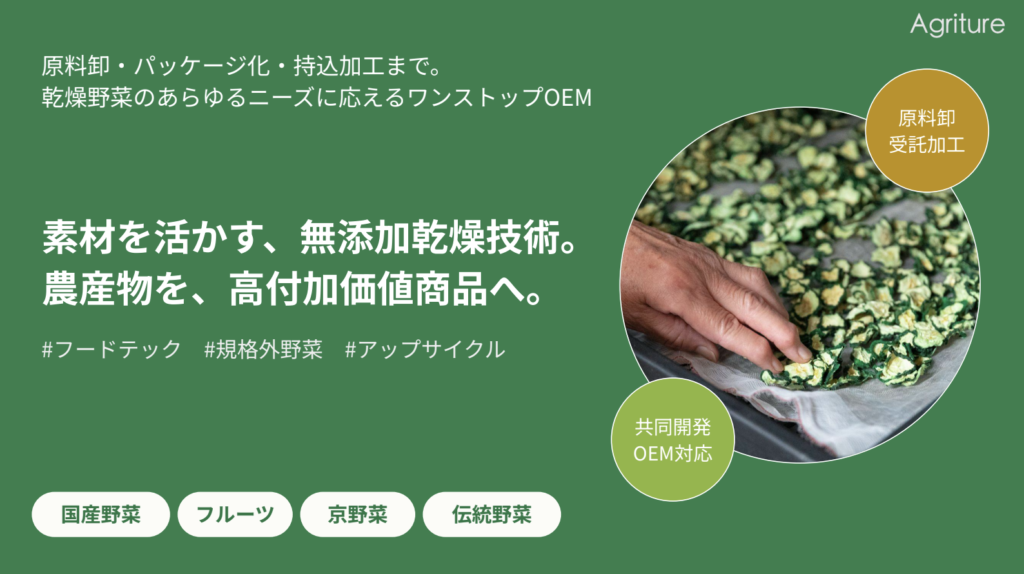
- OEM available from small lots of 10 kg
- Drying of brought-in raw materials also possible
- Support from processing to filling in one place
FOR BUSINESS
乾燥聖護院かぶを、原料としてお探しですか
国産の聖護院かぶを乾燥・粉砕してお出ししています。カット形状や粒度の指定、継続してのお取引もご相談ください。規格は Dried Shogoin Kabu・Shogoin Kabu Powder に掲載しています。
聖護院かぶの少量販売は姉妹ブランドの OYAOYA では取り扱いがありません。ほかの品目はカタログをご覧ください。
Related articles
- Shogoin Daikon: The Round, Sweet Standard-Bearer of Kyoto Vegetables
- Kamo Eggplant: A Kyoto Vegetable Prized for Its Round Shape and Rich Flavor
- Kintoki Carrot: A Vividly Colored, Strongly Sweet Kyoto Vegetable
- A list of famous Kyoto vegetable varieties and their characteristics
- Kyoto vegetable calendar — seasonal Kyoto vegetables that color the four seasons
Download the OEM contract processing materials
We will send the materials to your email address based on the information you provide.
- Spring Kyoto vegetables: the seasonal taste of Kyoto bamboo shoots, mibuna, and Kujo green onion
- Shogoin Daikon: The Round, Sweet Standard-Bearer of Kyoto Vegetables
Author of this article
Related articles
-
 京野菜は何品目あるのか、読み方の一覧と認定の枠組みから確かめる
 -
 Drying Is Another Kind of Cooking
 -
 The Technology to Lock In the Season. The Seasonal Story Dried Vegetables Connect.
 -
 The Cut Face of a Vegetable. The Difference the Cut Makes.
 -
 Tasting Kyoto Vegetables by Aroma. The Pleasure of Cooking That Begins at the Tip of the Nose
 -
 Vessels and Kyoto Vegetables. Creating the Scenery of Plating.
 -
 Vegetables and Heat Control. Between High and Low Flame
 -
 Kyoto Vegetables and Sake. The Happy Relationship of a Dish and a Cup.