
What Is Horikawa Gobo? A Thorough Explanation of Its Characteristics, Cultivation, How to Eat It, and Nutrition

Summary of this article
Horikawa burdock is a heirloom Kyoto vegetable grown for about 400 years, measuring 5–9cm in diameter and 50–80cm long, weighing about 1kg, with a hollow cavity called "su" inside. Said to have originated at the site of Toyotomi Hideyoshi's Jurakudai, it is known for the "year-crossing burdock" cultivation method of replanting at a 15-degree angle. In season October–December, its standard dishes are meat-stuffed burdock, simmered burdock, tempura, and kinpira that make use of the cavity.
TOC
What Is Horikawa Burdock? How It Differs from Ordinary Burdock
Horikawa burdock (Horikawa burdock) is a Kyoto vegetable grown in Kyoto for about 400 years. Certified as both a "Kyoto Heirloom Vegetable" and a "Brand Kyoto Vegetable," it is known as a rare Kyoto vegetable used even at high-end restaurants. It differs greatly from ordinary burdock (Takinogawa burdock) in both looks and flavor, and is an important ingredient supporting Kyoto cuisine.
Features of Horikawa Burdock
Horikawa gobo's greatest features are its thickness and its cavity. It reaches 5–9cm in diameter, about 50–80cm long, and about 1kg in weight. In the growing process, a cavity called "su" naturally forms inside, and cracks like the trunk of a pine tree run across the skin.
In flavor, a big difference is that it has less astringency and softer flesh than ordinary burdock. Its fine fibers give it a smooth mouthfeel, and heating increases its sweetness. With the earthy smell characteristic of burdock kept gentle and an elegant aroma, it has long been prized as an ingredient for Kyoto cuisine.
Comparison with Ordinary Burdock (Takinogawa Burdock)
Horikawa burdock and ordinary Takinogawa burdock differ in size, nutrition, and cultivation method alike. The table below compares them.
| Comparison item | Horikawa gobo | Takinogawa burdock (ordinary burdock) |
|---|---|---|
| Diameter | 5〜9cm | 2〜3cm |
| Length | About 50–80cm | About 1m |
| Weight | About 1kg | About 150–200g |
| Internal structure | Hollow (su-filled) | Densely packed |
| Cultivation period | Over a year (with replanting) | About 3–4 months |
| Peak period | October–December | Shipped year-round |
| Price range | 500–1,500 yen each | 100–200 yen each |
It is thick and easy to cook with, but because cultivation takes over a year, the volume reaching market is small and the price runs high. At about 1kg each, it is satisfyingly hearty, and part of its appeal is enjoying different textures by section.
Cultivation Method and Harvest Season
The cultivation of Horikawa burdock is exceptionally distinctive even among burdock. Ordinary burdock grows straight down in the soil, but Horikawa burdock is pulled up partway and replanted sideways in the field at a 15-degree angle. This makes it grow thick sideways and form a cavity inside.
The specific schedule is to sow seeds in autumn and raise seedlings, then transplant them the following year during the rainy season (around mid-May). Spacing is set wide at about 70cm, and in summer straw mulch prevents drying. Careful soil preparation is key, such as adding 1–3 tons of compost per 10 ares. Because it rots easily if waterlogged for more than two days, a well-drained field is essential. The harvest runs from late October to December, which is Horikawa burdock's season.
The History of Horikawa Burdock | A Kyoto Vegetable Born from Chance About 400 Years Ago
Cultivation That Began at Toyotomi Hideyoshi's Jurakudai
The origin of Horikawa burdock traces back to the Azuchi-Momoyama period. "Jurakudai," the government office and residence Toyotomi Hideyoshi built in Kyoto, was demolished in 1595, and its moat came to be used as a garbage dump. Burdock leftovers thrown into the moat sprouted the next year and, thanks to the nutrient-rich soil, grew unimaginably huge. Neighboring farmers who saw it began cultivating it, and that is said to be the beginning of Horikawa burdock.
About 400 years since this chance discovery, the unique cultivation method also called "year-crossing burdock" has been handed down by generations of farmers (reference: City of Kyoto official site)。
Certification as a Kyoto Heirloom Vegetable and Brand Kyoto Vegetable
Today, Horikawa burdock is certified as a Kyoto Prefecture "Kyoto Heirloom Vegetable" and a "Brand Kyoto Vegetable." Its main growing areas are parts of Kyoto's Sakyo Ward and Kita Ward, and the number of producing farms declines year by year, making it a "phantom Kyoto vegetable."List of Kyoto vegetable varieties introduces Kujo green onion and Shogoin turnip、Shogoin daikon and other heirloom vegetables as well.
FOR BUSINESS
乾燥堀川ごぼうを、原料としてお探しですか
国産の堀川ごぼうを乾燥・粉砕してお出ししています。カット形状や粒度の指定、継続してのお取引もご相談ください。規格は Dried Horikawa Gobo・Horikawa Gobo Powder に掲載しています。
堀川ごぼうの少量販売は姉妹ブランドの OYAOYA では取り扱いがありません。ほかの品目はカタログをご覧ください。
The Charm of Horikawa Burdock's Flavor and Texture
Horikawa burdock is prized at high-end restaurants for its elegant flavor unlike ordinary burdock and its texture that changes expression by section. The unique cultivation method refined over about 400 years gives rise to this character.
Low Astringency and a Smooth Mouthfeel
A big feature of Horikawa burdock is that it has less astringency (tannins and chlorogenic acid) than ordinary Takinogawa burdock and a gentle earthy smell. It finishes with good color even without long soaking in water, and the light prep work is another reason cooks favor it. Its fine fibers give a smooth mouthfeel, and it soaks up dashi well.
Sweetness and Elegant Aroma That Increase with Heat
Heat Horikawa burdock and its sweetness increases while the burdock's characteristic strong aroma softens into an elegant fragrance. The thick body section has dense, tender flesh suited to simmered dishes, while the octopus-leg-like root at the tip has strong aroma and bite suited to stir-fries—so you enjoy different flavors from a single one. It pairs well with dashi and enhances the delicate seasoning of Kyoto cuisine.
Recommended Ways to Eat Horikawa Burdock and Recipes
Horikawa burdock offers different flavors depending on the section. The thick body has dense, tender flesh suited to simmered dishes, and the octopus-leg-like root at the tip has strong aroma and bite suited to stir-fries.
Meat-Stuffed Burdock | The Signature Dish of Horikawa Burdock
Speaking of Horikawa burdock means meat-stuffed burdock. You stuff seasoned ground meat (chicken or a beef-pork blend) into the inner cavity and simmer it in dashi and soy sauce, or make it teriyaki style. The burdock's flavor and the meat's umami become one, and the cross-section is beautiful too. It is a cooking method only Horikawa burdock can achieve thanks to the cavity, and it appears in osechi and kaiseki cuisine.
Simmered Burdock | A Staple of Kyoto Cuisine
"Simmered Horikawa burdock," slowly cooked in dashi, soy sauce, and mirin, is a traditional dish representative of Kyoto cuisine. You slice the body section of Horikawa burdock into 5–6cm rounds, parboil them, then steep them in dashi and let the flavor soak in slowly over low heat. The exquisite texture—tender yet with remaining bite—is hard to replicate with other burdock, and it is often made for New Year's and special occasions.
Tempura / Kinpira | Making Use of the Tip
The octopus-leg-like root at the tip suits tempura and kinpira. Tempura gives a crisp outside and firm inside, and enjoying it simply with salt is recommended. Made into kinpira, the sweetness and aroma unique to Horikawa burdock stand out. The body for simmered dishes and the tip for stir-fries—enjoying two kinds of cooking from a single one is another charm of Horikawa burdock.
Prep Tips
Because Horikawa burdock has less astringency than ordinary burdock, long soaking in water is unnecessary. Scrubbing off surface dirt with a brush and lightly scraping the skin with the back of a knife is enough. If soil has gotten into the cavity, cut it in half lengthwise and rinse it out under running water. When making it stuffed, parboil it first (about 5 minutes in boiling water) before stuffing the meat, and it will cook through evenly.
How to Choose and Buy Horikawa Burdock
How to Spot Fresh Horikawa Burdock
There are three points for choosing tasty Horikawa burdock. First, one that feels heavy when held. A light one may be drying out. Next, one with even cracks on the surface and no extremely deep blemishes. Finally, choose one with no discoloration at the cut end. The firmer the octopus-leg-like tip, the fresher the proof.
Season and Where to Buy
Horikawa burdock is in season from late October to December. In Kyoto City you can buy it at Nishiki Market, JA farm stands, and department-store produce sections. Because production is very small, it can sell out even in season, so if reservations are possible, securing it early is recommended. For buyers outside the prefecture, mail order is the main means. Kyoto vegetable calendar Check the seasons of other Kyoto vegetables at as well.
FOR BUSINESS
乾燥堀川ごぼうを、原料としてお探しですか
国産の堀川ごぼうを乾燥・粉砕してお出ししています。カット形状や粒度の指定、継続してのお取引もご相談ください。規格は Dried Horikawa Gobo・Horikawa Gobo Powder に掲載しています。
堀川ごぼうの少量販売は姉妹ブランドの OYAOYA では取り扱いがありません。ほかの品目はカタログをご覧ください。
Frequently asked questions (FAQ)
Summary | Using Horikawa Burdock Year-Round as a Dried Vegetable
Horikawa burdock is a Kyoto vegetable with about 400 years of history, an ingredient offering different flavors by section—meat-stuffed dishes that use the cavity, simmered burdock, tempura, and more. Its low-astringency, smooth flesh is the character of Horikawa burdock, chosen even by high-end restaurants.
On the other hand, its season is short at about two months from October to December, and production is limited. Drying Horikawa burdock enables long-term storage while keeping its flavor and nutrition. Rehydrated in water, it can be used right away as an ingredient for simmered dishes and soups, so you can use short-season Horikawa burdock year-round. As a commercial ingredient too, drying is an effective means for stable supply and cost management.
At Agriture, we manufacture and sell domestically grown dried vegetables made from heirloom and off-grade vegetables. If you're interested in drying Kyoto vegetables such as Horikawa burdock, feel free to get in touch.
Related articles
- A list of Kyoto vegetable varieties — famous heirloom vegetables and their characteristics
- Kyoto vegetable calendar — check the seasons of the four seasons at a glance
- Kujo Green Onion | A Representative Kyoto Vegetable Supporting Kyoto's Cuisine
- Shogoin Turnip | A Fine Winter Kyoto Vegetable
We have materials available to help you understand dried processing OEM
Agriture OEM, flexibly handling everything from small lots to large lots
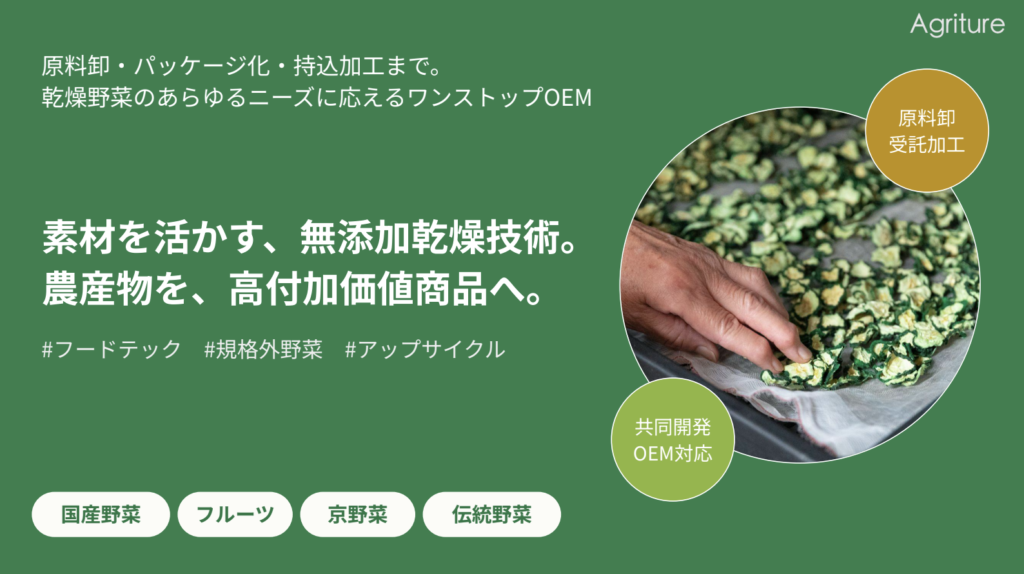
- OEM available from small lots of 10 kg
- Drying of brought-in raw materials also possible
- Support from processing to filling in one place
Download the OEM contract processing materials
We will send the materials to your email address based on the information you provide.
- Fushimi Togarashi: A Kyoto Vegetable with Little Heat and Standout Sweetness
- Manganji Togarashi: The Large, Thick-Fleshed King of Kyoto Vegetables
Author of this article
Related articles
-
 京野菜は何品目あるのか、読み方の一覧と認定の枠組みから確かめる
 -
 Drying Is Another Kind of Cooking
 -
 The Technology to Lock In the Season. The Seasonal Story Dried Vegetables Connect.
 -
 The Cut Face of a Vegetable. The Difference the Cut Makes.
 -
 Tasting Kyoto Vegetables by Aroma. The Pleasure of Cooking That Begins at the Tip of the Nose
 -
 Vessels and Kyoto Vegetables. Creating the Scenery of Plating.
 -
 Vegetables and Heat Control. Between High and Low Flame
 -
 Kyoto Vegetables and Sake. The Happy Relationship of a Dish and a Cup.