
Manganji Togarashi: The Large, Thick-Fleshed King of Kyoto Vegetables

Summary of this article
Manganji togarashi is a Brand Kyoto Vegetable grown in the Manganji district of Maizuru, Kyoto, since the end of the Taisho era. Large at 10–23cm and thick-fleshed with sweetness, it's said to have been born from the natural crossing of Fushimi togarashi with a native variety, and is also called the "king of chilis" and "Manganji ama-to." In season June–August, its staples are plain-grilled, jako stir-fry, grilled-and-steeped, and tempura; dried, its sweetness and umami rise a notch, and it can be used in instant dishes like miso soup and ramen too.
Manganji togarashi (Manganji togarashi) is one of Kyoto's representative summer Kyoto vegetables. Though a member of the chili family, it has almost no heat, and being large and thick-fleshed with sweetness, it's also called the "king of chilis." With few seeds and easy to eat, it's been beloved in various dishes, from plain-grilled to simmered-and-steeped. This article introduces the features and origin of Manganji togarashi, its differences from Fushimi togarashi, its season, recommended recipes, and how to choose and store it.
TOC
What Is Manganji Togarashi | The Kyoto Vegetable Called the "King of Chilis"
Manganji togarashi is far larger than an ordinary chili at 10–23cm long, and its thickness and thick flesh resemble a bell pepper. Its visual features are a vivid green, a slight constriction at the shoulder, and a gentle overall curve. The skin is firm and the flesh thick, and with few seeds it's easy to prep and hearty even cooked whole. Say chili and you think of heat, but Manganji togarashi has almost no heat, and its charm is a faint sweetness and tender texture. With a restrained grassy note too, it's widely enjoyed from children to adults.
The Origin of the Name "Manganji Ama-to"
Manganji togarashi is a variety grown in the Manganji district of Maizuru, Kyoto, since the end of the Taisho era. The place name is the direct origin of its name. There's a theory that it was born from the natural crossing of Fushimi togarashi, long grown in Kyoto, with a large native variety, inheriting the strengths of both to bear large, sweet fruit. From that sweetness, it's also distributed under the name "Manganji ama-to." Now, while originating in Maizuru, it's produced across Kyoto Prefecture and shipped nationwide as a representative summer Kyoto vegetable.
Its Positioning as a Brand Kyoto Vegetable
Kyoto vegetables include "Kyoto Heirloom Vegetables," covering fixed varieties grown in Kyoto since before the Meiji era, and "Kyoto Brand Products (Brand Kyoto Vegetables)," certifying produce that meets quality and production standards. Because Manganji togarashi is a relatively new variety born at the end of the Taisho era, it isn't included among heirloom vegetables, but it's certified as a representative Brand Kyoto Vegetable, with growing-region and shipping standards in place. Knowing that even among the same sweet chilis, its category differs from Fushimi togarashi—a "Kyoto Heirloom Vegetable" grown since the Edo period—makes choosing Kyoto vegetables all the more fun. List of Kyoto vegetable varieties You can check the differences from other varieties at too.
Differences from Fushimi Togarashi
It's often confused with Fushimi togarashi, a sweet chili born in Kyoto too, but they differ in size and flesh thickness. Let's compare them in the table below.
| Comparison item | Manganji togarashi | Fushimi togarashi |
|---|---|---|
| Size | 10–23cm, thick | 10–15cm, slender |
| Flesh thickness | Thick, juicy | Thin |
| Texture | Thick and firm | Tender |
| Turnip and daikon look similar, but there is a clear difference in their characteristics after drying. Please use this as a reference for material selection. | Strong sweetness | Mild sweetness |
| Heat | Almost none (rarely a hot individual) | Almost none |
| Well-suited dishes | Grilled dishes, stir-fries | Grilled dishes, simmered dishes, tempura |
| Season | June–August | June–September |
Season and production area
Manganji togarashi is in season in summer, from June to August. Grown now by farms across Kyoto Prefecture, including its birthplace Maizuru, its vivid green fruit lines the shelves at summer farm stands and supermarkets. Because it keeps setting fruit, shipments continue, and it's beloved as a Kyoto vegetable easy to grow in a home garden. You can check Kyoto Prefecture's seasonal vegetables at too. Kyoto vegetable calendar The Flavor and Texture of Manganji Togarashi
FOR BUSINESS
乾燥万願寺とうがらしを、原料としてお探しですか
国産の万願寺とうがらしを乾燥・粉砕してお出ししています。カット形状や粒度の指定、継続してのお取引もご相談ください。規格は Dried Manganji pepper・Manganji pepper powder に掲載しています。
少量でのご購入は、姉妹ブランドの通販サイト OYAOYA で承っています。
The greatest charm of Manganji togarashi is its thick, juicy flesh and faint sweetness. When heated, the sweetness stands out even more, and the savoriness of the skin and a melt-in-the-mouth texture emerge. With almost no heat or grassy note, it's easy to eat even for those who dislike chilis or mind the bitterness of bell peppers. Large and thick-fleshed, a single one is hearty, and it's a versatile Kyoto vegetable—grilled whole, or chopped and added to stir-fries.
Recommended Recipes and Ways to Eat Manganji Togarashi
With little grassiness or bitterness, Manganji togarashi can be used in a variety of dishes, Japanese and Western alike. Here are staple ways to make it easily at home.
The Staple Plain-Grilled and Jako Stir-Fry
The easiest is plain-grilled. Grill Manganji togarashi whole on a grill or in a frying pan until it browns, then just top it with bonito flakes and soy sauce for a dish where the sweetness and savoriness stand out. Jako stir-fry is popular too: crisply stir-fry chirimen-jako in sesame oil, add bite-sized Manganji togarashi, and season with soy sauce and mirin for a side dish that goes great with rice. With few seeds, the prep is easy too.
Grilled-and-steeped is a refreshing way to eat it, perfect for summer. Steep browned Manganji togarashi in a marinade of dashi, soy sauce, and mirin, and chill it in the fridge. Made into tempura, you enjoy the juiciness of the thick flesh and the crisp batter at once; enjoying it simply with salt is recommended.
Grilled-and-Steeped and Tempura
Arranged with other summer Kyoto vegetables like , it makes a colorful plate. Kamo eggplant Cooking Tips for a Delicious Finish
When you want to keep a crisp texture in a stir-fry, cutting along the fibers into thin strips gives good texture and makes bitterness less noticeable. When you want it to absorb flavor, as in a simmered-and-steeped dish, cutting across the fibers helps the flavor soak in. When microwaving, the air inside the flesh can expand and burst, so poking a few holes with a toothpick before heating is safer. Because a hot individual occasionally slips in, taste-testing before serving is wise for children.
How to Choose and Store Manganji Togarashi
How to Spot Fresh Manganji Togarashi
Fresh Manganji togarashi is vivid green, glossy and firm, and not wilted. One that feels heavy in the hand and thicker-fleshed is heartier. Choose ones with a fresh calyx cut that isn't blackened. Large blemishes or wrinkles on the surface are a sign of declining freshness.
Because Manganji togarashi is sensitive to moisture, wrap it in a paper towel, place it in a plastic bag, and store it in the refrigerator's vegetable drawer. Using it up within 3–5 days is recommended. To store it longer, remove the calyx, wash and pat it dry, and freeze it as-is. You can grill or stir-fry it straight from frozen, which is handy when you're busy. When you get a lot, there's also the method of drying it for storage.
Tips for storage
Manganji Togarashi, Even Richer When Dried
Thick-fleshed Manganji togarashi, when dried, concentrates its sweetness and umami a notch further into a deep flavor a step apart from fresh. Because it's dried with the seeds, you enjoy every bit of Manganji togarashi's deliciousness—another charm. Rehydrated in water, its tender, near-fresh texture returns, adding deep richness to simmered dishes and stir-fries. For instant dishes like miso soup and ramen, just add it as-is without rehydrating to enjoy its umami and bite.
At Agriture, we dry Kyoto vegetables like Manganji togarashi—shipped in large volumes in summer—at low temperature, delivering even off-spec fruit without waste in a form usable past its season. Kyoto-grown dried vegetables are
Frequently Asked Questions About Manganji Togarashi OYAOYA.
FOR BUSINESS
乾燥万願寺とうがらしを、原料としてお探しですか
国産の万願寺とうがらしを乾燥・粉砕してお出ししています。カット形状や粒度の指定、継続してのお取引もご相談ください。規格は Dried Manganji pepper・Manganji pepper powder に掲載しています。
少量でのご購入は、姉妹ブランドの通販サイト OYAOYA で承っています。
What's the difference between Manganji togarashi and Fushimi togarashi?
We have materials available to help you understand dried processing OEM
Agriture OEM, flexibly handling everything from small lots to large lots
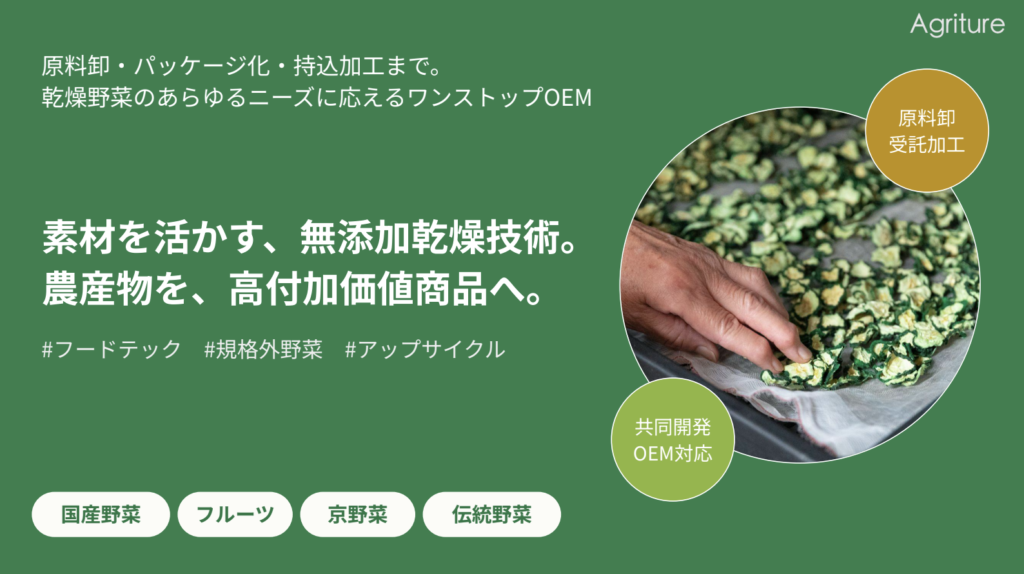
- OEM available from small lots of 10 kg
- Drying of brought-in raw materials also possible
- Support from processing to filling in one place
Related articles
- Kyo mizuna (Kyo mizuna) is one of the Kyoto heirloom vegetables and a winter leafy green certified as a Kyoto Brand Product too. This article explains, all together, its differences from mibuna, varieties such as senmuji, salad, and red-purple, its season and how to choose it, ways to eat it in harihari nabe and salads, storage tips, and the commercial and OEM use of dried mizuna.
- Kamo eggplant — a round, rich summer Kyoto vegetable
- Kujo Green Onion | A Representative Kyoto Vegetable Supporting Kyoto's Cuisine
- A list of Kyoto vegetable varieties — famous heirloom vegetables and their characteristics
- Kyoto vegetable calendar — check the seasons of the four seasons at a glance
Download the OEM contract processing materials
We will send the materials to your email address based on the information you provide.
- What Is Horikawa Gobo? A Thorough Explanation of Its Characteristics, Cultivation, How to Eat It, and Nutrition
- The Real Reason Chefs Use Kyoto Vegetables
Author of this article
Related articles
-
 京野菜は何品目あるのか、読み方の一覧と認定の枠組みから確かめる
 -
 Drying Is Another Kind of Cooking
 -
 The Technology to Lock In the Season. The Seasonal Story Dried Vegetables Connect.
 -
 The Cut Face of a Vegetable. The Difference the Cut Makes.
 -
 Tasting Kyoto Vegetables by Aroma. The Pleasure of Cooking That Begins at the Tip of the Nose
 -
 Vessels and Kyoto Vegetables. Creating the Scenery of Plating.
 -
 Vegetables and Heat Control. Between High and Low Flame
 -
 Kyoto Vegetables and Sake. The Happy Relationship of a Dish and a Cup.