
Kamo Eggplant: A Kyoto Vegetable Prized for Its Round Shape and Rich Flavor

Summary of this article
Kamo eggplant, called the "queen of eggplants," is a flagship Kyoto vegetable grown chiefly in the Kamigamo area of Kita-ku, Kyoto City. It is characterized by a round, thick-fleshed shape over 10 cm in diameter and a white section below the stem cap. Its season is May–August, at about 600–800 yen apiece. Recorded in the early-Edo-period gazetteer of Yamashiro Province, Yoshufushi, it is a Kyoto Heirloom Vegetable with over 400 years of history. We explain dengaku, agedashi, eggplant steak, shibazuke, and ways to use dried vegetables.
Kamo eggplant (kamo nasu) is a summer Kyoto vegetable representative of Kyoto, also called the "queen of eggplants." It is characterized by a round, hefty shape over 10 cm in diameter and densely packed, thick flesh, and has been grown chiefly in the Kamigamo area of Kita-ku, Kyoto City. Drawing on its flesh, it has long colored Kyoto cuisine in dishes such as dengaku, agedashi, and eggplant steak. This article introduces the history and origin of Kamo eggplant, its characteristics, season and growing region, recommended ways to eat it, and how to choose and store it.
TOC
What is Kamo eggplant | the Kyoto vegetable called the "queen of eggplants"
Kamo eggplant is a large eggplant, especially big even among round eggplants, sometimes exceeding 300 g apiece. Its form is completely different from ordinary long and medium-long eggplants, round and plump like a softball. Because its flesh is dense and satisfying and turns melting when heated, it has been dubbed the "queen of eggplants." In Kyoto it is treated as a premium vegetable indispensable to summer Kyoto cuisine, sometimes traded at about 600–800 yen apiece. In ryotei and catering it is often set as the star of a dish thanks to its commanding presence, and at home too it is beloved as a summer treat.
The history of Kamo eggplant and the origin of its name
The name "Kamo eggplant" derives from its having been actively grown in the Kamigamo and Nishigamo areas of Kita-ku, Kyoto City, and their surroundings. Originally it was made in the Yoshida and Tanaka districts of Sakyo-ku, but the center of cultivation eventually shifted to the Kamo area, and in the Meiji era it came to be called "Kamo eggplant."
Its exact origin is not clear, but it is confirmed to have already been cultivated in the early Edo period. It also appears in the Yoshufushi, a gazetteer of Yamashiro Province (present-day southern Kyoto Prefecture) published in the Edo period, making it a variety with over 400 years of history rooted in Kyoto's food culture. JA Kyoto official site – Kamo eggplant
Kamo is also the name of an area that has walked alongside the Kamo shrines, represented by Kamigamo Shrine (Kamowakeikazuchi Shrine). Amid the farming life carried on before the shrine gates, Kamo eggplant was carefully raised as a vegetable supporting the summer table, handed down as one of the ingredients coloring Kyoto's four seasons.
Kamo eggplant as a Kyoto Heirloom Vegetable
Kamo eggplant is one of the varieties certified as a "Kyoto Heirloom Vegetable." Fixed varieties cultivated in Kyoto since before the Meiji era and still in production today are the objects of the Kyoto Heirloom Vegetables. It is further certified as a "Kyoto Brand Product (Brand Kyoto Vegetable)" meeting quality and production standards, making it a vegetable representative of Kyoto on both tradition and quality fronts. List of Kyoto vegetable varieties, where you can also check other traditional varieties.
FOR BUSINESS
乾燥賀茂なすを、原料としてお探しですか
国産の賀茂なすを乾燥・粉砕してお出ししています。カット形状や粒度の指定、継続してのお取引もご相談ください。規格は Dried Kamo eggplant・Kamo eggplant powder に掲載しています。
少量でのご購入は、姉妹ブランドの通販サイト OYAOYA で承っています。
The characteristics of Kamo eggplant | round shape and dense flesh
The greatest characteristics of Kamo eggplant are its round, hefty large form and its densely packed, thick flesh. Over 10 cm in diameter, it has a solid heft in the hand. The skin is tender and glossy, and because the flesh is fine-grained and does not fall apart when heated, it has the presence to be the star of a dish. The white section below the stem cap is another mark unique to Kamo eggplant.
This white section below the cap is the trace of where the calyx covered the fruit and blocked sunlight as it grew large, and is said to be a sign of careful cultivation. Because eggplant pigment deepens with exposure to sunlight, the more evenly and deeply purple the whole fruit, the more it can be judged to have basked fully in the sun and matured. Rather than misshapen ones, plump, round fruit with left-right balance are the good-quality ones with packed flesh. Ones light for their size may have begun losing moisture, so choose by the guide of a solid heft.
The difference from ordinary eggplant
Kamo eggplant and ordinary long eggplant differ greatly in both shape and flesh. Let us compare in the table below.
| Comparison item | Kamo eggplant | Ordinary long eggplant |
|---|---|---|
| Shape | Round / softball-shaped | Long and slender |
| Size | Over 10 cm diameter / around 300 g | 12–15 cm long / around 100 g |
| Flesh | Dense and thick-fleshed / resists falling apart when simmered | Soft and juicy |
| Well-suited dishes | Dengaku, agedashi, steak | Grilled eggplant, stir-fries, nibitashi |
| Season | May–August | Year-round, centered on summer |
The season and growing region of Kamo eggplant
Kamo eggplant's season runs from May through August, in summer. Centered on Kamigamo, its birthplace, farmers within Kyoto Prefecture grow it. In Kamigamo especially, drawing on clear water and fertile soil, high-quality "Kyo Kamo eggplant" raised one by one with care by growers is also shipped. Because large Kamo eggplant with packed flesh is labor-intensive to grow, production volume is not that large, and it circulates in Kyoto's markets and farm stands in season. Kyoto's seasonal vegetables are Kyoto vegetable calendar The Flavor and Texture of Manganji Togarashi
In growing Kamo eggplant, farmers keep up meticulous management to raise each fruit large and fine. Painstaking work accumulates — thinning to keep good fruit among the flowers that bloom one after another, staking to support heavy fruit, and watering essential in the hot summer — to produce that dignified form and dense flesh. Kamo eggplant raised so carefully is shipped in sequence from early to high summer.
Recommended ways to eat Kamo eggplant and recipes
Kamo eggplant has dense flesh that resists falling apart when simmered, and pairs superbly with oil. Deep-fried or grilled, its richness and umami stand out, and its plain taste goes well with rich dashi and miso. Here we introduce representative ways to eat it.
Kamo eggplant dengaku
The flagship Kamo eggplant dish is dengaku. Halve the Kamo eggplant and grill it slowly in oil or deep-fry it, then finish by coating it with a sweet miso glaze. Cooked slowly, it turns melting in texture, and the aroma of miso and the thick flesh harmonize beautifully. Add a sprig of kinome and you gain the color and fragrance of summer Kyoto cuisine.
Agedashi and eggplant steak
Agedashi is a dish where you pour hot dashi over deep-fried Kamo eggplant and add grated ginger or grated daikon. The flesh soaks up the dashi and dissolves with a burst in the mouth. "Eggplant steak," cut thick and pan-seared, is also popular, letting you enjoy the eating satisfaction only thick-fleshed Kamo eggplant offers. Seared in olive oil and paired with salt or balsamic, it also becomes a Western-style plate.
Stuffed fritters and Japanese-Western arrangements
Thick-fleshed Kamo eggplant is also perfect for "stuffed fritters," cut with a slit and filled with a ground-meat mixture before frying. The flesh catches the umami of the meat mixture for a substantial dish. Sliced into rounds and layered with cheese and tomato sauce, it can also be applied to eggplant gratin or a lasagna style. Eggplant readily absorbs oil, but brushing the cut surface thinly with oil before searing lets it finish plump even with little oil. Fushimi togarashi and Manganji togarashi Simmered together with in agebitashi, you can enjoy summer Kyoto vegetables in a single dish.
In Kyoto pickles such as shibazuke
"Shibazuke," a flagship of Kyoto pickles, also uses eggplant, including Kamo eggplant. Shibazuke, pickling eggplant and cucumber with red shiso, is characterized by its vivid color and refreshing acidity. Because Kamo eggplant has firm flesh, texture remains even after pickling, and it is beloved as an accompaniment to rice or with tea.
How to choose and store Kamo eggplant
How to spot fresh Kamo eggplant
Fresh Kamo eggplant has taut, glossy skin and feels heavy in the hand. The fresher it is, the more the cut of the stem cap looks moist and the spines are firm. Choose ones with an even, deep purple color and no bruises or wrinkles.
Tips for storage
Because eggplant is weak against cold and drying, wrap Kamo eggplant in kitchen paper, put it in a poly bag, and store it in the vegetable compartment of the refrigerator. Using it up within 3–4 days is recommended. If you will not use it soon, cutting and grilling or deep-frying it before freezing is convenient, saving cooking labor too. When you want to store it long, there is also the method of drying it.
Kamo eggplant that gains umami through drying
Kamo eggplant, whose sponge-like flesh holds much moisture, tightens up when dried, with umami and sweetness densely concentrated. Rehydrate dried Kamo eggplant and heat it, and the melting texture like grilled eggplant revives, letting you enjoy a deep flavor a shade different from when fresh. Used in nibitashi, miso soup, or prep for dengaku, it soaks up dashi well and comes in handy. At Agriture, we dry Kyoto vegetables like Kamo eggplant, whose shipping concentrates in summer, at low temperature, and deliver them in a form usable even after the season passes. Kyoto-grown dried vegetables are OYAOYA.
FOR BUSINESS
乾燥賀茂なすを、原料としてお探しですか
国産の賀茂なすを乾燥・粉砕してお出ししています。カット形状や粒度の指定、継続してのお取引もご相談ください。規格は Dried Kamo eggplant・Kamo eggplant powder に掲載しています。
少量でのご購入は、姉妹ブランドの通販サイト OYAOYA で承っています。
Frequently asked questions about Kamo eggplant
We have materials available to help you understand dried processing OEM
Agriture OEM, flexibly handling everything from small lots to large lots
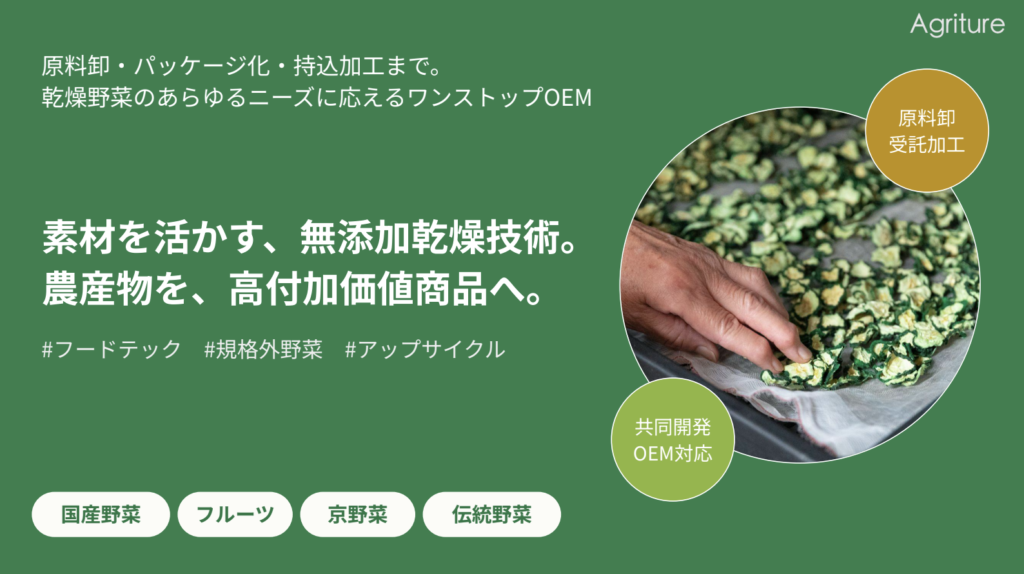
- OEM available from small lots of 10 kg
- Drying of brought-in raw materials also possible
- Support from processing to filling in one place
At Agriture, we dry and powder Kyoto vegetables including Kamo eggplant, and supply it as commercial Kamo eggplant powder to food makers. The color unique to deeply colored Kyoto vegetables can be put to work in processed-food formulations.
Related articles
- Manganji Togarashi | A Large, Thick-Fleshed Summer Kyoto Vegetable
- Kyo mizuna (Kyo mizuna) is one of the Kyoto heirloom vegetables and a winter leafy green certified as a Kyoto Brand Product too. This article explains, all together, its differences from mibuna, varieties such as senmuji, salad, and red-purple, its season and how to choose it, ways to eat it in harihari nabe and salads, storage tips, and the commercial and OEM use of dried mizuna.
- Shishigatani kabocha | the gourd-shaped summer Kyoto vegetable
- A list of Kyoto vegetable varieties — famous heirloom vegetables and their characteristics
- Kyoto vegetable calendar — check the seasons of the four seasons at a glance
Download the OEM contract processing materials
We will send the materials to your email address based on the information you provide.
- Summer Kyoto Vegetables: The Season of Fushimi Togarashi and Shishigatani Kabocha
- What Is Kyo-Mizuna | A Guide to Its Characteristics, Varieties, and How to Eat It
Author of this article
Related articles
-
 京野菜は何品目あるのか、読み方の一覧と認定の枠組みから確かめる
 -
 Drying Is Another Kind of Cooking
 -
 The Technology to Lock In the Season. The Seasonal Story Dried Vegetables Connect.
 -
 The Cut Face of a Vegetable. The Difference the Cut Makes.
 -
 Tasting Kyoto Vegetables by Aroma. The Pleasure of Cooking That Begins at the Tip of the Nose
 -
 Vessels and Kyoto Vegetables. Creating the Scenery of Plating.
 -
 Vegetables and Heat Control. Between High and Low Flame
 -
 Kyoto Vegetables and Sake. The Happy Relationship of a Dish and a Cup.