
Shishigatani Kabocha: A Kyoto Vegetable Prized for Its Distinctive Shape and Gentle Sweetness

Summary of this article
Shishigatani kabocha is a Japanese pumpkin whose seed was brought from Tsugaru Province to Awataguchi, Higashiyama Ward, Kyoto City in the Bunka era of the Edo period, characterized by a distinctive gourd shape it changed into, a modest sweetness, and smooth flesh. Its season is July–August, and it originated in Shishigatani, Sakyo Ward, Kyoto City. Soboro ankake, tempura, and miso soup are the classics, and the annual "Shishigatani Kabocha Memorial Service" at Anrakuji on July 25 is famous as a summer tradition praying for good health.
Shishigatani kabocha kabocha is one of Kyoto's heirloom vegetables, with a history of being brought to Kyoto from present-day Aomori Prefecture in the Edo period. It is a Japanese pumpkin characterized by a distinctive gourd-like shape and a gentle sweetness, and its delicate flavor, different from ordinary Western pumpkin, has long been prized in Kyoto cuisine.
TOC
The characteristics and appearance of Shishigatani kabocha
Unlike ordinary pumpkin, it has a gourd shape with a constriction and surface unevenness. When you put it in your mouth, you can enjoy a distinctive texture and flavor. Compared with ordinary Western pumpkin, it has less moisture and delicate, smooth flesh.
Its sweetness is not too strong, making it especially suited to Japanese dishes, and it can be enjoyed with various cooking methods—simmered dishes, steamed dishes, soups, and more. Also, because its texture is firm, it does not easily fall apart when simmered, giving a beautiful finish in appearance too.
The difference from Western pumpkin
| Comparison item | Shishigatani kabocha (Japanese pumpkin) | Western pumpkin |
|---|---|---|
| Shape | Gourd-shaped, with unevenness | Round, with a smooth surface |
| Flesh | Smooth, less moisture | Fluffy, more moisture |
| Sweetness | Modest and elegant | Strong sweetness |
| Falling apart when simmered | Not prone | Prone |
| Well-suited dishes | Simmered dishes, steamed dishes, Japanese cuisine | Soup, gratin, Western cuisine |
Season and production area
Shishigatani kabocha's season is summer, from July to August. The Shishigatani area of Sakyo Ward, Kyoto City is the birthplace, but the number of farms growing it has now declined, and only very limited farms within Kyoto City and around Kameoka City keep protecting the tradition. Because the amount reaching the market is small, it is sometimes called the "phantom pumpkin." It can sometimes be obtained at farmers' markets, specialty shops in Nishiki Market, and Kyoto ryotei, but we recommend buying it promptly if you spot it.
JA Kyoto official site – Shishigatani kabocha
The history and origin of Shishigatani kabocha
The history of Shishigatani kabocha goes back to the Bunka era of the Edo period. Cultivation began when a certain farmer brought pumpkin seeds back from Tsugaru Province to Awata Village, Yamashiro Province (present-day Awataguchi, Higashiyama Ward, Kyoto City).
It is said that what was initially a chrysanthemum-seat shape changed into a gourd-like shape as cultivation continued. Until the mid-Meiji era, it was cherished as a pumpkin representing Kyoto City, but entering the Showa era, its planted area declined sharply as it came to be replaced by more easily produced varieties. Reference: Kyoto City Information Museum
Its positioning as a Kyoto heirloom vegetable
Shishigatani kabocha is one of the varieties certified as a "Kyoto heirloom vegetable." Kyoto heirloom vegetables are fixed varieties that have been grown in Kyoto since before the Meiji era and whose production still continues today. Shishigatani kabocha has a cultivation history of over 200 years since the Bunka era and has become indispensable to speaking of Kyoto's food culture. Precisely because its production volume is small, cultivation committed to the quality of each and every one continues. List of Kyoto vegetable varieties, where you can also check other heirloom vegetables.
FOR BUSINESS
乾燥鹿ヶ谷かぼちゃを、原料としてお探しですか
国産の鹿ヶ谷かぼちゃを乾燥・粉砕してお出ししています。カット形状や粒度の指定、継続してのお取引もご相談ください。規格は Dried Shishigatani Kabocha・Shishigatani Kabocha Powder に掲載しています。
鹿ヶ谷かぼちゃの少量販売は姉妹ブランドの OYAOYA では取り扱いがありません。ほかの品目はカタログをご覧ください。
The reason it changed into a gourd shape
The reason a pumpkin that was originally a chrysanthemum-seat shape changed into a gourd shape is thought to be the result of adaptation to Kyoto's climate and natural features combined with natural mutation over the course of many years of cultivation. Kyoto's summers are hot and humid, with the muggy heat characteristic of a basin. As generations were repeated in such an environment, the distinctive shape became fixed. The change in shape is a product of chance, but it became the greatest individuality of Shishigatani kabocha.
The flavor of Shishigatani kabocha and how to enjoy it in Japanese cuisine
The appeal of Shishigatani kabocha lies not in a strong sweetness like Western pumpkin, but in a modest sweetness that brings out the flavor of dashi and smooth flesh with little moisture. This very individuality is the reason it pairs well with Kyoto cuisine, which values delicate seasoning.
A modest sweetness that makes the most of dashi
Whereas Western pumpkin is fluffy with strong sweetness, Shishigatani kabocha has gentle sweetness and smooth flesh. Because it does not get in the way of the flavor of dashi and lightly seasoned condiments, you can fully enjoy the harmony of the ingredient and dashi in simmered and steamed dishes. Precisely because the sweetness does not assert itself too much, it has long been prized in the delicate single dishes of ryotei.
Flavor that broadens with its affinity for oil
Shishigatani kabocha also has good affinity for oil, and made into tempura or a stir-fry its richness increases. Frying it makes the sweetness swell, creating a textural contrast of crisp outside and smooth inside. Tasted simply with a little salt, this pumpkin's inherent flavor stands out all the more.
Recommended ways to eat Shishigatani kabocha
A representative dish is soboro ankake. Letting it fully absorb dashi harmonizes the pumpkin's sweetness with the dashi's umami, letting you enjoy an elegant flavor. Also, made into a steamed dish, you can fully savor the inherent flavor and texture of Shishigatani kabocha.
How to make soboro ankake
Cut the Shishigatani kabocha into bite-sized pieces and simmer in dashi until soft. In a separate pot, stir-fry ground chicken into a soboro, season with dashi, soy sauce, and mirin, then thicken with potato-starch slurry. Pour the soboro an over the simmered pumpkin and garnish with grated ginger to complete. The pumpkin's modest sweetness and the chicken soboro's umami combine exquisitely, letting you enjoy a ryotei-like dish at home too.
For tempura and miso soup too
Shishigatani kabocha is also suited to tempura, letting you enjoy a texture that is crisp outside and fluffy inside. Frying increases the sweetness, and we recommend tasting it simply with a little salt. Also, putting it in miso soup or clear soup adds the pumpkin's faint sweetness, letting you enjoy a refreshing flavor. As with Western pumpkin, it can also be used in Western-style dishes such as soup and gratin. Fushimi togarashi Adding adds an accent of color and flavor.
Shishigatani Kabocha Memorial Service: a summer tradition of Kyoto
At Juren-zan Anrakuji in Kyoto, the "Shishigatani Kabocha Memorial Service" is held every year on July 25, and Shishigatani kabocha is served to participants. This event is said to originate from the mid-Edo period, when Shinku Ekizui Shonin, the head priest of Anrakuji, received a revelation from the temple's principal image, Amida Nyorai, that "if you serve Shishigatani kabocha around the summer doyo, you will not suffer a stroke."
How to enjoy the pumpkin memorial service
The pumpkin memorial service is held every year from around 9:00 on July 25, and simmered Shishigatani kabocha is served to worshippers. The flow is to pay an admission fee, worship in the main hall, and receive the pumpkin. Held in the hot period of summer, this event is loved by local people as a summer tradition of Kyoto praying for good health. Because many worshippers visit each year, we recommend heading there early.
The relationship between doyo and pumpkin
Japan has long had the custom of "eating eel on the Day of the Ox during doyo," but pumpkin too is said to be good to eat during the doyo period and has been incorporated into the summer table. The summer doyo falls in the hottest period, a season when it is easy to deplete one's stamina. The wisdom of people of old—to get through summer by eating nutritious seasonal vegetables—is likely what has linked doyo and pumpkin.
How to choose and store Shishigatani kabocha
How to tell a good Shishigatani kabocha
When choosing Shishigatani kabocha, choose one with a clear constriction and a well-formed gourd shape. Uniform surface unevenness and a hefty weight are proof that it contains plenty of moisture. One whose stem part has dried and gone corky is a sign that it is fully ripe. Fully ripe ones have more sweetness and higher storability.
Tips for storage
In its whole state, it can be stored for about 1–2 months in a well-ventilated, cool, dark place. When cut, remove the seeds and pith, wrap in plastic wrap, and put it in the refrigerator's vegetable compartment, and it keeps for about a week. For long-term storage, there is also a method of cutting it into bite-sized pieces, boiling it firm, and freezing it. Kyoto vegetable calendar, where you can also check the seasons of other Kyoto vegetables.
Using Shishigatani kabocha as a dried vegetable
Shishigatani kabocha can also be used as a dried vegetable. Drying it enables long-term storage, letting you enjoy the pumpkin's nutrition and flavor even after its season passes. Added to simmered dishes or soups, its flavor with concentrated umami stands out, and because its firm texture is retained even when reconstituted, it can be applied to various dishes.
How to use dried pumpkin and its appeal
Dried Shishigatani kabocha is used in cooking after reconstituting it in water for about 15–20 minutes. Japanese pumpkin, which originally has little moisture and smooth flesh, is suited to drying, and reconstituted it recovers a fluffy texture. Because a modest sweetness and umami also dissolve into the soaking liquid, it can be used as dashi for soups and simmered dishes. At Agriture, we dry rare Kyoto vegetables like Shishigatani kabocha, whose growing farms have declined, at a low temperature, delivering the short-season taste of summer in a form usable throughout the year. Kyoto-grown dried vegetables are handled at OYAOYA.
FOR BUSINESS
乾燥鹿ヶ谷かぼちゃを、原料としてお探しですか
国産の鹿ヶ谷かぼちゃを乾燥・粉砕してお出ししています。カット形状や粒度の指定、継続してのお取引もご相談ください。規格は Dried Shishigatani Kabocha・Shishigatani Kabocha Powder に掲載しています。
鹿ヶ谷かぼちゃの少量販売は姉妹ブランドの OYAOYA では取り扱いがありません。ほかの品目はカタログをご覧ください。
Frequently asked questions about Shishigatani kabocha
Recommended reading
List of Kyoto vegetable varieties / Kyoto vegetable calendar / Commercial dried vegetables / Mibuna: The Characteristics and History of a Kyoto Vegetable with Little Heat / The Work of "Subtraction" That Makes the Most of Kyoto Vegetables
We have materials available to help you understand dried processing OEM
Agriture OEM, flexibly handling everything from small lots to large lots
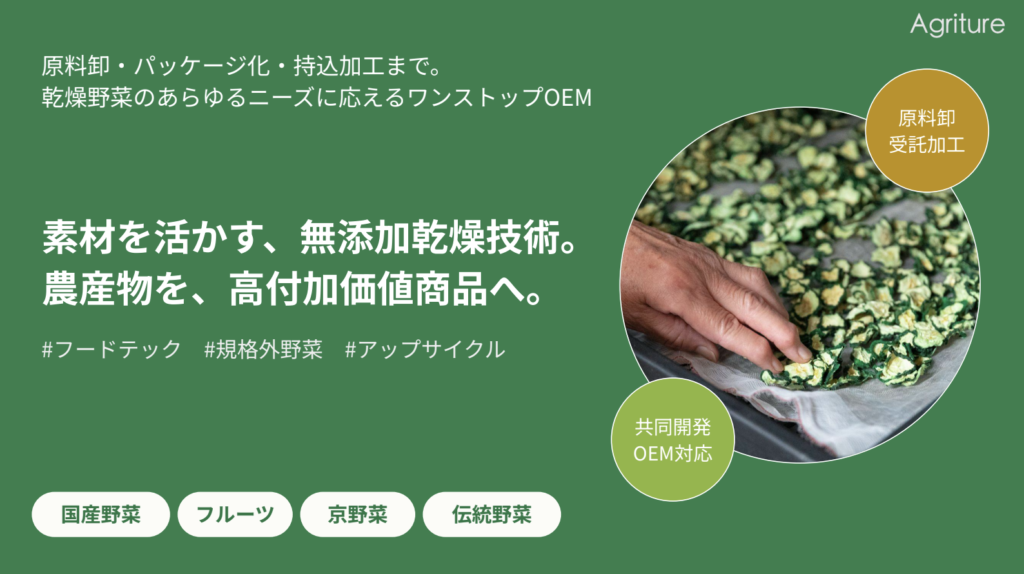
- OEM available from small lots of 10 kg
- Drying of brought-in raw materials also possible
- Support from processing to filling in one place
Related articles
- Fushimi togarashi — a summer Kyoto-vegetable classic
- Kamo eggplant — a round, rich summer Kyoto vegetable
- Kintoki carrot — a Kyoto vegetable that colors Kyoto's simmered dishes
- A list of Kyoto vegetable varieties — famous heirloom vegetables and their characteristics
- Kyoto vegetable calendar — check the seasons of the four seasons at a glance
Download the OEM contract processing materials
We will send the materials to your email address based on the information you provide.
- What is the Kyoto heirloom vegetable Kujo green onion? The difference from green onion, plus season, ways to eat, and storage explained
- Autumn Kyoto Vegetables: The Flavor and Texture of Shogoin Kabu and Kintoki Carrot
Author of this article
Related articles
-
 京野菜は何品目あるのか、読み方の一覧と認定の枠組みから確かめる
 -
 Drying Is Another Kind of Cooking
 -
 The Technology to Lock In the Season. The Seasonal Story Dried Vegetables Connect.
 -
 The Cut Face of a Vegetable. The Difference the Cut Makes.
 -
 Tasting Kyoto Vegetables by Aroma. The Pleasure of Cooking That Begins at the Tip of the Nose
 -
 Vessels and Kyoto Vegetables. Creating the Scenery of Plating.
 -
 Vegetables and Heat Control. Between High and Low Flame
 -
 Kyoto Vegetables and Sake. The Happy Relationship of a Dish and a Cup.