Dried Shishigatani Kabocha

Dried Shishigatani pumpkin is a commercial ingredient made by turning the Kyoto heirloom vegetable "Shishigatani pumpkin" into raw material. Shishigatani pumpkin is a Japanese pumpkin (Nihon kabocha) of the genus Cucurbita in the Cucurbitaceae family, and its distinctive traits are a unique gourd-like shape pinched top and bottom, along with a high-moisture, delicate flavor. At Agriture, we have a track record of actually producing this Shishigatani pumpkin as a dried product, finishing the gourd-shaped flesh into a raw material by low-temperature drying. For applications where you want to develop it into a powder, we can also accommodate with Shishigatani Kabocha Powder, proposing a division of use — dried Shishigatani pumpkin for applications where you want to keep the flesh's shape, and powder for blending into dough or sauce.
Compared with Western pumpkin (kuri-kabocha), Shishigatani pumpkin can be differentiated by being "high in moisture, delicate, and less cloying," "suited to Japanese simmered dishes and braises that let it soak up dashi," and "the story of a Kyoto vegetable." It's an ingredient we're frequently consulted about for prototypes as a raw material for braises, simmered assortments, soups, potages, Kyoto-style deli dishes, and confectionery.
TOC
The three commitments behind Agriture's dried Shishigatani pumpkin
1. Low-temperature drying that makes the most of its delicate character
Shishigatani pumpkin is high in moisture, a Japanese ingredient brought to life by letting it soak up dashi. At Agriture, we use a design that keeps the drying temperature down while removing moisture, leaving it in a state that readily takes up dashi when rehydrated. The delicate umami when it has soaked up dashi is an element that shapes the finish of braises and simmered assortments.
2. Shapes you can select to suit the application
Shishigatani pumpkin is dried in shapes suited to the application — diced, sliced, and so on. Diced to keep its shape for simmered dishes and braises, sliced for easy rehydration in soups and potages — you can select to match the appearance and texture of the final product. Because dried goods can be handled at room temperature, being easy to reduce prep-work labor in busy seasons is also valued for commercial use.
3. Selecting Kyoto-Prefecture-grown Shishigatani pumpkin for raw material
At Agriture, we use Kyoto-Prefecture-grown Shishigatani pumpkin, judging the shape and the firmness of the flesh to turn it into raw material. Raw material from Kyoto vegetables with a visible growing region makes traceability easy to design, and is one reason it's chosen for prototypes by makers of Kyoto-style deli dishes, confectionery, and vegetable-based products.
Product catalog showing the items we handle
Flexible support from small lots to large lots
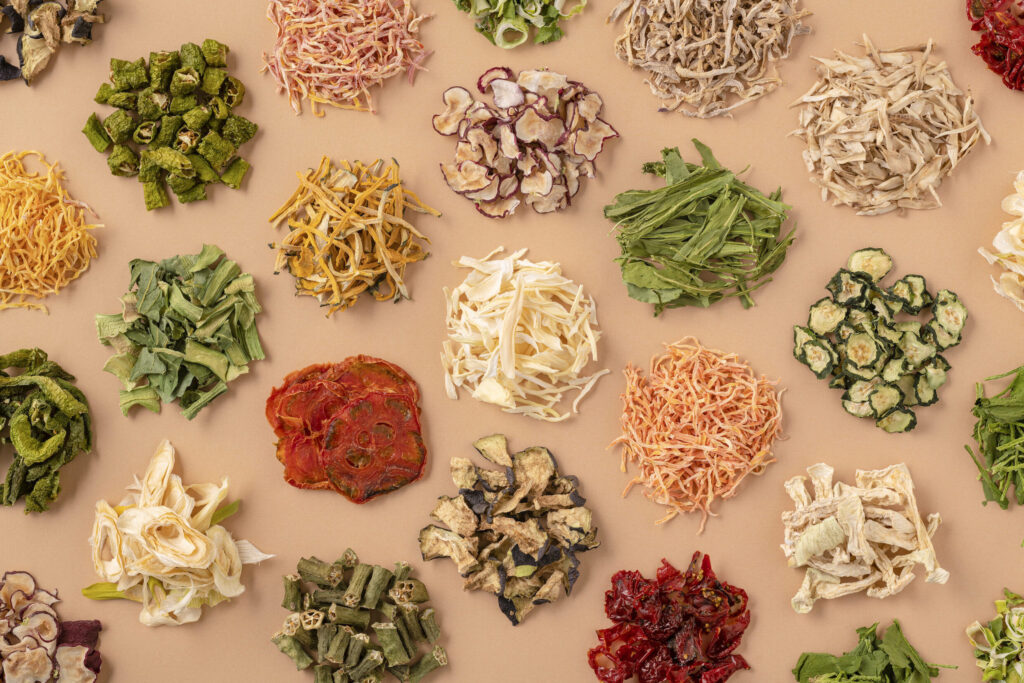
- Sold in small lots from 1 kg
- Handling heirloom vegetables from across Japan
- Dried fruits and herbs also supported
Features of commercial dried Shishigatani pumpkin
Even among pumpkin-based dried ingredients, Shishigatani pumpkin is a material with its own unique position, thanks to a delicate flavor, its affinity with Japanese cuisine, and the story of a Kyoto vegetable. We organize its strengths as a raw material from six perspectives.
A gourd-shaped Japanese pumpkin
Shishigatani pumpkin is a Japanese pumpkin of the genus Cucurbita in the Cucurbitaceae family, characterized by a unique gourd-like shape pinched top and bottom. Differing in flesh texture and flavor from Western pumpkin, it can be used in a product's storytelling as a material unique to a Kyoto vegetable.
A delicate flavor that takes up dashi
High in moisture and delicate, with restrained sweetness. It goes well with dashi-forward Japanese cuisine and suits dish designs that highlight the ingredient's flavor — braises, simmered assortments, simmered dishes, and more.
Flesh that resists falling apart
Its flesh is fine-grained and said to hold its shape well even when cut into squares and simmered. Since it doesn't fall apart even when braised in dashi, it's an ingredient easy to handle as a colorful component or filling in deli and bento simmered dishes.
The story of a Kyoto vegetable
Shishigatani pumpkin is a Kyoto vegetable positioned as a "Kyoto heirloom vegetable" and a "Kyoto Brand Product." You can use it, story of its origin and all, as an accent for product designs and gifts that feature Kyoto-grown ingredients, or for Kyoto-style menus.
A dried ingredient handled at room temperature
Dried goods can be secured as room-temperature stock, letting you incorporate Shishigatani pumpkin into final products regardless of season. Since prep work is already done, you can use it just by rehydrating, keeping the workload on the production line down.
Use in combination with powder
Finely milled Shishigatani Kabocha Powder By using it together with, you can design recipes that achieve both a sense of substance (diced, sliced) and blending into dough and soup (powder).
Product specifications (commercial)
Basic specifications at the prototype stage are as follows. Purchase lot, lead time, and packaging format are worked out through individual consultation.
| Item | Details |
|---|---|
| Product name | Dried Shishigatani Kabocha |
| Raw material | Shishigatani kabocha (Kyoto-grown) |
| Shape | Diced and sliced. Size adjusted to the application |
| Appearance | Dried flesh of pale yellow to golden-yellow |
| Aroma | A gentle, pumpkin-like aroma |
| Net content | Individual quote according to use and lot |
| Best-before date | About 6 months from the shipping date |
| Storage method | Avoid high temperature, high humidity, and direct sunlight; after opening, seal and store in a cool, dark place |
| Minimum prototype lot | From 1 kg of raw material |
Customization support
You can consult us from the prototype stage about shape, cut size, packaging, and final commercialization. Because we nail down the recipe while keeping records, it is a setup where specifications don't drift between prototype and mass production.
| Item | Available | Details |
|---|---|---|
| Shape adjustment | Diced / sliced / cubed | Size and thickness designed to match the appearance and texture of the final product |
| Powdering | Fine powder (made to order) | For confectionery, soup, blending into dough, and powder blends |
| Blend design | Combined with other Kyoto vegetables and root vegetables | A Japanese-deli mix with pumpkin, taro, and other Kyoto vegetables |
| Packaging form | Commercial bulk / small bag / individual wrapping | From prepared-dish bulk to packs for confectionery raw material |
| OEM productization | End-to-end support through the finished product | From planning to production of Kyoto-style deli dishes, soup bases, and confectionery ingredients |
For those considering the fine-powder type
For applications where you want to spread Shishigatani pumpkin's flavor evenly — blending into confectionery, soup, and dough, and powder blends — the finely milledShishigatani Kabocha Powderis well suited. Please also see the list of powder raw materials.
Commitments to variety, grower, and growing region
Shishigatani pumpkin is a Japanese pumpkin of the genus Cucurbita in the Cucurbitaceae family, one of the Kyoto vegetables long cultivated in Kyoto. At Agriture, we make the growing region and the state of the flesh the axes of our raw-material design.
BRAND|The positioning of Shishigatani pumpkin as a raw material
Shishigatani pumpkin has been used as an ingredient in dashi-soaked Japanese cuisine — braises, simmered assortments, Kyoto-style simmered dishes, and more. At Agriture, we translate this delicate flavor and gourd-shaped story into a commercial ingredient, offering it as a material usable across a wide range of final products — Kyoto-style deli dishes, confectionery, and soups.
PRODUCER | Basic policy for sourcing and coordination
We select lots of evenly shaped flesh by aligning directly with the growing region. At the prototype stage we procure small amounts at a time, evaluate them on ease of rehydration and ease of taking up dashi during drying, and then set up the supply line for mass-production lots.
REGION|The Kyoto growing region
Shishigatani pumpkin is a Kyoto vegetable nurtured in Shishigatani, Sakyo Ward, Kyoto City, and still cultivated within Kyoto Prefecture today. Positioned as a "Kyoto heirloom vegetable" and a "Kyoto Brand Product," it's cherished as a Kyoto vegetable that comes into season in summer. At Agriture, centering on Kyoto-Prefecture-grown ones, we identify lots of flesh suited to drying and turn them into raw material.
CULTIVATION|Season and cultivation
Shishigatani pumpkin is a Kyoto vegetable that comes into season in summer (around July–August). It's said that seeds conveyed from Tsugaru in the Bunka era, cultivated in Kyoto, gradually changed from a chrysanthemum-seat shape to a gourd shape. At Agriture, we select and turn into raw material the ones in season.
Low-temperature drying technology and quality control
Prompt drying after cutting
Because Shishigatani pumpkin is high in moisture, the state of the flesh changes readily as time passes after cutting. By moving swiftly from cutting to drying, we finish it in a state that readily takes up dashi when rehydrated.
Low-temperature drying for easy dashi uptake
High-temperature drying tends to make the flesh hard and tight and less able to take up dashi. By slowly removing moisture in the low-temperature range, we give it a finish that readily takes up dashi when rehydrated. When using it in a braise, braising the rehydrated flesh in dashi lets the flavor penetrate while keeping its shape. When using it in soup, rehydrating and then simmering spreads the delicate umami throughout the broth.
Use cases
We organize the applications we're consulted about for prototypes at Agriture into six categories. All are examples of recipe designs that make the most of Shishigatani pumpkin's delicate flavor, flesh that resists falling apart, and the story of a Kyoto vegetable.
1. Braises and simmered assortments
Usable as an ingredient for braises, simmered assortments, and Kyoto-style simmered dishes. Rehydrated and braised in dashi, it resists falling apart and the flavor penetrates while it keeps its shape. It suits deli dishes, bento, and catered meals that feature the story of a Kyoto vegetable, as a colorful element.
2. Japanese prepared dishes and simmered dishes
Usable as an ingredient for Japanese deli dishes — pumpkin simmered dishes, soboro-an, nishime, and the like. The delicate flavor blends well with dashi, and simmering it in the broth brings the ingredient's character to life. Since prep work is already done, it also leads to reducing labor in deli production.
3. Soups and potages
Usable as a vegetable source for potage, pumpkin soup, and vegetable-based soups. Rehydrated and simmered, its delicate umami spreads into the broth, blending into both Japanese and Western soups. The sliced shape rehydrates quickly and can also be developed into an instant-soup base.
4. Confectionery and bakery
Usable as an ingredient in baked goods, steamed sweets, and bread. Making the most of pumpkin's flavor, it can be developed into confectionery and bakery products that feature Kyoto vegetables — pumpkin scones, steamed buns, pound cakes, and the like. Combined with powder, it achieves both blending into dough and a sense of substance.
5. Retort, frozen foods, and prepared dishes
It can be built into retort and frozen deli dishes and meal kits as an ingredient. It can be stably secured as room-temperature stock, and since prep work is done, it reduces labor on the production line. It also suits products with short rehydration times — simmered dishes, soups, pumpkin bases, and the like.
6. Kyoto-vegetable and gift products
Usable as a material for products featuring Kyoto vegetables, Kyoto souvenirs, and gift planning. Because Shishigatani pumpkin carries the story of a Kyoto heirloom vegetable, it suits product designs that want to feature the origin's backdrop as an accent.
Commercial usage and rehydration
Rehydration basics
- For simmered dishes and braises: rehydrate in water for 10–15 minutes, then simmer in dashi or broth to let the flavor penetrate while keeping the shape
- For soups: rehydrate and then simmer to spread the delicate umami throughout the broth
- The sliced shape rehydrates quickly and is easy to use in instant soups and dressed dishes
- Since the rehydration liquid carries pumpkin's flavor, it's good to use it as-is in soups and simmered dishes
Blending guide
- Fukumeni: rehydration amount of 10 to 15 g dried per 100 g of finished dish
- Pumpkin simmered dish: a rehydration amount of 12–18g dried per 100g finished
- Potage: rehydrate and use 8 to 12 g dried per serving (200 ml)
- Confectionery dough: adjust the blend amount to match the product's texture and moisture design
How to store
- Before opening: store in a cool, dark place at room temperature, away from heat, humidity, and direct sunlight
- After opening: transfer to a zip bag or airtight container and use up within 1 to 2 months
- The best-before date is about 6 months from the shipping date. Note that moisture absorption changes the quality
- Refrigerated storage is possible. Because condensation forms right after taking it out, return it to room temperature before opening
Related cases and articles
- What is Shishigatani pumpkin – an explanation of its features as a Kyoto vegetable
- Dried pumpkin – raw material of ordinary pumpkin
- List of dried vegetable raw materials
- Consult us on food OEM and raw material supply
Product catalog showing the items we handle
Flexible support from small lots to large lots
- Sold in small lots from 1 kg
- Handling heirloom vegetables from across Japan
- Dried fruits and herbs also supported
Frequently asked questions
How does it differ from ordinary pumpkin?
Shishigatani pumpkin is a Japanese pumpkin of the genus Cucurbita in the Cucurbitaceae family, a Kyoto vegetable characterized by a unique gourd-like shape pinched top and bottom. Whereas the Western pumpkin (kuri-kabocha) commonly distributed is sweet and fluffy, Shishigatani pumpkin is high in moisture and delicate, suited to dashi-soaked Japanese simmered dishes and braises. You can use it differently from dried pumpkin (the ordinary product) by flavor and application.
Can I state the growing region as a Kyoto vegetable?
Shishigatani pumpkin is a Kyoto vegetable positioned as a "Kyoto heirloom vegetable" and a "Kyoto Brand Product." At Agriture, we turn Kyoto-Prefecture-grown Shishigatani pumpkin into raw material, so it can be featured as Kyoto-grown and as a Kyoto vegetable. Please consult us about using it as a material for deli dishes, confectionery, and gift products that feature Kyoto.
Doesn't it fall apart when used in simmered dishes?
Shishigatani pumpkin has fine-grained flesh and is said to hold its shape well even when cut into squares and simmered. Rehydrating the dried product in water and then braising it in dashi or broth lets the flavor penetrate while it keeps its shape, making it an ingredient easy to handle as a component in deli and bento simmered dishes. Please adjust the heating time and the amount of broth to match the final product's texture.
How does it differ in use from Shishigatani pumpkin powder?
Dried Shishigatani pumpkin is for "applications where you want to keep the diced or sliced sense of substance," while powder is for "blending into confectionery, soup, and dough, and powder blends." The dried product suits ingredients in braises, simmered dishes, and soups; powder (made to order) suits blending into scones, steamed buns, and potage. Using them together makes possible recipe designs that achieve both a sense of substance and even blending.
What is the minimum prototype lot?
We accept prototypes from 1kg of raw material. You can prototype multiple conditions in parallel — comparing diced and sliced shapes, comparing specs for simmered-dish and soup use, and so on. Full production is from 10kg, and we can consult with you all the way through to OEM commercialization of the final product. After hearing the specifications, lot, and schedule of the final product you envision, we'll propose a quote and delivery time individually.
Please tell me the best-before date and how to store it.
The best-before date is about 6 months from the shipping date. When unopened, store it in a cool, dark place at room temperature, away from high heat, high humidity, and direct sunlight. After opening, transfer it to a resealable bag or airtight container and use it up within 1 to 2 months as a guide while preventing moisture absorption. Refrigerated storage is also possible, but be careful of condensation right after taking it out, and return it to room temperature before opening.
Recommended reading
- What is Shishigatani pumpkin – a Kyoto-vegetable explanation
- Dried pumpkin – ordinary pumpkin
- List of dried vegetables
- List of powders
Download the product catalog
We will send the materials to your email address based on the information you provide.