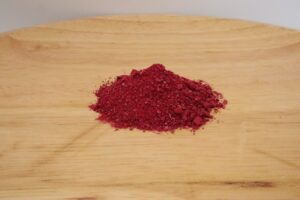
Shishigatani Kabocha Powder

Shishigatani kabocha powder is a raw material made by drying and then finely milling the traditional Kyoto vegetable "Shishigatani kabocha." For applications such as potage bases, baked-goods dough, Japanese-style simmered-dish powder, and baby-food bases, it is intended to spread the light, delicate flavor and gentle color of Shishigatani kabocha uniformly. Shishigatani kabocha is a Japanese kabocha characterized by its gourd shape; compared with Western kabocha it is less sweet, more watery, and has a dense flesh that does not fall apart when simmered. At Agriture, Dried Shishigatani Kabocha and makes it into powder by adding a pulverizing process.
Whereas ordinary Western kabocha powder has a deep yellow and strong sweetness, Shishigatani kabocha powder's distinctive character is a light Japanese-style flavor and a subdued color tone. It suits product-making with brand appeal — potage, baked goods, and Japanese-side-dish powder bases that make use of its storytelling as a Kyoto vegetable, as well as coloring applications. Specifications can be refined from small quantities.
TOC
Agriture's Shishigatani kabocha powder: three points of commitment
1. Drying design that preserves the light flavor characteristic of a traditional Kyoto vegetable
Because Shishigatani kabocha is watery, its flavor profile changes with drying conditions. At Agriture, we control the temperature range and operate under conditions that preserve the light flavor and gentle color characteristic of Japanese kabocha. Rather than the rich sweetness of Western kabocha, its distinctive character is a lightness that pairs easily with Japanese simmered dishes and dashi. Blend prototyping across application genres is possible.
2. Consistent handling of the form version and powder
For applications where you want to make use of texture and appearance, Dried Shishigatani Kabocha (slices, dices); for applications where you want to spread color and thickness uniformly, powder — you can use them by purpose from the same raw material. Because we handle the production of dried product in-house, you can consult us on the form version and powder together.
3. Storytelling as a Kyoto-grown, traditional Kyoto vegetable
Shishigatani kabocha is one of the traditional Kyoto vegetables certified by the City of Kyoto. Its unique gourd shape and the background of being a Kyoto vegetable are elements usable in building a product's worldview. As an ingredient suited to product development where you want to clearly indicate the raw material's origin, we powder Kyoto-grown Shishigatani kabocha.
Product catalog showing the items we handle
Flexible support from small lots to large lots
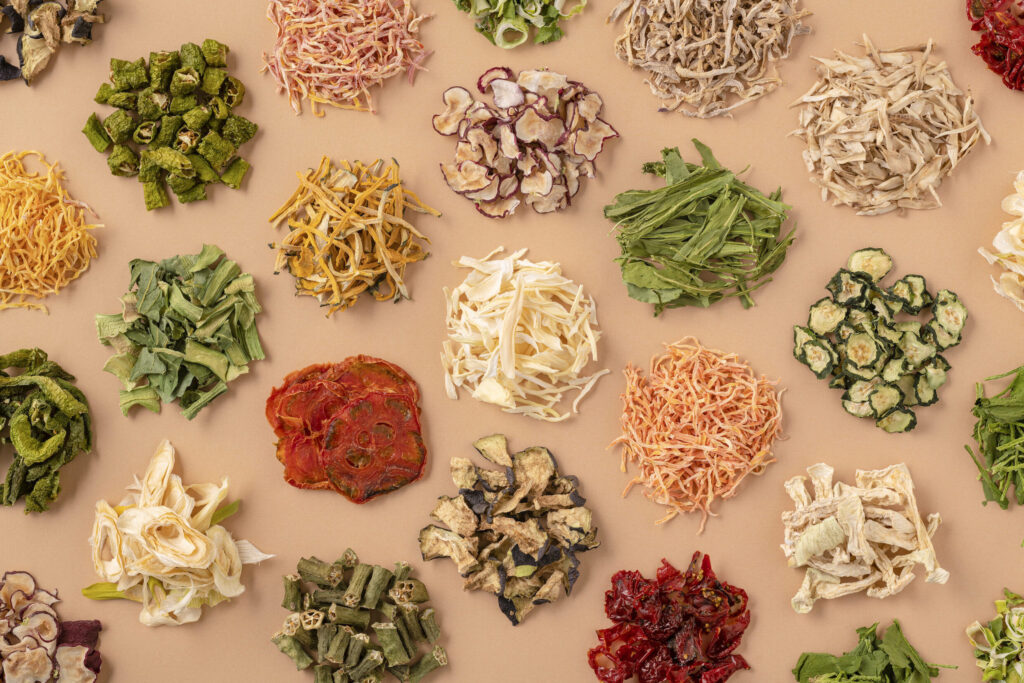
- Sold in small lots from 1 kg
- Handling heirloom vegetables from across Japan
- Dried fruits and herbs also supported
Features of commercial Shishigatani kabocha powder
Fine milling opens up the application area of "uniform blending into soups, dough, and pastes" that slices and dices cannot reach. We organize the strengths unique to Shishigatani kabocha powder from six perspectives.
The light flavor characteristic of Japanese kabocha
Unlike the rich sweetness of Western kabocha, a light flavor is its distinctive character. It pairs easily with dashi, milk, and soy milk, suited to base designs with suppressed sweetness, such as potage and Japanese-style simmered-dish powder. It is a powder easy to use in formulations where you do not want the ingredient's flavor to assert itself too much.
Design that makes use of the gentle color
The dried and milled powder becomes a subdued yellow-family color tone. Adding a small amount to potage, baked-goods dough, bread, and the like adds a natural color. It is an ingredient suited to products aiming for a natural color rather than strong coloring.
Uniform blending into soups, dough, and baby food
Because it disperses uniformly in liquids and powders, it can be developed for applications the raw-material forms cannot reach — potage, instant soup, baked-goods dough, baby-food bases, and the like. It can also be used in soup and paste designs that just dissolve in hot water or milk.
The storytelling of a Kyoto vegetable
The background of a traditional Kyoto vegetable is an element usable in building a product's worldview. As a raw material for gift confectionery, soups, and PB products where you want to emphasize Kyoto-grown, traditional-vegetable origins, a strength is that the origin can be clearly indicated.
Blending with other vegetable powders
By pre-blending with onion, carrot, and corn-type powders, you can design vegetable potage bases and mixed-soup powders from a single raw-material supplier. We accommodate mixing at specified ratios to match the application.
Use together with the ingredient-shape version
For applications where you want to keep texture or shape, Dried Shishigatani Kabocha (slices, dices); for applications where you want to spread color and thickness uniformly, powder — you can use them accordingly. An ingredient-rich feel and base smoothness can both be achieved in the same recipe.
Product specifications (commercial)
The basic specifications at the prototype stage are as follows. Procurement lots, delivery dates, and packaging forms for mass production and OEM are settled through individual consultation.
| Item | Details |
|---|---|
| Product name | Shishigatani Kabocha Powder |
| Raw material | Shishigatani kabocha (Kyoto-grown) |
| Shape | Micro-powder (flesh dried and ground) |
| Appearance | A subdued yellow-family fine powder |
| Aroma | The light, gentle aroma characteristic of Japanese kabocha |
| Net content | Individual quote according to use and lot |
| Best-before date | About 6 months from the shipping date |
| Storage method | Avoid high temperature, high humidity, and direct sunlight; after opening, seal and store in a cool, dark place |
| Minimum prototype lot | 100g〜 |
Customization support
| Item | Available | Details |
|---|---|---|
| Powdering | Consistent from dried product to powder | The form version (dried Shishigatani kabocha) and powder supplied from the same raw material |
| Blend design | Pre-mixing of vegetable powders | Mixing at specified ratios with onion, carrot, and corn types |
| Packaging form | From commercial bulk to small bags | Light-blocking aluminum bags, sticks and small bags, individual wrapping, and the like |
| OEM productization | End-to-end handling through the final product | Potage, soup, baked goods, baby-food base, etc. |
| Raw material supply | Kyoto-grown raw material + contract processing | We also handle contract drying and grinding at a specified growing region |
For those who want to make use of texture and shape (ingredient-shape version)
For simmered dishes, taitan, soup ingredients, and the like, applications that keep Shishigatani kabocha's texture and appearance are best served by dried Shishigatani kabocha (slices, dices). The flesh texture and presence that powder cannot deliver come through in the recipe.
Commitments to variety, grower, and growing region
Shishigatani kabocha is a Japanese kabocha of the Cucurbitaceae family, one of the traditional Kyoto vegetables certified by the City of Kyoto. It is said to originate from seeds brought back from Tsugaru in Oshu during the Bunka era and cultivated in the Shishigatani area of Kyoto, where it grew into a gourd shape with a constriction in the middle. Dense, sticky flesh, a light flavor, and abundant water content are its features, and as a powder raw material we select based on the balance of water content and flesh.
BRAND
At Agriture, using Kyoto-grown Shishigatani kabocha as the raw material, we handle everything from drying through milling in-house. Our basic policy is a finish that retains the light flavor and gentle color characteristic of a traditional Kyoto vegetable.
PRODUCER
We partner with growing regions and receive raw material after sharing harvest timing and guidelines for water content. We record raw-material lots and use them to reproduce flavor and color tone in mass production.
REGION
The main growing region is Kyoto Prefecture. Shishigatani kabocha is a traditional Kyoto vegetable in season in summer, and we procure raw material timed to the season. The fact that Kyoto-grown origin can be clearly indicated works in building a product's worldview.
CULTIVATION
We accept raw material that has grown into the Shishigatani-kabocha-like form — gourd-shaped with surface bumps — and sort it by the guide of the balance of water content and flesh. We ensure reproducibility in the powdering process.
Powdering technology and quality control
Moisture management and flavor retention
Shishigatani kabocha is watery and an ingredient whose flavor changes readily during the drying process. We control the temperature range and operate under conditions that remove moisture while preserving the light flavor characteristic of Japanese kabocha. We also control the frictional heat during milling, aiming for a finish where the powder does not become too hot. Commercial bulk uses light-blocking aluminum bags, and small bags and sticks use moisture-proof, light-blocking film — a specification we propose with in-store and warehouse storage in mind.
Lot-to-lot reproducibility
Traditional vegetables have a range in water content and flesh condition depending on harvest timing and the individual. By recording raw-material lots and adjusting the drying and milling conditions, we operate so as to suppress variation in flavor and color tone even in mass production. If you share the finish you are aiming for in the final product, we can discuss particle size and formulation to match it.
TIPS: Formulation guidelines for making the most of Shishigatani kabocha powder
When using it in potage, dissolving it a little at a time in water or milk to prevent clumping gives a smooth finish. In baked goods, replacing part of the flour adds a faint color and flavor. For a baby-food base, dissolving it in hot water into a paste is a suitable use. In Japanese-style simmered-dish powder, combining it with dashi lets you aim for a light finish with suppressed sweetness. Please consult us on the blend ratio to match the aim of the finished product.
Use cases
Because powder disperses evenly into liquids and powders, it extends to uses that slices and dice cannot reach. We organize the uses often consulted about.
Potage and soup
As a base for potages dissolved in hot water, milk, or soy milk, and instant soups. With its light flavor, you can design formulations that also pair easily with dashi and Japanese ingredients.
Baked goods and bread
Kneaded into the dough of cookies, muffins, and bread, it adds a gentle color and flavor. It also suits as a raw material for gift confectionery that emphasizes Kyoto-vegetable origins.
Baby-food and nursing-care food base
It becomes a smooth paste just by dissolving in hot water, an easy-to-use ingredient with a light flavor. It can be used in base designs that incorporate vegetable flavor.
Japanese side dishes and simmered-dish powder
As a Japanese-style simmered-dish powder combined with dashi, or a seasoning base like okabo no taitan. You can aim for a light Japanese-style finish with suppressed sweetness.
Coloring and topping
Also for uses dusted on as a finish to add a gentle color. With its natural color tone, it can be used in plating that emphasizes the ingredient's character.
Blended soup and mixed powder
For designing vegetable mixed-soup powder combined with onion, carrot, and corn-type powders. We handle everything through to mixing and bagging at specified ratios.
Related articles and other vegetable raw materials
These are the vegetable powders and related raw materials handled by Agriture. Please use them for blend design with Shishigatani kabocha.
- Dried Shishigatani Kabocha: a raw material that leaves the slice and dice shapes
- Kabocha squash powder: A standard vegetable powder
- Onion powder: richness for soups and simmered dishes
- Food OEM Directory: A consultation window for OEM projects
Product catalog showing the items we handle
Flexible support from small lots to large lots
- Sold in small lots from 1 kg
- Handling heirloom vegetables from across Japan
- Dried fruits and herbs also supported
Frequently asked questions
How do dried Shishigatani kabocha (with shape) and powder differ in use?
Dried Shishigatani kabocha is a type that keeps the slice or dice shape, suited to applications where you want to make use of texture and appearance — simmered dishes, taitan, soup ingredients. The powder, being finely milled, suits applications where you want to spread color and thickness uniformly — potage, baked-goods dough, baby-food bases, Japanese-style simmered-dish powder. Using both together lets you achieve both an ingredient-rich feel and base smoothness.
How does it differ from ordinary Western kabocha powder?
Shishigatani kabocha is a Japanese kabocha that is a traditional Kyoto vegetable; compared with Western kabocha it is less sweet, more watery, and has a light flavor as its distinctive character. The powder, too, is not aimed at rich sweetness or strong coloring, but is an ingredient that makes use of a light Japanese-style flavor and gentle color. It suits products where you want to emphasize the storytelling of Kyoto-grown, traditional-vegetable origins.
Can it be positioned as Kyoto-grown and heirloom?
Shishigatani kabocha is one of the traditional Kyoto vegetables certified by the City of Kyoto, and Agriture uses Kyoto-grown raw material. It can be used for product development that clearly indicates the raw material's origin. Please consult us on the wording for labeling and appeal, to match the finished product's specifications.
Can it be pre-blended with other vegetable powders?
Yes. We accommodate pre-blending with vegetable powders that pair well in soup and Western-cuisine types, such as onion, carrot, and corn. If you share the formulation you are aiming for in the finished product — vegetable potage bases, mixed-soup powders, and so on — we handle everything from mixing to bagging at that ratio.
What is the minimum prototype lot?
Prototyping is accepted from 100 g. For mass production and OEM, we propose a quote and delivery timeline individually. You can consult us all the way through to finished products such as potage, baked goods, baby-food bases, and Japanese-style simmered-dish powder.
Please tell me the best-before date and how to store it.
The best-before date is about 6 months from the shipping date. Because Shishigatani kabocha powder absorbs moisture easily, store the unopened product away from high temperature, high humidity, and direct sunlight, in a cool, dark place at room temperature. After opening, transfer it to a sealed container and use it up within 1–2 months as a guide.