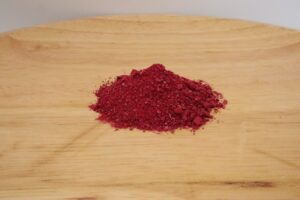
Mugwort powder

Domestically grown mugwort powder is a commercial herb ingredient made by drying and grinding 100% Kagoshima-grown mugwort (leaves and stems). Without using glucose, coloring, or antioxidants, it preserves mugwort's inherently deep green color and refreshing aroma in the powder. As a raw material for Japanese sweets (kusa-mochi, yomogi-mochi), herbal teas, bath additives, health foods, and more, it's an ingredient we're frequently consulted about for product development that wants to make the most of mugwort's color and flavor. Sourced from a partner factory, it offers stable quality and supports year-round supply. For consultations on dried vegetable and powder OEM here Please let us know your intended use and desired specifications from
TOC
The three commitments behind Agriture's mugwort powder
01 100% Kagoshima-grown, using both leaves and stems
For the raw material, we use 100% Kagoshima-grown mugwort and grind it whole, including not just the leaves but the stems. Adding the stem portion gives depth to the flavor and texture when kneaded into Japanese sweets. Mugwort grown in Kagoshima's warm climate has thick leaf flesh and retains good green color even after drying. Vegetable & herb powder list You can also consult us about blending with other materials from
02 Zero additives, no coloring, ingredient-first
Finished with mugwort alone, with no glucose coating, coloring, or antioxidants added. This achieves the simple listing of "ingredient: mugwort" that Japanese-sweets and health-food manufacturers want, making it a spec well suited to PB development for additive-free brands. Features and benefits of vegetable powder.
03 Stable supply system from a partner factory
Mugwort powder is sourced from a partner factory. It isn't a process Agriture carries out in-house, but it's produced stably at a partner that shares our quality standards, allowing year-round supply. We sell and propose it under the Agriture brand and handle everything in one stop, from OEM-development consultations to arranging prototypes.
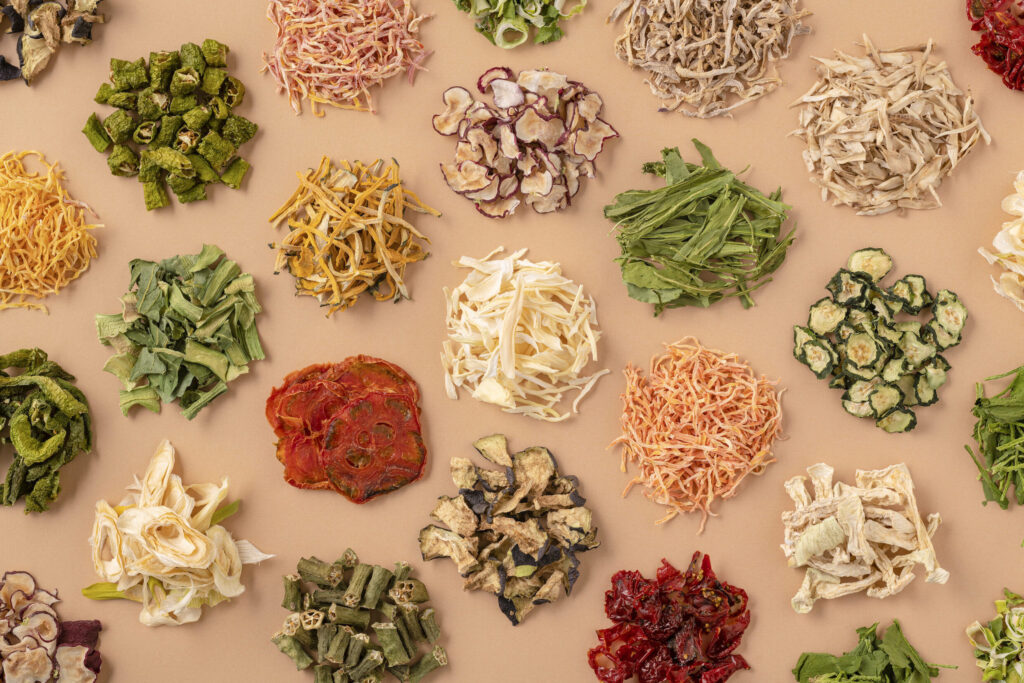
Product catalog showing the items we handle
Flexible support from small lots to large lots
- Sold in small lots from 1 kg
- Handling heirloom vegetables from across Japan
- Dried fruits and herbs also supported
Features of commercial mugwort powder
100% Kagoshima-grown
Made with 100% mugwort grown in Kagoshima Prefecture's warm climate. With thick leaf flesh and a vivid green that remains even after drying, it suits product designs that want to highlight "domestically grown mugwort" in Japanese sweets and health foods.
Good green color
It keeps mugwort's distinctive deep green within the powder. When kneaded into kusa-mochi or yomogi-mochi, it achieves a color that conveys a real sense of "mugwort" by sight — an element that shapes the finished quality of Japanese-sweets products.
Whole leaves and stems ground together
By grinding whole, including not just the leaves but the stems, it adds depth to the aroma and texture when kneaded into yomogi-mochi and dango. Japanese-sweets artisans have praised it as "rich in flavor."
Zero additives, no coloring
No glucose, dextrin, antioxidants, or coloring — all excluded. Because the ingredient listing can be kept to just "mugwort," it's a spec well suited to PB development for additive-free brands and to product designs that prize simplicity of ingredients.
Stable year-round supply
Thanks to a stable production system at the partner factory, year-round supply is possible regardless of season. It can accommodate product designs that need mugwort powder throughout the year, such as staple Japanese-sweets lines and gift items.
Flexible for blend design too
Pre-blending with other ingredients such as matcha powder and mulberry-leaf powder is also supported. We can consult on blend designs for PB use, such as Japanese-herb mixes and health-tea blends.
Product specifications (commercial)
|
Item |
Details |
|---|---|
|
Raw material |
Mugwort (Kagoshima-grown, leaves and stems used) |
|
Best-before date |
About 6 months from the shipping date |
|
Processing plant |
Partner factory |
|
Shipping unit |
Choose from 500 g bag, 1 kg bag, or 5 kg commercial bag |
|
Minimum-lot OEM |
Prototype from 1 kg of raw leaves / main production from 10 kg of raw leaves |
*Prototype consultations are possible from 1 kg of raw leaf.
Customization support
|
Item |
Available |
Details |
|---|---|---|
|
Blend design |
◎ |
Pre-blending with other ingredients such as matcha, mulberry leaf, and young barley leaf supported |
|
OEM small-lot prototyping |
◎ |
Multiple versions can be prototyped in parallel from 1 kg of raw leaf |
|
Packaging changes |
◎ |
500 g, 1 kg, and 5 kg bags can be sorted out |
|
Quality document issuance |
◯ |
Specification sheet, raw-material origin certification, microbiological test report (discussed per project) |
POWDER
Leave blend development with other vegetable and herb powders to us
We support not only mugwort on its own but also the development of Japanese-herb blends combining it with matcha, mulberry-leaf, young-barley-leaf, and hojicha powders. From more than 60 kinds of vegetable, herb, and fruit powders, we propose raw-material designs to match your product concept.
Commitment to variety and growing region
The raw material used in our mugwort powder is 100% Kagoshima-grown mugwort. Mugwort grown in Kagoshima's warm climate and volcanic-ash soil has thick leaf flesh and a strong aroma, and retains a vivid green color even after drying and processing. Mugwort powder is sourced from a partner factory; it isn't a drying process Agriture carries out in-house, but it's produced stably at a partner that shares our quality standards. We sell and propose it under the Agriture brand and handle everything in one stop, from OEM-development consultations to arranging prototypes.
BRAND
Variety: Genus Artemisia in the Asteraceae family (Artemisia indica var. maximowiczii). Using a native Japanese mugwort, it has the aroma and color suited to kusa-mochi and yomogi-mochi.
REGION
Growing region: Kagoshima-grown. The warm climate and abundant sunshine translate into thicker leaves and a higher concentration of aroma compounds. With good green color after drying, it's a growing region highly regarded for Japanese-sweets uses.
SUPPLY
Supply system: As it is sourced from a partner factory, it balances quality stability with year-round supply. With Agriture as your point of contact, we guide you through everything from OEM development consultations to prototyping and full production.
USAGE
Parts used: Both leaves and stems are used. Including the stems brings out the mugwort-like flavor and texture when kneaded into Japanese sweets.
Drying technique and quality control
Mugwort readily oxidizes as time passes after harvest, and its vivid green is prone to browning. At the partner factory, moving it into the drying step a short time after harvest achieves a finish that curbs the deterioration of color and aroma. It's ground immediately after drying and delivered to Agriture in powdered form.
The product is managed according to Agriture's quality standards, and for OEM projects, we issue necessary documents — specifications, raw-material origin certificates, microbiological test reports, and the like — after discussion on a case-by-case basis.
💡 TIPS|A little know-how on the color of mugwort powder
The color of mugwort powder varies greatly with the raw material's harvest timing and drying speed. Young leaves in early spring have a bright color, while mature leaves from summer onward turn a somewhat deeper green. Because Japanese-sweets uses call for vividness, specifying the harvest timing is a point that shapes the finish. Agriture can also consult on lot selection to match your application.
Use cases and adoption examples
Kneading ingredient for Japanese sweets (kusa-mochi, yomogi-mochi, dango)
The representative use of mugwort powder is kneading it into kusa-mochi and yomogi-mochi. Blending about 2 to 5% relative to joshinko or shiratamako spreads mugwort's aroma and green color evenly through the whole dough. The advantage of the powdered ingredient is that it's easier to measure than using fresh mugwort, and lets you make Japanese sweets of stable quality year-round.
- Suitable products: kusa-mochi, yomogi-mochi, yomogi dango, daifuku
- Blending guide: 2 to 5% of the powder weight
- Points to note in development: since too high a blend ratio brings out bitterness, check the flavor balance with a prototype
Flavoring baked goods and bread dough
Kneading it into the dough of financiers, madeleines, scones, sandwich bread, and the like leaves green remaining even after baking, allowing differentiation as Japanese-tinged baked goods. It's a category for which OEM inquiries from Western-confectionery shops and factory-production bakeries are increasing.
- Suitable products: mugwort financier, mugwort scone, mugwort sandwich bread
- Blending guide: 5–15 g per 1 kg of flour
- Points to note in development: it pairs well with butter-based dough, where the fat has an effect of enveloping mugwort's aroma
Blending ingredient for herbal teas and medicinal teas
Mugwort tea is an herbal tea that has long been drunk in folk tradition. In addition to mugwort tea on its own, we're consulted about it as a blended-tea ingredient with hojicha, mulberry-leaf tea, and dokudami tea. See details of our tea OEM service here。
- Suitable products: mugwort tea, Japanese-herb blended tea, aojiru blends combining young barley leaf or kale, and powder ingredients for tablets and capsules can also be proposed.
- Suitable products: mugwort aojiru, health tea, tablets, capsule supplements
- Blending guide: 5 to 30% depending on the product concept
- Points to note in development: adjust flavor and color through the blend balance with other green-type ingredients
- Suitable products: mugwort bath additive, yomogi steaming pack, aroma herb
- Blending guide: 20 to 50g per pack
- Points to note in development: a food-grade material is used, but check labeling and notification requirements according to the application
- Suitable products: original Japanese-herb mix, green-smoothie base, health-tea blend
- Blending guide: 10-30% of the whole blend
- Points to note in development: when kneading each ingredient into Japanese-sweets dough, first dissolving it in a small amount of water into a paste before adding makes it mix evenly and resist clumping. When using it as an herbal tea, fill it into a tea bag or steep and extract it in a teapot.
For storage, sealed storage away from light, heat, and moisture is best. After opening, use it up promptly or reduce air contact with a resealable bag to keep the green color and aroma longer.
- Dried mugwort product page
- Vegetable & herb powder list
- Features and benefits of vegetable powder
- Tea OEM service
- Sold in small lots from 1 kg
- Handling heirloom vegetables from across Japan
- Dried fruits and herbs also supported
Natural ingredient for bath additives and aroma-related products
Mugwort is also used as a natural ingredient in bath additives and aroma products. We can also accommodate inquiries about bath packs filled with the powder in nonwoven fabric and about use as an ingredient for yomogi steaming.
Blending with other herb and vegetable powders
By blending with Japanese-herb and green-type powders such as matcha, mulberry leaf, young barley leaf, and moringa, you can develop an original health-food base. Vegetable powder list We can propose it in combination with
Related cases and articles
Product catalog showing the items we handle
Flexible support from small lots to large lots
Frequently asked questions
Q. What is the minimum lot and prototype handling?
A. We guide customers using a rough standard of from 1kg of raw leaves for prototypes and from 10kg of raw leaves for full production. Doing parallel shipments of 2 to 3 patterns from the prototype stage makes it easier to narrow down, in a short time, the spec that fits your product concept.
Q. What is the price guideline?
A. Pricing varies with packaging specifications and lot quantity, so for an accurate quote please consult us via the inquiry form. If you tell us your product concept, we will propose lot design along with an estimated unit price.
Q. What is the lead time?
A. When stock is available, we can ship in a rough time frame of 2 to 3 weeks after order. It varies with the lot and customization details, so please feel free to consult us about delivery time.
Q. Can you issue a certificate of raw material origin and an analysis table?
A. Both a certificate of raw-material origin showing that it's Kagoshima-grown and a microbiological test report can be issued, and we proceed on a case-by-case basis after consultation. We can also discuss accommodating quality requirements for retail, mail order, and gift products.
Q. Is it processed in-house?
A. Mugwort powder is sourced from a partner factory. It's produced stably at a partner that shares Agriture's quality standards, and we handle sales, proposals, and OEM-development consultations under the Agriture brand.