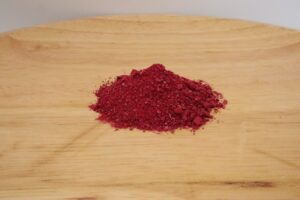
Winter melon powder

Winter melon powder is a raw material that spreads a light flavor and dietary fiber uniformly through soups, potages, Chinese-medicine-type foods, and nursing-care food bases, made by drying and finely milling winter melon (togan). Winter melon's characteristic of having little off-flavor and not interfering with other ingredients' flavors is finished into a size that disperses easily in liquids and powders. At Agriture, Dried winter melon, we powder it by adding a fine-powdering step.
Where raw-material-form winter melon suits "soup and simmered-dish ingredients where you want to keep texture and an ingredient-rich feel," winter melon powder suits applications where you want to spread a light flavor base and dietary fiber uniformly. It is an ingredient we are often consulted about as a base for nursing-care and dysphagia food, Chinese-medicine-type health foods, and low-calorie potages.
TOC
Agriture's winter melon powder: three points of commitment
Winter melon is composed of more than 95% water, making it a difficult ingredient to dry and powder. At Agriture, we manage everything from pretreatment through milling and packaging in-house at our processing facility, aiming for a finish with little lot-to-lot variation.
1. Low-temperature drying that preserves the light flavor
Winter melon's appeal is its light flavor with no off-flavor, and if the temperature is raised too high, harshness or a boiled-down aroma appears. By removing moisture slowly at low temperature, we retain the ingredient's inherent straightforward taste in the powder. A neutral flavor that does not interfere with other ingredients functions as a foundation for blend design.
2. A finish that retains dietary fiber
Winter melon is rich in dietary fiber, and used in potages and nursing-care food bases it produces a natural thickness and a feeling of fullness. We adjust the milling conditions so as not to break down the dietary fiber too much during powdering. Consultations are increasing for nursing-care food bases finished to a softness easily broken up with a spoon.
3. Blend design for Chinese-medicine and medicinal-diet uses
In Chinese herbal medicine, winter melon is known as tougashi (winter melon seed), and it is a staple ingredient in yakuzen cuisine. We can discuss formulations that combine it with other yakuzen ingredients as a blending material for yakuzen-style health foods, herbal teas and functional foods.
Product catalog showing the items we handle
Flexible support from small lots to large lots
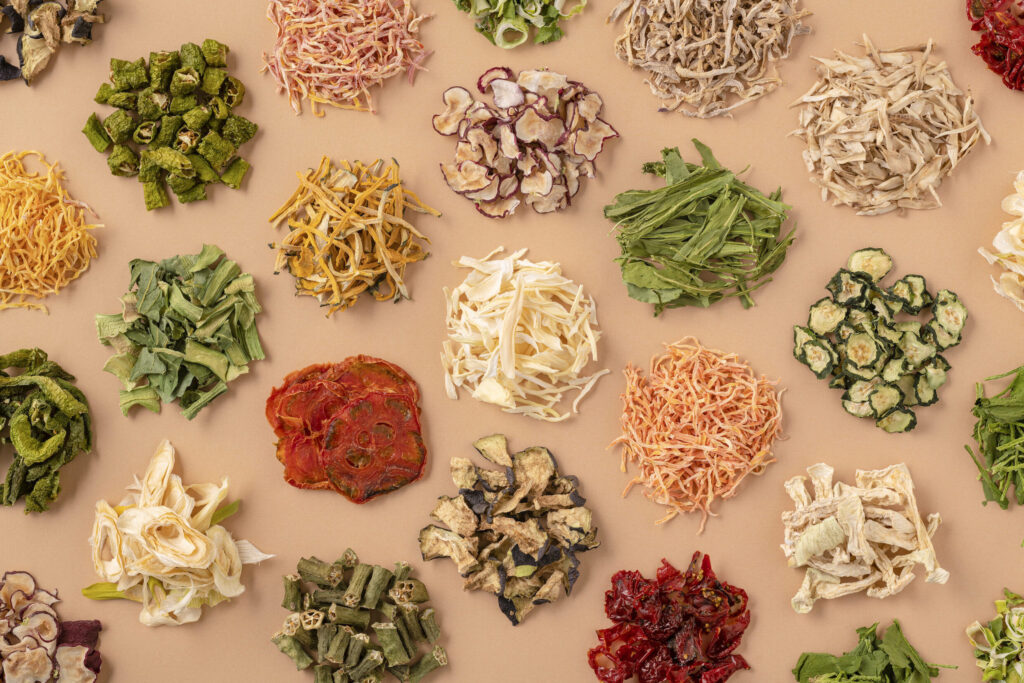
- Sold in small lots from 1 kg
- Handling heirloom vegetables from across Japan
- Dried fruits and herbs also supported
Features of commercial winter melon powder
A light flavor with no off-flavor
A neutral taste that does not interfere with other ingredients' flavors. It suits soup and potage bases, and recipes for nursing-care food where you do not want to introduce an unpleasant off-flavor.
Dietary fiber and minerals
Because it contains dietary fiber and potassium, it is adopted as a raw material for health foods, nursing-care food, and Chinese-medicine-type functional foods.
Natural thickness
Dissolved in liquid it adds a faint thickness, giving a natural mouthfeel in potages and nursing-care food bases.
Low-calorie appeal
Because winter melon itself is a low-calorie ingredient, it can be used as a base for diet foods, low-calorie soups, and healthy beverages.
Chinese-medicine and medicinal-diet uses
As a standard ingredient in Chinese medicine and medicinal cuisine, it is used as a blending raw material for health foods and medicinal-diet teas. Design combined with other medicinal-diet ingredients is possible.
Use together with the ingredient-shape version
Used together with dried winter melon, you can build recipes that balance texture (raw-material form) and a base feel (powder).
Product specifications (commercial)
Basic specifications at the prototype stage are as follows. Purchase lot, lead time, and packaging format are worked out through individual consultation.
| Item | Details |
|---|---|
| Product name | Winter melon powder |
| Raw material | Winter melon (domestically grown) |
| Shape | Fine powder (dried winter melon, milled) |
| Appearance | Pale cream to off-white fine powder |
| Aroma | Nearly odorless to a faint melon-type aroma |
| Net content | Individual quote according to use and lot |
| Best-before date | About 6 months from the shipping date |
| Storage method | Avoid high temperature, high humidity, and direct sunlight; after opening, seal and store in a cool, dark place |
| Processing plant | Our own processing plant within Kyoto Prefecture |
| Minimum prototype lot | From 1 kg of raw material |
Customization support
| Item | What we support |
|---|---|
| Pre-blending | Premixing available with flour, onion powder, other vegetable powders, and Chinese-medicine ingredients |
| Blend design | Composite recipes with vegetable types such as onion and cabbage, and medicinal-diet types such as chinpi, ginger, and turmeric |
| Packaging form | Commercial bulk, large bags for nursing-care food factories, small bags and sticks, canisters |
| OEM productization | Development into potage, soup powder, nursing-care food bases, Chinese-medicine tea, and health foods |
| Raw material supply | Besides our own raw material, we also handle contract drying and milling of designated-origin and non-standard produce |
For uses where you want to keep texture and a sense of ingredient presence, the raw-material form is recommended
For simmered dishes, ankake, soup ingredients, and the like, applications where you want to keep winter melon's melt-in-the-mouth texture are best served by dried winter melon (raw-material form). Its strength is that it can be rehydrated and used directly as an ingredient.
Commitments to variety, grower, and growing region
Winter melon is a large vegetable of the Cucurbitaceae family; harvested in summer, it can be stored until winter (keeping as a melon until winter), which is how it got the name "togan" (winter melon). As a powder raw material, variety selection to match the application is possible — a medium-sized heirloom variety with dense flesh from which moisture escapes easily, the large hime-togan, Okinawa's shibui (an elongated type), and so on.
Main growing region
| Growing region | Features |
|---|---|
| Okinawa Prefecture | A growing region for shibui (the elongated type). Stable production year-round |
| Aichi Prefecture | A major growing region for hime-togan and large winter melon. Distributed as a processing-oriented raw material |
| Okayama Prefecture | A growing region where local heirloom winter melon varieties survive. For product designs as a heirloom vegetable |
| Kanagawa Prefecture | A production area for the Tokyo metropolitan area, such as the Miura Peninsula. Development into processed products is advancing |
Using varieties and lineages differently
Large winter melon has a lot of flesh and suits mass-production lots for processing. Hime-togan has dense flesh and stable flavor, well suited as a base for premium products. Okinawa's shibui has an elongated shape and a distinctive flavor, usable as a raw material for regional-brand products. We can discuss variety selection and blend formulation to match the application.
Powdering technology and quality control
Because winter melon powder involves powdering a high-moisture raw material, drying time and temperature management govern quality. At Agriture, we manage everything from preparation through packaging consistently, suppressing lot-to-lot variation.
Low-temperature, long-duration drying
Because winter melon is high in moisture, drying that takes time is needed. Raising the temperature to shorten the process brings out harshness and a boiled-down flavor, so we remove moisture slowly at low temperature.
Milling that does not break down dietary fiber
Excessive milling breaks down the dietary fiber and causes it to lose its natural thickness. We adjust the milling lot and rotation speed, selecting how much dietary fiber to retain according to the application.
Moisture-resistant packaging
Winter melon powder is highly hygroscopic and clumps if left. The finished powder is moved promptly to moisture-proof packaging, and large bags for nursing-care food are combined with oxygen absorbers to maintain quality.
TIPS: Formulation for a nursing-care potage base
In a nursing-care-food-based potage, with 30–40% winter melon powder as the base, combining 15–20% onion powder, 5–10% flour, 20–30% skim milk or dextrin, and salt and seasonings gives a light, easy-to-drink design that also provides nutrition. When aiming at a dysphagia-food standard, adjust the thickness viscosity by combining with a thickener. When you want umami even in a reduced-salt design, increasing the amount of enoki powder brings balance.
Use cases and adoption examples
Winter melon powder is an ingredient that balances a light flavor and functionality. We organize the applications we are often consulted about into five categories.
1. Soups and potages
- Winter melon potage, cream soup
- Powder base for Chinese-style winter melon soup
- Adding body to consommé and Japanese-style soup
- Low-calorie healthy soup
2. Nursing-care and dysphagia food
- Nursing-care food base for facility meals
- Thickening-adjusted powder for dysphagia food
- Stick soup for the elderly
- A healthy-menu ingredient for hospital meals
3. Chinese-medicine and medicinal-diet-type health foods
- Blending ingredient for medicinal-diet tea (combined with winter melon seed, chinpi, and ginger)
- Dietary-fiber-containing stick beverages
- Chinese-medicine-type supplements
- Edema-care and beauty drinks
4. Diet foods and low-calorie
- Meal-replacement soup mix
- Powder for dietary-fiber intake
- Low-carb, low-calorie foods
- Diet drinks that appeal to a feeling of fullness
5. Baby food and weaning food
- Base soup for the middle and late weaning stages
- Extending purée for baby food
- A base for allergen-free food
- Vegetable-paste ingredient for young children
For blend design of nursing-care and medicinal-diet types, Onion powder・Turmeric powder. In the medicinal-food realm, it also pairs well with Yasai Yakuzen product design combined with the recipes of
How to use the powder and design blends
The raw-material form requires a reconstitution step, but the powder's advantage is that it can be formulated directly into powdered goods. We organize the operational points specific to powders.
Basics of use
- is also possible.
- Potage: dissolve 5–10 g per 200 ml
- Nursing-care food base: 8–15 g per 100 ml of water for natural thickness
- Soup: dissolve 3–5 g per 200 ml
- Medicinal-diet tea: 2–3 g per 200 ml of hot water as a guide
Example blend formulas
- Diet drink: 10–15 g per 200 ml for a feeling of fullness
- Nursing-care potage: 35% winter melon + 15% onion + 10% flour + 25% skim milk + 15% salt and seasonings
- Medicinal-diet tea: 30% winter melon + 20% chinpi + 15% ginger + 10% turmeric + 25% licorice and cinnamon
- Meal-replacement soup: 40% winter melon + 20% soy flour + 15% onion + 15% dietary fiber + 10% seasonings
How to store
- Before opening: store in a cool, dark place at room temperature, away from heat, humidity, and direct sunlight
- After opening: because it readily absorbs moisture, transfer it to a resealable bag or airtight container; refrigerated storage is also fine
- The best-before date is roughly 6 months from the shipping date. After opening, use it up within 1–2 months as a guide
- If lumps form, sift through a tea strainer before use to disperse it evenly
Related articles and other vegetable raw materials
Weaning-food base: 50% winter melon + 20% onion + 20% carrot + 10% rice flour
- Dried winter melon These are the vegetable-type powders and related raw materials handled by Agriture. Please use them when designing nursing-care food, potage, and medicinal-diet-type health foods.
- Onion powder: Raw-material form for simmered dishes and ankake
- Turmeric powder: A soup and nursing-care-food base standard
- Cabbage powder: For Chinese-medicine and functional foods
- Enoki powder: mushroom dashi and reduced-salt design
Product catalog showing the items we handle
Flexible support from small lots to large lots
- Sold in small lots from 1 kg
- Handling heirloom vegetables from across Japan
- Dried fruits and herbs also supported
Frequently asked questions
: A vegetable raw material containing vitamin U
How do dried winter melon (raw-material form) and winter melon powder differ in use?
The raw-material form suits applications where you want to keep texture and an ingredient-rich feel — simmered dishes, ankake, soup ingredients. The powder suits applications where you want to spread a light flavor base and dietary fiber uniformly — potage, nursing-care food bases, medicinal-diet tea, diet drinks. In some cases both are used together in the same recipe to balance a body feel and an ingredient-rich feel.
Can it be used as a base for nursing-care and dysphagia food?
This is one of the applications we are often consulted about. Winter melon is light with little off-flavor, an ingredient that makes it easy to create a mouthfeel the elderly can swallow easily. Made into a potage, it reaches a viscosity close to a dysphagia-food standard, and the thickness viscosity can be adjusted by combining with a thickener. We can also discuss OEM design for facility and hospital meals.
Yes, we can. In Chinese herbal medicine, winter melon is known as winter melon seed, and it is a staple ingredient in yakuzen cuisine. We can discuss formulations for yakuzen teas, health foods and drinks containing dietary fiber that combine it with chenpi, ginger, turmeric, licorice, cassia bark and so on. For yakuzen recipe consulting, Yasai Yakuzen Yes. Winter melon is used in Chinese medicine as "tougashi," a crude drug for diuresis and edema relief, and is a standard ingredient in medicinal cuisine. We can discuss designs for medicinal-diet teas, health foods, and dietary-fiber-containing drinks combined with chinpi, ginger, turmeric, licorice, cinnamon, and the like. Medicinal-diet recipe consulting can be handled in cooperation with
What is the minimum prototype lot?
.
Please tell me the best-before date and how to store it.
Prototyping is accepted from 1 kg of raw material. Because winter melon is high in moisture and the powder amount finished from 1 kg of raw material is small, telling us the lot and schedule in advance lets us propose the optimal approach. You can consult us all the way through to finished products such as nursing-care food bases, medicinal-diet tea, and potage.
The best-before date is about 6 months from the shipping date. Store the unopened product away from high temperature, high humidity, and direct sunlight, in a cool, dark place at room temperature. Because winter melon powder absorbs moisture especially easily, after opening transfer it to a zip-top bag or sealed container and use it up within 1–2 months as a guide. Combining with oxygen absorbers is also effective.
Can it be used as a base for baby food?
Recommended reading
- You can consult us on it as a base soup for the middle and late weaning stages, extending purée for baby food, and a base for allergen-free food. Winter melon is light with little off-flavor, an ingredient babies can eat without discomfort. However, if you need to meet baby-food standards (allergen management, bacterial testing, and the like), please consult us on the quality assurance system in advance.
- Dried winter melon – raw-material form for simmered dishes and ankake
- Onion powder – a soup and nursing-care-food standard
- Turmeric powder – Chinese-medicine and functional foods
- Enoki powder – mushroom dashi and reduced-salt design