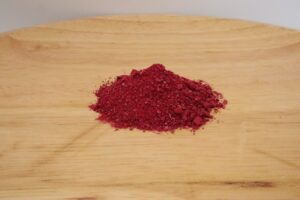
Mizuna powder

Mizuna powder is an ingredient made by finely milling mizuna — a leafy vegetable representative of Kyoto vegetables — to spread its vivid green and refreshing flavor throughout Japanese-style dressings, noodle sauces, furikake, and seasonings. The faint pungency characteristic of mizuna and the crisp aroma of fresh green leaves are finished into a size that disperses uniformly in liquids and powders. At Agriture, Dried mizuna, we powder it by adding a fine-powdering step.
Where raw-material-form mizuna suits "hot-pot, salad, and soup ingredients where you want to keep the crisp texture," mizuna powder suits applications where you want to spread color and aroma uniformly. Among Kyoto vegetables, kyona and Cabbage powder if you blend it in, you can design green flavor for both Japanese and Western dishes.
TOC
Agriture's mizuna powder: three points of commitment
For leafy-vegetable powders, the quality is determined by green color and the retention of green-leaf aroma. At Agriture, we manage everything from raw-material pretreatment through milling and packaging in-house at our processing facility, aiming for a finish with little lot-to-lot variation.
1. Low-temperature drying that preserves the vivid green
Mizuna's chlorophyll fades readily with heat and light, and if the drying temperature is raised too high, the powder takes on a brownish cast. By removing moisture slowly at low temperature and operating the milling step under conditions that suppress heat generation, we preserve the vivid green of the finish. Our guide is a state where, the moment the powder is spread on a plate, the bright green characteristic of mizuna is visible.
2. Balancing pungency and green-leaf aroma
Mizuna belongs to the mustard-greens lineage of the same Brassicaceae family and has a sharp pungent component (isothiocyanate-type). We adjust the pretreatment and drying conditions so this pungency does not dissipate too much during powdering. A powder that balances green-leaf aroma and pungency functions as an accent for Japanese-style dressings and noodle sauces.
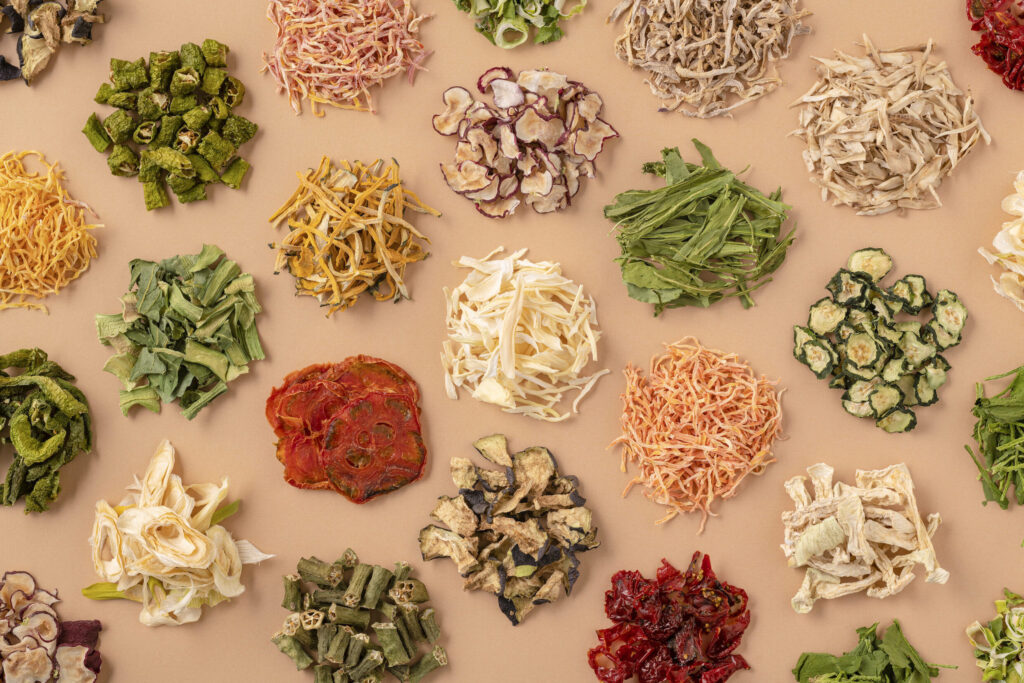
Product catalog showing the items we handle
Flexible support from small lots to large lots
- Sold in small lots from 1 kg
- Handling heirloom vegetables from across Japan
- Dried fruits and herbs also supported
Features of commercial mizuna powder
Vivid green color
Thanks to low-temperature drying that preserves chlorophyll, the powder itself is a bright green. Kneaded into noodle dough, dressings, or bread, it expresses the ingredient's own natural green.
Sharp Kyoto-vegetable flavor
The sharp pungency and green-leaf aroma characteristic of mizuna are concentrated. It functions as an accent for Japanese-style dressings, noodle sauces, and ponzu.
Dispersibility in liquids and powders
Even mixed into dressings or noodle sauces, the graininess is hard to notice, and it disperses uniformly in powder mixes. It needs no rehydration and can be used as-is. We propose the optimal milling degree for each application.
Kyoto-vegetable story
As a Kyoto-brand leafy vegetable, it adds depth to your product story. It is a use case we are often consulted about as a raw material for Kyoto souvenirs, local products, and premium foods.
Use together with the ingredient-shape version
Used together with dried mizuna, you can design recipes that balance color and aroma (powder) with texture (raw-material form).
Product specifications (commercial)
Basic specifications at the prototype stage are as follows. Purchase lot, lead time, and packaging format are worked out through individual consultation.
| Item | Details |
|---|---|
| Product name | Mizuna powder |
| Raw material | Mizuna (domestically grown) |
| Shape | Fine powder (dried mizuna, milled) |
| Appearance | Vivid green to yellow-green fine powder |
| Aroma | Green-leaf aroma, with a faint pungent scent characteristic of the Brassicaceae |
| Net content | Individual quote according to use and lot |
| Best-before date | About 6 months from the shipping date |
| Storage method | Avoid high temperature, high humidity, and direct sunlight; after opening, seal and store in a cool, dark place |
| Processing plant | Our own processing plant within Kyoto Prefecture |
| Minimum prototype lot | From 1 kg of raw material |
Customization support
| Item | What we support |
|---|---|
| Pre-blending | Premixing available with salt powder, shichimi, and other leafy-vegetable powders |
| Blend design | Composite design with leafy vegetables such as kyona, cabbage, and spinach, and Kyoto-brand ingredients such as yuzu and sudachi |
| Packaging form | Commercial bulk, sticks and small bags, spice jars, bottle canisters |
| OEM productization | End-to-end handling through to finished products such as dressings, noodle sauces, furikake, green juice, and fresh pasta |
| Raw material supply | In addition to our own raw material, we also handle contract drying and milling from specified growing regions or Kyoto-grown designations |
For uses where you want to keep texture and a sense of ingredient presence, the raw-material form is recommended
For hot-pot and soup ingredients, salads, stir-fry bases, and the like, applications that make use of mizuna's crisp texture are best served by dried mizuna (raw-material form). Its strength is that it can be rehydrated and used directly as an ingredient.
Commitments to variety, grower, and growing region
Mizuna is a Brassicaceae leafy vegetable, a representative Kyoto vegetable that has been cultivated since ancient times centered on Kyoto. As a powder raw material, the young leaves of the mibuna/mizuna lineage — soft-leaved and deep green — are easy to work with, and the color after drying is stable.
Main growing region
| Growing region | Features |
|---|---|
| Kyoto Prefecture | The birthplace of Kyoto vegetables. The traditional cultivation of the heirloom variety "Kyo-mizuna" survives here |
| Ibaraki Prefecture | Top national mizuna production. Year-round shipping enables stable procurement |
| Fukuoka Prefecture | A major growing region in western Japan. Soft-leaved raw material well suited to powdering |
| Hyogo Prefecture | A supply base for the Kansai area. Quality close to Kyoto-grown can be secured |
Using varieties and lineages differently
The heirloom Kyo-mizuna (a traditional Kyoto variety) has thin leaves and firm pungency, a lineage with strong appeal as a Kyoto brand. Modern improved mizuna (young-leaf-picked lineages grown in greenhouses) has gentle pungency, well suited to versatile recipes such as dressings and noodle sauces. We propose the lineage according to your application.
Powdering technology and quality control
For leafy-vegetable powders, the way color and aroma remain changes greatly with drying conditions. At Agriture, we manage everything from preparation through packaging consistently, suppressing lot-to-lot variation.
Preserving chlorophyll with low-temperature drying
The chlorophyll of leafy vegetables decomposes with heat, and once faded the powder takes on a brownish cast. By removing moisture slowly at low temperature, we keep the vivid green in the powder.
Heat control during grinding
Preventing fading with light-blocking packaging
Because leafy-vegetable powders also fade with light, the finished powder is moved promptly to light-blocking packaging. Commercial bulk uses light-blocking bags, while small bags and sticks use light-blocking film.
TIPS: Formulations to bring out Kyoto-vegetable color and flavor with mizuna powder
When using it in Japanese-style dressing, adding 0.5–1% powder relative to the total brings up a vivid green and a Kyoto-vegetable-like flavor. In noodle dough, kneading in 1–2% relative to the flour as a guide lets you make fresh pasta and udon that keep their green color even after boiling. When using it as furikake, combined with salt, white sesame, and chirimen, a 10–15% share of mizuna powder makes the Kyoto-vegetable flavor the star.
Use cases and adoption examples
Mizuna powder's strengths are the vivid green and distinctive flavor of Kyoto vegetables. We organize the applications we are often consulted about into five categories.
1. Japanese-style dressings and sauces
- Japanese-style mizuna and yuzu dressing
- Sesame-oil / soy-sauce-based Kyoto-vegetable dressing
- A green accent for ponzu and marinade liquid
- Japanese-style tartar sauce, Japanese-style mayo
2. Noodles and noodle sauces
- Kneaded into Kyoto-vegetable udon and pasta dough
- Japanese-style dipping sauce for cold soba and chilled udon
- Coloring fresh pasta and ravioli
- Topping powder for ramen soup
3. Furikake and seasonings
- Kyoto-vegetable furikake with mizuna, salt, and sesame
- Onigiri seasoning mix, ochazuke ingredient
- Marinade powder for meat and fish
- Kyoto-vegetable blended seasoning
4. Confectionery and bakery
- Kneaded into shokupan and focaccia
- Dough for Kyoto-vegetable scones and muffins
- Coloring crackers and grissini
- A substitute green ingredient for Japanese sweets (kusa-mochi type)
5. Health foods and beverages
- Ingredient for green-juice mixes and green smoothies
- Blending into vegetable-powder health foods
- Stick beverages (dissolve-in-hot-water type)
- Protein drinks, vegetable-soup mixes
For Kyoto-vegetable blend design, see the Dried mizuna page and Cabbage powder as well. In the medicinal-diet and health-food area, Yasai Yakuzen.
How to use the powder and design blends
In raw form a rehydration step is needed, but the advantage of powder is that it disperses directly into liquid. We organize the operation points unique to powder.
Basics of use
- Dressing: add 0.5–1 g per 100 g of oil + vinegar and mix well
- Noodle dough: knead in 1–2 g per 100 g of flour
- Bakery dough: blend 0.5–1 g per 100 g of wheat flour
- Furikake: combine with salt, sesame, and nori at a 10–15% share of the total
- Smoothie: dissolve 1–2 g per 200 ml
Example blend formulas
- Kyoto-vegetable furikake: 15% mizuna + 20% salt + 30% white sesame + 20% nori + 15% chirimen
- Japanese-style dressing: 40% soy sauce + 30% vinegar + 20% sesame oil + 5% mizuna powder + 5% sugar and salt
- Kyoto-vegetable udon dough: 95% flour + 3% mizuna powder + 2% salt
- Green-juice mix: 30% mizuna + 30% kale powder + 25% young barley grass + 15% matcha
How to store
- Before opening: store in a cool, dark place at room temperature, away from heat, humidity, and direct sunlight
- After opening: because it readily absorbs moisture, transfer it to a resealable bag or airtight container; refrigerated storage is also fine
- The best-before date is roughly 6 months from the shipping date. After opening, use it up within 1–2 months as a guide
- If lumps form, sift through a tea strainer before use to disperse it evenly
Related articles and other leafy raw materials
These are the leafy-vegetable powders and related raw materials handled by Agriture. Please use them when designing Kyoto-vegetable blends and health foods.
- Dried mizuna: Raw-material form for hot-pot, salad, and soup ingredients
- Cabbage powder: for okonomiyaki flour and soup powders
- Celery powder: for Western-style soup bases and processed meats
- Cucumber powder: A refreshing green aroma
- Onion powder: a staple for soups and seasonings
Product catalog showing the items we handle
Flexible support from small lots to large lots
- Sold in small lots from 1 kg
- Handling heirloom vegetables from across Japan
- Dried fruits and herbs also supported
Frequently asked questions
How do dried mizuna (raw-material form) and mizuna powder differ in use?
The raw-material form suits applications where you want to keep the crisp texture — hot-pot, salad, and soup ingredients, and stir-fries. The powder suits applications where you want to spread color and aroma uniformly — dressings, noodle sauces, fresh-pasta dough, and furikake. In some cases both are used together in the same recipe to balance depth of flavor and texture.
How much of the powder's green color remains?
Thanks to low-temperature drying and heat suppression during milling, it finishes with a vivid yellow-green to green color. However, because the components are sensitive to light and heat, we recommend light-blocking packaging, and after opening we ask that you store it in a sealed container. When kneaded into fresh-pasta dough, a design that keeps the green color even after boiling is possible.
Can I specify Kyoto-grown mizuna?
Yes. We can also discuss contract drying and milling of the heirloom Kyo-mizuna lineage grown within Kyoto Prefecture. Kyoto-grown designations may lengthen lead time depending on the raw-material purchase volume, so please let us know your lot and schedule in advance. It suits product designs that make the most of the Kyoto brand. After hearing the specifications, formulation, lot, and schedule of your intended finished product, we propose a quote and delivery timeline individually. Beyond supplying the powder on its own, you can consult us all the way through to finished products such as dressings, noodle sauces, furikake, and fresh pasta.
Please tell me the best-before date and how to store it.
The best-before date is about 6 months from the shipping date. Store the unopened product away from high temperature, high humidity, and direct sunlight, in a cool, dark place at room temperature. Because the powder absorbs moisture easily, after opening transfer it to a zip-top bag or sealed container and use it up within 1–2 months as a guide. Because leafy-vegetable powders fade with light, we recommend using a light-blocking container.
Can you design blends with other leafy-vegetable powders?
Yes. We can discuss designs for green-juice mixes, health foods, Kyoto-vegetable blended furikake, and the like, combining it with other leafy and green powders such as cabbage, celery, spinach, and young barley grass. If the blend ratio, lot, and packaging form are decided in advance, we can also run a premix operation that delivers the powder in a state close to the finished product.