
What Is Vegetable Powder? Features, Shelf Life, Uses and a Guide to OEM

Summary of this article
We've summarized the characteristics, storage life and uses of vegetable powder from the perspective of a drying manufacturer. This article explains how removing moisture reduces bulk so vegetables can easily be added to dishes, how heat-stable components and texture tend to remain while components sensitive to heat and water tend to change, the advantage of long-term storage at room temperature, and examples of use in smoothies, baby food and OEM. We manufacture in a low-temperature range with around 45°C as a guide, and support small-lot prototypes from 100g.
Even when we know it's important to eat plenty of vegetables every day, the effort of cooking and the difficulty of storing them mean it easily gets put off in a busy life. One ingredient drawing attention as a support for that kind of diet is "Vegetable powder." Turning vegetables into powder removes moisture and reduces bulk, making it easy to add vegetables to dishes.
This article clearly explains the characteristics and storage life of vegetable powder, examples of use in cooking, and product development through OEM.
What you'll learn in this article
- What vegetable powder is and how it differs from fresh vegetables
- What changes and what doesn't when vegetables are dried and powdered
- The merits of long-term storage, inventory management, and ease of use
- Examples of use in cooking and OEM

We have materials available to help you understand dried processing OEM
Agriture OEM, flexibly handling everything from small lots to large lots
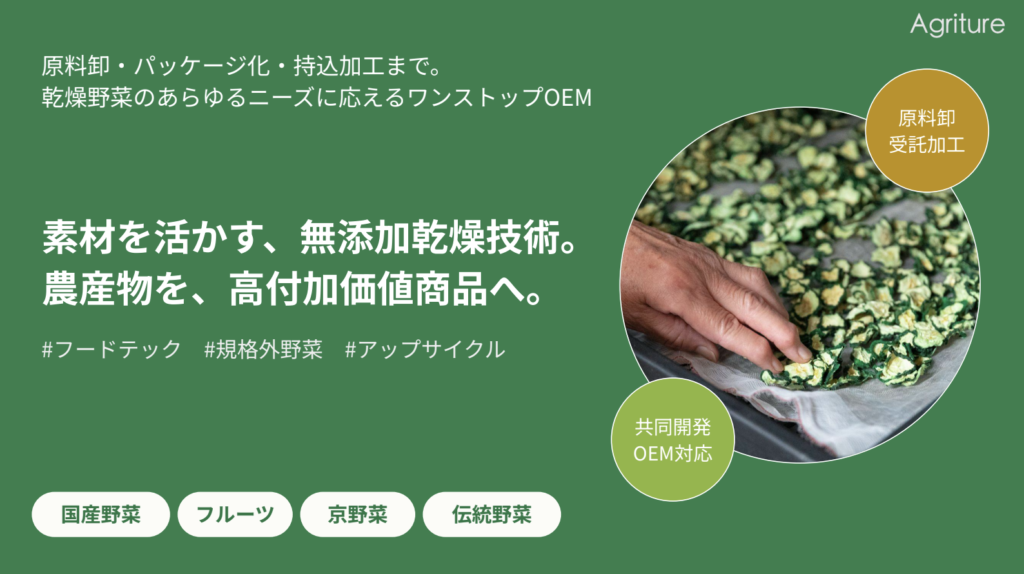
- OEM available from small lots of 10 kg
- Drying of brought-in raw materials also possible
- Support from processing to filling in one place
TOC
Vegetable powder is compact and easy to use
The biggest advantage of vegetable powder is that moisture is removed and bulk is reduced. Vegetables are more than 90% water, and drying and powdering them turns them into a form where a small amount adds vegetables to a dish. It's an ingredient suited to people who are too busy to cook vegetables.
Example: Otsukare Dried Vegetable Mix
For instance, let’s look at the nutritional components of “Otsukare Dried Vegetable Mix" blends several dried vegetables and lets you add vegetables easily just by putting it into miso soup or other soups.
Both dried vegetables and powder are ingredients with the moisture removed. Adding just one spoonful to your daily miso soup or soup brings vegetable color and texture to the dish.
Drying reduces bulk
Think of kiriboshi daikon (dried shredded daikon radish). When fresh daikon is dried, the moisture leaves, and weight for weight the flavor and texture become densely concentrated.
Using about a spoonful of powder per meal adds vegetable flavor and color to a dish. Because it works in small amounts, it's handy for making a dish when you're busy.
What changes and what doesn't with drying
When vegetables are dried and made into powder, how much color, aroma and components remain depends on the ingredient and the drying method. Things that withstand heat and drying tend to remain, while things sensitive to heat and water tend to change.
| Property | Tendency when dried |
|---|---|
| Dietary fiber and minerals (heat-stable components) | Tend to remain |
| Pigments (fat-soluble components such as beta-carotene) | Tend to remain relatively well |
| Components sensitive to water and heat | Tend to change during processing |
| Water-soluble components | Using the soaking liquid as well reduces loss |
💡 POINT | The finish depends on the drying method
The above are general tendencies. How well color and aroma are retained changes with the drying method. Agriture uses in a low-temperature range of about 45℃as its standard process, designed to retain as much of each ingredient's color and aroma as possible.
Vegetable powder isn't something that completes a meal on its own, but it is a practical ingredient for easily adding vegetables to dishes. Its advantage is that it's easy to work into everyday meals in combination with fresh or cooked vegetables.
FOR BUSINESS
乾燥野菜のOEM・受託加工を承ります
国産の野菜・果物の乾燥、100メッシュ相当までの粉砕、10g以上の小袋充填までをお受けしています。小ロットの試作から量産までご相談ください。寄せられた相談の実例は OEM・卸のご相談 に掲載しています。
乾燥品の賞味期限は、出荷日から6ヶ月程度を目安にご案内しています。
What to make of the claim that vegetable powder has no nutrition
The claim often seen on the web that “vegetable powder has no nutrition" claim, looked at in terms of the properties of the ingredients.
Components sensitive to heat and water tend to change
Some components exposed to heat and air during drying are prone to change. The higher the temperature and the longer the drying time, the stronger this tendency. This is something we should be honest about.
Heat-stable components and texture tend to remain
On the other hand, heat-stable components, dietary fiber and texture tend to remain even after drying, and with the moisture gone they are more concentrated weight for weight. Lumping it all together as "no nutrition" isn't accurate; the changes differ by ingredient and component.
Why it excels at long-term storage | No refrigeration needed, easier inventory management too
Another reason vegetable powder is valued as a commercial ingredient is its overwhelmingly high storability. Fresh vegetables spoil in a few days, but powder that has gone through drying can be stored at room temperature for 6 months to 1 year in a sealed state..
| Comparison item | Fresh vegetables | Dried vegetables | Vegetable powder |
|---|---|---|---|
| Storage period | 3–5 days | 6 months | 6 months to 1 year (unopened) |
| Storage method | Refrigerated (humidity management required) | Room temperature, cool and dark | Room temperature, sealed |
| Ease of degradation | Very high | Not easily degraded | Not easily degraded, though some color loss |
Being able to store at room temperature long-term means
- you can cut costs without using refrigeration or freezing equipment
- less swayed by seasonal fluctuations in vegetable prices
- inventory loss decreases, which also reduces food waste
—these advantages make it an important merit in OEM product development as well. In particular, stick aojiru, powdered soup, emergency food, and care food pair superbly with products that require storability and functionality. Using aluminum packaging can also extend shelf life further.
A little extra for your diet! Ways to use vegetable powder
Depending on how you use it, you can naturally incorporate nutrients you tend to lack into your life.
- A spoonful in your morning smoothie| Add color and flavor with kale and komatsuna powder
- Knead it into bread or pancakes| Natural sweetness and color with pumpkin or carrot powder
- Mix it into baby food or care food| Fine and easy to dissolve, for an easy-to-swallow form
- A base ingredient for sweets and baked goods| Additive-free coloring with matcha or beetroot
- Commercial instant soup and furikake| Effective for room-temperature shipping, long best-before dates, and color appeal
Related article: A collection of ideas for using dried Kujo green onion powder/Solve picky eating too! 3 ideas for commercializing vegetable powder you can keep up every day
Agriture’s vegetable-powder lineup
Agriture, based in Kyoto and Kyotango, manufactures vegetable powder through low-temperature drying at 45°C the process. With a lineup of over 30 items from small lots of 100 g up to commercial quantities. The full list of products handled is Commercial vegetable powder | Agriture’s lineup available for viewing here.
| Item | Details |
|---|---|
| Processing method | Low-temperature drying at 45°C (retains color, aroma, nutrition) |
| Items handled | Kujo leek, Shogoin daikon, spinach, carrot, pumpkin, beetroot, and 30-plus other kinds |
| Minimum lot | Prototyping supported from 100 g |
| Best-before date | 6–12 months from the production date |
| Applicable projects | Food OEM, restaurants, functional foods, baby food, gift products, and more |
As examples of actual D2C products, Otsukare Dried Vegetable Mix (iron and dietary-fiber supplementation)、OYAOYA (a D2C brand upcycling non-standard vegetables from northern Kyoto), contained in seaweeds.
We have materials available to help you understand dried processing OEM
Agriture OEM, flexibly handling everything from small lots to large lots
- OEM available from small lots of 10 kg
- Drying of brought-in raw materials also possible
- Support from processing to filling in one place
FOR BUSINESS
乾燥野菜のOEM・受託加工を承ります
国産の野菜・果物の乾燥、100メッシュ相当までの粉砕、10g以上の小袋充填までをお受けしています。小ロットの試作から量産までご相談ください。寄せられた相談の実例は OEM・卸のご相談 に掲載しています。
乾燥品の賞味期限は、出荷日から6ヶ月程度を目安にご案内しています。
Frequently asked questions about vegetable powder
Does vegetable powder really have nutrition?
Dietary fiber, heat-stable components and texture tend to remain after drying, while components sensitive to heat and water tend to change during processing. "No nutrition at all" is a misconception; the changes differ by ingredient and component. We recommend using it in combination with fresh vegetables.
Can it replace fresh vegetables?
It's convenient as a way to add vegetables to dishes, but it isn't a replacement for fresh vegetables themselves. a ”supplement” used in combination with fresh or frozen vegetables is the appropriate way to think of it.
How much should I take per day?
Many people use about a spoonful, depending on the dish. It's difficult to cover a whole day's vegetables with vegetable powder alone, so we recommend using it in combination with fresh or cooked vegetables.
Is it okay to use for children or baby food?
If you choose additive-free, Japanese-grown, single-ingredient vegetable powder, it can be used in baby food too. From around 5–6 months of age, mixing a small amount into a paste or rice porridge is common. However, try any new ingredient on its own in a small amount first, and check for allergies.
Where can I buy it? I want to source commercial quantities
Home-use products can be bought at supermarkets and online. For commercial and OEM raw materials, Agriture’s commercial vegetable powder page offers prototyping consultations from 100 g. We supply over 30 items from our bases in Kyoto and Kyotango.
Summary | Vegetable powder combines ease of use with long storage life
Three-line summary
- With the moisture removed, it's compact and makes it easy to add vegetables to dishes
- Heat-stable components and texture tend to remain, while components sensitive to heat and water tend to change
- It's practical to use as a ”supplement” in combination with fresh or frozen vegetables
Vegetable powder is a convenient food ingredient that combines ease of use, storage life and color. It's particularly suited to uses such as the following.
- For general consumers who want to make up for a vegetable shortfall
- For OEM product development requiring long-term storage
- A wide range of fields, including baby food, vegetable sweets and products for older adults
If you'd like an easy way to add vegetables to your diet, or your company is considering product development, Agriture's commercial-use vegetable powders (30+ items) do consider. We accommodate small-lot prototyping from 100 g as well.
Download the OEM contract processing materials
We will send the materials to your email address based on the information you provide.
Recommended reading
→ Commercial vegetable powder | Agriture’s lineup
→ A complete guide to choosing vegetable powder
→ A collection of ideas for using dried Kujo green onion powder
→ Do dried vegetables have no nutrition? Clearing up a common misconception
If you are considering product development with off-spec or your own farm's vegetables:From planning to processing, materials, package printing and novelties, you can consult us through a single point of contact. → Learn more about one-stop product development
- Heirloom vegetable OEM | A commercialization case guide using Kyoto vegetables and local ingredients
- What is vegetable paste? The difference from powder, dried vegetables, purée, and extract
Author of this article
Related articles
-
 Original coffee marketing strategy | Ways to grow sales
 -
 ベジタリアンとは?国の規格が分けている4つの区分と食べられないもの
 -
 長ねぎと白ねぎは同じもの?ねぎの種類と呼び名を国の資料で確かめる
 -
 柚子の種類は何種類あるのか、公の資料で名前が残る系統を数えた
 -
 ゆずの時期は年に二度、青ゆずは7月から黄ゆずは10月から
 -
 ゆずの産地は高知が半分を占め、二位は徳島から愛媛に変わった
 -
 Preventing Food OEM Failures: Common Failure Cases and Countermeasures for Success
 -
 How to find a food OEM | How to efficiently find the best manufacturing partner