Vegetable powder

TOC
What is vegetable powder?
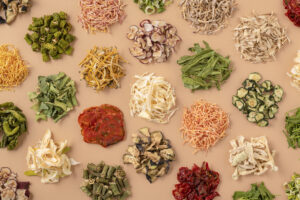
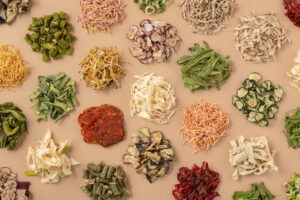
Vegetable powder is a food material made by processing raw or dried vegetables into a fine powder. Powdered while retaining the vegetable's natural flavor, color, and nutrients, it is used for a wide range of purposes such as soups, bakery, confectionery, and nutritional supplements.
In the food and health food industries, it draws attention as a means of improving processability while raising material shelf stability, and in OEM manufacturing it is used for purposes such as replacing colorants and fortifying nutrition.
English notation / reading: vegetable powder / yasai paudaa / vegetable powder
Features and background of vegetable powder
The prototype of vegetable powder lies in "powder-processing technology," which developed amid the postwar flow of preserved-food technology and space-food development. Dried vegetables are ground and, Spray drying and Freeze-dried with technologies such as these, a stable particle size and quality are secured.
Within Japan, as part of the 6th-Industrialization of farm produce, cases of farmers across the country adopting it are increasing, and it is used for "the effective use of off-spec vegetables that were being discarded" and for "developing regional brand products."
In particular, it is drawing attention alongside keywords such as "additive-free," "naturally derived," and "Gluten-Free」「allergen-free," and demand is expanding as a material for children's foods, vegan products for overseas markets, and foods with functional claims. Because it is in powder form, it is easy to add flavor and color in small amounts, making it valued as a commercial ingredient as well.
Examples of vegetable powder use at Agriture
At Agriture, in the processing of dried vegetable raw materials, we manufacture vegetable powder that can be customized by vegetable—from coarse to fine powder. All raw materials used are domestically grown, additive-free and sugar-free as a rule, and we are particular about a production method that seals in color, aroma, and nutrition as they are.
For example, dried okra can be finely milled to make a soup material that uses the body of water-soluble pectin, and Kyokurenai carrot can be finely powdered to serve as a natural red material for Western and Japanese confectionery without colorants.
Furthermore, from an upcycling perspective, we are advancing efforts to powder off-spec vegetables and surplus goods, reducing waste while converting them into high-value-added products. We also support small-lot OEM, and it is used for original powder mixes and for rollouts as branded ingredients.
Related keywords
Vegetable flakes
Superfoods Powder
Functional vegetable materials
Additive-free colorants
Related articles
Solve Vegetable Aversion Too! Product Ideas for Vegetable Powder You Can Keep Up with Every Day
How to start OEM products using vegetable powder | How to differentiate for restaurants and retail
FOR BUSINESS
乾燥野菜を業務用でお探しですか
国産の野菜・果物を乾燥し、必要に応じて粉砕してお出ししています。扱っている品目は100種前後で、規格は 乾燥品の一覧・パウダーの一覧 に掲載しています。
少量でのご購入は、姉妹ブランドの通販サイト OYAOYA で承っています。
FAQ
Q. What dishes can vegetable powder be used in?
A. It can be used in many recipes—soups, bread, cakes, pasta, baby food, granola, smoothies, and more. It is widely used for coloring, nutritional fortification, and adding flavor.
See here for commercial vegetable powder
Q. Isn't nutrition lost by turning it into powder?
A. Some heat-sensitive vitamins may decrease, but minerals, Dietary fiber, and pigment components are relatively likely to remain, making it effective as a nutritional-supplement material.
Q. How long is the storage period?
A. It depends on the storage environment, but with proper dry conditions and light-blocking packaging, room-temperature storage of about six months to one year is possible. After opening, be careful of humidity and it is best to use it up early.