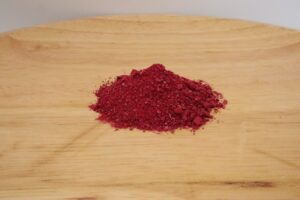
Okra powder

Okra powder is a raw material made by drying and finely milling domestically grown okra, intended to spread okra's water-soluble dietary fiber (the sticky component) and natural thickness uniformly through Japanese-style soups, sauces, baby food, and functional powders. By powdering it, the function of "spreading thickness uniformly through liquid" — hard to achieve with fresh or dried okra — can be supplied as a powder with stable quality. At Agriture, Dried okra (a type that keeps the slice shape), we powder it by adding a fine-powdering process.
Because water-soluble dietary fibers such as pectin are concentrated as a powder, it can be developed broadly as a thickening ingredient for soups, sauces, baby food, and functional foods. Prototyping is accepted from 1 kg of raw material.
TOC
Agriture's okra powder: three points of commitment
1. Low-temperature drying that makes use of the sticky component
Okra's thickness derives from water-soluble dietary fibers such as pectin, and if high-temperature heating is prolonged the components denature and the viscosity drops. By finishing at a low temperature range from the raw-material drying stage and suppressing heat generation during milling, we finish it into a powder that develops thickness smoothly when reconstituted in water. It suits differentiation design, such as an easy-to-drink type that adds natural thickness to green juice or smoothies.
Product catalog showing the items we handle
Flexible support from small lots to large lots
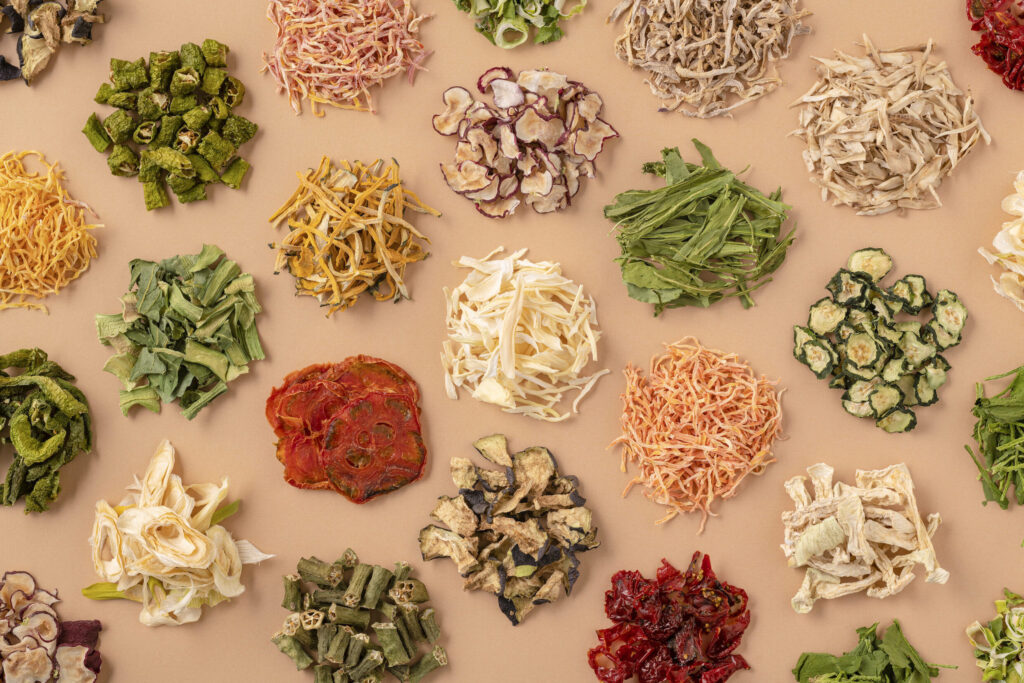
- Sold in small lots from 1 kg
- Handling heirloom vegetables from across Japan
- Dried fruits and herbs also supported
Features of commercial okra powder
Natural thickening
Water-soluble dietary fibers such as pectin are concentrated, adding natural thickness to soups, sauces, and baby food. It suits natural-type products that avoid chemical thickeners.
Rich in water-soluble dietary fiber
Its dietary fiber makes functional claims easy to communicate, and it can be used as an ingredient in health foods and functional powders.
Dispersibility in liquids and powders
Because it is a fine powder, it clumps less even when dissolved in water or dashi, and mixes uniformly into soup, sauce, and beverage bases. It also suits powder-to-powder premixing, a specification with high freedom in formulation design.
Combined use with other vegetable powders
Adding it to green powders such as broccoli and Swiss chard lets you design functional powders with enhanced drinkability and mellowness.
Use together with the ingredient-shape version
For applications where you want to keep the texture, dried okra; for applications where you want to spread thickness uniformly, powder — you can use them accordingly.
Product specifications (commercial)
The basic specifications at the prototype stage are as follows. Procurement lots, delivery dates, and packaging forms for mass production and OEM are settled through individual consultation.
| Item | Details |
|---|---|
| Product name | Okra powder |
| Raw material | Okra (domestically grown) |
| Shape | Fine powder (dried and ground) |
| Appearance | Pale green to yellow-green fine powder |
| Aroma | The gentle green-leaf aroma characteristic of okra |
| Net content | Individual quote according to use and lot |
| Best-before date | About 6 months from the shipping date |
| Storage method | Avoid high temperature, high humidity, and direct sunlight; after opening, seal and store in a cool, dark place |
| Processing plant | Our own processing plant within Kyoto Prefecture |
| Minimum prototype lot | From 1 kg of raw material |
Customization support
| Item | What we support |
|---|---|
| Thickness design | Adjust the target viscosity through the combination of dilution ratio and powder blend ratio |
| Blend design | Soup-base prototyping with other vegetable powders, dashi powder, and salt |
| Packaging form | Commercial bulk, sticks and small bags, spice jars, canisters, and more |
| OEM productization | End-to-end handling through Japanese-style soups, sauces, baby food, functional powders, and smoothies |
| Raw material supply | Besides our own raw material, we also support contract drying and grinding at a specified growing region |
For those who want to make use of texture (raw material shape version)
For soup and miso soup ingredients, aemono, frozen-food ingredients, and the like, applications that make use of the texture and appearance of slices are best served by dried okra (a type that keeps the sliced shape). The crisp presence of okra and the star-shaped cross-section that powder cannot deliver come through.
Commitments to variety, grower, and growing region
Okra is a vegetable of the genus Abelmoschus in the Malvaceae family, and its pods are eaten. There are variety groups such as green okra, red okra, white okra, and round okra, differing in the strength of the sliminess and the pod size.
Main growing region
| Growing region | Features |
|---|---|
| Kagoshima Prefecture | Japan's largest okra growing region. Supports year-round shipping |
| Kochi Prefecture | Soft pods in a warm climate |
| Okinawa Prefecture | A growing region for island okra and round okra. Strong stickiness |
| Kumamoto Prefecture | One of the major growing regions for commercial okra |
Using varieties differently
Five-sided okra has a good balance of stickiness and texture and is used as a general powder raw material. Round okra and island okra have strong sliminess, suited to functionality-focused powders. Red okra suits powders where you want to add a faint pink from the skin pigment, but because it turns green when heated, the powder color is basically pale green.
Powdering technology and quality control
Protecting the water-soluble dietary fiber
Water-soluble dietary fibers such as pectin denature and lose viscosity with high-temperature, long-duration heating. By adjusting the drying temperature range and time and suppressing the frictional heat during milling, we maintain a quality that develops firm thickness when reconstituted in water. Commercial bulk uses moisture-proof, light-blocking aluminum bags, and small bags and sticks use moisture-proof film — a specification we propose to maintain quality during storage.
TIPS: Formulations that make the most of okra powder
When using it in soups and sauces, 2–3 g per 200 ml of liquid is a guide, giving natural thickness. Because it clumps easily when shaken directly into boiling water, either dissolve it in a little cold water first before adding, or pre-blend it with other powders (dashi powder, salt) before adding for smooth dispersion. In baby food, mixing 0.5–1 g per 100 g of okayu adds thickness for an easier-to-eat texture. In functional powder mixes, a 10–20% blend relative to other green powders lets you design in natural thickness while suppressing grassiness.
Use cases and adoption examples
Because the powder disperses uniformly in liquids and powders and spreads thickness, it can be developed for applications the sliced shape cannot reach. We organize the applications we are often consulted about. From soup bases, sauce ingredients, and functional mixes, we handle everything through to mixing and bagging at specified ratios.
Related articles and other vegetable raw materials
These are the vegetable powders and related raw materials handled by Agriture. Please use them for blend design with okra.
- Dried okra: A type that keeps the slice shape
- Broccoli powder: Green powder
- Swiss chard powder: Colorful vegetable powder
- Zucchini powder: a mild green vegetable powder
- Food OEM Directory: A consultation window for OEM projects
Product catalog showing the items we handle
Flexible support from small lots to large lots
- Sold in small lots from 1 kg
- Handling heirloom vegetables from across Japan
- Dried fruits and herbs also supported
Frequently asked questions
What is the difference between dried okra (sliced shape) and powder?
Dried okra is a type that keeps the sliced shape, suited to applications that make use of the texture and star-shaped cut — soup ingredients, aemono, frozen foods. The powder, being finely milled, suits applications where you want to spread thickness uniformly — soups, sauces, baby food, functional powders, and so on.
How much thickness does it produce?
2–3 g per 200 ml of liquid gives natural thickness. It is not as strong a viscosity as a chemical thickener, but a mellow thickness derived from okra's own water-soluble dietary fiber. The target viscosity can be adjusted through the combination of dilution ratio and powder amount. Because it clumps easily when shaken directly into boiling water, we recommend dissolving it in a little cold water first, or pre-blending it with other powders. We accommodate pre-blending with green powders such as broccoli and Swiss chard, and with dashi powder, salt, and the like. If you share the formulation you are aiming for in the finished product — soup bases, functional mixes, and so on — we handle everything from mixing to bagging at that ratio.
What is the minimum prototype lot?
Prototyping is accepted from 1 kg of raw material. For mass production and OEM, we propose a quote and delivery timeline individually. You can consult us all the way through to finished products such as Japanese-style soups, sauces, baby food, functional powders, and smoothies.
Please tell me the best-before date and how to store it.
The best-before date is about 6 months from the shipping date. Because it absorbs moisture easily and clumps readily, store the unopened product away from high temperature, high humidity, and direct sunlight, in a cool, dark place at room temperature. After opening, transfer it to a sealed container and use it up within 1–2 months as a guide.
What applications are you consulted about often?
We are often consulted about thickening for Japanese-style soups and sauces, swallowing support for baby food and nursing-care food, functional powder mixes, adding richness to smoothies, and more. It is prototyped in natural-type and functional foods where you want to produce a natural, vegetable-derived thickness without using chemical thickeners.