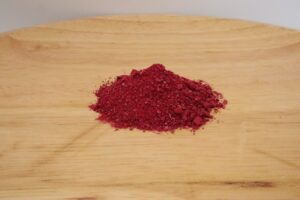
Swiss chard powder

Swiss chard powder is an ingredient made by drying and finely powdering Swiss chard, which has diverse stem colors such as red, yellow, white, and pink, intended to spread vivid color and vegetable sweetness evenly into confectionery, smoothies, green powders, and colorful powder mixes. It is characterized by color derived from vegetable-based natural pigments such as betacyanin (red hues) and betaxanthin (yellow hues). At Agriture, from the same raw material as dried Swiss chard (a type that keeps the leaf shape), we powder it by adding a fine-powdering step.
Swiss chard, drawing attention as a colorful vegetable, becomes easy to extend—by powdering it—to "show off with color" final products such as confectionery batters, smoothie mixes, and colorful powders. Prototyping is accommodated from 1 kg of raw material, and powdering by stem color can also be handled individually.
TOC
Agriture's Swiss chard powder: three commitments
Swiss chard powder's value changes with how you make use of the stem color and the leaves' green. At Agriture, we manage everything from drying to grinding and packaging at our own processing facility and also accommodate powdering by stem color and by leaf.
1. Powdering by stem color lets you design the color
Swiss chard has diverse stem colors—red, yellow, pink, white, orange, and more. By separating the stems and leaves and powdering them, you can make color-specific ingredients—red powder (from betacyanin), yellow powder (from betaxanthin), and green powder (leaves only). As a colorful vegetable powder, this raises the freedom of color design in confectionery, smoothies, and powder mixes.
2. Low-temperature drying and grinding that protect the pigments
Betacyanin and betaxanthin are natural pigments that readily fade with heat. By finishing at a low temperature range from the raw-material drying stage and operating under conditions that curb heat generation during grinding, we make it easier to retain vivid color even after powdering. We record temperature, grinding time, and lot size from the prototype stage and reproduce the same color during mass production.
Product catalog showing the items we handle
Flexible support from small lots to large lots
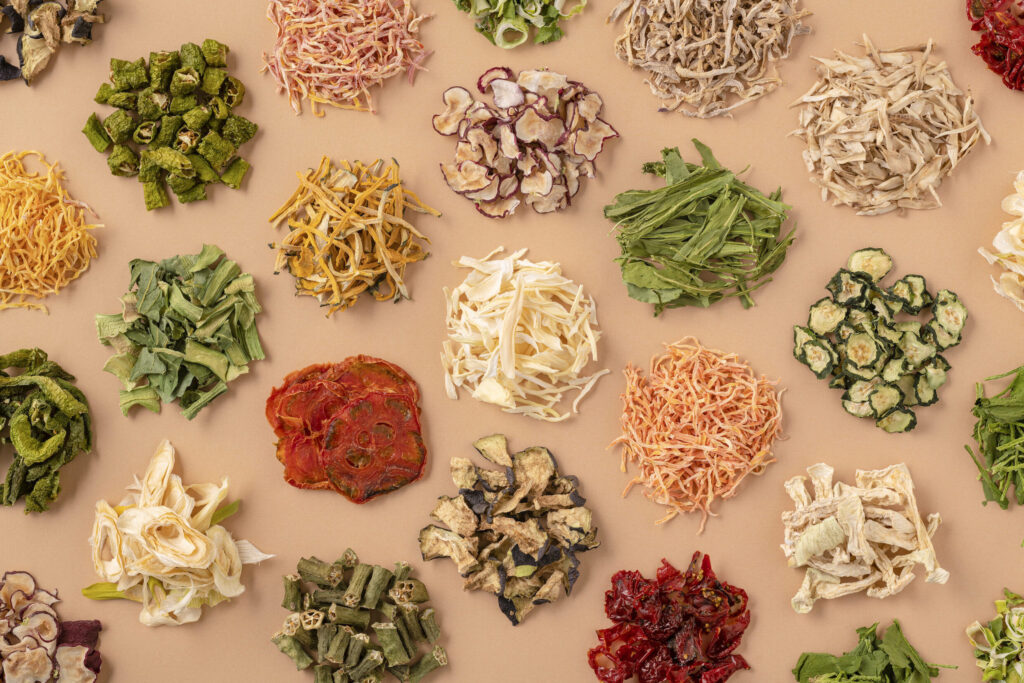
- Sold in small lots from 1 kg
- Handling heirloom vegetables from across Japan
- Dried fruits and herbs also supported
Characteristics of commercial Swiss chard powder
Colorful coloring
It has diverse colors by part—stem and leaf—such as red, yellow, pink, and green. By making powders separately for each pigment, you can design colorful powder mixes.
Natural sweetness derived from the vegetable
It has the sweetness characteristic of the Amaranthaceae family, and even added to smoothies or confectionery it does not have a strong grassy note. It is a material easy to use in powder mixes for children and the health-conscious.
Dispersibility in liquids and powders
Disperses evenly into smoothies, beverages, and batters. It is suited to the "spread only color and aroma" use that is difficult with the leaf or stem form.
Easy to build into vegetable-powder blends
Because it is handled on the same line as other vegetable powders such as broccoli, okra, and zucchini, pre-blend design of green powders and colorful mixes is possible.
Use together with the ingredient-shape version
For uses where you want to keep the stems' texture, dried Swiss chard; for uses where you want to spread color evenly, powder—you can use them differently.
Product specifications (commercial)
The basic specifications at the prototype stage are as follows. Procurement lots, delivery dates, and packaging forms for mass production and OEM are settled through individual consultation.
| Item | Details |
|---|---|
| Product name | Swiss chard powder |
| Raw material | Swiss chard (domestically grown, leaves and stems) |
| Shape | Fine powder (dried and ground) |
| Appearance | Fine powder in red, yellow, pink, and green by stem color (leaves only are deep green) |
| Aroma | A gentle green-leaf aroma characteristic of the Amaranthaceae family, with a faint sweetness |
| Net content | Individual quote according to use and lot |
| Best-before date | About 6 months from the shipping date |
| Storage method | Avoid high temperature, high humidity, and direct sunlight; after opening, seal and store in a cool, dark place |
| Processing plant | Our own processing plant within Kyoto Prefecture |
| Minimum prototype lot | From 1 kg of raw material |
Customization support
| Item | What we support |
|---|---|
| Stem-color specification | Selectable from red, yellow, pink, or an all-color mix |
| Part specification | Leaves only (green powder) / stems only (pigment powder) / a leaf-and-stem blend |
| Blend design | A green-powder blend with broccoli, okra, zucchini, and the like |
| Packaging form | Commercial bulk, sticks and small bags, spice jars, canisters, and more |
| OEM productization | Consistent handling through to final products—smoothie mixes, aojiru, confectionery materials, and colorful powder mixes |
For those who want to make the most of the stems' texture and appearance (raw-material form version)
For uses that make the most of the leaf or stem shape—salad toppings, soup ingredients, colorful ingredients for frozen foods—uses that make the most of the leaf or stem shape we recommend dried Swiss chard (a type that keeps the leaf and stem shape). The presence of the colorful stems enhances the look of the table and the menu.
Commitments to variety, grower, and growing region
Swiss chard is a leafy vegetable of the genus Beta in the Amaranthaceae family, also called "fudanso" and "seiyo-fudanso" in Japan. Variety groups with colorful stem colors are distributed as "rainbow chard" and "bright lights" and are used in salads, stir-fries, and smoothies.
Main growing region
| Growing region | Features |
|---|---|
| Nagano Prefecture | A production area of highland vegetables. The leaf color is vivid in summer |
| Ibaraki Prefecture | The main production area of commercial Swiss chard. Accommodates stable supply |
| Kyoto Prefecture | A cultivation track record as a Kyoto vegetable. Accommodates small-lot distinctive raw materials |
| Shizuoka Prefecture | Year-round cultivation in a warm climate. Good uniformity of stem color |
Using varieties differently
Rainbow chard has diverse stem colors and is suited to colorful powder mixes. Bright lights has more stable color and is suited to confectionery. White-stem White Chard is suited to green powders where you want to bring out the leaves' green strongly.
Powdering technology and quality control
Protecting betacyanin and betaxanthin
Both the betacyanin of red-hued stems and the betaxanthin of yellow-hued stems are heat-sensitive pigments. If fading progresses due to frictional heat during grinding, red leans toward brown and yellow toward a dull beige. We adjust the grinding lot's size, rotation speed, and rest time and operate under conditions that keep the powder temperature low.
Separate processing of stems and leaves
Because the stems and leaves differ in pigment composition, moisture content, and fibrous properties, separating them for drying and grinding lets you make the targeted color of powder. You can choose the supply form according to the use—stems-only powder, leaves-only powder, or a powder mixing both. Red-stem powder develops a more vivid color when combined with an acid (such as lemon juice). In confectionery batter, kneading in about 1–2% relative to the flour makes the color easier to retain after baking. For green-powder uses, using leaves-only powder brings out a deeper green. For colorful-powder-mix uses, preparing the three colors—red, yellow, and green—separately and blending them at the time of use enables high-freshness color design.
Use cases and adoption examples
Because the powder disperses evenly into liquids and powders, it extends to uses that the leaf or stem form cannot reach. We organize the uses we are often consulted about. We carry out everything through to mixing and bagging at a specified ratio—green-powder mixes, colorful vegetable mixes, and the like.
Related articles and other vegetable raw materials
These are the vegetable powders and related raw materials handled at Agriture. Please make use of them for blend design with Swiss chard.
- dried Swiss chard: a type that keeps the leaf and stem shape
- Broccoli powder: suited to green-powder blends
- Zucchini powder: a mild-flavored green vegetable powder
- Red shiso powder: A vivid red-purple Japanese-style powder
- Food OEM Directory: A consultation window for OEM projects
Product catalog showing the items we handle
Flexible support from small lots to large lots
- Sold in small lots from 1 kg
- Handling heirloom vegetables from across Japan
- Dried fruits and herbs also supported
Frequently asked questions
What is the difference between dried Swiss chard (leaf and stem form) and the powder?
Dried Swiss chard is a type that keeps the leaf and stem shape and is suited to uses that make the most of appearance and texture—salad toppings, soup ingredients, coloring for frozen foods. Because the powder is a fine powder, it is suited to uses where you want to spread color and aroma evenly—smoothies, confectionery batters, colorful powder mixes.
Is powdering by stem color possible?
It is possible. We accommodate powdering with the part and color separated according to the use—red-hued stems (from betacyanin), yellow-hued stems (from betaxanthin), leaves only (green), and so on. You can use it for designing colorful powder mixes and prototyping confectionery materials targeting a specific color. We accommodate pre-blending with vegetable powders such as broccoli, okra, zucchini, and red shiso. We carry out everything through to mixing and bagging at a specified ratio—green-powder mixes, colorful vegetable mixes, and the like.
What is the minimum prototype lot?
We accept prototyping from 1 kg of raw material. For mass production and OEM, we propose quotes and lead times individually. You can consult us consistently through to final products—smoothie mixes, aojiru, confectionery materials, colorful powder mixes, and so on.
Please tell me the best-before date and how to store it.
The best-before date is about 6 months from the shipping date. Because the pigments readily fade with light and moisture, while unopened avoid high temperature, high humidity, and direct sunlight, and store in a cool, dark place at room temperature. After opening, we recommend transferring it to an airtight container and using it up within 1–2 months as a guide.
What applications are you consulted about often?
We are often consulted for smoothie mixes and aojiru, confectionery and bakery, colorful powder mixes, health foods, and baby and toddler food. Because the color variation and the natural vegetable-derived sweetness come alive, it is prototyped in final products where you want to add value on both the appearance and nutrition sides.