dried Swiss chard


TOC
Product Overview of Dried Swiss Chard
Swiss chard is a vegetable characterized by vividly colored stalks and a flavor resembling spinach. Kyoto-grown Swiss chard in particular has a juicy flavor with little peculiarity and is used broadly both raw and heat-cooked. Drying keeps its vivid coloring and nutritional value over the long term, making it an ideal ingredient for dishes that call for color and nutritional value.
Made into powder, it can add a vividly colored accent to soups and pasta sauces, useful for health-conscious product development beyond the food-and-beverage field.
Three commitments Agriture values
01 Colorful Kyotango Swiss chard cultivated by partner farmers
Swiss chard characterized by vividly colored stalks in red, yellow, pink, and more is carefully grown open-field by our partner farmers in Kyotango. As a leafy vegetable where both stalk and leaf can be used without waste, we have arranged a system for stable supply in commercial lots.
02 Low-temperature drying that makes the most of the color development
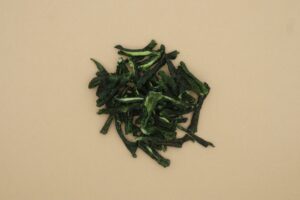
Swiss chard's vivid pigment fades right away if the heating temperature is too high. At Agriture, removing moisture slowly at low temperature processes it while keeping the colorful stalks and the green of the leaves. It is finished as a visually striking raw material.
03 Primary processing with zero glucose or additives
We use no glucose coating or preservatives to suppress bitterness or harshness. Because it is dried in the state of the ingredient just as it is, it is a raw material easy to adopt for organic brands and clean-label-oriented product development.
Product catalog showing the items we handle
Flexible support from small lots to large lots
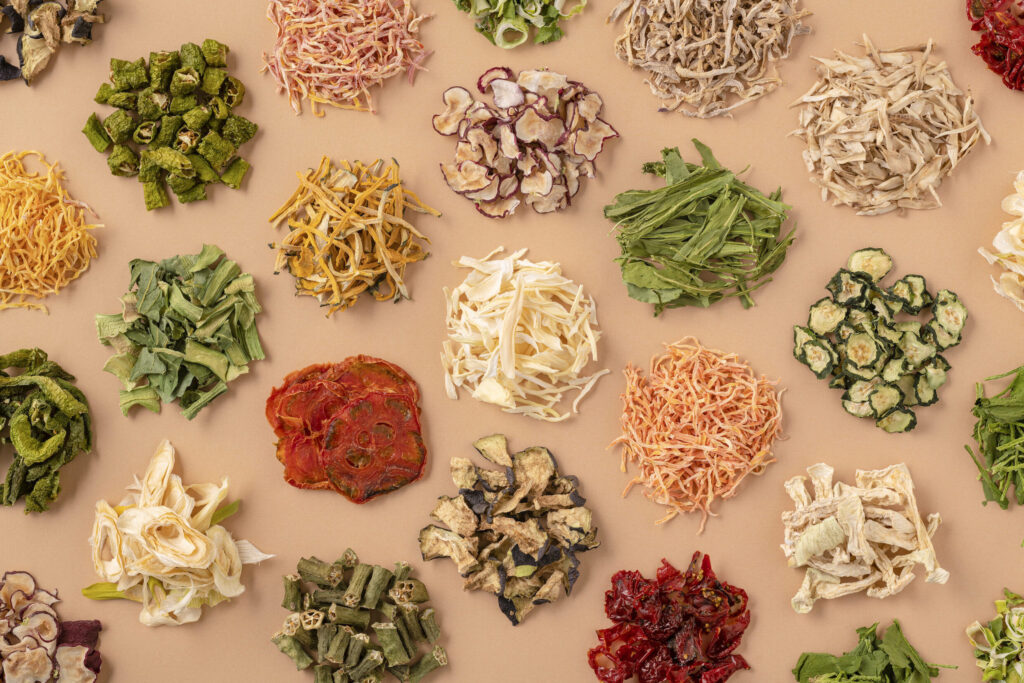
- Sold in small lots from 1 kg
- Handling heirloom vegetables from across Japan
- Dried fruits and herbs also supported
Characteristics as a commercial raw material
A rare colorful leafy vegetable
Precisely because it is a leafy vegetable rarely seen in supermarkets, there is value in being able to procure it stably in commercial lots. It performs as a colorful component in salad mixes and pasta sauces.
The color resists fading even when heated
Because the stalk color development remains even when added to soups, pasta, and stir-fries, the color stands out in recipe photos and menu photography. It is a primary material also prized in year-round frozen-prepared-food development.
An easy-to-handle leafy vegetable with little bitterness
With bitterness gentler than spinach, it blends into a wide range of dishes. It is a material easy to incorporate into healthy menus that address vegetable deficiency and into products for children.
Ease of use with no rehydration needed
Just adding it directly to soup, it rehydrates soft in a few minutes. Easy to build into store operations, it is a commercial-oriented design that reduces prep labor.
Reducing disposal loss with dried storage
Fresh leafy vegetables have a short shelf life even refrigerated and tend to produce disposal loss. The dried product allows long-term room-temperature storage and efficient operation using only what you need.
Flexible support for OEM uses too
Ground into powder, it can also be used as a dressing or bread-kneading material. We can accommodate OEM requests for original product development to match lot and specification.
Product specifications
Item | Details |
|---|---|
Raw material growing region | Kyoto Prefecture (partner farm) |
Specification | Rough cut |
Storage method | Room temperature (store away from high heat and humidity) |
Best-before date | 6 months from the shipping date |
Minimum lot | From 10 bags / 100 g |
Powder | Available |
Manufacturing period | Summer |
Customization and OEM support
Through cooperation with partner farmers and our own processing facilities, Agriture achieves stable raw material supply and high-quality manufacturing. We can flexibly accommodate OEM manufacturing and also handle consultations on specification changes and packaging.
- Custom-size support (cut-thickness changes, shape adjustments): consultation available for orders of 10 kg or more
- OEM support: available (from small-lot prototyping to mass production)
- Large-lot manufacturing: available (consultation required 3 months before the manufacturing period)
POWDER
We also offer powder products
Agriture offers not only dried vegetables but also a wide range of commercial vegetable powders. If you want to use them as an ingredient for dressings, sauces, or bakery products, please also see the powder product list.
Commitments to variety, producer, growing region, and cultivation
BRAND
Variety:Swiss chard (Japanese name fudanso). A leafy vegetable with colorful stalks in red, yellow, white, pink, and more, an all-purpose material usable both raw and heat-cooked.
PRODUCER
Producer:Partner farmers centered on Kyotango, Kyoto. Based on organic fertilizer, they grow it while selecting varieties whose colorful hues stand out.
REGION
Growing region:Kyotango-grown. The summer sea breeze and temperature swings support the vividness of the leaf color.
CULTIVATION
Cultivation method:Centered on open-field cultivation, harvested from summer through early autumn. After harvest, it is brought into the processing facility in a short time and immediately fed into the low-temperature drying line.
*Reference: OYAOYA product page
Low-temperature drying that preserves the ingredient's character
At Agriture, to make the most of Swiss chard's flavor, color, and texture, we use a drying method that removes moisture slowly over time at low temperature. High-temperature hot-air drying can remove moisture in a short time, but it has the drawback of easily damaging aroma compounds, pigments, and heat-sensitive vitamins. Low-temperature drying retains as much of these components as possible while improving the material's shelf stability, and is characterized by the way the ingredient's inherent flavor rises when rehydrated.
💡 TIPS | Drying-processing trivia
The betacyanin pigment contained in Swiss chard fades easily under heating above 60℃, and ordinary hot-air drying turns the color brown. At Agriture, we use a proprietary process that removes moisture slowly at low temperature, processing it while keeping the vivid colorfulness.
Scenarios for Using Dried Swiss Chard
As a "colorful leafy vegetable," Swiss chard is seeing spreading use across a wide range of businesses—restaurants, delis, frozen foods, bakeries, and more. It is a raw material especially prized when you want to secure a stable colorful material year-round.
As a color ingredient for pasta sauces and soups
Just adding dried Swiss chard to tomato sauce or cream soup lets you add colorful hues and a leafy-vegetable texture. It is perfect for developing photogenic menu items.
As a material for salad mixes and deli products
Mixed into salad mixes dressed with oil or vinegar, it takes on a colorful expression a step different from arugula or baby leaf. It is adopted as a color vegetable in delis and takeout prepared foods too.
As an ingredient for quiche, omelets, and frittata
As a leafy vegetable that pairs well with egg dishes, it suits ingredients for quiche and frittata. Because it can be mixed directly into the batter without rehydration, it can streamline prep for deli and cafe menus. The vividly colored leaves and stalks become a differentiating material for prepared dishes that call for color.
As an ingredient for green smoothies and juices
Powdering it for use in breakfast smoothies and vegetable juices is also popular. Because it can make the most of the vivid coloring, it suits natural-oriented beverage development that does not rely on synthetic coloring. Finely powdered, its dispersibility in liquid also improves.
Kneading into bread and baked-goods dough
Made into powder and kneaded into brioche or focaccia dough, you can make faintly tinted colorful bread. It is also recommended for developing vegetable bread for children.
About commercial and OEM consultations
At Agriture, working with partner farmers in Kyotango, we low-temperature dry Swiss chard harvested from summer through autumn at our own processing facility. As a color-retaining primary-processed material, we maintain an ongoing shipping structure for restaurants, food makers, and bakeries.
Past initiatives and adoption projects can also be seen on the following pages.
- Past initiative case studies are here
- Commercial dried vegetable OEM here
- Commercial vegetable powder here
Product catalog showing the items we handle
Flexible support from small lots to large lots
- Sold in small lots from 1 kg
- Handling heirloom vegetables from across Japan
- Dried fruits and herbs also supported
Frequently Asked Questions About Dried Swiss Chard
Q. What is the minimum lot for dried Swiss chard, and the volume per bag?
A. For commercial use, we can do business from a minimum of 10 bags at 100 g per bag. We can accommodate small lots even at the prototyping and test-adoption stage, and for mass production you can consult with us on package specifications and lot quantities.
Q. What is the commercial price range?
A. The price varies with the raw material market, specifications, lot size, and cut specifications. When you inquire, we will propose a quote to match your desired specifications and lot, so first let us know your required conditions.
Q. What is the lead time from order to delivery?
A. Stocked items can be shipped in about a few days to a week. For made-to-order or custom specifications, there are cases where we ask for a lead time of about two weeks to a month, including raw material preparation and the drying process. Consulting early provides reassurance.
Q. Can you obtain a certificate of origin for the raw material?
A. Depending on the client's request, we can prepare a certificate of origin for the raw material. Since there are cases where we can provide it together with the cultivation information of partner farmers, please let us know the documents you need in advance.
Q. Can you handle food-sanitation and HACCP compliance and export-oriented support?
A. Agriture's processing carries out hygiene management in line with the HACCP approach, and you can consult us on dried vegetable raw materials for export as well. Please also consult us on confirming requirements by destination country and label support when you inquire.
Q. For an OEM request, in what flow should I consult?
A. First, let us know your product image, lot quantity, and desired delivery date via the inquiry form. After a hearing, we propose prototyping, a quote, and a production plan, and once you approve, we schedule mass production—this is the general flow.
Q. Can you handle custom specification changes such as cut size and shape?
RETAIL
For those looking to purchase in small packs
For those who want to try Swiss chard's usability from a small quantity, our partner brand OYAOYA offers retail packs in a wide range of sizes: 10 g, 40 g, 100 g, and 500 g. They can also be used for testing before restaurant introduction, or for shelf deployment at retail stores.
Download the product catalog
We will send the materials to your email address based on the information you provide.