Dried Osmanthus

Dried kinmokusei is a commercial ingredient made from the small autumn-blooming flower kinmokusei (fragrant olive) of the genus Osmanthus in the olive family, turned into a raw material while keeping the flower's shape and aroma. It's characterized by small orange flowers clustered in racemes that give off a sweet, rich fragrance, and we lock in that color and aroma with low-temperature drying. At Agriture, we run this in parallel with a finely powdered kinmokusei powder (made to order), proposing a division of use: dried kinmokusei for applications where you want to retain the flower grains and color, and the powder for scenting syrups, doughs, and powdered products.
Compared with edible flowers and herb-type dried materials, kinmokusei differentiates itself with its "small orange flowers," its "sweet, strong fragrance," and its "staple status in Chinese tea culture, represented by osmanthus tea and osmanthus syrup." It's a material we get many prototype inquiries about—for osmanthus tea and flavored-tea blends, adding aroma and color to jellies, baked goods, and wagashi, flavoring syrups and jams, and as a craft material for potpourri and herbariums.
TOC
Three points of pride in Agriture's dried kinmokusei
1. Low-temperature drying that highlights the sweet fragrance
The appeal of kinmokusei is its sweet, rich fragrance. At Agriture, we design the process to hold down the drying temperature and remove moisture in a short time, keeping as much of the aroma in the finished product as possible. The way the sweet aroma rises when steeped in hot water is a factor that shapes osmanthus tea, syrup, and confectionery.
2. Handling that preserves the flower shape and color
Kinmokusei is handled carefully so the small flowers aren't broken up too much before drying. Keeping the flower grains conveys the character of kinmokusei—in the look when floated in osmanthus tea or a beverage, and in the color when scattered over wagashi and baked goods. You can select between a whole-flower spec and a loosened spec to match the application.
3. Ingredient production based on assessing aroma and color
At Agriture, we turn it into an ingredient by assessing the flower's vivid orange color and how the sweet aroma rises. Because aroma and color vary greatly with harvest timing and drying conditions, we check each lot's condition and then set up the supply line to match the finish required in the prototypes of osmanthus-tea, confectionery, and craft makers.
Product catalog showing the items we handle
Flexible support from small lots to large lots
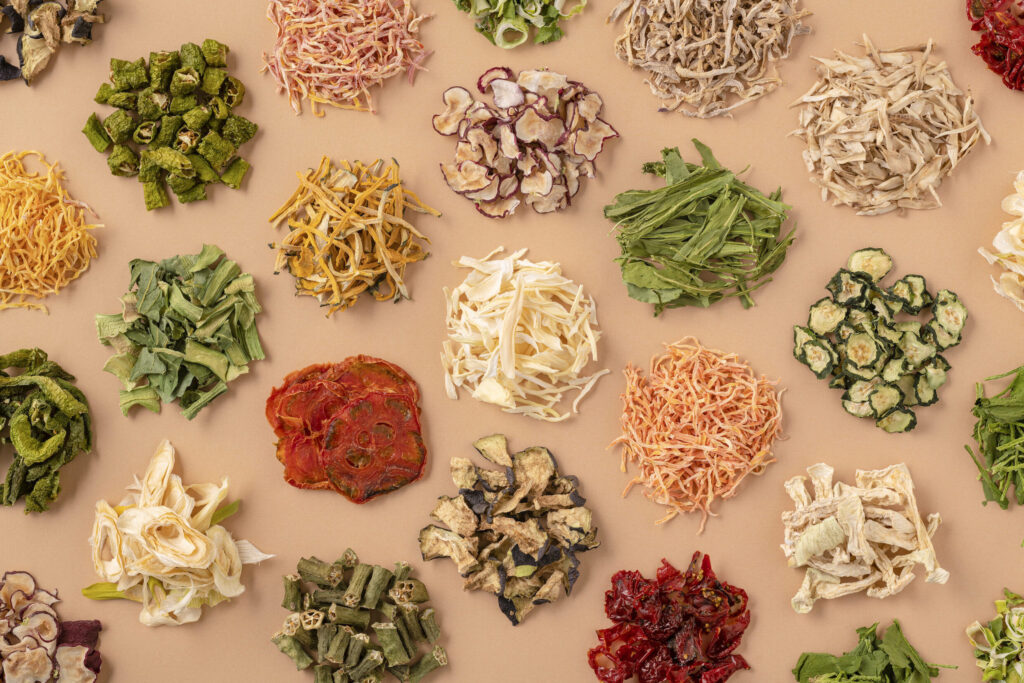
- Sold in small lots from 1 kg
- Handling heirloom vegetables from across Japan
- Dried fruits and herbs also supported
Features of commercial dried kinmokusei
Even among floral dried materials, kinmokusei holds a distinctive position with its small orange flowers, sweet fragrance, and presence in Chinese tea culture. We organize its strengths as a floral material across six perspectives.
A sweet, strong fragrance
Kinmokusei is a flower known for giving off a sweet, rich fragrance. Even in small amounts the outline of the aroma is distinct, so it suits product designs where you want aroma to take the lead—osmanthus tea, flavored tea, syrup, confectionery, and more.
Small orange flowers
Its hallmark is the way small orange flowers cluster in racemes. It can be used as a point of color that works in small touches—floating in a beverage, scattering over wagashi and baked goods—giving the kinmokusei look that other floral materials don't have.
Staple status in osmanthus tea and Chinese tea culture
As osmanthus (keika), it's a flower long enjoyed in Chinese food culture—in osmanthus tea, osmanthus syrup, and more. A dried product that can be stored at room temperature lets you bring the aroma of kinmokusei into a final product regardless of season.
Versatility across beverages and confectionery
It can be developed widely from beverages to confectionery—steeping in hot water to transfer the aroma, soaking in syrup or jam, kneading into dough. That it can deliver aroma and color at once makes it prized in the design of flavored products.
Suitability as a craft material
Taking advantage of the flower's shape and color, it can also be used as a craft material for potpourri, herbariums, sachets, and more. As a floral material that combines aroma and appearance, it suits use as an accent in sundry and gift products.
Use in combination with powder
By using it together with the finely powdered kinmokusei powder (made to order), you can design recipes that deliver both the flower grains (dried flower) and scenting for syrups and doughs (powder).
Product specifications (commercial)
Basic specifications at the prototype stage are as follows. Purchase lot, lead time, and packaging format are worked out through individual consultation.
| Item | Details |
|---|---|
| Product name | Dried Osmanthus |
| Raw material | Kinmokusei (flower) |
| Shape | Whole-flower. A loosened spec is also available depending on the application |
| Appearance | Small orange flowers |
| Aroma | The sweet, rich fragrance characteristic of kinmokusei |
| Net content | Individual quote according to use and lot |
| Best-before date | About 6 months from the shipping date |
| Storage method | Avoid high temperature, high humidity, and direct sunlight; after opening, seal and store in a cool, dark place |
| Minimum prototype lot | Inquire |
Customization support
You can consult us from the prototype stage on the flower shape, packaging, and finishing the final product. Because we keep records while refining the recipe, our setup keeps specifications from drifting between prototype and mass production.
| Item | Available | Details |
|---|---|---|
| Shape adjustment | Whole-flower / loosened | Designed as whole-flower for floating in beverages, and a loosened spec for kneading into dough |
| Powdering | Fine powder (made to order) | Suited to scenting confectionery, syrup, and beverages, and to powder blending |
| Blend design | Combining with tea leaves and other floral materials | Design of osmanthus tea, flavored tea, and herb blends |
| Packaging form | Commercial bulk / small bag / individual wrapping | From bulk for confectionery ingredients to gift and craft packs |
| OEM productization | End-to-end support through the finished product | From planning to production of osmanthus tea, flavored sweets, and syrup products |
For those considering the fine-powder type
For applications where you want to spread the aroma of kinmokusei uniformly—such as scenting confectionery, syrup, and beverages, or blending into powders—the finely powdered kinmokusei powder (made to order) is well suited. Please also see the list of powder raw materials.
Commitments to variety, grower, and growing region
Kinmokusei is an evergreen tree of the genus Osmanthus in the olive family that blooms small orange flowers in autumn and has long been enjoyed as a flower that gives off a sweet fragrance. At Agriture, we make the flower's color, how the aroma rises, and its condition after drying the axes of our ingredient design.
BRAND|The position of kinmokusei as an ingredient
Kinmokusei is a flower that has been used for scenting in Chinese food culture—in osmanthus tea, osmanthus syrup, osmanthus liqueur (guihua chenjiu), and more. At Agriture, we translate this sweet aroma and orange color into a commercial ingredient, offering it as a material usable across a wide range of final products—from beverages and confectionery to crafts.
PRODUCER | Basic policy for sourcing and coordination
We select lots with vivid flower color, strong aroma, and uniform condition by coordinating directly with suppliers. At the prototype stage we source small amounts from several suppliers, evaluate the aroma retention and color retention after drying, and then set up the supply line for mass-production lots.
SELECTION|Our approach to ingredient selection
Kinmokusei is a floral material whose life is aroma and color. At Agriture, we select the raw material by application—lots that prioritize aroma for osmanthus tea, lots that prioritize flower shape and color for confectionery and crafts. Rather than limiting the growing region, we prioritize identifying the flower that suits the finish we're after.
SEASON|Harvest timing and aroma
Kinmokusei blooms only for a short period in autumn, and its aroma rises all at once during the few days of full bloom. By swiftly moving the flowers picked when the aroma is strongest to drying, we finish an ingredient that retains the sweet fragrance.
Low-temperature drying technology and quality control
Prompt drying after picking
Kinmokusei flowers lose their aroma and dull in color easily as time passes after picking. By moving swiftly from picking to drying, we finish them under conditions that deliver both the sweet aroma and the orange color.
Retention of fragrance and color through low-temperature drying
High-temperature drying drives off the sweet aroma and dulls the flower's color easily. By removing moisture slowly in a low-temperature range, we produce a finish whose aroma rises even when steeped in hot water and whose orange color remains. As an ingredient for osmanthus tea and confectionery, we aim for an ingredient that conveys the character of kinmokusei in aroma and appearance. When using it in tea, steeping the flowers briefly in boiling water brings out the aroma. When using it in syrup, soaking the flowers in sugar or honey transfers the aroma and color to the liquid.
Use cases
We organize the applications we get prototype inquiries about at Agriture into six categories. Each is an example of recipe design that takes advantage of kinmokusei's aroma, orange color, and flower shape.
1. Osmanthus tea and flavored tea
It can be used as a scenting ingredient for osmanthus tea, or for flavored teas blended with green tea, oolong, or black tea. Steeping the flowers in boiling water brings up a sweet aroma, and the flowers floating in the beverage add color. It can be held as room-temperature stock, letting you commercialize kinmokusei tea regardless of season.
2. Wagashi and baked goods
It can be used to add aroma and color to wagashi and baked goods such as agar jelly, jelly, yokan, steamed sweets, and cookies. It can be developed into confectionery that makes use of the aroma and orange color—scattering the flowers, kneading them into dough, or turning them into syrup and pouring it in.
3. Syrup, jam, and honey-steeped preparations
It can be used as an ingredient for osmanthus syrup (tang guihua) steeped in sugar or honey, jam, and honey-steeped preparations. Steeping transfers the aroma and color to the liquid, allowing wide development—drink toppings, shaved-ice syrup, sauces for toast and yogurt, and more.
4. Drinks, cocktails, and liqueurs
It can be used to scent liqueurs represented by osmanthus liqueur (guihua chenjiu), as well as non-alcoholic drinks and cocktails. Steeping the flowers in liquor or water transfers a sweet aroma, and the flowers floated in the beverage become a visual accent. It suits the design of flavored drinks and craft liqueurs.
5. Potpourri, herbariums, and crafts
Taking advantage of the flower's shape, color, and sweet aroma, it can be used as a craft material for potpourri, sachets, herbariums, and more. As a material for sundry, interior, and gift products, it suits use as an accent in product designs that foreground both aroma and appearance.
6. Gifts and seasonal products
It can be built in as a material for autumn gift and seasonal products—seasonal-limited sweets, teas, and drinks that foreground the aroma of kinmokusei. Aroma and color make it easy to convey a sense of season, suiting the creation of talking points for gift and limited-time products. Combined with the powder, it can deliver both scenting and the flower grains.
Commercial usage and rehydration
Basics of use
- For tea and beverages: steep the flowers in boiling water for 2–4 minutes to extract the aroma. Also works blended with green tea or oolong
- For syrup: soaking the flowers in sugar or honey transfers the aroma and color to the liquid
- For confectionery: knead into dough, or scatter before or after baking to add aroma and color
- The extracted hot water or syrup carries the aroma, so it can be used as is in drinks and sweets
Blending guide
- Osmanthus tea: steep 1–2g of dried product per 150ml of hot water as a guide
- Flavored tea: blend 1–2g of dried product per 10g of tea leaves
- Syrup: soak 3–5g of dried product per 100g of sugar
- Baked goods: knead in 1–3g of dried product per 100g of dough
How to store
- Before opening: store in a cool, dark place at room temperature, away from heat, humidity, and direct sunlight
- After opening: transfer to a zip bag or airtight container and use up within 1 to 2 months
- The best-before date is about 6 months from the shipping date. Note that light and moisture absorption change the aroma and color
- Since it's a material whose aroma dissipates easily, use it up as soon as possible after opening
Related cases and articles
- Dried rose (edible rose) – a floral dried ingredient
- Dried moringa – a herb dried ingredient
- Dried Mugwort – a Japanese aroma material
- List of dried raw materials
- Consult us on food OEM and raw material supply
Product catalog showing the items we handle
Flexible support from small lots to large lots
- Sold in small lots from 1 kg
- Handling heirloom vegetables from across Japan
- Dried fruits and herbs also supported
Frequently asked questions
How does it differ from the edible rose flower?
Kinmokusei is a small orange flower of the olive family, prized for its sweet, rich fragrance. Whereas the edible rose has large, showy petals, kinmokusei clusters small-grained flowers in racemes and asserts its presence through the strength of its aroma. It has staple status in Chinese tea culture, in osmanthus tea and osmanthus syrup, and can be used for different purposes than dried rose (edible rose) by aroma and application.
How much of the aroma remains?
By moving swiftly from picking to low-temperature drying, we finish it in a way that retains the sweet aroma. The aroma rises when steeped in hot water, and you can confirm it as a flavor in osmanthus tea, syrup, and confectionery. The aroma has a tendency to dissipate easily and weakens with high-heat cooking, long storage, and moisture absorption, so care is needed with the final product's heating conditions and storage design.
Can it be used for osmanthus tea?
It's one of the applications we get the most inquiries about. Just steeping the flowers in boiling water extracts a sweet aroma, and it can be developed into a single-ingredient osmanthus tea as well as flavored teas blended with green tea, oolong, or black tea. The orange flowers floated in the beverage also serve as a visual touch, and it can be commercialized regardless of season.
How does it differ in use from kinmokusei powder?
Dried kinmokusei is for "applications where you want to retain the flower grains and color," while the powder is for "scenting confectionery, syrup, and beverages, and powder blending"—that's the division of use. Osmanthus tea and floating in beverages suit the dried flower; spreading aroma uniformly through dough or sauce suits the powder. Using them together lets you design recipes that deliver both the flower grains and uniform scenting.
What is the minimum prototype lot?
Prototype lots are available on request. You can run multiple conditions in parallel—comparing the whole-flower spec against the loosened spec, or comparing osmanthus-tea and confectionery specs, for example. You can consult us all the way through to OEM finished-product development. After hearing your intended final-product specifications, lot, and schedule, we'll propose an individual quote and lead time.
Please tell me the best-before date and how to store it.
The best-before date is roughly 6 months from the shipping date. Before opening, store it in a cool, dark place at room temperature, away from high heat, high humidity, and direct sunlight. Because kinmokusei's aroma and color change easily with light and moisture absorption, after opening we recommend transferring it to a zip-lock bag or light-blocking container and using it up within a guideline of 1–2 months. Refrigeration is also possible, but watch for condensation right after taking it out, and bring it back to room temperature before opening.
Recommended reading
- Dried rose (edible rose) – a floral dried ingredient
- Dried moringa – a herb dried ingredient
- Dried Mugwort – a Japanese aroma material
- List of dried ingredients
- List of powders
Download the product catalog
We will send the materials to your email address based on the information you provide.