Dried purple chili pepper

Purple chili pepper is a chili distinguished by the vivid purple from anthocyanin pigment, with a fruity heat and a distinctive color. Dried purple chili preserves the purple hue to the fullest through low-temperature drying, offered in three forms: whole, flakes, and coarse crush. It is a commercial ingredient that can appeal with color and heat at once, for spice mixes, drink infusion, dessert toppings, and as a coloring ingredient for noodles.
Three commitments behind Agriture's dried purple chili
01 Preserving the anthocyanin purple through low-temperature drying
The product value of purple chili lies in the "purple" itself. Anthocyanin is heat-sensitive, and high-temperature drying fades it to a brownish color. At Agriture, low-temperature drying with strictly managed temperature ranges reproduces a vivid purple close to the fresh product even in the dried form. This color-retention technology was also recognized in our supply of purple chili powder to the Nara Prefecture Miwa Somen Industrial Cooperative.
02 Fruity heat with wide-ranging uses
Compared with common red chili, purple chili has milder heat and a fruity flavor. This trait lets it extend into areas that were hard to use with conventional hot seasonings—sweets, drinks, flavored salts, and more—greatly widening the scope of product design.
03 Story appeal as a Yamato vegetable
Purple chili is a heirloom ingredient counted among Nara's Yamato vegetables. Because it is a raw material with a story rooted in regional food culture, it pairs well with brands that want to convey the tale of origin and variety on product packaging and websites, supporting high-value-added product design.
Product catalog showing the items we handle
Flexible support from small lots to large lots
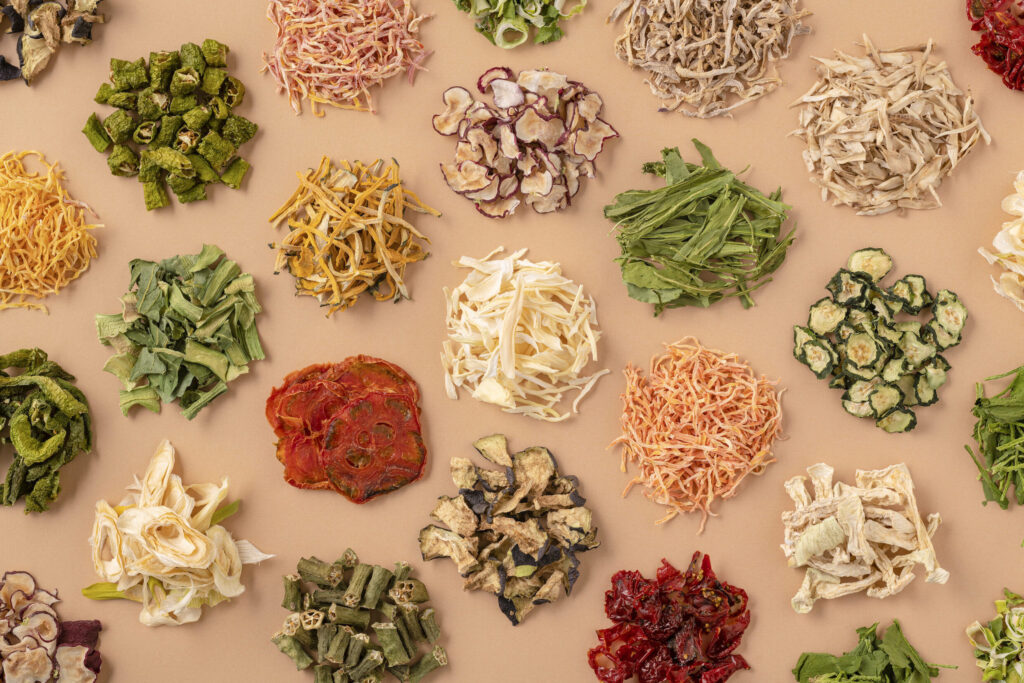
- Sold in small lots from 1 kg
- Handling heirloom vegetables from across Japan
- Dried fruits and herbs also supported
Features of commercial dried purple chili
Vivid anthocyanin purple
By curbing pigment degradation through low-temperature drying, it maintains a vivid purple even after drying. The purple remains even when powdered, creating visual impact as a kneading ingredient for noodles and sweets.
Mild, fruity heat
Rather than the sharp heat of red chili, it is characterized by a soft heat with a fruity quality. It is easily accepted even by those who dislike spiciness, and applies to areas where chili was hard to use, such as sweets and drinks.
Three forms: whole, flakes, and coarse crush
Whole (as-is) for oil pickling and display, flakes for topping pizza and dishes, and coarse crush for blending into spice mixes—we can deliver in the form that suits the use. Powdering is also available.
Six-month storage at room temperature
Because it is finished with reduced water activity, it can be stored at room temperature for about six months. Fresh purple chili has a limited distribution window, but the dried product can be stocked and used steadily year-round.
The brand value of an heirloom vegetable
Purple chili, certified as a Yamato vegetable, is a material with strong story appeal backed by regional food culture. The pitch of "a Nara heirloom vegetable" ties directly to raising product value and differentiating the brand.
Blending and formulation support
We also handle pre-blending with other spices (chili flakes, sansho, yuzu peel, etc.). You can consult us from the raw-material design of original shichimi or flavored salt, advancing to commercialization while repeating prototype runs of blend ratios.
Product specifications (commercial)
Item | Details |
|---|---|
Raw material | Purple chili (domestic) |
Shape | Whole / flakes / coarse crush (powdering also available) |
Production method | Low-temperature hot-air drying |
Best-before date | About 6 months from production |
Processing plant | Our own processing plant within Kyoto Prefecture |
Shipping unit | 100g〜 |
Minimum-lot OEM | Prototype from 1kg / full production from 10kg |
Customization support
Item | Available | Details |
|---|---|---|
Form change | ◎ | Selectable from whole, flakes, coarse crush, and powder |
Powdering | ◎ | Supports fine-powder processing as purple chili powder (with a track record) |
Small-lot OEM prototyping | ◎ | Prototyping available from 1kg |
Mixed materials and blends | ◎ | Blending with other spices and dried vegetables available |
Packaging changes | ◎ | Both commercial and small-portion individual packaging are available |
POWDER
A powder type is also available
We also carry "purple chili powder," a further fine-milled version of dried purple chili. It can also be blended as a kneading ingredient for noodles, as flavored salt, or as a coloring material for confectionery.
Commitments to variety, grower, and growing region
The purple chili used for our dried purple chili is a variety counted among Nara Prefecture's Yamato vegetables. Its greatest feature is the purple skin from anthocyanin, and as a variety with a fruity flavor not found in ordinary red chili, it is a rare heirloom vegetable tied to regional food culture. Agriture sources it at the harvest timing when the purple coloring is best, then begins drying that makes the most of the hue.
BRAND
Variety: Purple chili (Yamato vegetable). It is characterized by purple skin containing anthocyanin pigment and a fruity, mild heat. In drying, "how to retain the purple" is the key to quality, and we use drying programs specialized for color retention.
PRODUCER
Producer: We partner with purple chili growers centered on Nara Prefecture. With a track record of supplying purple chili powder to the Miwa Somen Industrial Cooperative, we have built a stable raw-material procurement route through collaboration with a traditional industry.
REGION
Growing region: Nara Prefecture (the Yamato region) is the main growing region. The basin's characteristic temperature swings raise deeply colored chili, and the harvest yields raw material whose vivid purple tends to remain even after drying.
CULTIVATION
Cultivation method: It is grown mainly in open-field cultivation under a management system with reduced pesticide use. After harvest it is brought to our own processing facility in Kyoto Prefecture without losing freshness, minimizing the lead time to processing to prevent the anthocyanin from fading.
Low-temperature drying technology and quality control
The most important technical challenge in drying purple chili is retaining the anthocyanin pigment. Anthocyanin is sensitive to heat, light, and oxygen, and high-temperature drying fades the purple into a brownish color. Agriture uses a low-temperature hot-air method with temperature ranges and drying times set specifically for purple chili, removing moisture while minimizing pigment breakdown.
Processing is managed consistently at our own facility in Kyoto Prefecture, ensuring traceability from raw-material acceptance inspection through shipment. Foreign-matter removal and microbial testing are built in as standard steps, and we can also issue the analysis tables and raw-material origin certificates required for OEM projects. In supplying raw material to Miwa Somen, we have a track record of clearing strict quality standards for color uniformity.
TIPS | A note on color retention
Anthocyanin is stable in acidic environments and tends to fade in alkaline ones. When powdering purple chili for use as a kneading ingredient for noodles, adjusting the dough's pH can enhance the finished coloring. Agriture also provides processing advice tailored to the raw material's characteristics, and can work with you all the way to the color design of the final product.
Use cases and adoption examples
As a kneading ingredient for noodles
Kneading purple chili powder into somen or udon dough creates distinctive noodles with a purple color. At the Nara Prefecture Miwa Somen Industrial Cooperative, purple chili powder was adopted as the raw material for "somen with Yamato vegetables," and product development combining traditional food with new processing technology is progressing. See the Miwa Somen × Agriture collaboration case here
As a blending material for spice mixes and shichimi
Flakes and coarse crush of dried purple chili are used as blending materials for original shichimi and spice mixes. Mixing in purple flakes different from red chili achieves both visual differentiation and a flavor accent at once. We also handle pre-blended delivery with other materials such as sansho, yuzu peel, and aonori. See details of spice and seasoning OEM here
As a coloring material for flavored salt and seasonings
Flavored salt made by mixing purple chili flakes with salt has visual impact as a table seasoning. Because the heat is mild, it suits uses where spiciness should not dominate, such as dipping salt for tempura or finishing salt for steak.
As a drink-infusion and infusion material
Steeping whole dried purple chili in spirits or syrup extracts a purple essence, letting you make visually vivid drinks. It is a category drawing growing interest from restaurants as a garnish for craft cocktails and a flavoring material for non-alcoholic drinks.
As a topping for sweets and chocolate
With its fruity heat, purple chili can stage a "sweet-and-spicy" taste experience combined with chocolate or caramel. Topping with purple flakes produces a photogenic look, used to develop talked-about limited-edition products.
OEM product raw material and gift development
Making use of the story of "purple chili, a Yamato vegetable," we also propose it as a raw material for gift sets and region-limited products. By tying it to Nara souvenirs and regional-brand products, it is a rare material that can imbue products with the tale of their origin. See the list of dried vegetable and spice products here
As a raw material for pet food and functional foods
As a purple material containing anthocyanin, it is also being considered as a raw material for pet treats and functional foods. Because it can produce a natural purple without using colorants, we also respond to inquiries from additive-free-oriented pet food brands and supplement makers. See details of pet food OEM here
TOC
Commercial usage and rehydration
When kneading powdered purple chili into noodle dough, adjust the blend amount according to the dough's moisture content and water-addition rate. If you want to bring out a vivid color, keeping the dough slightly acidic stabilizes the anthocyanin and makes the finished purple stand out. Optimizing blend amounts and processing conditions can be worked out together with Agriture's technical team at the prototype stage.
Related cases and articles
- Nara Prefecture Miwa Somen Industrial Cooperative × Agriture collaboration case (Adoption case)
- Purple chili pepper powder (powder-version product page)
- Spice and seasoning OEM (As a spice-mix raw material)
Product catalog showing the items we handle
Flexible support from small lots to large lots
- Sold in small lots from 1 kg
- Handling heirloom vegetables from across Japan
- Dried fruits and herbs also supported
Frequently asked questions
Q. What is the minimum lot and prototype handling?
A. We accept prototypes from 1 kg and full production from 10 kg. Simultaneous prototyping of multiple forms, such as whole, flakes, and powder, is also possible. Because it is a material where color verification matters, we proceed while verifying the finished coloring together at the prototype stage.
Q. Is the purple retained even after drying?
A. Because low-temperature drying curbs anthocyanin breakdown, it maintains a purple close to the fresh product. If you observe the storage conditions (avoiding direct sunlight and high heat), color change can be kept to a minimum within the best-before period. The purple remains even when powdered, giving sufficient coloring as a kneading ingredient for noodles and sweets.
Q. How hot is it?
A. It is considerably milder than red chili, a gentle heat with a lingering fruity aftertaste. As a guide, the Scoville value is about one-third that of red chili, kept mild enough that the heat does not stand out even when blended into sweets or drinks. However, the heat can vary by lot and harvest timing, so we recommend confirming at the prototype stage.
Q. What is the lead time?
A. In-stock items can ship within 1 to 2 weeks after order. For new custom-spec processing, prototyping takes 1 to 2 weeks and full production about 3 to 4 weeks as a guide. Please consult us in advance for large orders, so we can secure raw material in line with the purple chili harvest season.
Q. Can you issue a raw-material origin certificate?
A. We can issue a raw-material origin certificate proving that it is domestic purple chili. It can also be used when you want to reflect the "Yamato vegetable" origin appeal on product packaging.
Q. Can you deliver it blended with other spices?
A. We handle pre-blended delivery with other spices and dried materials, such as red chili flakes, sansho, yuzu peel, and aonori. You can consult us from blend design through prototyping of original shichimi and flavored salt, all in one place.
Q. Please tell me the OEM consultation flow
A. The flow is: consult via the inquiry form → concept hearing → free sample dispatch → paid prototyping → spec confirmation → full production. Because color reproduction matters for purple chili, we carefully confirm the coloring at the prototype stage and move to full production only after you are satisfied.
Recommended reading
- Miwa Somen × Agriture collaboration case (Track record of supplying purple chili powder)
- Purple chili pepper powder (details of the powder version)
- List of dried vegetable and spice products
Download the product catalog
We will send the materials to your email address based on the information you provide.