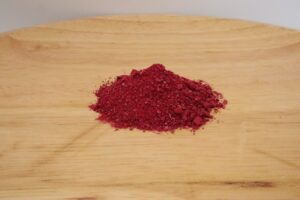
Purple chili pepper powder

Purple chili pepper powder is a commercial spice raw material made by low-temperature drying of purple-variety chili peppers with anthocyanin-type pigments, then processing them consistently through milling at our in-house processing facility in Kyoto Prefecture. Making use of the balance of purple color development, fruity top notes, and the soft pungency characteristic of the purple variety, it is an ingredient we are consulted about across a wide range of food development — Japanese, Western, confectionery, drinks, and more. We also accommodate prototyping from 1 kg of raw leaf, so For consultations on dried vegetable and powder OEM here.
TOC
Agriture's purple chili pepper powder: three points of commitment
01 A low-temperature drying profile that protects the purple pigment
The pigment component of purple chili pepper (anthocyanin-type) is sensitive to heat and light, a raw material prone to browning with ordinary hot-air drying. At Agriture, by using low-temperature hot-air drying with a suppressed product temperature, we structure the process to retain the purple color and distinctive fruity aroma in the powder. Vegetable & herb powder list we can also propose it together with other pigment-type ingredients.
02 Domestic purple variety, additive-free ingredient design
The raw material uses only domestically grown purple chili peppers procured through domestic contract routes, with no additives such as glucose, coloring, or antioxidants. As a naturally derived pigment raw material, it is finished to a specification that pairs well with additive-free, colorful-vegetable product concepts. The nutritional value and benefits of vegetable powder.
03 Comparative prototyping that balances color and pungency
In purple chili pepper, the balance of pungent and pigment components varies with variety and harvest timing. For details, see the Prototyping news for purple chili pepper powder.
Product catalog showing the items we handle
Flexible support from small lots to large lots
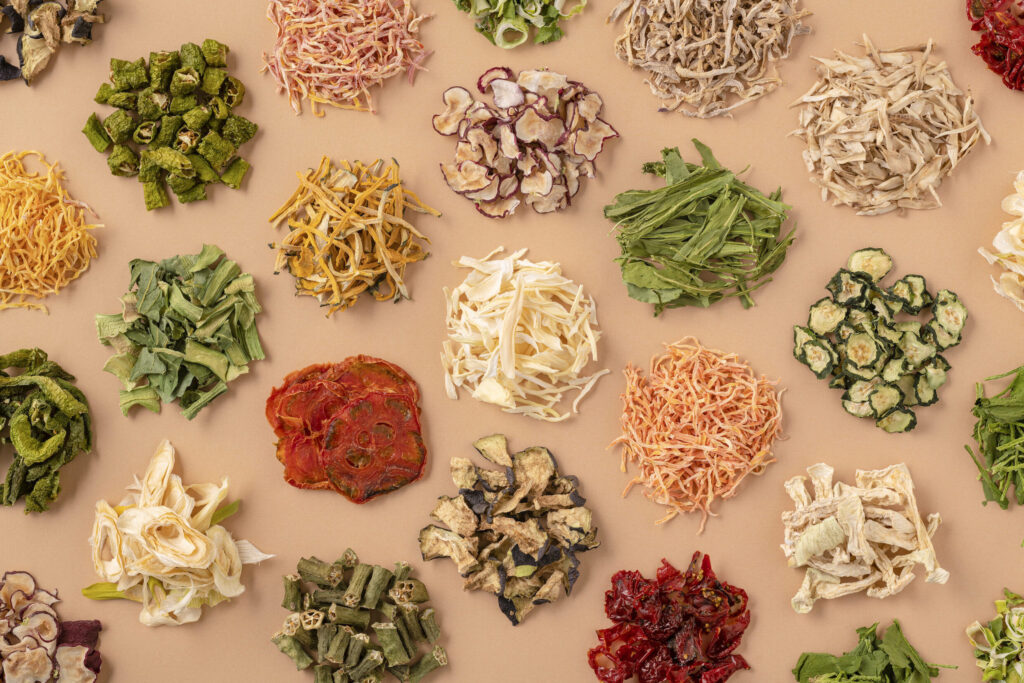
- Sold in small lots from 1 kg
- Handling heirloom vegetables from across Japan
- Dried fruits and herbs also supported
Features of commercial purple chili pepper powder
100% domestic purple variety
Uses only domestically contract-farmed purple chili peppers. Because variety, lot, and harvest timing can be traced, it is a specification easy to use in product designs accompanied by raw-material origin certificates or origin appeal.
A process that preserves the purple color
A process design that retains the pigment characteristic of purple chili pepper even after powdering, through low-temperature hot-air drying and short-duration milling. It suits product development where you want to make use of color in the appearance of packaging or dishes.
Soft pungency and aftertaste
The pungency characteristic of the purple variety is not too sharp, finishing into an aftertaste balanced with a fruity aroma. It is an ingredient easy to appeal to those who dislike overly strong heat.
Zero additives, no coloring
Glucose, dextrin, antioxidants, and colorants are all unused. It is a specification well suited to the PB development of additive-free brands that want to keep the ingredient labeling simple.
Accommodates blend design
We also accommodate pre-blending with other ingredients such as rock salt, pepper, garlic, dried tomato, and herbs. You can consult us on developing original spice mixes.
Product specifications (commercial)
|
Item |
Details |
|---|---|
|
Raw material |
Purple chili pepper (domestically grown, contract-farmed) |
|
Best-before date |
About 6 months from the shipping date when unopened (varies with storage conditions) |
|
Processing plant |
Our own processing plant within Kyoto Prefecture |
|
Shipping unit |
Choose from 500 g bag, 1 kg bag, or 5 kg commercial bag |
|
Minimum-lot OEM |
Prototyping from 1 kg of raw fruit / full production from 10 kg of raw fruit |
※ Prototyping consultation is available from 1 kg of raw fruit.
Customization support
|
Item |
Available |
Details |
|---|---|---|
|
Blend design |
◎ |
Pre-blending with rock salt, spices, and dried vegetables available |
|
OEM small-lot prototyping |
◎ |
Parallel prototyping of multiple versions available from 1 kg of raw fruit |
|
Packaging changes |
◎ |
500 g, 1 kg, and 5 kg bags can be sorted out |
|
Quality document issuance |
◯ |
Specification sheet, raw-material origin certification, microbiological test report (discussed per project) |
POWDER
Leave blend development with other pigment-type vegetable powders to us
Beyond purple chili pepper powder on its own, we also develop "colorful vegetable"-type blends combining natural-pigment dried vegetables such as beet, purple sweet potato, red shiso, and pumpkin powder. From more than 60 vegetable, herb, and fruit powders, we propose raw-material formulations tailored to your product concept.
Commitments to variety, grower, and growing region
Agriture's purple chili pepper powder uses purple-variety chili peppers harvested at domestic contract-farming plots. Purple chili pepper is drawing attention as a colorful vegetable, but grower routes able to supply it stably as a processing raw material are still limited. At Agriture, by having it shipped at a harvest timing suited to processing, we secure raw material with a balanced color, pungency, and aroma.
BRAND
Variety: Purple-variety chili peppers with anthocyanin-type purple pigment. Depending on the application, we can also propose lots with different aroma tone and pungency for comparison.
PRODUCER
Producer: Sourced directly through domestic contract-farming routes. By having it shipped at a harvest stage suited specifically to processing, we secure raw material with a balanced color and aroma.
REGION
Growing region: We work mainly with processing-use plots in warm regions. With multiple lots timed to the harvest, we maintain a flexible shipping system that matches required volumes.
CULTIVATION
Cultivation method: With managed cultivation that keeps pesticide use low,
Low-temperature drying technology and quality control
The pigment component of purple chili pepper is heat-sensitive, and if dried all at once at high temperature for a short time, browning and color loss occur readily. At Agriture, we use low-temperature hot-air drying with a suppressed product temperature, finishing it in a process that lets only the moisture escape while retaining pigment and aroma. By milling immediately after drying and minimizing contact time with oxygen and light, we operate so as to preserve the balance of purple color development and pungency.
Manufacturing is done in-house at our processing facility in Kyoto Prefecture, with consistent management from raw-material receiving inspection through shipping. It is filled hygienically through a foreign-matter removal step, and for OEM projects we issue necessary documents — specifications, raw-material origin certificates, microbiological test reports, and the like — after discussion on a case-by-case basis.
💡 TIPS|Purple Pigment Know-How
Anthocyanin-type pigments shift color tone toward red-purple on the acidic side, purple at neutral, and blue-purple on the alkaline side. When blending into bread dough, cream, or drinks, simply being mindful of the finished pH lets you express completely different colors from the same raw material. At Agriture, we can propose color-tone comparisons that account for pH conditions from the prototype stage.
Use cases and adoption examples
Seasonings and spice mixes
A use we are consulted about as a lead ingredient for shichimi-style mixes combined with salt, rock salt, pepper, and garlic powder, or for color spices that make use of a fruity heat. It also suits gift products that make the most of the vivid color.
- Suitable products: Color spice salt, shichimi mix, botanical recipes — just adding a small amount creates a color and aroma accent.
- Suitable products: Craft beer adjunct, botanical spirits
- Blending guide: 0.05–0.2% of the brewing liquid volume
- Points to note in development: The extraction behavior of color and pungency changes with alcohol concentration
- Suitable products: Craft chocolate, spice macarons, spice cookies
- Blending guide: 0.5–2% of the ingredient weight
- Points to note in development A fiber source for pet food and feed
- Suitable products: Herb dressing, ethnic-style marinade liquid, BBQ sauce
- Blending guide: 0.3–1.5% of the total sauce volume
- Points to note in development: Develops toward red-purple on the acidic side, toward purple on the neutral side
- Suitable products: Spice supplements, functional drink mixes, granule seasonings
- Blending guide: 0.5–3% of the total product volume
- Points to note in development: Design that accounts for color varying with pH differences from other ingredients
- Suitable products: Colorful spice mix, powder base for hot-pot broth, coloring for seasonings
- Blending guide: 5–15% of the whole blend
- Points to note in development: To bring out the color to the maximum, dissolving it in an acidic liquid (vinegar, citric acid, lemon juice) before blending develops it toward red-purple, while neutral-to-alkaline recipes develop it toward purple. To suppress the pungency, dispersing it first in oil or milk fat before combining gives a mellow finish.
For storage, sealed containers away from light, heat, and moisture are best. Because purple pigment fades readily with light, after opening we recommend transferring it to a light-blocking container or using nitrogen-fill operation.
- We Prototyped "Purple Chili Powder" Using Domestically Grown Purple Chili (News)
- Vegetable & herb powder list
- The nutritional value and benefits of vegetable powder
- Sold in small lots from 1 kg
- Handling heirloom vegetables from across Japan
- Dried fruits and herbs also supported
Chocolate and sweets ingredients
A use where adoption is advancing as an ingredient for craft chocolate, macarons, and galettes, making use of the contrast between purple color development and sweetness. Being able to suppress the sharp edge of the heat is a strength unique to purple chili pepper.
Dressings, sauces, and marinade liquids
A use also serviceable in ethnic-style dressings combined with vinegar and oil, and in marinade liquids for meat dishes. With its purple color and distinctive aroma, it broadens the range of expression in both Japanese and Western dishes.
Functional spices and health foods
From its context as a colorful-vegetable ingredient, consultations are increasing as a differentiating ingredient for functional spice products. It can also be added to portion supplements, tablets, and drink mixes.
Blends with other pigment-type vegetable powders
You can develop original colorful spices by blending it with naturally derived pigment-type ingredients such as beet, purple sweet potato, red shiso, and purple cabbage. Vegetable powder list we can propose combinations with it.
Related cases and articles
Product catalog showing the items we handle
Flexible support from small lots to large lots
Frequently asked questions
Q. What is the minimum lot and prototype handling?
Q. Can the pungency level be adjusted?
Q. I want to stabilize the color development.
A. Anthocyanin-type pigments each change color tone in acidic, neutral, and alkaline conditions. The trick is to decide the finished pH first, then adjust the blend ratio. So you can compare multiple pH conditions at the prototype stage, we can also attach color samples when shipping the samples.
Q. Can you issue a certificate of raw material origin and an analysis table?
A. Both a raw-material origin certificate showing it is domestically grown purple chili pepper and a microbiological test report can be issued after discussion on a case-by-case basis. We also accommodate quality requirements for mass-retail, mail-order, and gift products.
Q. Can it be blended with other pigment-type vegetable powders?
A. Yes. We can also discuss developing colorful spices combining natural-pigment vegetable powders such as beet, purple sweet potato, red shiso, and purple cabbage. We can also propose blending into Italian mixes or Japanese-herb mixes.
Q. What is the lead time?
A. When stock is available, shipping is possible around 2–3 weeks after order. For projects that include new contract farming, please plan for a lead time of 4–8 weeks in relation to the harvest timing.
Q. Please tell me the flow of an OEM consultation
A. The process runs from consultation via the inquiry form → concept hearing → sample shipment → paid prototyping (from 1 kg of raw fruit) → specification finalization → full production. We can propose specifications that account for the balance of color and pungency unique to purple chili pepper.