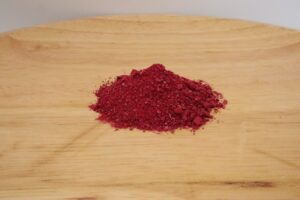
Sweet basil powder

Domestic sweet basil powder is a commercial herb raw material made by drying basil leaves harvested through domestic contract farming at low temperature and handling everything through to milling at our own processing facility within Kyoto Prefecture. Without glucose, colorants, or antioxidants, it keeps the leaf's natural aroma and deep green in the powder. It's a raw material we get many inquiries about for food product development where you want to draw on aroma and color at the same time—Italian seasoning, herb salt, confectionery dough, craft drinks, dressings, genovese-style sauces. Prototyping from 1kg of raw leaf is also available. For consultations on dried vegetable and powder OEM here Please let us know your intended use and desired specifications from
TOC
Agriture's Sweet Basil Powder: Three Points of Care
01 Process Design That Preserves the Top Note Through Low-Temperature Drying
For sweet basil, volatile components typically including linalool, 1,8-cineole, eugenol, and methyl chavicol are the focus in aroma design, and the higher the temperature rises, the faster the top note fades. At Agriture we adopt a profile that keeps the product temperature around 40°C while letting only the moisture escape, structuring the process so the sweet, floral top note from the leaf remains even after powdering. Vegetable & herb powder list You can also consult us about blending with other materials from
02 Ingredient Design with Only Domestic Leaves and Zero Additives
The raw material is only domestic sweet basil delivered from domestic contract farms, finished without any glucose coating, colorants, antioxidants, or the like. It's a spec that also fits well with product concepts adopted in mass-retail, mail-order, and gift products, such as "domestic ingredients only" and "additive-free."The nutritional value and benefits of vegetable powder.
03 Small-lot prototypes from 1 kg of raw leaf and comparison runs
At Agriture we take on herb powder prototyping from 1kg of raw leaf, making it easy to compare sensory evaluations before commercialization—a form we get inquiries about in the early development of PB and OEM. For prototype inquiries, Basil Powder Prototype News.
Product catalog showing the items we handle
Flexible support from small lots to large lots
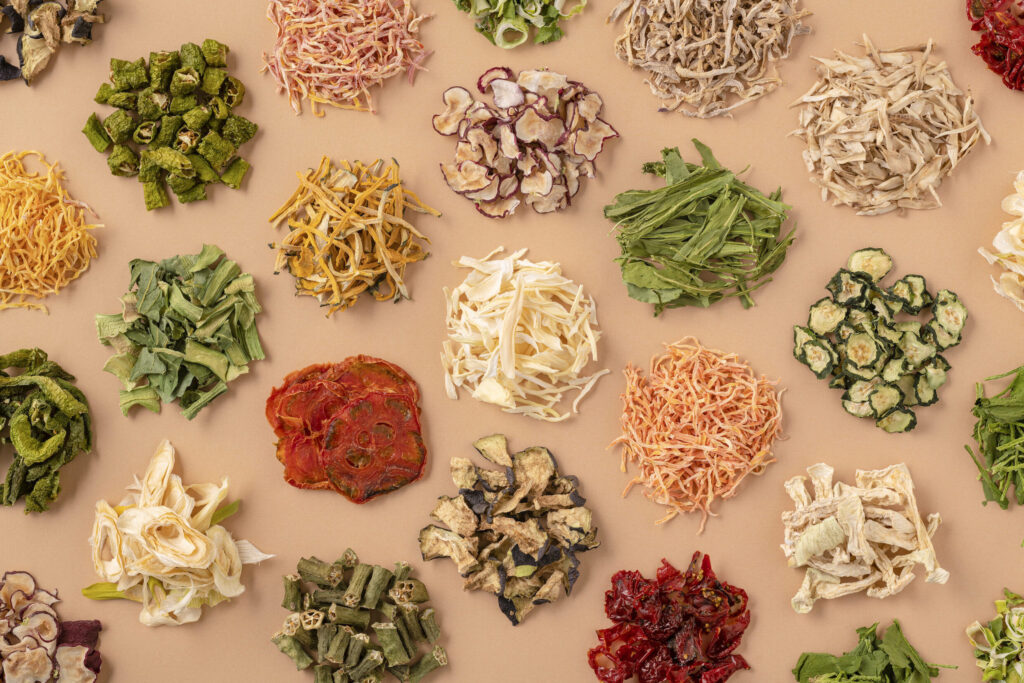
- Sold in small lots from 1 kg
- Handling heirloom vegetables from across Japan
- Dried fruits and herbs also supported
Features of Commercial Sweet Basil Powder
100% Domestic Leaves
The raw material is only domestic contract-grown sweet basil. Because variety, lot, and harvest timing can be traced, it's a spec that's easy to use in product designs that involve raw-material origin certification or origin-based appeals.
Retains the Floral Top Note
Low-temperature drying at a product temperature around 40°C suppresses aroma loss, keeping a sweet top note and cooling freshness close to fresh leaves within the powder. It's a range we get many inquiries about for aroma-adding in Italian and confectionery applications.
A deep green color
Low-temperature drying and short-time milling keep the leaf-derived green in the powder even after powdering. It's an ingredient that also works in development projects where you want to visually convey "basil-ness" in packaging or plating.
Zero additives, no coloring
Glucose, dextrin, antioxidants, and colorants are all unused. It is a specification well suited to the PB development of additive-free brands that want to keep the ingredient labeling simple.
Flexible for blend design too
Pre-blending with other ingredients like rock salt, dried tomato, and garlic powder is also available. Blend design for PB, such as Italian mixes and Japanese herb mixes, is open to discussion.
Product specifications (commercial)
|
Item |
Details |
|---|---|
|
Raw material |
Sweet basil (domestic leaves, contract-grown) |
|
Best-before date |
About 6 months from the shipping date when unopened (varies with storage conditions) |
|
Processing plant |
Our own processing plant within Kyoto Prefecture |
|
Shipping unit |
Choose from 500 g bag, 1 kg bag, or 5 kg commercial bag |
|
Minimum-lot OEM |
Prototype from 1 kg of raw leaves / main production from 10 kg of raw leaves |
*Prototype consultations are possible from 1 kg of raw leaf. By shipping 2-3 patterns of drying temperature in parallel, you can narrow down the specification that fits your use.
Customization support
|
Item |
Available |
Details |
|---|---|---|
|
Blend design |
◎ |
Pre-blending with other herbs, rock salt, and dried vegetables available |
|
OEM small-lot prototyping |
◎ |
Multiple versions can be prototyped in parallel from 1 kg of raw leaf |
|
Packaging changes |
◎ |
500 g, 1 kg, and 5 kg bags can be sorted out |
|
Quality document issuance |
◯ |
Specification sheet, raw-material origin certification, microbiological test report (discussed per project) |
POWDER
Leave blend development with other vegetable and herb powders to us
Beyond basil on its own, we also handle blend development for Italian mixes and Japanese herb mixes combining rock salt, dried tomato, garlic, oregano, and more. From over 60 kinds of vegetable, herb, and fruit powders, we propose raw-material designs to match your product concept.
Commitments to variety, grower, and growing region
The leaves used in Agriture's sweet basil powder are sourced directly from domestic contract farms. Because most domestic basil is distributed for fresh use, the grower routes that can stably supply it as a processing raw material are limited. At Agriture we partner with farms that can secure leaves dedicated to processing and shorten the lead time from harvest to drying, structuring a process that suppresses loss of aroma components.
BRAND
Variety: Sweet basil (Ocimum basilicum) of the genus Ocimum in the mint (Lamiaceae) family. We mainly use leaves with a genovese-type aroma, and can also compare and propose at the prototype stage while observing differences in aroma character according to use.
PRODUCER
Producer: Sourced directly from domestic contract farms. By having them harvest at a leaf-picking timing suited to processing, we secure raw material with a consistent balance of leaf thickness and aroma.
REGION
Growing region: Partnering mainly within Kyoto Prefecture with processing-use herb farms in temperate regions. By combining multiple lots by harvest timing, we've built a system close to year-round supply.
CULTIVATION
Cultivation method: With managed cultivation that keeps pesticide use low,
Low-temperature drying technology and quality control
The terpenes that make up basil's aroma are heat-sensitive, and drying all at once with high-temperature hot air volatilizes much of the top note. At Agriture we adopt low-temperature hot-air drying that keeps the product temperature around 40°C, designed to let only the moisture escape and minimize the outflow of aroma components. Right after drying we mill it, shortening the contact time with oxygen so we can structure the process to keep color development and aroma fresh.
Manufacturing takes place at our own processing facility within Kyoto Prefecture, with consistent management from raw-material acceptance inspection through shipment. We fill it hygienically through a foreign-matter-removal step, and for OEM projects issue necessary documents—specification sheets, raw-material country-of-origin certificates, microbial test reports, and so on—after consulting on each project.
💡 TIPS|Herb Drying Trivia
Herbs like basil are raw materials whose contained components change easily with variety and chemotype. At Agriture we prepare 2–3 drying profiles at the prototype stage, running things so you can compare how the aroma develops alongside sensory evaluation. Making it easier to find a spec that fits the product concept is the benefit of the herb powder prototype stage.
Use cases and adoption examples
The Lead Ingredient for Herb Salt and Seasonings
This is a use we get many inquiries about as the lead in Italian herb salt combined with rock salt, pepper, garlic powder, dried tomato, and the like. Blending in around 3–8% of the total weight makes the top note clearly perceptible, finishing into a spec usable in gift products and restaurant PB.
- Suitable products: Italian herb salt, pizza seasoning. A blend of about 2–5g per 1kg of flour is a guide, an easy use for pushing the aroma forward while keeping bitterness from coming out.
- Suitable products: Focaccia, herb scones, basil cookies, financiers
- Blending guide: 2–5g per 1kg of flour
- Points to note in development: To avoid oxidation, move to the baking step soon after preparing the batter
- Suitable products: Basil syrup, herb cordials, herbal tea blends
- Blending guide: 0.1–0.5% of the liquid volume (adjust depending on whether there is a filtration step)
- Points to note in development: sedimentation and suspension are assumed. Verify filtration suitability in advance
- Suitable products: Herb marinade liquid, herb sausage, Vegetable powder list We can propose it in combination with
- Suitable products: Original spice mixes, seasonings, powdered base for hot-pot broth
- Blending guide: 5–15% of the whole blend
- Points to note in development: To draw out the aroma to the fullest, dissolve it in advance into oil or a solvent (syrup, wine, vinegar) before adding to the main step, and the aroma spreads uniformly throughout. For recipes with a heating step, we also recommend sprinkling in half the amount at the finish as an added-basil top-up.
For storage, sealed storage away from light, heat, and moisture is best. After opening, use it up quickly, or reduce air contact with nitrogen flushing or a zip bag to keep the green color development and aroma longer.
- We Prototyped "Basil Powder" Using Domestically Grown Sweet Basil (News)
- Vegetable & herb powder list
- The nutritional value and benefits of vegetable powder
- Sold in small lots from 1 kg
- Handling heirloom vegetables from across Japan
- Dried fruits and herbs also supported
Related cases and articles
Product catalog showing the items we handle
Flexible support from small lots to large lots
Frequently asked questions
Q. What is the minimum lot and prototype handling?
Q. What is the price guideline?
A. Because domestic basil has limited distribution as a processing raw material, the unit price is higher than imported basil powder. It varies by packaging spec and lot count, so please consult our inquiry form for an accurate quote. If you tell us your product concept, we'll also propose lot design along with an estimated unit price.
Q. What is the lead time?
A. If stock is available, we can ship in about 2–3 weeks after order as a guide. For projects involving new contract farming, please plan for a lead time of 4–8 weeks depending on the harvest timing. Herbs have strong raw-material seasonality, so for projects with a visible annual required volume, consulting us the year before makes it easier to plan a stable supply.
Q. Can you issue a certificate of raw material origin and an analysis table?
A. Both a raw-material origin certificate showing the basil is domestic and a microbiological test report are issued after discussion on a per-project basis. We can also discuss quality requirements for mass-retail, mail-order, and gift products, as well as documentation requirements for export.
Q. Can it be blended with other herbs or vegetable powders?
A. Yes. From over 60 kinds of vegetable, herb, and fruit powders that Agriture dries and processes, we can propose blend designs to match your product concept. We also handle PB development such as Italian mixes, Japanese herb mixes, and vegetable-broth mixes.
Q. Can you handle projects for overseas markets?
A. The scope of required documents and the terms of support are decided after discussion on a per-project basis. We have experience supporting projects for food makers with overseas transactions, so please inquire together with your shipping form and labeling requirements.
Q. Please tell me the flow of an OEM consultation
Recommended reading
Dressings, Sauces, and Genovese-Style Paste
Thanks to a dispersibility that lets it go straight into emulsion dressings and emulsified sauces, this is a use we get many inquiries about for stable blending in genovese-style sauce and as an alternative raw material on lines where fresh basil can't be used. It's also an area we get inquiries about in PB development of pasta sauces and pizza sauces. Because it doesn't fully dissolve, a design that accounts for the mechanism of settling and dispersion is necessary. It also suits prototyping for basil lemonade, basil soda, and craft cordials.
Flavoring Processed Meats and Delicatessen Items
Blended into an herb marinade for chicken breast or a spice blend for sausages and meatballs, it spreads the herb's top note uniformly. Because it's in powder form, the flavor doesn't easily escape in combi-oven cooking or sous-vide steps, making it a use we're getting more inquiries about in prepared-food development.