Dried asparagus

Asparagus is a vegetable in season from spring to early summer, rich in asparagine and vitamin groups, characterized by a crisp texture and sweetness. Dried asparagus is made by carefully drying domestic in-season asparagus at low temperatures, finished in slice and chip shapes. It can be used as a commercial raw material for varied applications — soups, simmered dishes, mixed rice, salad toppings, and more — and can also be ground into powder.
TOC
Three points of dedication in Agriture's dried asparagus
01 In-season domestic asparagus finished with low-temperature drying
Asparagus is in season from spring to early summer, and we use domestic asparagus harvested in this period. By drying it with a low-temperature hot-air method while freshness is high, we seal the sweetness and green color of the fresh produce into the dried chip. Unlike imported frozen goods, freshness management from harvest to processing is the foundation of quality.
02 Ingredient appeal drawing on asparagine and vitamin groups
It is a vegetable containing nutrients such as asparagine — also the origin of asparagus's name — as well as B vitamins, folic acid, and rutin. Because drawing off moisture through drying concentrates the nutritional value per unit weight, it is an ingredient easy to appeal to as "contains asparagus" as a raw material for health foods and soups.
03 Multi-stage shape development: slice, chip, powder
Product catalog showing the items we handle
Flexible support from small lots to large lots
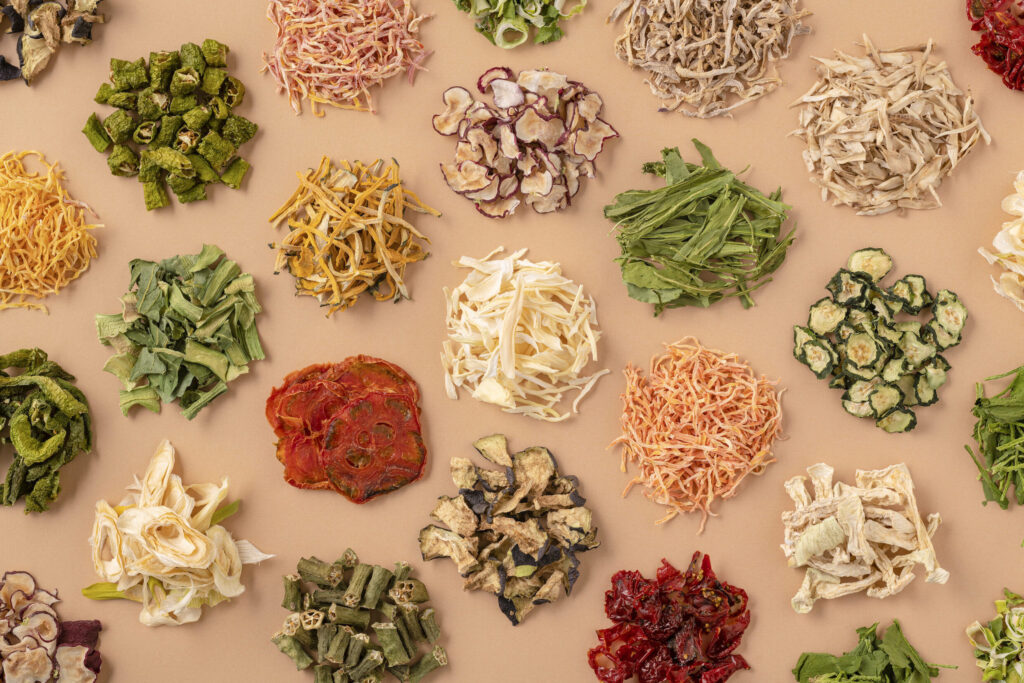
- Sold in small lots from 1 kg
- Handling heirloom vegetables from across Japan
- Dried fruits and herbs also supported
Features of commercial dried asparagus
The quality of in-season domestic harvest
We use domestic asparagus harvested from spring to early summer. By sourcing and processing intensively in season, we finish the raw material with sweetness fully developed into a dried product. We can also handle inventory for commercial uses requiring stable year-round supply.
Easy nutritional appeal
Containing asparagine, B vitamins, folic acid, and rutin, the nutritional value per unit weight is concentrated through drying. As a raw material for health foods and soups, the "contains asparagus" label has appeal thanks to high consumer recognition.
Retention of green color
Low-temperature drying suppresses chlorophyll oxidation and maintains a vivid green. Topped on soups or salads, it becomes a visual accent and also functions as a color element for products.
Six-month storage at room temperature
Because it is finished with suppressed water activity, storage at room temperature for about six months is possible. Being able to stock and use asparagus — with its limited season — year-round is a benefit unique to dried products. It also leads to reducing food loss.
Multi-stage shape development
It can be developed in shapes to suit the application — from slice and chip to powder — and can be output differently to match a wide range of processing such as soups, confectionery, and toppings.
Blending and formulation support
We also handle pre-blending with other dried vegetables (onion, carrot, spinach, etc.). We also accept delivery as ingredient sets for mixed-vegetable soup or as dried-vegetable salad-topping mixes.
Product specifications (commercial)
|
Item |
Details |
|---|---|
|
Raw material |
Asparagus (domestic) |
|
Shape |
Slice (rounds) / chip (diagonal cut) / powder (fine mill) |
|
Production method |
Low-temperature hot-air drying |
|
Best-before date |
About 6 months from production |
|
Processing plant |
Our own processing plant within Kyoto Prefecture |
|
Shipping unit |
100g〜 |
|
Minimum-lot OEM |
Prototype from 1kg / full production from 10kg |
Customization support
|
Item |
Available |
Details |
|---|---|---|
|
Cut form changes |
◎ |
Selectable from slice, chip, and dice |
|
Powdering |
◎ |
Fine-milling into asparagus powder available |
|
Small-lot OEM prototyping |
◎ |
Prototyping available from 1kg |
|
Mixed materials and blends |
◎ |
Blending with other dried vegetables available |
|
Packaging changes |
◎ |
Both commercial and small-portion individual packaging are available |
POWDER
A powder type is also available
We can also produce "asparagus powder," a further fine-milled form of dried asparagus. It can also handle blending into smoothies, potage, and seasonings. A detailed page for the powder version is in preparation.
Commitments to variety, grower, and growing region
What we use in our dried asparagus is green asparagus raised in domestic open-field and greenhouse cultivation. We carefully select raw material with sweetness developed from tip to base, harvested in the spring-to-early-summer season, and by entering processing before freshness declines, we reflect a flavor and color close to the fresh produce in the dried product.
BRAND
Variety: Green asparagus. The green type, which grows basking in sunlight, has deeper color than white asparagus and its green shows well even after drying. We use raw material harvested in a state where the tips are tight and the stems carry firm sweetness.
PRODUCER
Producer: We partner with domestic asparagus-growing farms and procure raw material intensively in season. By keeping the lead time from harvest to arrival at the processing facility as short as possible, we prevent flavor decline from loss of freshness.
REGION
Growing region: We source raw material from leading domestic asparagus-growing regions such as Hokkaido, Nagano Prefecture, and Saga Prefecture. Asparagus raised in regions with large day-night temperature swings has high sugar content, and its sweetness stands out even after drying.
CULTIVATION
Cultivation method: We handle both open-field and greenhouse cultivation. We recommend cultivation management with reduced pesticide use, and by actively accepting off-grade-size raw material as well, we achieve both food-loss reduction and optimization of raw-material cost.
Low-temperature drying technology and quality control
In drying asparagus, because the fibrous stem and the tender tip lose moisture differently, uneven drying tends to arise, which is a technical challenge. At Agriture, after making the slice thickness uniform, we adopt a low-temperature hot-air method that controls temperature and airflow in stages, managing it so the whole finishes evenly.
Processing is managed consistently at our own facility in Kyoto Prefecture, securing traceability from raw-material intake inspection to shipment. Foreign-matter removal and microbiological testing are built in as standard steps, and we also handle issuance of the analysis sheets and certificates of origin required in OEM projects.
TIPS | Asparagus drying know-how
Asparagus is a vegetable that keeps respiring after harvest, and as time passes its sugar is consumed and sweetness drops. Because the quality of dried processing changes greatly with "how quickly you can enter processing after harvest," at Agriture we strictly manage the arrival schedule from the growing region and standardize a flow of same-day-arrival pretreatment → drying starting the next day.
NEW | Asparagus stem powder
At Agriture we have also succeeded in prototyping a powder using only the asparagus stem (the hard part). The stem has a stronger aroma than the tip, and powdered it gives off a very fine aroma. By using a part that usually tends to be discarded, it also leads to food-loss reduction. Those interested in stem powder, Asparagus-stem powder prototype report.
Use cases and adoption examples
As an ingredient for soups and potage
Dried asparagus slices can be used as an ingredient in consommé soup and minestrone. Added to just-add-hot-water instant soups, the green color and texture of asparagus become an accent. Inquiries as a raw material for freeze-dried soups and cup soups are also increasing. Details on soup OEM here
As a raw material for simmered dishes and stews
Add asparagus chips to stew, gratin, or cream simmers, and they rehydrate with heat and gain texture. Unlike frozen asparagus, they are easy to measure and light on the inventory-management load, so there is demand from dining chains as a commercial simmered-dish base raw material.
As an ingredient for mixed rice and pilaf
Cook dried asparagus chips together with rice and they rehydrate naturally in the cooking moisture, transferring asparagus's sweetness to the rice. There are cases of food makers consulting us on prototyping an "asparagus mixed-rice base" as a spring seasonal menu. List of dried vegetables and herb products here
As a topping for salads and pasta
Thinly sliced dried asparagus, used as-is as a topping for salads or pasta, adds a crisp texture and green color. Simply tossed lightly with olive oil, it functions as a differentiating ingredient for commercial salad bars.
As a raw material for smoothies and health drinks
Asparagus powder can be blended as a base raw material for green smoothies and health drinks. Its nutritional appeal — containing asparagine and B vitamins — is easy to make, and being able to list "asparagus" on the ingredient label makes it an ingredient that readily gains consumer recognition. Details on smoothie OEM here
As a raw material for baby food and weaning food
Additive-free dried asparagus powder can also be used as a vegetable raw material for baby food and weaning food. Because it becomes a paste simply by rehydrating with water, we respond to inquiries from baby-food makers who want to skip the labor of straining. Details on baby-food OEM here
As a raw material for pet food and functional foods
Focusing on the asparagine and rutin contained in asparagus, study is also advancing for use as a raw material for functional pet treats and supplements. The appeal of additive-free, domestic raw material is drawing attention as a differentiating element in the pet-food market as well. See details of pet food OEM here
Commercial usage and rehydration
For dried asparagus, the easy way is to add it straight to soups or simmered dishes and rehydrate it during heating. In 10–15 minutes of heating it absorbs moisture and its texture returns, giving the crisp bite characteristic of asparagus. For mixed rice, just add the dried chips to washed rice and cook with the usual amount of water.
For topping uses, the texture changes depending on whether you use the dried slices crisp as-is or soak them in water for 3–5 minutes to half-rehydrate before using. For salads, use them crisp as-is; for tossing into pasta or risotto, half-rehydration is recommended. The powder type can be mixed directly into smoothies and potage, and there is also the use of mixing it into tempura batter or baked-goods dough to add green color and flavor.
Related cases and articles
- Soup OEM (use as a soup ingredient)
- List of dried-vegetable and herb products
- Smoothie OEM (use as a powder raw material)
Product catalog showing the items we handle
Flexible support from small lots to large lots
- Sold in small lots from 1 kg
- Handling heirloom vegetables from across Japan
- Dried fruits and herbs also supported
Frequently asked questions
Q. What is the minimum lot and prototype handling?
Q. Can you supply it outside the season too?
A. Asparagus harvest concentrates from spring to early summer, but we supply dried product processed and stocked in bulk in season year-round. For large orders, if you consult us on quantity in advance, we secure raw material to align with the in-season processing period.
Q. Is powdering possible?
Q. What is the lead time?
A. Stock items can ship 1–2 weeks after order. New processing to customized specs takes 1–2 weeks for prototyping and 3–4 weeks for full production as a guide. Consulting us during the in-season processing period (April–June) lets us start processing with the raw material at its freshest.
Q. Can you issue a raw-material origin certificate?
A. We can issue a certificate of origin proving the asparagus is domestic. If you have a growing-region specification (Hokkaido, Nagano Prefecture, etc.), that can be discussed too, so please use it for growing-region appeal on the product package.
Q. Can off-grade goods be used?
A. Asparagus that is hard to ship as fresh produce due to bends or uneven thickness can be used without issue in dried processing, since it is made into slices or powder. We also propose achieving both food-loss reduction and raw-material-cost optimization by accepting off-grade goods.
Q. Please tell me the OEM consultation flow
A. The flow is: consult via the inquiry form → concept hearing → free sample delivery → paid prototyping → spec finalization → full production. Because asparagus has a limited season, we propose a prototyping schedule aligned with the harvest period. We support planned development with an eye to year-round supply volume.
Recommended reading
- Soup OEM (use as a soup ingredient)
- List of dried-vegetable and herb products
- Baby-food OEM (use as a powder raw material)
- Asparagus powder
Download the product catalog
We will send the materials to your email address based on the information you provide.