Dried Basil

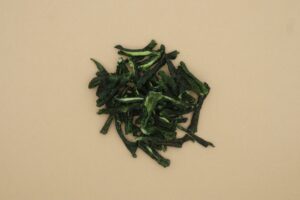
Basil is an herb of the genus Ocimum in the Lamiaceae family, characterized by a sweet, refreshing aroma with linalool as its main component. Dried basil is domestically grown sweet basil carefully dried at low temperature, retaining an aroma close to fresh leaf in dried-leaf form. It is an ingredient that can accommodate a wide range of commercial-raw-material applications — pasta sauce, pizza, simmered dishes, herb tea, and more.
Agriture's dried basil: three points of commitment
01 Low-temperature drying that retains the linalool-type aroma
Linalool, the main component of sweet basil's aroma, volatilizes rapidly at high temperature. At Agriture, by drying slowly with a low-temperature hot-air method, we seal a sweet, gorgeous aroma close to fresh leaf into the dried leaf. It is a finish that stands apart from the "dried grass" smell common to imported products.
02 A coarsely crushed leaf shape that balances visibility and cooking versatility
After drying the whole leaf, we apply coarse-crushing and crush processing to match the application. Used as a topping, the green leaf can be visually confirmed; put into simmering, the aroma spreads along with the rehydration. Because you can choose the cut specification from whole leaf, coarse crush, and fine powder, raw-material delivery to match your product design is possible.
03 One-stop handling from small-lot prototyping to mass production
For herb-type ingredients, fine adjustment of the blend ratio governs the product's completeness. At Agriture, we accommodate small-lot prototyping from units of 1 kg, refining the optimal shape and blend amount while running alongside the R&D teams of seasoning makers and restaurant chains. Because the same processing line is used at the shift to mass production as well, it is a system where discrepancy between prototype and full production is unlikely to occur.
Product catalog showing the items we handle
Flexible support from small lots to large lots
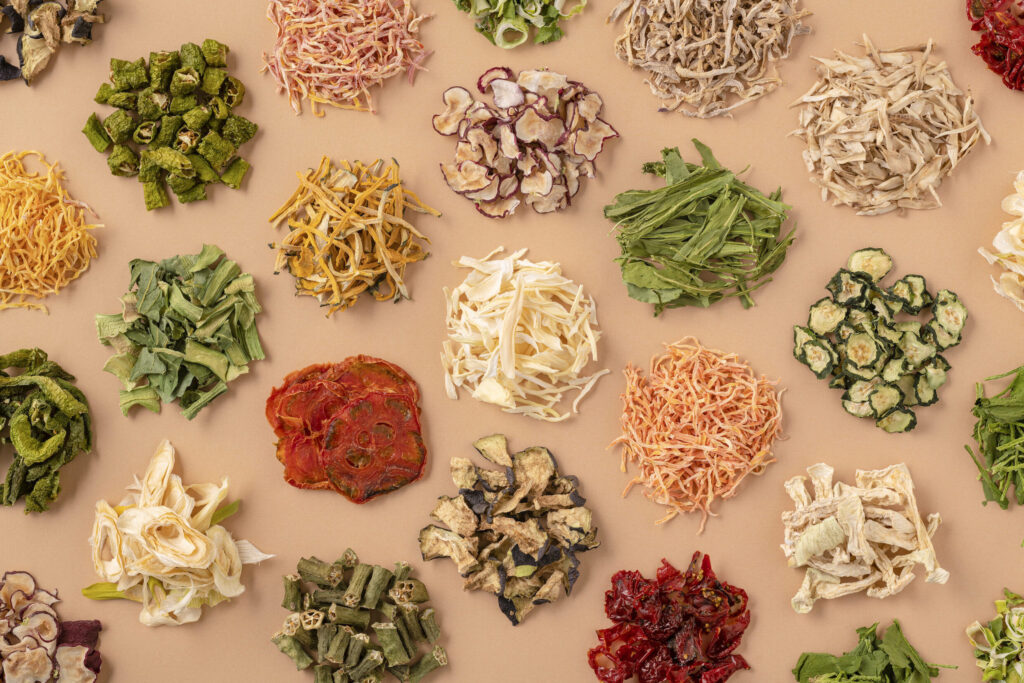
- Sold in small lots from 1 kg
- Handling heirloom vegetables from across Japan
- Dried fruits and herbs also supported
Features of commercial dried basil
Retention of linalool-type aroma
Linalool, the main component of basil's characteristic sweet, spicy aroma, is sealed in without being volatilized through low-temperature drying. The aroma rise reminiscent of fresh basil upon opening links directly to the flavor appeal of processed foods.
Vivid green color
With drying control that suppresses the oxidation of chlorophyll, a deep green color that does not fade easily is maintained. Blended into pasta sauce or dressing, its visual appeal is high, and it also suits topping uses.
Multi-stage cut shapes
From whole leaf, coarse crush, to fine powder, we can provide it in the cut shape that matches the application — kneading into sauces, seasoning, and the like.
Six-month storage at room temperature
Because it is finished with water activity kept low, it can be stored at room temperature for about 6 months. Unlike fresh herbs, you can hold inventory without worrying about disposal loss, greatly reducing the management burden as a commercial raw material.
Additive-free, domestic raw material
Without using coloring, preservatives, or fragrance, it is finished with basil leaves alone. It pairs well with clean-label-oriented product designs that want to keep the ingredient list simple, and we can also discuss handling with organic raw material.
Blending and formulation support
We also accommodate pre-blending with other dried herbs (oregano, thyme, rosemary, and the like) and dried vegetables. You can consult us from the raw-material design of Italian herb mixes and original seasonings.
Product specifications (commercial)
Item | Details |
|---|---|
Raw material | Basil (domestically grown sweet basil) |
Shape | Dried leaf (choose from whole / coarse crush / fine powder) |
Production method | Low-temperature hot-air drying |
Best-before date | About 6 months from production |
Processing plant | Our own processing plant within Kyoto Prefecture |
Shipping unit | 100g〜 |
Minimum-lot OEM | Prototype from 1kg / full production from 10kg |
Customization support
Item | Available | Details |
|---|---|---|
Cut form changes | ◎ | Selectable from whole leaf, coarse crush, and fine powder |
Powdering | ◎ | Accommodates fine-milling processing into basil powder |
Small-lot OEM prototyping | ◎ | Prototyping available from 1kg |
Mixed materials and blends | ◎ | Blending with other herbs and dried vegetables available |
Packaging changes | ◎ | Both commercial and small-portion individual packaging are available |
POWDER
A powder type is also available
We also carry "basil powder," made by further finely milling dried basil. It can also accommodate blending into dressings, smoothies, and seasoning mixes.
Commitments to variety, grower, and growing region
What we use for dried basil is domestically cultivated sweet basil (Ocimum basilicum). This variety, also called Italian basil, grows well even in Japan's hot, humid summer environment and gives off a strong fragrance at harvest time. At Agriture, we source basil harvested in season and set a schedule that enters the drying process at the aroma's peak state.
BRAND
Variety: Sweet basil (Lamiaceae, genus Ocimum). A variety characterized by a sweet aroma with linalool as its main component, a standard herb of Italian and Thai cuisine. In dry processing, how well you retain this aroma component without volatilizing it becomes the key to quality.
PRODUCER
Producer: Partnering with domestic herb-cultivation farms, we shorten the lead time from harvest through processing. Because basil deteriorates in freshness quickly after harvest, the speed of coordination with growers greatly governs the quality of the dried product.
REGION
Growing region: Uses basil cultivated in warm regions of Japan, centered on Kyoto Prefecture. Because soil and climate conditions affect the accumulation of aroma components, the selection of the growing region links directly to the quality of the aroma.
CULTIVATION
Cultivation method: Accommodates both open-field and greenhouse cultivation. We recommend cultivation management with reduced pesticide use, aiming at raw-material procurement that can accommodate clean-label products and organic-oriented product designs as well.
Low-temperature drying technology and quality control
In the dry processing of basil, how well you retain the volatile aromatic components such as linalool and eugenol is the greatest technical challenge. With high-temperature, short-duration drying the aroma escapes readily, and the finish takes on a "dead grass"-like flavor. At Agriture, we adopt a low-temperature hot-air method with finely controlled temperature range and air volume, slowly removing moisture while keeping the leaf-surface temperature below a certain level.
Processing is consistently managed in-house at our processing facility in Kyoto Prefecture, securing traceability from raw-material receiving through shipping. We standardize a process of packing after foreign-matter removal and microbiological testing, and can also accommodate the issuance of analysis tables and raw-material origin certificates required in OEM projects.
TIPS|Herb-Drying Know-How
Lamiaceae herbs like basil store essential oils in the glandular hairs (trichomes) on the leaf surface. If the glandular hairs are destroyed too much during drying, the aroma volatilizes all at once, so the temperature and air-speed settings govern the finished flavor. At Agriture, we set a dedicated drying program for herbs, performing processing that keeps glandular-hair damage to a minimum.
Use cases and adoption examples
As a raw material for pasta sauce and pizza sauce
Dried basil is a standard herb raw material blended into tomato-based pasta sauce and pizza sauce. Adding the coarse-crush type during heated cooking spreads the basil aroma throughout the sauce along with the rehydration. That it can be supplied at stable quality as a raw material for retort pouches and commercial sauces is valued by food makers.
As a blending ingredient for seasonings and spice mixes
The fine-powder type suits use as a blending ingredient for Italian herb mixes, garlic basil seasoning, and the like. We also accommodate pre-blend delivery with other herb powders (oregano, thyme, rosemary, and the like), and it is used by makers who want to omit the in-house mixing step. See the dried vegetable and herb list here
As flavoring for simmered dishes and soups
Adding dried basil to simmered dishes such as minestrone and ratatouille lets the aroma persist even with long heating. As a raw material for commercial soup bases, the stable supply and ease of inventory management that are hard to achieve with fresh herbs are major merits.
As an ingredient for herb tea and blended tea
The whole-leaf type can also be used as a blend ingredient for herb tea. Combined with lemongrass or chamomile, it is used as a raw material for relaxation-type blended teas. We can also accommodate cut-size specification for tea bags. See details of our tea OEM service here
As a raw material for dressings and oil infusions
Dried basil is used as a sub-ingredient for olive-oil-based basil dressing and basil oil. Steeping the coarse-crushed leaf in oil transfers the aroma over time, and it can also present an herbal presence in appearance. See dressing OEM details here
As a knead-in ingredient for bakery and baked goods
Kneading basil leaf into focaccia or cheese bread lets the green leaf be visually confirmed even after baking, adding value in both aroma and appearance. Cases of blending the fine powder into bread dough are also increasing, and there is demand from bakeries as "basil-flavored bread."
As an herb raw material for frozen and retort foods
Cases are spreading where dried basil is incorporated as an herb raw material into frozen pasta and microwave-ready retort foods. Compared with fresh herbs, storage and measuring are easy, and the high efficiency of feeding it into the production line suits it as a raw material for mass-produced products. See retort-food OEM details here
TOC
Commercial usage and rehydration
Dried basil basically needs no rehydration and can be used directly in cooking. For pasta sauce and soup, put it in as-is during heating. The timing at which the leaf's aroma stands out most is when added in the final 2–3 minutes of heating. When simmering for a long time, adding it early still leaves plenty of flavor.
For topping uses, simply sprinkling the coarse-crushed leaf as-is makes a green accent. When using it in salad or caprese, steeping it in olive oil for about 5 minutes makes the leaf supple, giving a texture close to fresh basil. For blending into a seasoning mix, dry-blending it with salt and garlic powder beforehand saves the trouble of measuring.
Related cases and articles
- Basil powder (powder-version product page)
- Tea OEM (use as an herb-tea raw material)
- Spice and seasoning OEM (as a seasoning-mix raw material)
Product catalog showing the items we handle
Flexible support from small lots to large lots
- Sold in small lots from 1 kg
- Handling heirloom vegetables from across Japan
- Dried fruits and herbs also supported
Frequently asked questions
Q. What is the minimum lot and prototype handling?
A. Prototyping is accepted from 1 kg~, and full production from 10 kg~. Simultaneous prototyping of multiple cuts — coarse crush, whole, fine powder — is also available. If you send a concept sheet, we will propose sample shipment by the shortest route.
Q. What is the difference in aroma from fresh basil?
A. Because it is processed by low-temperature drying, it retains roughly 70–80% of the aroma intensity compared with fresh basil. Compared with high-temperature-dried products or long-stored imported products, there is a clear difference in aroma rise upon opening. Because the aroma is drawn out further by heat when added to cooking, the flavor after cooking sufficiently exhibits basil-like character.
Q. Is organic handling possible?
A. We handle basil processing with Organic JAS-certified raw material on a case-by-case basis. Because it depends on the raw-material procurement situation, please inquire first. We also have processing records with organic-certified raw material.
Q. What is the lead time?
A. In-stock items can be shipped 1–2 weeks after order. New processing to custom specifications is a guide of 1–2 weeks for prototyping and 3–4 weeks for full production. We can also discuss advanced handling timed to basil's harvest season (summer).
Q. Can you issue a raw-material origin certificate?
A. A raw-material origin certificate proving it is domestic basil can be issued. Because it can also accommodate raw-material origin labeling under the Food Labeling Act, it can be used when you want to state "domestic raw material used" on the product packaging as well.
Q. Can you deliver a blend with other herbs?
A. We accommodate pre-blend delivery with other dried herbs such as oregano, thyme, and rosemary. Because the blend ratio can also be discussed at the prototype stage, please make use of it when you want to make an original Italian herb mix.
Q. Please tell me the OEM consultation flow
A. The flow is: consultation via the inquiry form → concept hearing → free sample shipment → paid prototyping → specification finalization → full production. Because for herb types the fine adjustment of aroma governs the completeness, there are also cases of repeating prototyping 2–3 times. We proceed with a system that runs alongside you from the development stage.
Recommended reading
- Basil powder (details of the powder version)
- Spice and seasoning OEM (use as a seasoning raw material)
- List of dried-vegetable and herb products
Download the product catalog
We will send the materials to your email address based on the information you provide.