
What is spice OEM? Development of original mixed spices made with dried vegetables and small-lot manufacturing

Summary of this article
First, start by getting quotes from several companies and comparing. The OEM partner best for your business is sure to be found.
A dried-vegetable maker explains the basics and blends of spice OEM. We've compiled the practical side of making original mixed spices and curry powder that make use of dried vegetables' umami—from small-lot development to the ordering flow.
You want to make your own brand's mixed spice, or turn an original seasoning matched to a dish into a product. That's where a spice OEM (contract manufacturing) comes in. Still, many staff hesitate at the first step, unsure "what kinds of blends can be made" and "whether small lots are possible."
TOC
On this page, from the standpoint of a maker producing dried vegetables, we organize with a practical eye the basics of spice OEM, how to think about blends, design using dried vegetables, how to start with small lots, and how to proceed with consultation.
What is a spice OEM
OEM refers to manufacturing products sold under another company's brand. With a spice OEM, you leave everything to the maker—blend design of the spices and ingredients, production, filling into small pouches or jars, and packaging—so you can focus on planning and sales. A merit is being able to start casually with almost no capital investment.
Products you can make with a spice OEM
- With a spice OEM, you can make not only single spices but mixed spices combining several, and seasonings specialized for a dish. Curry powder, barbecue mixes, Japanese-style mixes, and more—the design changes by the dish it accompanies. Powder types are the base, and the ease of "just sprinkle and the flavor is set" earns support.
- Curry powder / spice-curry mixes
- Undertaste spices for meat and fish
- Small-pouch products for novelties and sales promotion
Blends that suit vegetable dishes and soups
Cases where a spice OEM fits
FOR BUSINESS
乾燥野菜のミックスを、まとめてお探しですか
用途に合わせて複数の品目を配合した乾燥野菜ミックスをお作りしています。法人の備蓄やローリングストックのご相談も承っています。配合の考え方は 法人向けローリングストック に掲載しています。
少量でのご購入は、姉妹ブランドの通販サイト OYAOYA で承っています。
It suits companies wanting their own brand of spices, restaurants wanting to commercialize their shop's flavor, and businesses planning souvenirs that make use of local ingredients. It's also used when selling as a private brand (PB).
How to think about mixed-spice blends
A mixed spice's individuality is determined by the balance of aroma, heat, and umami. The point is to design which spice takes the lead, aimed at the dish it accompanies.
Build up aroma, heat, and umami
| Role | Combine a spice that raises the aroma, a spice that adds heat, and an ingredient that carries the base umami, to create a flavor that suits the dish. Adding dried vegetables here brings umami and sweetness, making it easier to finish a spice with depth that doesn't rely on heat alone. | Example ingredient to carry it |
|---|---|---|
| Aroma | Design aim | Various spices |
| Pungency | Chili pepper | Decide the dish's first impression |
| Adjust the stimulation and aftertaste | Umami / sweetness | Dried vegetables such as onion and tomato |
Add body and depth to the flavor
Design the particle size and finish Contract manufacturing of vegetable powder filling.
- Spices change in finish by particle size. Grinding fine makes them blend into dishes easily; grinding coarse makes the material feel and aroma stand out. Being able to adjust the particle size to match the dish is design unique to a maker that handles ingredients from the raw material. Design using powder is
- Salt or no salt: change the design depending on whether it's used as-is or for undertaste
- Powder or coarse grind: whether to blend into dishes, or make aroma and texture stand out
- Aroma-led or umami-led: spices as the lead, or supported by vegetable umami
We have materials available to help you understand dried processing OEM
Agriture OEM, flexibly handling everything from small lots to large lots
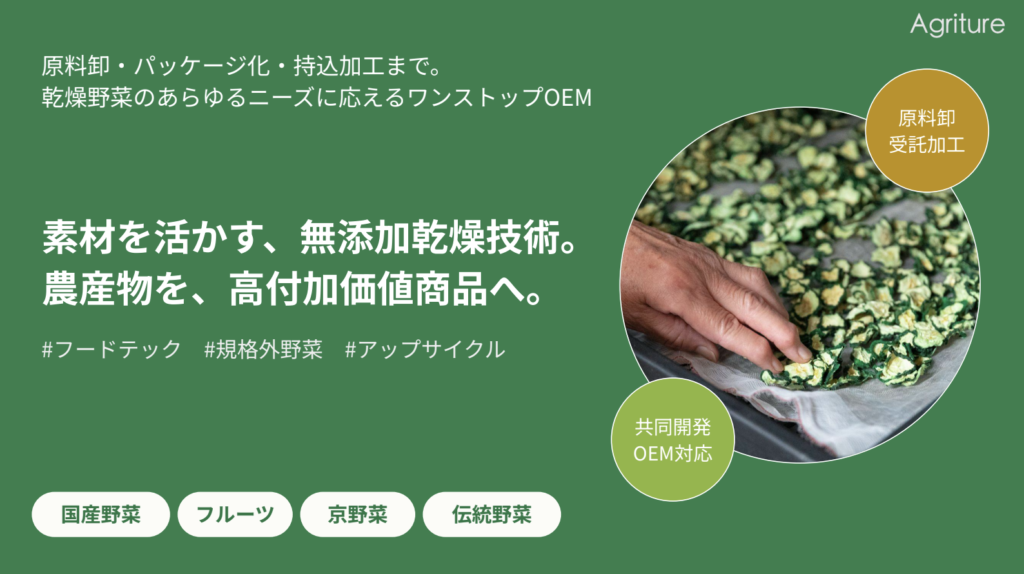
- OEM available from small lots of 10 kg
- Drying of brought-in raw materials also possible
- Support from processing to filling in one place
By use: change the blend for curry, meat, vegetables, and the like
Spice OEM made with dried vegetables
Nearly 100 kinds of dried vegetables to choose from
We dry-process nearly 100 kinds of vegetables, including Kyoto vegetables and heirloom vegetables (based on our own research). Onion and Tomato Spices that make use of vegetables' umami and sweetness are a field often consulted about as a design that doesn't rely on heat alone. For a maker that handles dried vegetables from the raw-material stage, it's an area easy to design in both flavor and appearance, where our strengths come alive.
Making use of off-spec and local vegetables
, mushrooms, and other umami-rich vegetables make it easier to build a flavor that doesn't lean too much on salt or heat. Being able to handle everything consistently—drying, grinding, and blending—is an advantage. Dried vegetable OEM and contract processing.
Off-spec vegetables with irregular shapes that don't usually distribute well can, when dried and ground, be used as spice ingredients. Using regional vegetables also creates story as a souvenir or local product. For contract processing of dried vegetables themselves,
Representative spices and mixes by dish
A mixed spice is made by combining spices with different roles. Knowing each one's characteristics makes it easier to consult on a blend aimed at your target flavor.
The roles of commonly used spices
| Spice | Role | Features |
|---|---|---|
| Spices have roles—raising aroma, adding heat, giving color, and so on. Adding dried vegetables' umami here finishes a flavor with depth, where umami and sweetness come through. | Cumin | The base of aroma |
| A curry-like nuttiness | Coriander | The unifier |
| Refreshing and mild | Turmeric | Coloring |
| Yellow and an earthy aroma | Paprika | Color and richness |
| Chili pepper | Pungency | Red and a faint sweetness |
Stimulation and aftertaste
The direction of mixes by dish
| Dish | Depending on the dish it accompanies, the spices and dried vegetables to play up change. Deciding the use before designing yields a mix that blends into the dish. | The direction of the mix |
|---|---|---|
| Curry | Suitable dried vegetables | Onion / tomato |
| Solid aroma and heat | Barbecue / meat dishes | Nuttiness and richness |
| Onion / paprika | Ethnic / stir-fries | Aroma-led and light |
| Negi / carrot | Vegetables / soups | Umami as the base |
Mushrooms / tomato
For first-time product development, making a large volume right away is a big source of anxiety. The realistic approach is to prototype with a small lot first, then move to mass production while watching the response.
How to think about the minimum lot
Minimum lots for spice OEM vary by product and format. Mass production of finished goods typically runs in the thousands of bags or bottles, while processing of dried vegetables used as raw materials can start from small lots of 10 kg for some items. Thinking about finished-product lots and raw-material lots separately helps you read quotes correctly.
Combine with other categories
The minimum lot for a spice OEM varies by product and form. Mass-producing finished goods is on the order of thousands of pouches or bottles, whereas processing the raw-material dried vegetables can, depending on the item, be handled from a small lot of 100g. Thinking of finished-goods and raw-material lots separately keeps you from misreading the quote. Furikake OEM and seasoning OEM、Using the same dried vegetables, you can also extend to seasonings, furikake, and shichimi with a similar mindset. Planning as a series makes it easier to hold down cost by standardizing the raw materials. Related categories are is also a helpful reference.
Things to decide before consulting
shichimi OEM
- To make consultation smooth, organizing your requests in advance helps. The clearer your requests, the more concrete the maker's proposals. Whether they're an easy partner to consult with is also a point to watch for a long relationship.
- The dish it accompanies (curry, meat, vegetables, etc.)
- The form (small pouch, jar, refill)
- The desired lot and budget guide
The direction you're aiming for (which of aroma, heat, or umami to play up)
Spice design only Agriture can offer
For spices, the freshness of aroma and color is everything. With the techniques cultivated in dried-vegetable processing, we can support making mixes that retain aroma and color.
- We also have a track record of dry-processing varieties of vegetables with enhanced functionality (such as Kyo-kurenai carrot), and we're good at design that makes use of vegetables' umami and color (from Agriture's experience).
- Low-temperature drying to retain aroma and color
- Choose from nearly 100 kinds of dried vegetables for umami, sweetness, and color
- Upcycle off-spec vegetables, balancing cost and food-loss reduction
Projects you could plan
- Adjust particle size from fine powder to coarse grind
- A "gentle curry powder" mindful of salt reduction through vegetable umami
- A "local spice" using regional vegetables
- An "upcycle spice" making use of off-spec vegetables
We have materials available to help you understand dried processing OEM
Agriture OEM, flexibly handling everything from small lots to large lots
- OEM available from small lots of 10 kg
- Drying of brought-in raw materials also possible
- Support from processing to filling in one place
FOR BUSINESS
乾燥野菜のミックスを、まとめてお探しですか
用途に合わせて複数の品目を配合した乾燥野菜ミックスをお作りしています。法人の備蓄やローリングストックのご相談も承っています。配合の考え方は 法人向けローリングストック に掲載しています。
少量でのご購入は、姉妹ブランドの通販サイト OYAOYA で承っています。
Frequently asked questions
It depends on the maker, but we can sometimes handle supplied raw materials. If you want to use specified spices or local ingredients, confirming early whether supply is possible and the acceptance conditions keeps the plan from wavering.
Summary: differentiate with a spice OEM that makes use of vegetables
A spice OEM is a way to plan and sell an original mixed spice without owning your own equipment. Decide the dish it accompanies and the direction you're aiming for, and by growing it from small-lot prototypes, you can advance to commercialization while holding down risk.
Download the OEM contract processing materials
We will send the materials to your email address based on the information you provide.
If you are considering product development with off-spec or your own farm's vegetables:From planning to processing, materials, package printing and novelties, you can consult us through a single point of contact. → Learn more about one-stop product development
- How to start a shichimi OEM | A dried-vegetable maker explains domestic chili peppers and local shichimi
- What Is Citrus Powder? Manufacturing Methods, Uses, How to Choose for Commercial Use, and OEM Explained
Author of this article
Related articles
-
 Original coffee marketing strategy | Ways to grow sales
 -
 ベジタリアンとは?国の規格が分けている4つの区分と食べられないもの
 -
 長ねぎと白ねぎは同じもの?ねぎの種類と呼び名を国の資料で確かめる
 -
 柚子の種類は何種類あるのか、公の資料で名前が残る系統を数えた
 -
 ゆずの時期は年に二度、青ゆずは7月から黄ゆずは10月から
 -
 ゆずの産地は高知が半分を占め、二位は徳島から愛媛に変わった
 -
 Preventing Food OEM Failures: Common Failure Cases and Countermeasures for Success
 -
 How to find a food OEM | How to efficiently find the best manufacturing partner