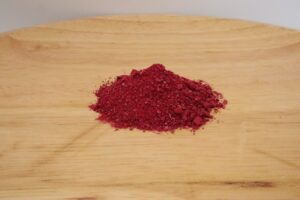
Tomato Powder

Tomato powder is an ingredient made by drying tomatoes and then finely powdering them. For uses such as tomato sauce, soup bases, pasta sauce, seasonings, and confectionery formulations, it is intended to spread tomato's umami and red color evenly as a powder. Tomato is a Solanaceae vegetable and contains the umami component glutamic acid, so even a small amount added lends richness and body to a whole dish. At Agriture, using a raw material of the same lineage as Dried tomato, we powder it by adding a grinding step.
Combined with , which pairs well with the same Western and sauce-based dishes, Onion powder and Garlic powder you can design the powder formulations for tomato sauce, meat sauce, and soup bases all together. Specifications can be finalized starting from small amounts. While raw tomato has a lot of moisture and is hard to handle, powdering it improves storability and ease of measuring, making it easy to handle as a powder seasoning, seasoning ingredient, and confectionery formulation material. If you share the use—whether you want to keep a tomato feel as an "ingredient" or apply it evenly as a "flavor and color base"—we will proceed with prototyping at a particle size and finish matched to that.
TOC
Agriture's tomato powder: three commitments
1. A drying design that keeps umami and red color
Tomato has a lot of moisture, and how the flavor comes through changes with drying conditions. At Agriture, we adjust the temperature range and operate under conditions where the balance of tomato's characteristic umami and acidity remains. The color finishes somewhat calmer through drying and grinding, leaning red to red-orange, but we aim for a tone that blends naturally into sauces, soups, and seasonings. Prototyping across use categories is possible.
2. Fine pulverization with selectable particle size
We finely powder tomato powder while asking about your desired particle size according to the final product's use. The required particle size differs between uses where you want quick dispersion into a liquid, such as soups and beverages, and uses where you mix powder with powder, such as seasonings and snack coatings. If you share the use, we will proceed with prototyping at a particle-size feel matched to that aim.
3. Compatible with Western, Japanese, and confectionery blends
By pre-blending it with Western-style powders such as onion, garlic, basil, and celery, you can design tomato sauce, meat sauce, and soup bases from a single raw-material supplier. It can also be extended to red coloring and umami for confectionery and snacks, enabling use that crosses over use categories.
Product catalog showing the items we handle
Flexible support from small lots to large lots

- Sold in small lots from 1 kg
- Handling heirloom vegetables from across Japan
- Dried fruits and herbs also supported
Characteristics of commercial tomato powder
Finely powdering it lets you extend into the use area of "uniform blending into sauces, soups, and seasonings," which slices and dice cannot reach. We organize the strengths unique to tomato powder from six perspectives.
Concentrating umami and acidity
Tomato is a Solanaceae vegetable and contains the umami component glutamic acid. With a small amount added, you can lend umami and richness to the base of simmered dishes such as tomato sauce, soup, and meat sauce. It is a material that can make up for that "last bit of body" in a dish with a powder.
Coloring that makes use of the red color
You can use tomato's red color as a powder. Through drying and grinding the color finishes calmer, leaning red to red-orange, but it is suited to uses where you want to add a red tone to sauces, soups, snack coatings, and confectionery batters. It is a material that can handle coloring and umami at the same time.
Dispersibility into liquids
Because it is a fine powder, it is a form that disperses easily into liquids such as soups, beverages, and sauces. It can be extended to soup bases where you want to spread a tomato feel evenly, and to the design of powder sauces used diluted. We adjust to your desired particle size.
Compatible with Western, Japanese, and confectionery blends
By pre-blending it with onion, garlic, basil, and celery-type powders, you can design tomato sauce, meat sauce, and soup bases from a single raw-material supplier. It can also be extended to red coloring for confectionery and snacks, enabling use that crosses over use categories.
As a base for seasonings
For the base of seasonings such as snacks, popcorn, and french fries, you can bring in tomato's umami, acidity, and red color all together. Blended with salt, spice, and cheese-type powders, it is a material that makes it easy to design a tomato-flavored seasoning.
Use together with the ingredient-shape version
For uses where you want to leave texture, Dried tomato (slices, dice); for uses where you want to spread umami and color evenly, powder—you can use them differently. It is possible to combine a sense of ingredient presence and the body of a base in the same recipe.
Product specifications (commercial)
The basic specifications at the prototype stage are as follows. Procurement lots, delivery dates, and packaging forms for mass production and OEM are settled through individual consultation.
| Item | Details |
|---|---|
| Product name | Tomato Powder |
| Raw material | Tomato |
| Shape | Fine powder (dried and ground) |
| Appearance | A calm red-to-red-orange fine powder |
| Aroma | An aroma of tomato's characteristic umami and mild acidity |
| Net content | Individual quote according to use and lot |
| Best-before date | About 6 months from the shipping date |
| Storage method | Avoid high temperature, high humidity, and direct sunlight; after opening, seal and store in a cool, dark place |
| Minimum prototype lot | Inquire |
| Main production lot | On consultation |
Customization support
| Item | Available | Details |
|---|---|---|
| Particle size | Fine powder according to the use | Liquid-dispersion-oriented / powder-blend-oriented and the like—consult us according to your aim |
| Blend design | Pre-mixing with vegetable and spice powders | Mixing at a specified ratio with onion, garlic, basil, celery, and spices |
| Packaging form | From commercial bulk to small bags | Light-blocking aluminum bags, sticks and small bags, individual wrapping, and the like |
| OEM productization | End-to-end handling through the final product | Tomato sauce, soup base, seasoning, confectionery formulation, etc. |
For those who want to make use of texture and shape (ingredient-shape version)
For uses that keep tomato's texture and appearance—salads, pasta ingredients, ingredients for simmered dishes—dried tomato (slices, dice) is suited. Tomato's texture and presence, which cannot be obtained with powder, come alive in the recipe.
A commitment to varieties, lineages, and raw materials
Tomato is a vegetable of the genus Solanum in the Solanaceae family. There are diverse lineages—large tomatoes, medium tomatoes, cherry tomatoes, and cooking tomatoes—and the thickness of the flesh, the amount of moisture, and the balance of acidity and umami differ by lineage. As a powder raw material, we select by looking at the balance of moisture and flesh and how the umami and acidity come through.
BRAND
At Agriture, we manage everything consistently from drying to grinding and packaging, using tomato as the raw material. A finish that retains tomato-like umami and red color is our basic policy.
RAW MATERIAL
We accept raw materials after confirming the lineage, harvest time, and moisture-level guideline. We record the raw-material lots and use this for reproducing umami, acidity, and color tone during mass production.
SELECTION
For powder use, we assess raw materials using the balance of flesh thickness and moisture as a guide. Checking how the umami and acidity come through and the depth of the color, we choose raw materials that suit the use.
PROCESS
We adjust the drying conditions according to the moisture level and carry through to the grinding step to ensure reproducibility. We finely powder it while asking about your desired particle size according to the use.
Powdering technology and quality control
Moisture management and flavor retention
Tomato has a lot of moisture and is a material in which the balance of umami and acidity readily changes during the drying process. We adjust the temperature range and operate under conditions that remove moisture while keeping tomato's characteristic umami. We also control the frictional heat during grinding, aiming for a finish where the powder does not get too hot.
Moisture-absorption measures and packaging
Tomato powder is a material that readily absorbs moisture. For commercial bulk we use light-blocking aluminum bags, and for small bags and sticks we use moisture-proof, light-blocking film, proposing specifications that assume storage at the storefront and warehouse. You can consult us on a packaging form matched to your use, including handling after opening.
TIPS: guideline formulations that make the most of tomato powder
When using it as a tomato-sauce base, a formulation of 3–6% of the sauce weight lets tomato's umami and red color blend naturally into the base. In a soup base, about 5–10% of the total powder seasoning is a guide. In seasonings, 20–30% if you want to bring the tomato flavor to the fore, or about 5–10% as a hidden flavor, is an easy-to-use range. In confectionery formulations, with the aim of adding red color and acidity to the batter or finish, we recommend first trying a small amount and exploring the target color and flavor.
Use cases
Because powder disperses evenly into liquids and powders, it extends to uses that slices and dice cannot reach. We organize the uses often consulted about.
Tomato sauce / pasta sauce
Used as a base for tomato sauce, meat sauce, and pasta sauce, it can spread tomato's umami and red color evenly. It is suited to uses that supplement the body of flavor and color when used together with fresh tomato or paste.
Soup / soup base
It can be extended to a base for minestrone, tomato soup, and powder soups. Making use of its dispersibility into liquids, it is also suited to the design of powder soups used diluted.
Seasoning / snack coating
For snack seasonings such as popcorn, potato chips, and french fries, you can bring in tomato's umami, acidity, and red color all together. Blended with salt, spice, and cheese-type powders, you can design a tomato-flavored seasoning.
Confectionery / bread-making formulation
Kneaded into the batter of cookies, baked goods, and bread, it can be extended to uses that add red color and a faint acidity. A strength unique to powder is that it can handle coloring and flavoring at the same time.
Seasoning / blend base
Pre-blended with onion, garlic, basil, and celery-type powders, you can design a Western-style seasoning base. You can consult us on formulations matched to the final product, such as a ratatouille-style or tomato-stew-style powder base.
Beverages / tomato-based drinks
It can be extended as a powder to tomato-juice-style beverages and tomato-based mixed drinks. It is a use suited to beverage design that makes the most of dispersibility into liquids.
Commercial usage and thinking on blending
Basics of use
- When adding it to liquid, add a little at a time and disperse it while preventing lumps
- In a powder blend, mix it first with salt and spices, then spread it throughout the whole
- For uses where you want to make the most of the color, avoid overheating and add it closer to the finish
Blending guide
- Tomato-sauce base: 3–6% of the sauce weight
- Soup base: 5–10% of the powder seasoning
- Seasoning: 20–30% if you want to bring the tomato flavor to the fore
- Confectionery formulation: first check the color and flavor from a small amount
How to store
- While unopened, avoid high temperature, high humidity, and direct sunlight, and store in a cool, dark place at room temperature
- After opening, transfer it to an airtight container to prevent moisture absorption
- After opening, use it up promptly
Related raw materials and powders
- Dried tomato: a raw material that leaves the slice and dice shapes
- Onion powder: adding richness to sauces and soups
- Garlic powder: a Western-style aromatic base
- Sweet basil powder: an herb that pairs well with tomato
Product catalog showing the items we handle
Flexible support from small lots to large lots
- Sold in small lots from 1 kg
- Handling heirloom vegetables from across Japan
- Dried fruits and herbs also supported
Frequently asked questions
How do I use dried tomato (with form) and powder differently?
Dried tomato is a type that keeps its slice or dice form and is suited to uses where you want to make the most of texture and appearance—salads, pasta ingredients, ingredients for simmered dishes. Because the powder is a fine powder, it is suited to uses where you want to spread tomato's umami and color evenly—tomato sauce, soup bases, seasonings, confectionery formulations. Used together, you can combine a sense of ingredient presence with the body of a base.
What happens to the color?
Tomato's red color is due to lycopene, but through the drying and grinding process it changes to a calmer red to red-orange. It is suited to uses where you want to add a red tone to sauces, soups, snack coatings, and confectionery batters. It is not well suited to uses that reproduce the vivid red of fresh tomato as is; the finish is suited to uses that handle umami and color at the same time.
Please tell me about the umami.
Tomato is a Solanaceae vegetable and contains the umami component glutamic acid. For this reason, tomato powder is a material that can lend umami and richness to a dish even in a small amount. Combined with the umami of dashi, cheese, meat, or seafood, it makes it easier to design the body of the flavor. If you share the direction of the flavor you are aiming for, we will respond to consultations on formulation.
Can it be pre-blended with other vegetable powders?
It is possible. We accommodate pre-blending with vegetable and herb powders that pair well in Western and sauce-based dishes—onion, garlic, basil, celery, and the like. If you share the formulation you are aiming for in the final product—tomato sauce, meat sauce, soup base, seasoning, and so on—we will carry out mixing and bagging at that ratio.
How large is the prototype lot?
The minimum prototype lot is by inquiry. Because conditions change depending on the use, particle size, and blend content, please consult us first. For mass production and OEM, we propose quotes and lead times individually. You can consult us consistently through to the final product—tomato sauce, soup base, seasoning, confectionery formulation, and so on.
Can it be used for coloring confectionery and snacks?
It can. Because you can add tomato's red color to batters and coatings as a powder, you can handle coloring and umami at the same time in baked goods, cookies, snack seasonings, and the like. Since how the color and flavor come through changes with heating and the batter formulation, we recommend proceeding with prototyping from a small amount while sharing the direction of the color and flavor you are aiming for.
Please tell me the best-before date and how to store it.
The best-before date is about 6 months from the shipping date. Because tomato powder readily absorbs moisture, while unopened avoid high temperature, high humidity, and direct sunlight, and store in a cool, dark place at room temperature. After opening, we recommend transferring it to an airtight container and using it up promptly.
Recommended reading
- Dried tomato – a raw material in slice or dice form
- Onion powder – richness for sauces and soups
- Garlic powder – a Western-style aromatic
- Sweet basil powder – an herb that pairs well with tomato
Download the product catalog
We will send the materials to your email address based on the information you provide.