
What is seasoning OEM? A dried-vegetable maker explains small-lot development

Summary of this article
A dried-vegetable manufacturer explains the basics of seasoning OEM and flavor design. Design original flavors for snacks and prepared foods using dried vegetable powder. We cover everything from small-lot development to the ordering flow.
You want to create an original seasoning for snacks, prepared foods, popcorn, and the like. That is where seasoning OEM (contract manufacturing) comes in. Even so, many people in charge stumble at the first step, unsure of what flavors can be made or whether small lots are possible.
On this page, from the standpoint of a dried-vegetable manufacturer, we organize the basics of seasoning OEM, the thinking behind flavor design, design using dried vegetable powder, how to start with a small lot, and how to move a consultation forward, all from a practical perspective.
TOC
What is seasoning OEM
OEM refers to manufacturing a product that is sold under another company's brand. With seasoning OEM, you can leave everything from flavor formulation and manufacturing to small-pouch filling and packaging to the manufacturer, letting your company focus on planning and sales. It requires almost no capital investment and is easy to start, which is another advantage.
Products you can make with seasoning
Seasoning is a condiment sprinkled onto dishes and foods to add flavor. The design changes with the food it accompanies, whether popcorn, chips, fried chicken, prepared foods, or pasta. Powder types are the standard, favored for the ease of settling the flavor just by mixing it in.
- Seasoning for snacks and popcorn
- Seasoning for fried chicken and prepared foods
- Mix-in seasoning for pasta and rice
- Small-pouch products for novelties and sales promotion
Cases where seasoning OEM is a good fit
It suits companies that want to turn an original flavor into a product without owning a factory, restaurants that want to commercialize the flavor of their signature dish, and businesses that want to plan souvenirs making the most of local ingredients. It is also used for rollouts as a private brand (PB).
FOR BUSINESS
乾燥野菜のOEM・受託加工を承ります
国産の野菜・果物の乾燥、100メッシュ相当までの粉砕、10g以上の小袋充填までをお受けしています。小ロットの試作から量産までご相談ください。寄せられた相談の実例は OEM・卸のご相談 に掲載しています。
乾燥品の賞味期限は、出荷日から6ヶ月程度を目安にご案内しています。
The thinking behind seasoning flavor design
A seasoning is built by adding umami, aroma, and color to a base flavor. The key is designing the balance of saltiness, acidity, and heat to match the food you are targeting.
Set the direction with the base flavor
The impression of the product changes greatly with the base flavor, whether salt, consomme, soy sauce, or curry. Adding dried vegetable powder here brings in the umami and color of vegetables, making it easier to arrive at a flavor unlike any other.
| Base flavor | Matching foods | Good ingredients to add |
|---|---|---|
| Salt / consomme | Popcorn / chips | Onion and tomato powder |
| Curry | Snacks / prepared foods | Carrot and kabocha powder |
| Soy sauce / Japanese-style | Rice / fried chicken | Green onion and mushroom powder |
Design color and particle size
Appearance matters for seasoning too. Using the color of vegetables lets you add color without relying on artificial coloring. Uniform powder particle size blends well into food, while a coarser grind keeps the sense of the ingredient. Being able to adjust particle size to match the food is design that only a manufacturer working from the raw material can offer. Design using powder is also touched on in Contract manufacturing of vegetable powder filling.
- Adhesion: for coating snacks, use a fine particle size for good adhesion
- Oil compatibility: for fried foods, design it to mix easily with oil
- Sense of the ingredient: a coarser grind brings out the presence and aroma of the vegetable
- Color: using the color of vegetables lets you finish without relying on artificial coloring
We have materials available to help you understand dried processing OEM
Agriture OEM, flexibly handling everything from small lots to large lots
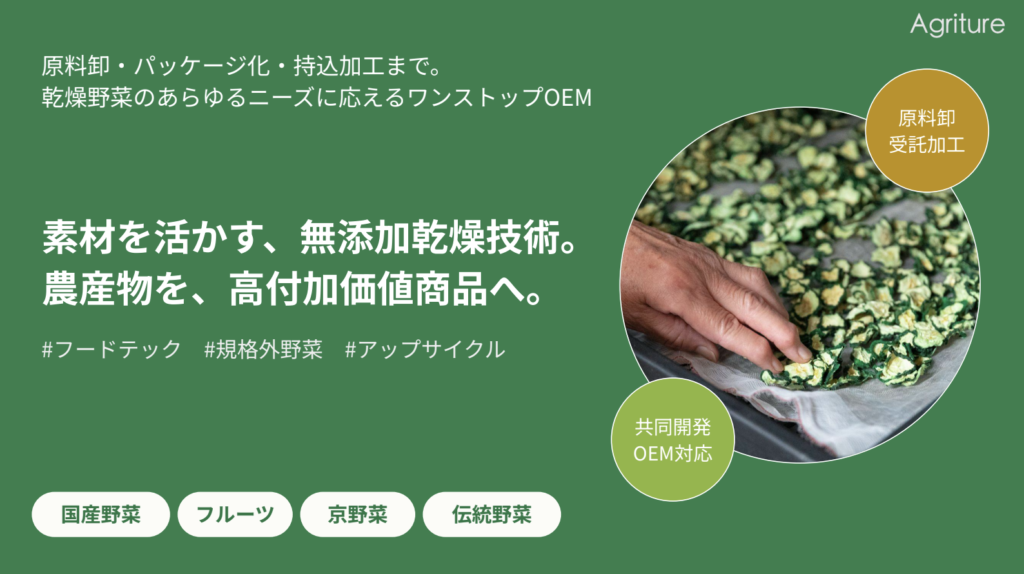
- OEM available from small lots of 10 kg
- Drying of brought-in raw materials also possible
- Support from processing to filling in one place
Seasoning made with dried vegetable powder
Seasoning that makes the most of vegetable umami and color is a field where consultations often center on products conscious of health orientation and additive-free positioning. For a manufacturer that handles dried vegetables from the raw material, it is an area where both taste and appearance are easy to design and its strengths come to life.
Nearly 100 kinds of dried vegetables to choose from
We dry-process nearly 100 kinds of vegetables, including Kyoto vegetables and heirloom vegetables (based on our own research). Onion and Tomato, mushrooms, and other vegetables with strong umami can be turned into powder, making it easier to design a flavor that does not rely too heavily on salt. Being able to handle everything from drying and milling to blending in-house is an advantage.
Making use of off-spec and local vegetables
Off-spec vegetables with irregular shapes that are normally hard to distribute can also be used as seasoning ingredients once dried and milled. Using local vegetables gives rise to a story as a souvenir or regional product. Contract processing of dried vegetables themselves is covered in Dried vegetable OEM and contract processing.
Seasoning design and flavor variations by use
The optimal flavor and particle size change with the food a seasoning accompanies. Deciding what it goes on first sets the direction of the design.
Change flavor and particle size by use
For snacks, use a fine particle size to coat evenly; for fried foods, design it to blend with oil. For prepared foods and rice, a particle size that resists clumping when mixed is suitable. Grasping the differences by use keeps the finish consistent.
| Use | Flavor tendency | Design point |
|---|---|---|
| Popcorn / chips | Salt / consomme type | Fine particle size, easy to coat |
| Fried chicken / fried foods | Garlic / spice type | A formulation that blends with oil |
| Prepared foods / salads | Japanese-style / umami type | A particle size that resists clumping |
| Rice / onigiri | Nori-salt / umami type | Balancing color and ease of mixing |
Standard flavor variations
After deciding the base flavor, adding the umami and color of dried vegetables turns even a standard into a product with a distinct edge. Choose the flavor family to match your target customer and sales floor.
| Flavor family | Matching foods | Good dried vegetables to add |
|---|---|---|
| Salt / consomme | Popcorn / chips | Onion / tomato |
| Curry | Snacks / prepared foods | Carrot / kabocha |
| Nori-salt / Japanese-style | Rice / onigiri | Green onion / mushroom |
| Cheese type | Snacks / bread | Tomato, bell pepper |
Starting seasoning OEM with a small lot
For first-time product development, making a large volume right away is a big source of anxiety. The realistic approach is to prototype with a small lot first, then move to mass production while watching the response.
How to think about the minimum lot
The minimum lot for seasoning OEM varies with the product and format. While mass production of finished goods is on the order of several thousand pouches, processing of the dried vegetable raw material can, depending on the item, start from a small lot of 100 g. Thinking of the finished-goods lot and the raw-material lot separately keeps you from misreading a quotation.
Combine with other categories
Using the same dried vegetable powder, you can expand to furikake and soups with an approach close to seasoning. Planning them as a series makes it easier to hold costs down by sharing raw materials. Related categories include Furikake OEM and Spice OEM、How to start soup OEM manufacturing is also a helpful reference.
Things to decide before consulting
Organizing your requirements in advance helps a consultation go smoothly. The clearer your requirements, the more concrete the manufacturer's proposals. Whether a company is easy to consult with casually is also a point worth checking for a long-term relationship.
- The food it accompanies (snacks, prepared foods, rice, etc.)
- The flavor direction you are targeting (salt, curry, Japanese-style, etc.)
- The expected sales channel and packaging format
- The desired lot and budget guide
Seasoning design that only Agriture can offer
For seasoning, how well it blends into food and its color shape the finish. With the fine-milling and particle-size adjustment techniques honed in turning dried vegetables into powder, we can support design suited to the use.
We are skilled at low-temperature drying that keeps colors from fading, and for somen noodle making in Nara we have purple chili pepper fine-milled into a vivid purple powder, keeping the color intact (from experience at Agriture). This can be applied to color design that does not rely on artificial coloring.
- Optimizing adhesion and blending through fine milling and particle-size adjustment
- Using the color of vegetables for color design that does not rely on artificial coloring
- Choosing umami and color from nearly 100 kinds of dried vegetables
- Upcycling off-spec vegetables to reduce food loss
Projects you could plan
- A "gentle seasoning powder" that uses vegetable umami to cut back on salt
- A "local flavor" using regional vegetables
- A "colorful seasoning" that pops with vibrant vegetables
- Health-appeal products using vegetables with enhanced functionality
We have materials available to help you understand dried processing OEM
Agriture OEM, flexibly handling everything from small lots to large lots
- OEM available from small lots of 10 kg
- Drying of brought-in raw materials also possible
- Support from processing to filling in one place
FOR BUSINESS
乾燥野菜のOEM・受託加工を承ります
国産の野菜・果物の乾燥、100メッシュ相当までの粉砕、10g以上の小袋充填までをお受けしています。小ロットの試作から量産までご相談ください。寄せられた相談の実例は OEM・卸のご相談 に掲載しています。
乾燥品の賞味期限は、出荷日から6ヶ月程度を目安にご案内しています。
Frequently asked questions
Summary: Differentiate with vegetable-forward seasoning OEM
Seasoning OEM is a way to turn an original flavor into a product without owning equipment. By deciding the base flavor and the food it accompanies and growing it from small-lot prototyping, you can move commercialization forward while keeping risk down.
Seasoning made with dried vegetable powder in particular is an area where it is easy to set yourself apart through umami and color, and where the strength of a manufacturer that can make it consistently from the raw material comes to life. If you are considering commercializing a flavor, first organize the food it accompanies and the flavor you are targeting, and get in touch.
Download the OEM contract processing materials
We will send the materials to your email address based on the information you provide.
If you are considering product development with off-spec or your own farm's vegetables:From planning to processing, materials, package printing and novelties, you can consult us through a single point of contact. → Learn more about one-stop product development
- How to start a dashi OEM | A dried-vegetable maker explains vegetable dashi and dashi packs
- How to start a shichimi OEM | A dried-vegetable maker explains domestic chili peppers and local shichimi
Author of this article
Related articles
-
 Original coffee marketing strategy | Ways to grow sales
 -
 ベジタリアンとは?国の規格が分けている4つの区分と食べられないもの
 -
 長ねぎと白ねぎは同じもの?ねぎの種類と呼び名を国の資料で確かめる
 -
 柚子の種類は何種類あるのか、公の資料で名前が残る系統を数えた
 -
 ゆずの時期は年に二度、青ゆずは7月から黄ゆずは10月から
 -
 ゆずの産地は高知が半分を占め、二位は徳島から愛媛に変わった
 -
 Preventing Food OEM Failures: Common Failure Cases and Countermeasures for Success
 -
 How to find a food OEM | How to efficiently find the best manufacturing partner