
Contract Manufacturing Guide for Vegetable Powder Filling | Quality Control and Optimal Package Selection

Summary of this article
This guide covers contract manufacturing for vegetable powder filling: the 4-stage process of weighing, filling, sealing and inspection; 3 criteria for choosing packaging (barrier properties, workability, design); measures for powder-specific issues (moisture absorption, static electricity, foreign matter contamination); certified factories such as HACCP, FSSC 22000 and organic JAS; a small-bag filling service from 500 bags; and optimizing cost and lead time. It also explains channel fit by filling format from commercial large bags to stand-up pouches, sticks and jars, filling points for additive-free and fine powders, how to create original blends, and end-to-end handling of client-supplied raw materials.
The filling and packaging of vegetable powder is a step that heavily influences the quality and cost of the final product. Because powder carries risks of static electricity, moisture absorption, clumping, weighing accuracy, and foreign-matter contamination, it requires "filling-specific expertise" separate from raw-material processing. When making a differentiated commercial product, a filling maker's equipment, quality control, and small-lot capability become the deciding factors in selection.
This article lays out, for food makers, D2C brands, and regional cooperatives considering contract manufacturing of vegetable-powder filling, the basic process, packaging selection, powder-specific quality control, how to judge certified plants, and the practicalities of small-lot support. Agriture's handled items are at the product page for commercial vegetable powder, and its latest small-lot filling service is at Press release on the small-bag filling service.

TOC
The basics of vegetable-powder filling
Filling is the step of packing the vegetable powder made by drying and grinding into a container. In commercial cases, the format splits by use and sales channel, from large 1kg+ bulk to the small pouches and sticks consumers pick up. The flowability of vegetable powder changes with "the vegetable type, particle size, and moisture," so the three key practical points are "filling-machine compatibility, weighing accuracy, and hygiene management."
Flowability that changes between leafy greens and root vegetables
| Vegetable type | Flowability | Challenges that tend to arise during filling |
|---|---|---|
| Leafy greens (spinach, kale, Kujo green onion) | Light and easily airborne | Dust during weighing, static-electricity adhesion to the machine |
| Root vegetables (carrot, kabocha, burdock) | Heavy and prone to jamming | Bridging (clogging) in the hopper, uneven feed |
| High-sugar ingredients (kabocha, beet) | Clump easily from moisture absorption | Clumping lowers weighing accuracy |
| Additive-free fine powders in general | Unstable flowability without an excipient | Yield is hard to stabilize |
Because the choice of filling machine and the dehumidification and static-elimination measures change with the raw-material type, checking behavior across several lots at the prototype stage keeps the defect rate down.
Standard flow of contract manufacturing
- Raw-material receiving and inspection (particle size, moisture, microbes)
- Blending and sieving (grinding / fine-grinding to a fine powder)
- Filling and sealing (weighing with a filling machine matched to the volume and format)
- Inspection (weight checker, metal detector, X-ray)
- Packing and shipping (checking the outer packaging, labels, and delivery temperature range)
The four-step filling and packaging process
The practical work of vegetable-powder filling consists of four steps: weighing, filling, sealing, and inspection. Each requires different precision and equipment, so the items to agree on in the specification change.
Key points for each of the four steps
| Stage | Equipment used | Management points |
|---|---|---|
| 1. Weighing | Weight checker, load cell | Agree the allowable weighing-error range (±0.5-2g) in the specification |
| 2. Filling | Screw type, auger type, rotary type | Choose the machine to match the powder's flowability |
| 3. Sealing | Heat sealer, impulse sealer | Pass criteria for seal temperature, dwell time, and seal width |
| 4. Inspection | Metal detector, X-ray inspection unit, weight sorter | Foreign-matter measures and a final check of weighing accuracy |
Agreeing on not just "standard values" but a "defect-isolation procedure" for each step speeds up handling when a complaint arises. For example, set the weight-checker threshold for weight anomalies and the leak-inspection frequency for seal defects in advance.
FOR BUSINESS
乾燥野菜のOEM・受託加工を承ります
国産の野菜・果物の乾燥、100メッシュ相当までの粉砕、10g以上の小袋充填までをお受けしています。小ロットの試作から量産までご相談ください。寄せられた相談の実例は OEM・卸のご相談 に掲載しています。
乾燥品の賞味期限は、出荷日から6ヶ月程度を目安にご案内しています。
A table of format × volume × sales channel
The filling format is decided in tandem with volume, sales channel, and product image. Below is a single table of the formats commonly adopted for vegetable powder.
| Form | Capacity guide | Suited products and channels |
|---|---|---|
| Commercial large bag (aluminum laminate) | 1 kg, 5 kg, 10 kg | Food-maker raw materials, restaurant seasonings, wholesalers |
| Stand pouch | 100〜500g | D2C, gifts, supermarket shelves |
| Three-side-seal small pouch | 20〜100g | Samples, subscription individual packs, promotions |
| Stick (individual pack) | 2〜10g | Office stock, portable use, supplements, mail-order sets |
| Jar / canister | 50〜200g | Specialty stores, department stores, gifts |
Even for the same contents, the customer unit price and purchase frequency change greatly between a large bag and a stick. The realistic approach is to choose the format by working back from your sales strategy, like "sticks if you want to lower the first-purchase hurdle" and "large bags if you want to cut the per-kg price for ongoing use."
Three criteria for choosing packaging
Choosing packaging for vegetable powder comes down to a balance of three things: barrier property, workability, and design. Which you prioritize changes the material cost and the per-kg price significantly.
Barrier property (quality protection)
- Aluminum laminate: excellent barrier against light, oxygen, and moisture, suited to long-term storage
- Clear PET + nylon: high visibility of the contents, adopted for e-commerce and gifts
- The more additive-free and fine-powder the product, the higher the barrier material to choose
- Enclosing an oxygen absorber or desiccant curbs moisture absorption and clumping
Workability (ease of handling on the floor)
- Zip-top and stand pouches are easy to open, close, and display
- Stick packaging needs no weighing and is quick to deploy on the floor in commercial use
- If spooning it in is the premise, wide-mouth jars or canisters are handy
Design (brand and labeling)
- For gifts, boxes, jars, and cans give a premium feel
- For D2C, a pouch plus custom label lets you add SKUs quickly
- Secure a space to display the producer, origin, and cultivation method
Powder-specific quality control
The finish of vegetable powder changes with moisture, particle size, and static electricity. Nailing the powder-specific management points, different from liquid or solid OEM, drops the defect rate significantly.
Main powder challenges and measures
| Challenge | Countermeasure |
|---|---|
| Moisture absorption and clumping | A temperature- and humidity-controlled filling room, oxygen absorbers and desiccants, high-barrier packaging |
| Static electricity | A static eliminator on the filling machine, grounding, anti-static measures for workers |
| Dust and work environment | Local exhaust, dust collector, ventilation |
| Foreign-matter contamination | Metal detector, X-ray inspection device, workwear that prevents hair contamination |
| Weighing variation | Weight checker, automatic weighing correction, operator training |
| Lot variation in color and aroma | Single-farm raw material with specified harvest timing, management with a color-difference meter |
When the product is additive-free and finely ground, checking the compatibility of a dehumidified environment with a screw-type filler first looks like a detour but is the shortcut. To hold filling accuracy without an excipient, you run the machine spec and raw-material-lot management more strictly than usual.
Reliability backed by certified plants
In commercial contract manufacturing, the indicators that back reliability are the plant's certifications and audit track record. When you have major deals or export in view, which certified plant does the filling becomes the deciding factor in selection.
Main certifications worth checking commercially
| Certification | Meaning | Where it's adopted |
|---|---|---|
| HACCP | An international standard for food-hygiene management | A basic requirement for deals with domestic food makers |
| FSSC22000 | ISO 22000 plus a technical-specification combination | Major food makers, export deals |
| ISO22000 | A food-safety management system | Mid-tier food makers, overseas |
| GMP certification | Standards for manufacturing and quality control | For supplements and functional foods |
| Regulatory aspects | A labeling certification for organic raw materials | Organic products, export |
Checking not just whether a certification exists, but the disclosure scope of the audit history, improvement reports, and traceability records, lowers the quality risk after a deal begins.
We have prepared materials that explain small-pouch filling
Agriture, flexibly handling everything from small lots to large lots
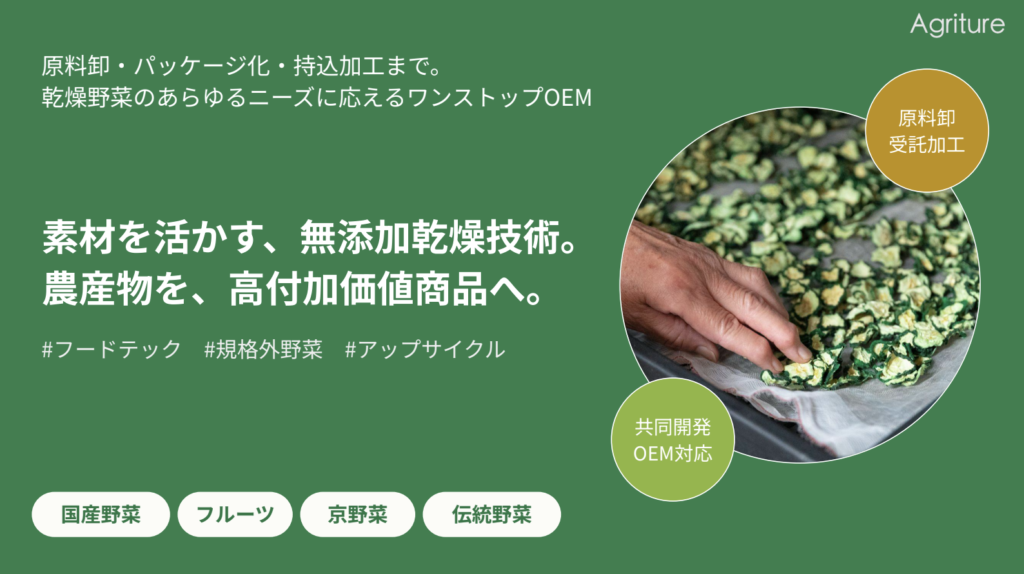
- Small-bag filling from 500 bags
- Tea and coffee also supported
- Sealing carried out in a single seamless flow
Agriture's scope and partnerships
From its base in Kyoto, Agriture can handle drying, grinding, blending, and small-pouch filling in-house. For projects requiring a certified plant or categories needing dedicated equipment, it's a hybrid model, combining with partner plants.
Processes completed in-house at Agriture
- Raw material intake, inspection, and storage
- Drying (hot-air), grinding, sieving, blending
- Filling of commercial large bags and small bags (from 500 bags)
- Issuance of specifications, certificates of origin, and lot management
Steps that use a partner plant (as needed)
- Processing requiring special equipment, such as freeze-drying and vacuum drying
- High-volume, high-speed stick filling
- Manufacturing at FSSC 22000 / GMP-certified plants (major deals, export projects)
- Lab testing such as X-ray inspection and high-precision microbial testing
Track record and handled cases
- Launch of small-bag filling service (April 2026)
- Original blend OEM from over 30 kinds of dried vegetables
- Started full production of lotus-root powder (from prototype to mass production)
- Also has a track record of projects filling leafy greens (Kujo green onion, spinach) and root vegetables (lotus root, kabocha) on the same line
Optimizing cost and lead time
The cost of contract filling is set by "filling unit price + material cost + inspection cost + minimum lot." The smaller the minimum lot, the higher the processing cost per unit, so the balance against your sales forecast becomes an important judgment point.
Ballpark price, lot, and lead time
| Item | Guideline | Notes |
|---|---|---|
| Filling unit price | 20-200 yen per bag | Varies with volume, format, and lot |
| Packaging material cost | Pouch 10-80 yen each | Custom label printing is separate |
| Inspection cost | Several thousand to tens of thousands of yen per lot | Metal detection, X-ray, microbial testing |
| Minimum lot | Ready-made products from 500 bags, original formulations from 1,000 bags | Select based on whether small lots are supported |
| Lead time | Off-the-shelf 2 weeks, original 2-3 months | Includes the raw-material sourcing period |
For a first order, comparing on the "total including setup costs" lets you grasp the total cost that a per-kg-only comparison tends to miss.
Tips for optimizing cost
- Standardize the material across prototype and mass production (design so only the label swaps out)
- Hold down design cost with an off-the-shelf aluminum-laminate pouch plus a sticker label
- Align the timing of lot consolidation to lower the filling unit price
- Select inspection items according to the product's risk (to the necessary and sufficient range)
We have prepared materials that explain small-pouch filling
Agriture, flexibly handling everything from small lots to large lots
- Small-bag filling from 500 bags
- Tea and coffee also supported
- Sealing carried out in a single seamless flow
FOR BUSINESS
乾燥野菜のOEM・受託加工を承ります
国産の野菜・果物の乾燥、100メッシュ相当までの粉砕、10g以上の小袋充填までをお受けしています。小ロットの試作から量産までご相談ください。寄せられた相談の実例は OEM・卸のご相談 に掲載しています。
乾燥品の賞味期限は、出荷日から6ヶ月程度を目安にご案内しています。
FAQ
Summary
Contract manufacturing of vegetable-powder filling comes down to advancing the four steps of weighing, filling, sealing, and inspection with attention to powder-specific challenges (moisture absorption, static electricity, foreign matter). Mindful that flowability differs between leafy greens and root vegetables and that yield tends to drop when additive-free, choose packaging on a balance of barrier property, workability, and design, and select a contractor by the necessary certifications and small-lot capability, and you can go from prototype to mass production.
From its base in Kyoto, Agriture handles drying, grinding, blending, and small-pouch filling in-house, and shares the steps requiring a certified plant with partners. The handled items are at the product page for commercial vegetable powder, and the latest filling service is public at Small-bag filling from 500 bags. For contract-manufacturing inquiries, Agriture's page on Food OEM no Madoguchi feel free to reach out.
Download the small-pouch filling materials
We will send the materials to your email address based on the information you provide.
If you are considering product development with off-spec or your own farm's vegetables:From planning to processing, materials, package printing and novelties, you can consult us through a single point of contact. → Learn more about one-stop product development
- 柚子の皮の使い道は干すと広がる、果汁と種まで使い切る手順
- A Complete Guide to Choosing Commercial Fruit Powder: Manufacturing Methods, Particle Size, Lot, and Procurement Practice
Author of this article
Related articles
-
 Original coffee marketing strategy | Ways to grow sales
 -
 ベジタリアンとは?国の規格が分けている4つの区分と食べられないもの
 -
 長ねぎと白ねぎは同じもの?ねぎの種類と呼び名を国の資料で確かめる
 -
 柚子の種類は何種類あるのか、公の資料で名前が残る系統を数えた
 -
 ゆずの時期は年に二度、青ゆずは7月から黄ゆずは10月から
 -
 ゆずの産地は高知が半分を占め、二位は徳島から愛媛に変わった
 -
 Preventing Food OEM Failures: Common Failure Cases and Countermeasures for Success
 -
 How to find a food OEM | How to efficiently find the best manufacturing partner