
We Began Full Production of Lotus Root Powder

Agriture has begun full production of lotus root powder. A genuine mass-production system has started up, processing 100 kg of lotus root into powder and handling everything through to small-pouch filling in-house.
Lotus root powder had been offered mainly at the prototype stage, but in response to inquiries from several food manufacturers, we took the step of building a mass-production system. At our own processing facility in Kyoto Prefecture, we manage the entire process from washing, cutting, drying, and milling to filling the raw material, establishing a structure to deliver consistent quality.
Lotus root powder is adopted for a wide range of uses, including as a kneading ingredient for Japanese confectionery and bread-making, a thickening ingredient for soups and potages, and a raw material for health foods. Because we also handle small-pouch filling, rollouts of retail-oriented products can proceed smoothly as well.
At Agriture, we offer OEM manufacturing and commercial-ingredient proposals for dried vegetables and powders, including lotus root powder. Feel free to consult us about mass-production lots as well.
TOC
Features of full lotus root powder production and the mass-production system
Lotus root powder is an ingredient made by drying and milling lotus root, characterized by a chewy stickiness and a mild sweetness. Having gone through the prototype stage, Agriture has completed full production of 100 kg of raw material and started a mass-production system that can handle up to small-pouch filling. Familiar as a Japanese ingredient, it is drawing inquiries for a wide range of uses, including health foods, baby food, and gluten-free products. Basic specifications can be checked on the existing lotus root powder product page.
Overview of the mass-production system
Full production of lotus root powder has been carried out in a 100 kg raw-material lot. Based on the track record of moving from prototype to mass production, we have organized a stable-supply structure.
| Item | Details |
|---|---|
| Full-production lot track record | Completed full production with 100 kg of raw material |
| Filling handled | Handles small-pouch filling (included) |
| Raw materials | Domestic lotus root (Kaga lotus root, etc.) |
| Quality control | Quality inspection and document issuance by the lot |
For origin-brand lotus root such as Kaga lotus root specifications, see the Kaga lotus root product page.
You can check the details of turnip's powder form on the
Lotus root powder has completed full production of a 100 kg lot, and the small-pouch filling line is also operational. Because the finish was adjusted at the prototype stage, we have a structure that can smoothly handle repeat orders and lot increases. Because lotus root is high in sticky components, the setting of milling conditions directly affects the finish. Having a full-production track record is a strength, ensuring reproducibility of quality.
.
Lotus root powder is suited to product design that makes use of its stickiness, viscosity, and mild sweetness. We have organized ideas by use.
Baby food and weaning food
The smooth texture and natural sweetness of lotus root powder make it suitable as a baby-food ingredient. It is an allergen-free, reassuring ingredient.
- A thickening ingredient for weaning-food purees
- A blend ingredient for baby-oriented rice crackers and boro biscuits
- An allergen-free vegetable powder mix
Gluten-free products
The stickiness of lotus root powder can be used as a binder for gluten-free dough in place of wheat flour. It enables product design without wheat while giving a chewy texture.
- Gluten-free okonomiyaki and chijimi mixes
- A binding blend for rice-flour bread and rice-flour pasta
- Texture improvement for gluten-free cookies and muffins
Japanese confectionery and traditional foods
Lotus root has a strong affinity with osechi and shojin cuisine, so it can be used for product development that makes the most of a Japanese image.
- Turning lotus root mochi and lotus root kinpira into dried foods
- Dried lotus root powder for shojin cuisine
- OEM ingredient for osechi gifts and seasonal products
Health foods and functional ingredients
It is also used as a health-food ingredient with attention to the tannins and fiber in lotus root. Vegetable powder list An ingredient for oden and pot-au-feu
- Throat-care candies and tablets containing lotus root
- A blend ingredient for fiber supplements
- An ingredient for lotus root tea and health-tea blends
A base raw material for vegetable bouillon and dashi powder
We have summarized representative specifications for the full lotus root powder production system. Based on the 100 kg lot track record, stable supply is possible.
A vegetable base powder for baby food
| Item | Agriture's manufacturing specs and OEM support |
|---|---|
| Raw materials | Domestic lotus root (Kaga lotus root, etc.) |
| Processing step | Washing -> peeling -> slicing -> hot-air drying -> milling -> filling |
| Processing plant | Our own processing plant within Kyoto Prefecture |
| Additives | Domestic turnip |
| Best-before date | About 6 months from the shipping date |
| Main production lot | Raw material from 10 kg (100 kg lot track record available) |
| Filling handled | 500 g bag, 1 kg bag, 5 kg commercial bag |
| Not used | Minimum prototyping lot |
Customization support
- Origin: Kaga lotus root can be specified, or other domestic lotus root can be chosen
- Blending: pre-blending with other vegetable powders can be accommodated
- Packaging: handled from commercial bags upward
- Shape: slice (for pickles), dice cut (for ingredients), powder
The flow for a full-production consultation
Because the mass-production system is in place, lotus root powder can accommodate substantial-lot orders from the first order. Of course, you can also start from a small prototype run.
- dried vegetable / powder OEM inquiry form Let us know your required lot, desired specifications, and intended use via
- In a concept consultation (via Zoom or email), share the specifications, filling format, and delivery schedule
- After specifications are fixed, full production begins (raw material from 10 kg; 100 kg lot track record available)
- Delivery in small-pouch filling or commercial bags. Issuance of required documents supported
Product catalog showing the items we handle
Flexible support from small lots to large lots
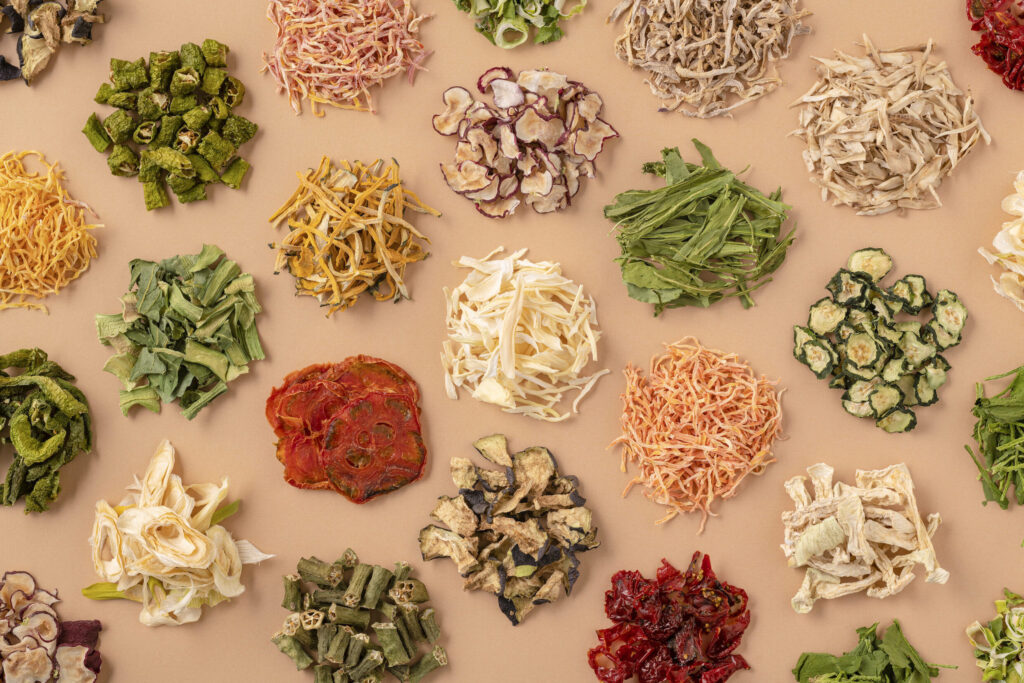
- Sold in small lots from 1 kg
- Handling heirloom vegetables from across Japan
- Dried fruits and herbs also supported
FOR BUSINESS
乾燥れんこんを、原料としてお探しですか
国産のれんこんを乾燥・粉砕してお出ししています。カット形状や粒度の指定、継続してのお取引もご相談ください。規格は Dried lotus root・れんこんパウダー に掲載しています。
少量でのご購入は、姉妹ブランドの通販サイト OYAOYA で承っています。
Frequently asked questions
Q. How sticky is lotus root powder?
A. Dissolved in water, it develops a thickness. It isn't as strongly sticky as freshly grated raw lotus root, but it has enough viscosity to use as a binder.
Q. What is the minimum lot for full production?
A. Full production is possible from 10 kg on a raw-material basis. With a 100 kg lot track record, we can also handle large orders. Small-pouch filling ( ) is supported as well.
Q. Can Kaga lotus root be specified?
A. Yes. Kaga lotus root product page Please check the details of the origin brand. Tell us the raw-material origin you'd like when you inquire.
Q. Can it be blended with other vegetable powders?
A. It can be combined with the more than 60 kinds of vegetable and herb powders we process at Agriture. Vegetable powder list page Please check the specifications on
Q. Can you issue specifications and inspection documents?
A. We can issue specifications, raw-material origin certificates, and microbial inspection certificates. Consult us about the documents needed for listing on mass retailers or e-commerce malls as well.
Related pages and further reading
- We Prototyped "Dried Wakegi and Wakegi Powder" Using Domestically Grown Wakegi
- We Prototyped "Dried Piman (Bell Pepper)" Using Domestically Grown Piman
Author of this article
Related articles
-
 We Prototyped "Chestnut Skin Powder" Using Domestically Grown Chestnut Skins
 -
 A Notice About the Rose Prototype
 -
 We produced a prototype of dried cactus made from domestic cactus (nopal)
 -
We Made a Prototype of Dried Blueberry Leaf Using Japanese-Grown Blueberry Leaves
-
 We Prototyped "Basil Powder" Using Domestically Grown Sweet Basil
 -
 We Prototyped "Purple Chili Powder" Using Domestically Grown Purple Chili
 -
 We Prototyped "Asparagus Powder" Using Domestically Grown Asparagus
 -
 We Prototyped "Green Papaya Powder" Using Domestically Grown Green Papaya