
A Notice About the Rose Prototype

Summary of this article
Agriture brings you an announcement of a prototype of dried rose using domestic edible roses. We carefully dried domestic edible roses and finished them additive-free and colorant-free so as not to spoil the aroma. We assume a wide range of applications—herbal tea, flavored tea, baked goods, drink toppings—and support flower-material dried raw materials and OEM development.
The rose is known as a fragrant, gorgeous flower, and beyond its visual beauty, because it contains aromatic components with a relaxing effect, it is used for food and herbal tea as well. Edible roses are a material that can add aroma and color just by adding a small amount to sweets, beverages, seasonings, and the like. Drying enhances storability and lets us supply them at a stable quality.


In this prototype, we carefully dried domestic edible roses and finished them additive-free and colorant-free so as not to spoil the aroma. We assume a wide range of applications—herbal tea, flavored tea, baked goods, drink toppings.
Agriture develops plant-derived dried raw materials, including flower materials, and OEM. Companies considering product-making that makes the most of the aroma and color of domestic materials are welcome to inquire.
Characteristics of edible roses and points to note about their components
Edible roses are a variety of the genus Rosa in the Rosaceae family cultivated for food use, a material whose gorgeous fragrance and relaxing effect become points to note during development. Aromatic components such as geraniol, citronellol, and nerol make up the rose's characteristic aroma, but because the direction of the aroma differs by variety and cultivation conditions, we recommend sensory evaluation of each lot at the prototyping stage. Agriture low-temperature dries the petals of edible roses grown without pesticides and finishes them as dried rose that retains its aroma. For spec details, you can check the edible rose product page.
Using fresh petals, dried petals, and powder differently
For edible roses, the destination of use and how the aroma remains change with the shape. Use the following comparison table as a guide for choices at the development stage (figures vary by variety and cultivation conditions).
| Item | Fresh petals | Dried petals | Rose powder |
|---|---|---|---|
| Main use | Garnish, salad, dessert | Herbal tea, sweets decoration, bath herb | Confectionery dough, drink mix, cosmetic raw material |
| Storage period guide | A few days refrigerated | About 6 months at room temperature (from the shipping date) | About 6 months from the shipping date |
| Aroma intensity | ★★★ | ★★ (retainable with low-temperature drying) | ★★ (aroma rises easily with fine grinding) |
| Visual impact | ◎ (petals as they are) | ◎ (petals with color retained) | △ (shape is lost due to the powder form) |
| Dispersibility | Not suitable | Not suitable | ◎ (mixes evenly into drinks and dough) |
Dried petals can make use of the petal shape as a topping for herbal tea and sweets, so they suit products that value visual presentation. Powder is chosen when you want to disperse the aroma evenly into dough or drinks.
Aromatic components and drying design
The rose's aromatic components are highly volatile, a material whose aroma flies off easily with high-temperature drying. Agriture uses a process design that releases only moisture with low-temperature drying under controlled product temperature, raising the retention rate of the aromatic components.
You can check the details of turnip's powder form on the
For edible roses, both "aroma" and "appearance" determine product value. For herbal tea, retaining the color and aroma of the dried petals is important; for kneading into confectionery dough, the aroma intensity of the powder is the key point. In prototyping, we recommend comparing dried samples of 2–3 varieties and narrowing down the direction of aroma that fits the product concept.
.
Edible roses suit product design centered on "gorgeous fragrance," "visual beauty," and "a sense of relaxation." We introduce representative ideas by application.
Herbal tea and flavored tea
Rose tea with dried rose petals sealed directly into a tea bag is a representative product form for edible roses. It is also popular as a blended tea with chamomile, lavender, and lemongrass, and prototyping is advancing at brands with relaxation and self-care concepts.
- Tea-bag products of rose tea (single item)
- A blending material for relaxation-blend herbal tea
- Blended products with flavored tea and black tea
Sweets and confectionery
Kneading rose powder into the dough of macarons, chocolate, and financiers finishes them into rose-scented sweets. Dried petals can present a gorgeous appearance as a topping for cakes and tarts. The nutritional value and benefits of vegetable powder.
- A kneading raw material for rose macarons and rose chocolate
- A topping for wedding cakes and gift sweets
- A manufacturing raw material for rose jam and rose paste
Drinks and syrups
A material used in prototyping as a raw material for drink products that make the most of the rose's aroma—rose syrup, rose water, rose latte. It also suits developing cafe-oriented PB syrups and craft cordials. Vegetable powder list page you can also check combinations with other materials on.
- An extraction raw material for rose syrup and cordial
- A flavor material for rose latte and flavored drinks
- A presentation material for craft soda and mocktails
Bath herb, aroma, cosmetic raw material
Food-grade dried rose is also used as a bath herb (bath-agent raw material), aroma sachet, and cosmetic raw material. The story of "roses of edible quality" becomes a differentiator for skincare products. Dried vegetable and herb product list.
- A blending material for bath herbs and bath agents
- A natural raw material for aroma sachets and potpourri
- A plant-derived raw material for cosmetics (lotions, packs)
FOR BUSINESS
乾燥野菜を業務用でお探しですか
国産の野菜・果物を乾燥し、必要に応じて粉砕してお出ししています。扱っている品目は100種前後で、規格は 乾燥品の一覧・パウダーの一覧 に掲載しています。
少量でのご購入は、姉妹ブランドの通販サイト OYAOYA で承っています。
A base raw material for vegetable bouillon and dashi powder
We have compiled representative specifications for Agriture's commercial lots of edible roses. A defining feature is a low-temperature drying process that emphasizes aroma retention. Edible rose spec details please refer to together with.
A vegetable base powder for baby food
| Item | Agriture's manufacturing specs and OEM support |
|---|---|
| Raw materials | Domestic edible roses (petals, grown without pesticides) |
| Processing step | Sorting → washing → low-temperature drying (temperature design emphasizing aroma retention) → powder processing (on request) → filling |
| Additives | No colorants, fragrances, or antioxidants used |
| Storage period | A guide of about 6 months at room temperature (from the shipping date) (varies by storage conditions) |
| Processing shape | From 1 kg of raw material |
| Main production lot | From 5 kg of raw material |
| Not used | Minimum prototyping lot |
Customization support
- Blending: supports blended-tea design with other herbs (chamomile, lavender, etc.)
- Packaging: 500 g bag, 1 kg bag, 5 kg commercial bag, tea-bag filling supported
- Shape: slice (for pickles), dice cut (for ingredients), powder
- Growing region: a domestic contract-cultivation route is prepared
Blending: pre-blend support with other dried vegetables
Since the direction of aroma differs by variety, we recommend a process of comparative aroma evaluation at the prototyping stage for edible roses.
- dried vegetable / powder OEM inquiry form Contact us with the prototyping content, application, and desired form via
- Share the assumed product and target aroma and color in a concept hearing (Zoom or email)
- We ship prototype samples in 1 kg units of raw material (normally 2–3 weeks). Comparative prototyping across different varieties is possible
- Contact us with the prototyping content, desired shape, and assumed application via
- Main manufacturing (from 5 kg of raw material). Issuing necessary documents and lot-by-lot quality inspection supported
If you tell us the application—"dried petals for tea bags," "powder for confectionery dough," "a blend for bath herbs"—we will propose the optimal processing conditions.
Product catalog showing the items we handle
Flexible support from small lots to large lots
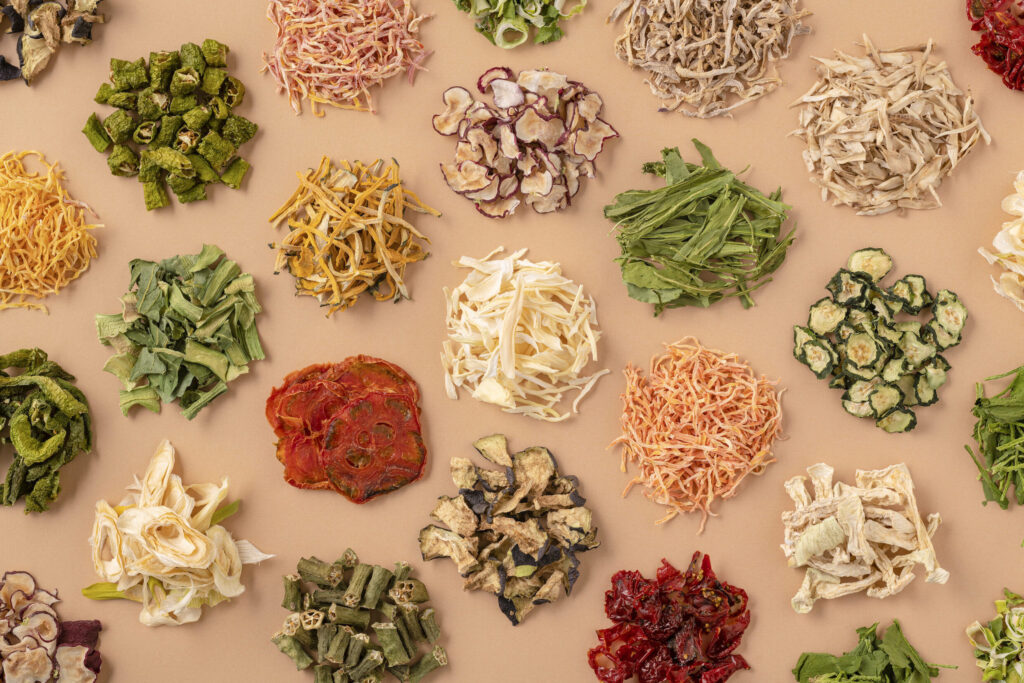
- Sold in small lots from 1 kg
- Handling heirloom vegetables from across Japan
- Dried fruits and herbs also supported
FOR BUSINESS
乾燥野菜を業務用でお探しですか
国産の野菜・果物を乾燥し、必要に応じて粉砕してお出ししています。扱っている品目は100種前後で、規格は 乾燥品の一覧・パウダーの一覧 に掲載しています。
少量でのご購入は、姉妹ブランドの通販サイト OYAOYA で承っています。
Frequently asked questions
Q. Are the pesticides on edible roses okay?
A. The edible roses handled by Agriture use raw material grown without pesticides. Their cultivation system differs from ornamental roses, and cultivation management premised on food use is carried out. We also support issuing documents.
Q. Does the aroma remain after drying?
A. We use a process that retains the aromatic components as much as possible with low-temperature drying, but the aroma intensity declines compared with fresh flowers. Since the persistence of the aroma also changes with the storage environment (light-blocking, sealing), we recommend testing storage conditions to match the product design.
Q. Can it be blended with other herbs?
A. Yes. We support the design of blended teas combined with dried herbs such as chamomile, lavender, lemongrass, and peppermint. Vegetable powder list page Please check the items on
Q. Can you issue a certificate of raw material origin and an analysis table?
A. We can issue both a certificate of raw material origin showing that it is domestic raw material and a microbiological test report. We support the quality requirements for both food and cosmetic applications.
Q. Can it be blended with other dried vegetables?
A. Prototyping is possible from 1 kg on a raw material basis. You can compare the dried-petal and powder forms simultaneously, and main manufacturing is a guideline of 5 kg or more of raw material.
Related pages and further reading
- We Prototyped "Dried Nameko" Using Domestically Grown Nameko
- Agriture was featured on the official site of Takii Seed's "Fight & Rich"
Author of this article
Related articles
-
 We released a free news release posting service on our operated “Food OEM Directory”
 -
 We Prototyped "Chestnut Skin Powder" Using Domestically Grown Chestnut Skins
 -
 Products from OYAOYA, A Letter from a Pear, and Agriture featured on "Urelio"
 -
 Launched the employee-benefit service “Office Yaoya (OFFICE YAOYA)”
 -
 OYAOYA, a dried-vegetable brand using Kyoto vegetables, announces it will become a consolidated subsidiary of global cutlery maker Kai through M&A
 -
 We Published the Dried Vegetable Projects Page
 -
 Is There Demand for Dried Vegetables in Dubai?
 -
Our Office Yaoya was introduced by the placed-cafeteria service “Taberel”