
We Prototyped "Dried Nameko" Using Domestically Grown Nameko

Summary of this article
At Agriture, we prototyped dried nameko using domestic nameko. By carefully drying domestic nameko at low temperature and finishing it additive-free and without coloring, the umami components are concentrated and shelf life is improved. Even after rehydration, the sliminess and texture distinctive of nameko remain, and it can be used for diverse product development such as soups, retort foods, dashi raw material, and health foods.
Nameko is a mushroom characterized by a distinctive sliminess and rich umami, widely enjoyed in miso soup, dressed dishes, and more. Drying concentrates the umami components and improves shelf life, so it can be used in a form suited to commercial and processing uses. A feature is that the texture and flavor of nameko remain firmly even after rehydration.

In this prototype, we carefully dried domestic nameko as the raw material at low temperature and finished it additive-free and without coloring. It can be used for diverse product development such as soups, retort foods, dashi raw material, and health foods.
At Agriture, we conduct OEM development and provide commercial raw materials centered on domestic mushrooms. If you are considering product-making that makes the most of natural umami, please consult us.
Features of dried nameko and points to focus on regarding its components
Nameko (Pholiota microspora) is a mushroom of the Strophariaceae family, and its greatest feature is having a slimy component (viscous polysaccharides). Drying processing removes moisture and concentrates the umami, and the sliminess is restored when rehydrated in water. Dietary fiber, vitamin D, and niacin are points to focus on in terms of components, but because the content varies with cultivation conditions, we recommend confirming at the prototype stage. Nameko is familiar in Japanese miso soup and dressed dishes, but making it into a dried product widens shelf life and the range of uses. For detailed specifications, the product page for dried nameko.
Choosing between fresh nameko, boiled, and dried
Nameko differs in how the sliminess comes out and in its uses by processing form. Use the following comparison table as a guide for choices at the development stage (figures vary with cultivation conditions and processing methods).
| Item | Fresh nameko | Boiled (pouch, canned) | Dried nameko |
|---|---|---|---|
| Main use | Miso soup, dressed dishes, udon | Miso soup, hot pot | Dashi raw material, soup ingredient, or powdered into seasoning |
| Storage period guide | Refrigerated 3-5 days | Room temperature 6-6 months (from the shipping date) | About 6 months from the shipping date |
| Restoration of sliminess | As is | As is | Sliminess restored by rehydration |
| Concentration of umami | ★ | ★ | ★★★ (umami concentrated by drying) |
| Presence of additives | None | Citric acid, etc. (depends on the product) | Not used (Agriture specification) |
A distinctive point of dried nameko is that the slimy component is restored when rehydrated in water. This sliminess contributes to the mouthfeel of miso soup and the thickness of soups, and even the dried product gives a texture close to fresh nameko.
Variations of processing form
Agriture handles whole drying, cut drying, and powder processing. Whole drying suits soup and miso soup ingredients that make the most of the appearance, while powder suits dashi raw material and seasoning blends.
You can check the details of turnip's powder form on the
Because nameko's slimy component is water-soluble, it is restored when rehydrated in water even after drying. The distinctive thickness when added to miso soup or soup is still present in the dried product, making it an ingredient easy to respond to consultations like wanting to add slimy nameko to instant miso soup. Since it dissolves in when made into powder, we recommend cut or whole drying if you want to make the most of the slimy texture.
.
Dried nameko suits product development centered on the mouthfeel from the slimy component and the concentration of umami. Here we introduce representative ideas by application.
Miso soup and instant soup
The most representative use of dried nameko is as a miso soup ingredient. Adding dried nameko to freeze-dried miso soup or instant miso soup restores the sliminess when hot water is poured, finishing as an authentic nameko soup.
- Ingredient for instant miso soup and freeze-dried miso soup
- Blend ingredient for cup soups and soup kits
- Ingredient for hot-pot sets (mushroom mix)
Dashi and seasonings
Powder-processed dried nameko is used as a raw material for mushroom-type dashi and in seasoning blends, allowing the design of natural dashi with layered umami. The nutritional value and benefits of vegetable powder.
- Blend raw material for natural dashi packs
- Mushroom-flavored powdered seasonings and furikake
- Umami-reinforcing ingredient for reduced-salt dashi
Dressed dishes, tsukudani, and prepared foods
There is also a way of using dried nameko rehydrated in water as an ingredient for dressed dishes and tsukudani. Being able to use nameko of stable quality year-round in seasons and regions where fresh nameko is hard to obtain is a commercial advantage. List of dried-vegetable products You can also check other dried mushroom products at .
- Commercial ingredient for nameko grated-daikon dressed dishes
- Raw material for mushroom tsukudani and nametake-style products
- Mushroom ingredient for prepared foods and bento
Health foods and functional foods
We also receive consultations for use as a raw material for health foods focused on nameko's slimy component and dietary fiber. In powder form, it can be filled into tablets, granules, and capsules. Vegetable powder list page An ingredient for oden and pot-au-feu
- Blend raw material for mushroom-type supplements
- Health food ingredient with dietary fiber blended in
- Wellness products that appeal to the slimy component
FOR BUSINESS
乾燥なめこを、原料としてお探しですか
国産のなめこを乾燥・粉砕してお出ししています。カット形状や粒度の指定、継続してのお取引もご相談ください。規格は Dried nameko・Nameko powder に掲載しています。
なめこの少量販売は姉妹ブランドの OYAOYA では取り扱いがありません。ほかの品目はカタログをご覧ください。
A base raw material for vegetable bouillon and dashi powder
Here we summarize representative specifications for Agriture's commercial lots of dried nameko. A processing sequence that achieves both retention of the slimy component and concentration of umami is a feature. Product specifications for dried nameko please refer to together with.
A vegetable base powder for baby food
| Item | Agriture's manufacturing specs and OEM support |
|---|---|
| Raw materials | Domestic nameko (contract cultivation) |
| Processing step | Washing → cutting (if desired) → low-temperature hot-air drying (product-temperature control) → powder processing (if desired) → filling |
| Additives | No colorants or antioxidants used |
| Storage period | A guide of about 6 months from the shipping date (varies by storage conditions) |
| Processing shape | From 1 kg of raw material |
| Main production lot | Slice / dice cut / powder |
| Not used | Minimum prototyping lot |
Customization support
- Blending: handles set design with other dried mushroom products, wakame, and tofu
- Packaging: handling of 500 g bags, 1 kg bags, 5 kg commercial bags, and individual packaging
- Shape: slice (for pickles), dice cut (for ingredients), powder
- Growing region: multiple domestic contract-cultivation routes prepared
Blending: pre-blend support with other dried vegetables
Because the degree to which the sliminess is restored and the texture change with cut size and drying conditions for dried nameko, we recommend a process of confirming the target finish at the prototype stage.
- dried vegetable / powder OEM inquiry form Contact us with the prototyping content, application, and desired form via
- Share the envisioned product and target texture in a concept hearing (Zoom or email)
- Ship a prototype sample per 1 kg of raw material (usually 2-3 weeks). Comparison prototyping with different cut sizes is possible
- Contact us with the prototyping content, desired shape, and assumed application via
- Main manufacturing (from 10 kg of raw material). Issuing necessary documents and lot-by-lot quality inspection supported
If you tell us the application, such as for miso soup ingredients, for dashi-pack raw material, or wanting to make it into powder and blend it into seasoning, we will propose the optimal processing conditions.
Product catalog showing the items we handle
Flexible support from small lots to large lots
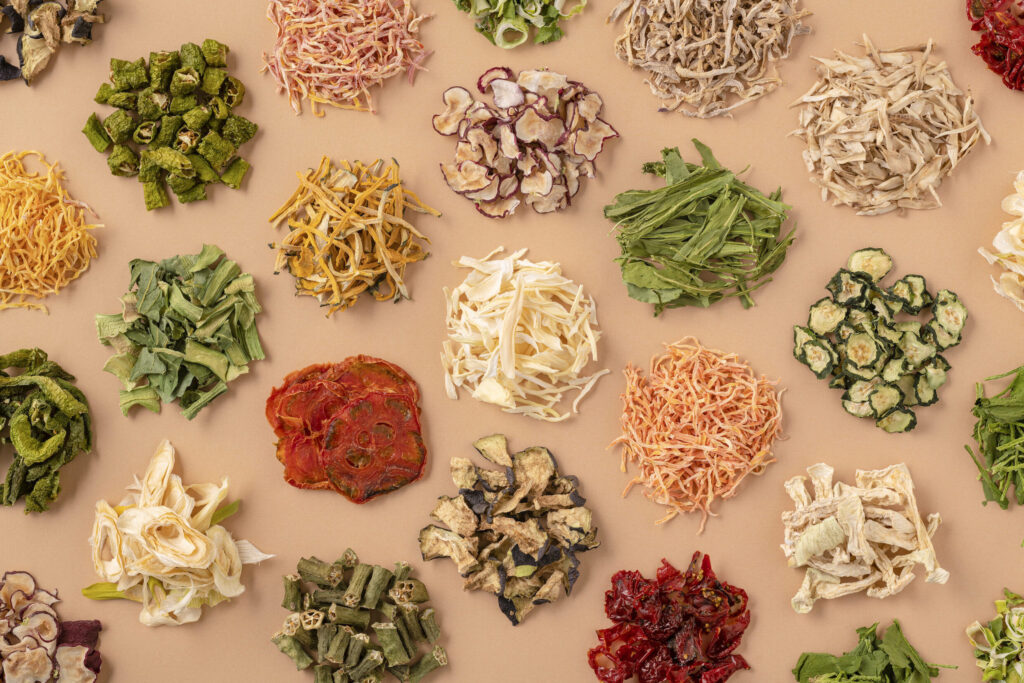
- Sold in small lots from 1 kg
- Handling heirloom vegetables from across Japan
- Dried fruits and herbs also supported
FOR BUSINESS
乾燥なめこを、原料としてお探しですか
国産のなめこを乾燥・粉砕してお出ししています。カット形状や粒度の指定、継続してのお取引もご相談ください。規格は Dried nameko・Nameko powder に掲載しています。
なめこの少量販売は姉妹ブランドの OYAOYA では取り扱いがありません。ほかの品目はカタログをご覧ください。
Frequently asked questions
Q. Does the sliminess of dried nameko come back?
A. When rehydrated in water, the slimy component is restored, giving a mouthfeel close to fresh nameko. The thickness when added to miso soup or soup is still present in the dried product. Since the slimy texture is harder to feel when made into powder, cut or whole drying is recommended if you want to make the most of the mouthfeel.
Q. Can it be used as an ingredient for instant miso soup?
A. Cut dried nameko has a prototyping track record as an ingredient for instant miso soup. When hot water is poured, it rehydrates in a short time and the sliminess emerges, finishing as an authentic nameko soup.
Q. Can it be blended with other mushroom or vegetable powders?
A. Yes. With other dried mushroom products such as enoki, shiitake, and maitake, and. Vegetable powder list page Please check the items on
Q. Can you issue a certificate of raw material origin and an analysis table?
A. We can issue both a certificate of raw-material origin showing it is a domestic raw material and a microbial test report.
Q. Can it be blended with other dried vegetables?
A. Prototyping is possible from 1 kg on a raw-material basis. You can compare whole, cut, and powder forms at the same time, and main production is from 10 kg of raw material as a guide.
Related pages and further reading
Author of this article
Related articles
-
 We released a free news release posting service on our operated “Food OEM Directory”
 -
 We Prototyped "Chestnut Skin Powder" Using Domestically Grown Chestnut Skins
 -
 A Notice About the Rose Prototype
 -
 Products from OYAOYA, A Letter from a Pear, and Agriture featured on "Urelio"
 -
 Launched the employee-benefit service “Office Yaoya (OFFICE YAOYA)”
 -
 OYAOYA, a dried-vegetable brand using Kyoto vegetables, announces it will become a consolidated subsidiary of global cutlery maker Kai through M&A
 -
 We Published the Dried Vegetable Projects Page
 -
 Is There Demand for Dried Vegetables in Dubai?