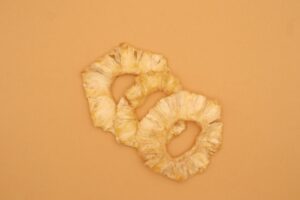
Dried Kaga lotus root


TOC
Dried Kaga Lotus Root: product overview
Kaga lotus root is a specialty of the Kaga region of Ishikawa, a high-quality lotus root characterized by stickiness and sweetness. Drying in particular concentrates a fluffy texture and rich sweetness, giving deep richness to dishes. The stickiness is firmly felt even after rehydration, and it can be widely used in simmered dishes, dressed dishes, and stir-fries.
Processed into powder, it is also prized for thickening soups and sauces, making the most of lotus root's characteristic stickiness and umami.
Three commitments Agriture values
01 Using Kaga lotus root, a Kaga traditional vegetable
"Kaga lotus root," long grown in the Kaga region of Kanazawa, Ishikawa, is a traditional vegetable also certified as a Kaga vegetable. Characterized by strong stickiness and thick, meaty texture, we use only fine raw material sourced directly from partner farmers.
02 Balancing a crisp and fluffy texture
Kaga lotus root's appeal is being able to enjoy both the crisp bite when raw and the fluffiness when heated. Drying slowly at low temperature, we achieve an exquisite finish where the crispness remains even after rehydration.
03 Primary processing with zero glucose or bleaching agent
We use no bleaching agents or glucose coating, the kind often used on commercial dried lotus root. To deliver the traditional vegetable's flavor as-is, it is an additive-free primary-processed raw material that competes with the ingredient alone.
Product catalog showing the items we handle
Flexible support from small lots to large lots
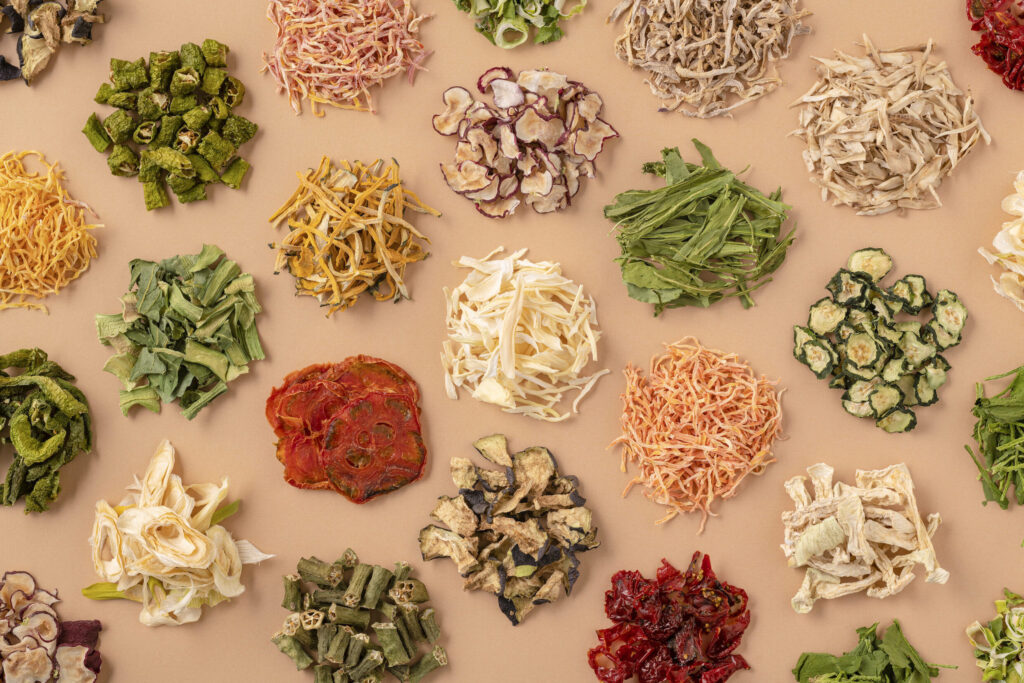
- Sold in small lots from 1 kg
- Handling heirloom vegetables from across Japan
- Dried fruits and herbs also supported
Characteristics as a commercial raw material
The value of the Kaga-vegetable brand
Kaga lotus root is one of the 15 Kaga vegetables certified by Kanazawa. It is a raw material whose traditional-vegetable story can be put straight into product appeal.
Sticky, thick-meaty texture
Compared with ordinary lotus root, strong stickiness and thick flesh are the features of Kaga lotus root. Its texture remains firmly even after drying, and used in simmered dishes and kinpira, its presence stands out.
Resistance to falling apart after rehydration
Because the crisp fibers are firm, it does not become too soft even when rehydrated, and has commercial-friendly ease of use, resisting falling apart.
Functional raw material through powdering
Kaga lotus root is also offered as Kaga lotus root powder at Agriture/OYAOYA, usable as a raw material for health foods and Japanese sweets that make the most of the stickiness and dietary fiber.
Stable year-round supply
Fresh Kaga lotus root is a seasonal ingredient in season in autumn and winter, but as a dried product it can be supplied year-round, so it can be adopted regardless of menu-development timing.
A tradition × OEM combination
The angle of Kaga lotus root × OEM matches collaborative product development with restaurants, food makers, hotels, and tourism operators inside and outside Ishikawa.
Product specifications
Item | Details |
|---|---|
Raw material growing region | Ishikawa-grown |
Specification | Rounds |
Storage method | Room temperature (store away from high heat and humidity) |
Best-before date | 6 months from the shipping date |
Minimum lot | From 10 bags / 100 g |
Powder | Available |
Manufacturing period | Autumn |
Customization and OEM support
Through cooperation with partner farmers and our own processing facilities, Agriture achieves stable raw material supply and high-quality manufacturing. We can flexibly accommodate OEM manufacturing and also handle consultations on specification changes and packaging.
- Custom-size support (cut-thickness changes, shape adjustments): consultation available for orders of 10 kg or more
- OEM support: available (from small-lot prototyping to mass production)
- Large-lot manufacturing: available (consultation required 3 months before the manufacturing period)
POWDER
We also offer powder products
We also handle products made by processing Kaga lotus root into powder. Ideal as a raw material for soups, drinks, and health foods that make the most of the stickiness and dietary fiber.
Commitments to variety, producer, growing region, and cultivation
BRAND
Variety:Kaga lotus root (a traditional vegetable grown in the Kaga region of Ishikawa). One of Kanazawa's certified Kaga vegetables, characterized by strong stickiness and thick, meaty texture.
PRODUCER
Producer:Partner farmers in the Kaga region of Ishikawa. In partnership with growers who raise lotus root while preserving traditional cultivation methods, we balance raw-material quality and stable supply.
REGION
Growing region:The Kaga region of Ishikawa. Clay soil and abundant water resources nurture strongly-sticky lotus root.
CULTIVATION
Cultivation method:Grown by traditional mud-paddy cultivation and harvested in autumn. Right after harvest, it enters the processing step, drying without impairing the flavor of the Kaga traditional vegetable.
*Reference: OYAOYA product page
Low-temperature drying that preserves the ingredient's character
At Agriture, to make the most of Kaga lotus root's flavor, color, and texture, we use a drying method that draws out moisture slowly over time at low temperature. While high-heat hot-air drying can remove moisture in a short time, it has the drawback that aroma components, pigments, and heat-sensitive vitamins are easily lost. Low-temperature drying can raise the raw material's shelf stability while retaining these components as much as possible, characteristically bringing up the ingredient's natural flavor when rehydrated.
💡 TIPS | Drying-processing trivia
Lotus root is a vegetable that discolors easily, oxidizing from the cut surface, and a material prone to darkening in ordinary drying processes. At Agriture, by shortening the post-harvest processing time and suppressing oxidation with low-temperature drying, we balance a white, beautiful appearance with a crisp texture.
Use cases for dried Kaga lotus root
Dried Kaga lotus root is a raw material whose appeal is balancing traditional-vegetable appeal with texture. It shows its strength especially in developing Japanese food, Japanese sweets, health foods, and tourism products.
Ingredient for simmered dishes, kinpira, and chirashi sushi
Used after rehydration as an ingredient for simmered dishes, kinpira, and chirashi sushi, it can bring out Kaga lotus root's characteristic sticky richness and texture. Because it saves the trouble of peeling and thin-slicing, it suits menu development at Japanese restaurants and streamlining prepared-dish prep. Being usable stably even outside the season thanks to room-temperature storage is also an advantage.
Raw material for tempura and fried foods
Rehydrated and then made into tempura or plain-fried, it lets you enjoy Kaga lotus root's characteristic fluffy texture and toasty aroma. Because it is pre-prepped with uniform specifications, it is an easy raw material to handle for kaiseki and shojin-cuisine menus and fried-food prepared dishes.
Raw material for Japanese sweets and lotus root mochi
Grated and heated, Kaga lotus root can be processed into chewy lotus root mochi or steamed sweets. Powdered, the blend amount is easy to adjust, so it can be used in OEM development of regional traditional sweets and souvenirs. It is a raw material with good affinity with brand designs that highlight the origin name.
Thickening material for soups and potages
Added as grated powder to soups and potages, it can impart lotus root's characteristic thickness and umami. Because the starch content gives natural thickness, it is also a material suited to health-conscious product development that wants to curb thickeners.
Accent for salads and marinades
Rehydrated and dressed with oil or vinegar, it finishes into salads and marinades that make the most of the crisp texture. Because the round-slice shape can be used as-is, the appearance is neat too, making it an easy raw material to use as an ingredient for deli dishes in both Japanese and Western styles.
About commercial and OEM consultations
At Agriture, in partnership with partner farmers in the Kaga region of Ishikawa, we carry out stable supply and dry processing of Kaga lotus root. We can also respond flexibly to consultations on product development using traditional vegetables and regional-collaboration projects.
Past initiatives and adoption projects can also be seen on the following pages.
- Past initiative case studies are here
- Commercial dried vegetable OEM here
- Commercial vegetable powder here
Product catalog showing the items we handle
Flexible support from small lots to large lots
- Sold in small lots from 1 kg
- Handling heirloom vegetables from across Japan
- Dried fruits and herbs also supported
FAQ about dried Kaga lotus root
Q. Please tell me the minimum lot for dried Kaga lotus root and the volume per bag.
A. For commercial use, we can do business from a minimum of 10 bags at 100 g per bag. We can accommodate small lots even at the prototyping and test-adoption stage, and for mass production you can consult with us on package specifications and lot quantities.
Q. What is the commercial price range?
A. The price varies with the raw material market, specifications, lot size, and cut specifications. When you inquire, we will propose a quote to match your desired specifications and lot, so first let us know your required conditions.
Q. What is the lead time from order to delivery?
A. Stocked items can be shipped in about a few days to a week. For made-to-order or custom specifications, there are cases where we ask for a lead time of about two weeks to a month, including raw material preparation and the drying process. Consulting early provides reassurance.
Q. Can you obtain a certificate of origin for the raw material?
A. Depending on the client's request, we can prepare a certificate of origin for the raw material. Since there are cases where we can provide it together with the cultivation information of partner farmers, please let us know the documents you need in advance.
Q. Can you handle food-sanitation and HACCP compliance and export-oriented support?
A. Agriture's processing carries out hygiene management in line with the HACCP approach, and you can consult us on dried vegetable raw materials for export as well. Please also consult us on confirming requirements by destination country and label support when you inquire.
Q. For an OEM request, in what flow should I consult?
A. First, let us know your product image, lot quantity, and desired delivery date via the inquiry form. After a hearing, we propose prototyping, a quote, and a production plan, and once you approve, we schedule mass production—this is the general flow.
Q. Can you handle custom specification changes such as cut size and shape?
RETAIL
For those looking to purchase in small packs
For those who want to try Kaga lotus root's flavor starting small, our partner brand OYAOYA sells retail packs of 20g, 80g, 200g, and 500g. They can also be used as a household stock of the traditional vegetable or as prototype samples for in-store sales.
Medicinal-food properties (in the case of fresh Kaga lotus root)
Lotus root, including Kaga lotus root, is one of the ingredients long used in the world of medicinal food. As a versatile root vegetable that can be used differently by season and physical condition, it is a standard material in medicinal-food recipes.
In medicinal food, lotus root is said to have an action that regulates the flow of blood in the body and calms excess heat. It is said to be recommended when you feel inflammation or flushing, and because heating it turns it into a gentle ingredient that does not over-cool, in winter a way of eating that regulates the body through warm simmered dishes and soups is favored. Known also as an ingredient that supports the workings of the stomach and intestines, it is incorporated into dishes mindful of digestion and recovery of stamina.
💡 TIPS | Yakuzen trivia
As a rule, the medicinal-food use of vegetables including Kaga lotus root is adjusted to match constitution and season. Because dried vegetables can be stored at room temperature, they are also an easy material to build into prototyping of medicinal-food recipes and product development.
For lotus root with strong stickiness like Kaga lotus root, a way of eating where you process it into powder and mix it into soups and congee is also recommended. Because it can add thickness and nourishment at once, it is a material with good affinity with medicinal-food recipe development.
YAKUZEN
For those who want to learn more about Kaga lotus root from a medicinal-food perspective
Yasai Yakuzen explains lotus root's medicinal-food properties and hints for seasonal ways to eat it. It carries information useful for planning lotus root dishes including Kaga lotus root, and for developing medicinal-food menus.
Recommended reading
- Kaga lotus root: featuring a sticky, thick-fleshed texture (traditional vegetable)
Download the product catalog
We will send the materials to your email address based on the information you provide.