
Flavored Tea Development: Differentiating Aroma with 3 Elements × 4 Axes

Summary of this article
We organize flavored tea development across the three contents elements (base tea leaf × flavor ingredient × flavoring method) and the four selling axes (ingredient story, scene, package, experience). Examples of Japanese ingredients × flavored tea; Agriture provides ingredients only, with OEM maker introductions going through foodoem.jp.
Flavored tea is a product category in which base tea leaves—black tea, green tea, oolong, white tea, and the like—are scented with fruit, herbs, spices, flowers, and so on. Differentiating across three elements—base tea leaf + flavor ingredient + flavoring method—is the basic approach, and it’s an area where demand keeps growing in D2C, cafés, gifts, and tourist souvenirs. Note that Agriture itself is not a tea production factory; its area is providing Japanese ingredients and formulation consultation, and OEM maker introductions go Food OEM Directory through.
This article organizes the big picture of flavored tea development, how to choose the base tea leaf, the three flavoring methods (flavoring / real-ingredient blending / steam adsorption), axes of differentiation, and through to lot, cost, and legal labeling. Related articles: Black Tea OEM: Original Blends/Flavored coffee OEM。

TOC
The Three Elements of Flavored Tea Development
Flavored tea’s character is decided by the combination of three elements—base tea leaf, flavor ingredient, and flavoring method. Deciding where to differentiate first makes it easier to balance cost and brand appeal.
The Three Elements and Their Roles
| Element | Main Options | How It Affects Differentiation |
|---|---|---|
| Base tea | Black tea, green tea, oolong, white tea, hōjicha, domestic | The taste foundation and pitch axis (domestic / overseas-grown) |
| Flavor ingredient | Fruit, herbs, spices, flowers, Japanese ingredients | Aroma, appearance, and story |
| Flavoring method | Flavoring / real-ingredient blending / steam adsorption | Cost, labeling, lot feel |
Deciding the broad worldview with the base tea leaf, adding character with the flavor ingredient, and adjusting cost and lot with the flavoring method—building in that order is the practical design flow.
How to choose the base tea leaf
The base tea leaf is the foundation that brings out the flavor. The basic combination is a mild tea leaf for a strong-aroma flavor, and a low-quirk tea leaf for a delicate aroma.
Suitability by Base Tea Leaf
| Base tea | Features | Flavors That Suit |
|---|---|---|
| Black tea (Assam, Ceylon) | Richness and astringency | Berry types, chai types, milk-tea types |
| Black tea (Darjeeling) | Delicate aroma | Suited to straight; light fruit |
| Green tea (sencha, gyokuro) | Astringency and umami | Yuzu, sakura, hōji, Japanese ingredients |
| Oolong tea | Toastiness and floral aroma | Lychee, peach, osmanthus |
| White tea | Delicate and light | Jasmine, honey, rose |
| Hōjicha | Toastiness | Brown sugar, kinako, chestnut, spice |
Cases That Differentiate with Domestic Tea Leaves
- Domestic black tea × Japanese ingredients (yuzu, Japanese chestnut, sakura) for tourist-souvenir and gift products
- Uji sencha × fruit for a modern blend aimed at younger consumers
- Kyoto-grown hōjicha × spice for a winter-limited chai
- Shizuoka tea, Kagoshima tea × regional fruit for a local-specialty line
The Three Basic Flavoring Methods + Derivative Patterns
The flavoring method differs greatly in cost, labeling, and lot feel. Choose to match the product’s price range, pitch axis, and sales channel.
Comparison by Method
| Method | Features | Cost | Labeling |
|---|---|---|---|
| Adding aroma compounds | Uniform, strong aroma | Low | “Flavoring” must be listed |
| Blending real ingredients (fruit, herbs) | Ingredient feel, appearance | Medium to high | Ingredient names can be listed individually |
| Steam adsorption | Natural aroma, gentle | Medium | Varies by method |
| Hybrid (real ingredient plus aroma compounds) | Balances appearance and aroma | Medium | Flavoring listing + ingredient name |
When to Use Flavoring
- Creating a stable aroma for mass-production and chain-oriented products
- Easy to move to mass production in 1–2 prototypes
- Almost no aroma variation between lots, so it suits mass distribution
- Because “flavoring” goes on the label, it pairs poorly with additive-free appeal
When to Use Real-Ingredient Blending
- Ingredient appeal for premium, D2C, gift, and tourist souvenirs
- Ingredient names can be listed individually on the label, giving it a story
- Aroma varies with season and lot, tending to increase the number of prototypes
- Blending in freeze-dried fruit or herbs lets you pitch appearance too
When to Use Steam Adsorption
- Natural scenting for mid-price products
- Close to traditional methods like jasmine tea and osmanthus tea
- Compatible factories are limited, tending to make the order lead time longer
The Four Axes of Differentiation (Designing the Selling and the Presentation)
The three elements so far were the “design of the contents” of flavored tea, but to be chosen as a product, you also need to design the “selling and presentation.” Differentiate across four axes that go beyond a mere “unusual taste.” The key is whether you can put into words “why choose this product” when it sits next to competitors.
① Ingredient Story
- Concretely state the origin, farm, and harvest time
- Regional branding such as Kyotango-grown, Uji-grown, Shizuoka-grown
- Food-loss appeal through use of off-spec or B-grade produce
② Scene Suggestion
- Time-of-day lines such as morning wake-up, afternoon relaxation, and before bed
- Seasonal limited editions (spring = cherry blossom, summer = yuzu, autumn = chestnut, winter = cinnamon)
- By gift occasion (birthday, wedding, get-well, retirement)
③ Packaging and presentation
- Create a world view with material differences—cans, cloth bags, wooden boxes
- Elevate the feel with ribbon-style tea-bag strings and triangular bags
- Design so aroma rises when opened (aluminum lamination + degassed packaging)
④ Experience design
- The color, aroma, and visual change when hot water is poured (freeze-dried ingredients rehydrating, etc.)
- Include a leaflet on brewing and temperature matched to the blend
- A subscription or calendar format that delivers a different flavor each month
Examples of Japanese ingredients × flavored tea
Japanese ingredients are an area where you can differentiate from overseas brands. Here we bring together combination patterns using the Kyotango-grown freeze-dried strawberry and Kyoto-grown dried vegetables that Agriture offers.
- Freeze-dried strawberry x Darjeeling: a visually appealing tea for spring to early summer
- Dried yuzu × sencha: a warm flavored tea for winter
- Japanese chestnut x Assam: milk tea and gifts for autumn and winter
- Black soybean × hojicha: a low-caffeine line focused on toasty notes
- Dried Kujo leek × black tea: a spicy, unconventional chai (prototype consultation available)
Basics of lots, cost, and labeling
The ordering conditions for flavored tea vary with the flavoring method and packaging. Here are the items to nail down before commercialization.
Rough guide to lots and cost
- Flavoring added: from 1,000 units, 80–200 yen each
- Real-ingredient blend: from 3,000 units, 150–400 yen each
- Steam infusion: from 5,000 units, 200–500 yen each
- Original package printing: 1,000–3,000 units + printing plate fee of 30,000–200,000 yen
Checking labeling and regulations
- If flavoring is added, “flavoring” must be listed in the ingredients
- For organic claims, confirm whether JAS certification is held
- Confirm that functional or efficacy claims don’t violate the Pharmaceutical and Medical Device Act
- If allergens (milk, soy, wheat, etc.) are present, labeling is mandatory
We have materials available to help you understand dried processing OEM
Agriture OEM, flexibly handling everything from small lots to large lots
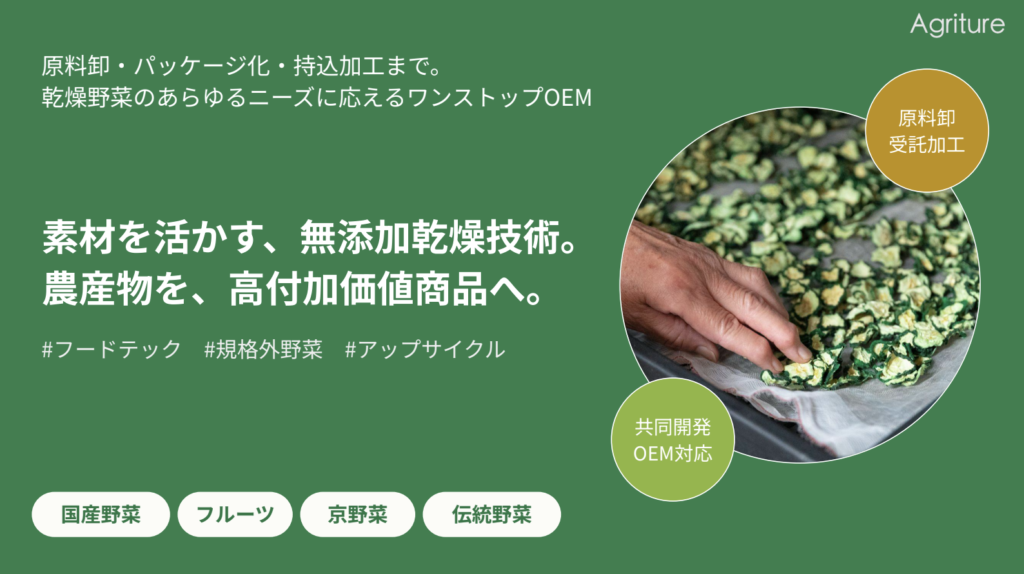
- OEM available from small lots of 10 kg
- Drying of brought-in raw materials also possible
- Support from processing to filling in one place
FAQ
Flavoring added or real-ingredient blend—which should you choose?
For volume, mass distribution, and low unit price, flavoring added is suited; for premium, D2C, gifts, and tourist souvenirs where you want to appeal to the ingredient, real-ingredient blend is suited. Real-ingredient blends require more prototype rounds and handling of raw-material lot variation, but they let you list the ingredient name on the label, making differentiation easier.
Can we make an additive-free claim?
It’s possible with a design that adds no flavoring (real ingredients only, or steam infusion only). “No added flavoring” and “additive-free” labeling is possible only when the product is made without using additives, so this decision needs to be made at the point of choosing the method.
I’d like to differentiate with Japanese ingredients × flavored tea—what are my options?
There are examples combining Kyotango-grown freeze-dried strawberry, Kyoto-grown dried vegetables, Japanese chestnut, Yuzu, black soybean, cherry blossom, matcha, and more with base tea leaves. They’re adopted in designs that differentiate from overseas ingredients for tourist souvenirs, regional brands, and gifts.
About how many prototype rounds are needed?
As a rough guide, flavoring added takes 1–2 rounds, real-ingredient blend 3–5 rounds, and steam infusion 2–3 rounds. Real-ingredient blends involve more fine-tuning for seasonal and lot variation, so it’s reassuring to allow ample time for prototyping.
Where is the OEM consultation point?
Introductions to tea OEM makers are Shokuhin OEM no Madoguchi (foodoem.jp), and Agriture handles the supply of Japanese ingredients and formulation consultations directly. For inquiries about Japanese ingredients × flavored tea, Food OEM no Madoguchi (Agriture) is the way to reach us.
Summary
The development of flavored tea has its structure determined by three elements—base tea leaves, flavor ingredients, and flavoring method—and is differentiated along four axes: ingredient story, scene proposal, packaging, and experience design. Using flavoring added, real-ingredient blend, and steam infusion appropriately, and designing regional brands that combine Japanese ingredients, is a direction that will work in the coming market.
Related article: Black Tea OEM: Original Blends・Flavored coffee OEM. For Japanese-ingredient provision, see Food OEM no Madoguchi (Agriture), and for introductions to tea OEM makers, Food OEM Directory.
Download the OEM contract processing materials
We will send the materials to your email address based on the information you provide.
If you are considering product development with off-spec or your own farm's vegetables:From planning to processing, materials, package printing and novelties, you can consult us through a single point of contact. → Learn more about one-stop product development
- Flavored coffee OEM | Design guide for beans and adding aroma
- A must-read for e-commerce businesses: how to make a dried vegetable mix through OEM
Author of this article
Related articles
-
 Original coffee marketing strategy | Ways to grow sales
 -
 ベジタリアンとは?国の規格が分けている4つの区分と食べられないもの
 -
 長ねぎと白ねぎは同じもの?ねぎの種類と呼び名を国の資料で確かめる
 -
 柚子の種類は何種類あるのか、公の資料で名前が残る系統を数えた
 -
 ゆずの時期は年に二度、青ゆずは7月から黄ゆずは10月から
 -
 ゆずの産地は高知が半分を占め、二位は徳島から愛媛に変わった
 -
 Preventing Food OEM Failures: Common Failure Cases and Countermeasures for Success
 -
 How to find a food OEM | How to efficiently find the best manufacturing partner