
A Complete Guide to Choosing Commercial Fruit Powder: Manufacturing Methods, Particle Size, Lot, and Procurement Practice

Summary of this article
業務用フルーツパウダーの選び方を、製法別の違い(FD・真空・噴霧・熱風)、粒度・添加物・認証の基本6軸、フルーツ特有の5つの確認項目(吸湿・粉砕難度・酸味・色残り・ざらつき)、用途別の定番品目、5つの仕入れルートと最低ロットまで整理します。Agritureの粉末化実績(京都産柚子パウダー)と乾燥素材実績(ワンズデイリー葉取らずりんご、dry-pear京丹後二十世紀梨、キウイ・レモン・沖縄産フルーツの試作)を紹介。食品OEMの窓口掲載の主要メーカーも整理しています。
Commercial fruit powder is a commercial raw material made by powdering fruit, used widely across confectionery, beverages, smoothies, dairy, snacks, and health foods. Unlike fresh fruit, it keeps at room temperature and can be blended in small amounts while concentrating color, aroma, and nutrients, making it an ingredient you can handle flexibly from the prototype stage of product development through mass production.
This article is for food manufacturers, confectionery workshops, restaurants, and D2C brands looking to source commercial fruit powder. Based on knowledge from the contract-processing floor, we organize the differences by production method, checkpoints for selection, item mapping by application, sourcing routes, minimum lots, and Agriture's track record in fruit processing. From yuzu powder prototypes to dried leaf-left apples and Twentieth-Century pears, we can consult on both powdering and dried ingredients.

TOC
What is commercial fruit powder
Fruit powder is an ingredient made by drying fruit and grinding it into powder. Commercial powder is distributed in capacities and specifications aimed at businesses such as food manufacturers, confectionery workshops, restaurants, and cafés. Compared with household use (20-100 g small bags), it's characterized by large capacities in units of 1 kg to 10 kg, and by coming with specifications for particle size and lot management.
| Item | Commercial | Household use |
|---|---|---|
| Volume | 1 kg, 5 kg, 10 kg | 20-100 g small bags |
| Price (per kg) | Low to medium | High |
| Particle-size specification | Mesh specification available | Fixed specification |
| Quality documents | Test report, certificate of origin | Package labeling only |
| Main sources | Direct from manufacturer, wholesale, B2B matching | Confectionery-supply stores, e-commerce |
Commercial fruit powder has a wide range of applications, from confectionery, bread, and dessert development to raw materials for health foods and functional beverages, and the per-kg price drops as the sourcing volume grows.
Characteristics of each production method and how to choose
The quality of fruit powder is decided by the drying method. The four representative production methods differ in the balance of color, aroma, and nutrient retention against cost.
| Production method | Temperature range | Cost | Color and aroma retention | Suited use |
|---|---|---|---|---|
| Freeze-dried (FD) | Reduced pressure below freezing | High | Relatively easy to retain | Confectionery colorant, premium products |
| Vacuum drying | 30 to 60C plus reduced pressure | Medium | High retention depending on conditions | Raw materials where you want to protect functional components |
| Spray drying | Dried in a mist at 150-200°C | Medium | Medium | Raw material for granular and powdered beverages |
| Hot-air drying | Around 60-90°C | Low | Somewhat degraded | Soups, sauces, and kneading in |
strawberry Fruits where "vivid color" is the value—strawberry, blueberry, raspberry—tend to go to FD or vacuum drying, apples・mikan while uses that blend sweetness and aroma into soup or baked-good batter tend to go to hot-air or vacuum drying.
FOR BUSINESS
乾燥野菜のOEM・受託加工を承ります
国産の野菜・果物の乾燥、100メッシュ相当までの粉砕、10g以上の小袋充填までをお受けしています。小ロットの試作から量産までご相談ください。寄せられた相談の実例は OEM・卸のご相談 に掲載しています。
乾燥品の賞味期限は、出荷日から6ヶ月程度を目安にご案内しています。
Checkpoints for commercial selection
Before sourcing for commercial use, in addition to the general six axes (origin, production method, particle size, additives, certification, minimum lot), grasping the practical items unique to fruit powder makes manufacturer comparison and spec agreement smooth.
The general six axes
| Point | Details to confirm |
|---|---|
| 1. Raw material origin | Domestic/imported, disclosure scope of prefecture name and contract farmers |
| 2. Production method | FD/vacuum/spray/hot-air, temperature range and drying time |
| 3. Particle size | Whether mesh can be specified, tolerance for lot-to-lot variation |
| 4. Raw material labeling | Fruit name only, or presence of additives like dextrin and maltose |
| 5. Quality certification | HACCP, FSSC 22000, JAS Organic, etc. |
| 6. Minimum lot | The labeled minimum vs. the practical operational minimum (including prototyping) |
The five checks unique to fruit powder
Fruit handles sugar content, acidity, pigment, and moisture more delicately than vegetables, and to avoid a "not what we expected" after adopting it for commercial use, the realistic approach is to line up the following five points in advance.
| Item | Why it matters | How to check |
|---|---|---|
| Moisture absorption and clumping | Fruit is high in sugar, so the powder easily absorbs moisture and clumps | Check storage conditions (desiccant, vacuum packaging, temperature/humidity) and presence of excipients with the manufacturer |
| Milling difficulty | High-sugar fruits like banana and mango easily clump into a dough when milled | Check the particle-size distribution with a prototype sample, ask about re-milling and mesh-sorting processes |
| How the acidity comes through | Citrus can lose acidity to heat or develop bitterness | Ask the drying temperature range and verify post-baking and post-heating flavor with a prototype |
| Color retention after baking | Strawberry and blueberry lose anthocyanin color during baking | Presence of low-temperature baking recipes, specify a production method closer to FD |
| Grittiness from peel and seeds | For citrus and berries, residual grittiness from peel and seeds affects texture | Specify the sieving mesh, agree on the final particle size in writing |
Differences between domestic and foreign fruit
Domestic fruit powder has clear traceability and pairs well with additive-free and clean-label appeal, though the unit price is higher than imported. Foreign fruit (Thailand, Vietnam, China, the US, etc.) has a low per-kg price and is strong for large-volume supply, but requires checks on residual-pesticide testing, import procedures, and stable supply. For commercial use, a two-axis approach of "imported for staple items, domestic for differentiation products" is realistic.
How to read additives and raw-material labeling
Many commercial fruit powders have dextrin, maltose, or excipients added to maintain flowability. If the raw-material labeling is "fruit name (e.g., strawberry)" only, it's additive-free; if other components are listed like "strawberry, dextrin," additives are included. If it's the raw material for baby food or clean-label products, specify additive-free.
Recommended fruits by application
We have organized the items often adopted for commercial use, by application. Choosing the item by working backward from what you want to develop also makes the particle-size and production-method specifications easier to decide.
| Use | Staple items | Recommended production method |
|---|---|---|
| Baked goods (cookies, muffins, pound cake) | Strawberry, blueberry, apple, banana | FD, vacuum |
| Chocolate, fresh confectionery, molded sweets | Strawberry, raspberry, mango | FD (color and flavor focus) |
| Drinks, smoothies, protein | Strawberry, blueberry, acai, banana | FD, spray |
| Dairy (yogurt, ice cream) | Strawberry, raspberry, mango | FD |
| Baby food and weaning food | Apple, banana, mikan | FD, vacuum (additive-free) |
| Health foods, functional beverages | Acai, blueberry, yuzu | Vacuum, FD |
| Snacks, granola | Apple, strawberry, mikan | FD, hot-air |
| Pet food, additive-free treats | Apple, banana, mikan | Hot-air, vacuum (no added sugar) |
For baked goods where you blend it into the batter with butter and egg, a medium 40-100 mesh; for drinks and smoothies where you prioritize ease of dispersion, a fine 100-mesh-or-finer powder; for fresh chocolate and molded sweets where color is the star, a coarser particle that retains pigment via FD—choosing by application is the practical approach.
Sourcing routes and minimum lots
There are broadly five ways to source commercial fruit powder. The realistic approach is to use them differently by scale and application, and for startups and early development, starting from a route with small-lot support reduces failures.
| Route | Minimum lot | Customizability | Businesses it suits |
|---|---|---|---|
| Direct from specialist manufacturer | 1〜10kg | Medium | Confectionery workshops and restaurants for continuous use |
| OEM contract manufacturer | 10〜50kg | High | Businesses that want to differentiate with an original formulation |
| Wholesaler, trading company | 5〜20kg | Low | Businesses that want to consolidate multiple items |
| B2B matching, commercial e-commerce | 1kg〜 | Medium | Development staff who want to compare multiple candidates |
| Bring-your-own raw material processing | Raw material 50-100 kg and up | Highest | Businesses with their own farms or contract farmers |
Price and prototyping-fee benchmarks
- Ready-made powder per-kg price: 3,000-12,000 yen (varies by item and production method. FD strawberry can run 15,000 yen or more)
- Original-formulation prototyping fee: 5,000 to 30,000 yen per pattern
- Packaging, small-bag filling: 20-200 yen per bag
- Lead time: 1-2 weeks for ready-made products, 2-3 months for an original formulation
Agriture's fruit-processing track record
Agriture, centered on contract processing of dried vegetables and vegetable powder, also handles the drying and powdering of fruit ingredients. For those considering commercial fruit powder, we organize our "powdering" track record and our "dried ingredient (dried/slice/stick)" track record separately.
Powdering track record | Yuzu powder prototype
- 原料: 京都市右京区の柚子
- Processing: low-temperature drying and fine powdering, designed to retain a bright aroma and vivid yellow
- Particle size: adjustable from fine powder (for confectionery and drinks) to medium, to match commercial applications
- Applications: flavoring for confectionery, drinks, seasonings, and caffeine-free teas
Details of the prototype are published in京都産柚子パウダー試作のお知らせ. It's a case that also works as an inroad for consultations on powdering citrus.
Dried-ingredient track record | Leaf-left apple (One's Daily)
- Raw material: Nagano-grown leaf-left apples (a cultivation method that ripens them fully without removing the leaves)
- Processing: sugar-free dry processing, shaped into sticks
- Applications: additive-free treats both people and dogs can eat, raw material for pet supplements
- Distinctiveness of the project: a brand originating with a cooking researcher and food coordinator, valuing product-making where you can see the producer's face
Project details are published in the One's Daily collaboration page.
Dried-ingredient track record | dry-pear (Kyotango-grown Twentieth-Century pear)
- Raw material: "Twentieth-Century" pears grown in Kyotango, Kyoto
- Processing: low-temperature drying with no added sugar or additives
- Applications: dried pears from a D2C specialty brand (gifts, mail-order treats)
- Distinctiveness of the project: a sister brand of the Agriture Group. It established a rare position by pinning down both the variety and the growing region
The brand site is Letters from a Pear (dry-pear.com).
Other prototype track record in fruit drying and milling
- Domestic kiwi dried-product prototype (for confectionery and granola. Consultation on milling into powder is also possible)
- Domestic lemon slice prototype (drink toppings, baked goods. Fine powdering also applies to seasonings)
- Start of handling Okinawa-grown dried fruit (tropical fruit; high sugar content means the milling process needs care for powdering)
Because Agriture can handle everything in-house from drying through milling and particle-size adjustment, being able to "build a temperature design that anticipates powdering at the drying-prototype stage" leads to reproducibility as a powder raw material.
Major companies for commercial fruit powder
From the companies listed on the Food OEM Portal, we have organized the major manufacturers that handle contract processing and wholesale of commercial fruit powder and dried fruit. We have lined up companies whose track record in fruit powdering or fruit drying can be confirmed on their official pages.
Contract-processing manufacturers of fruit powder and fruit drying
| Company name | Base | Area of strength | Features |
|---|---|---|---|
| Agriture Inc. | Kyoto | Contract processing of dried vegetables, dried fruit, and powder | Domestic raw materials, additive-free, small-lot prototyping available, Small-bag filling from 500 bags Available |
| Okisu Co., Ltd. | Kanoya City, Kagoshima Prefecture | Drying of vegetables and fruit | 20 ha of own farms plus over 100 ha of contract farmers, a track record drying sweet potato and citrus |
| Nikka Foods Co., Ltd. | — | Integrated hot-air drying and milling | Over 50 years of hot-air drying track record, also handles fruit drying |
Related drying-equipment and adjacent-ingredient manufacturers
| Company name | Area of strength | Notes |
|---|---|---|
| Yasai Yakuzen | Powder of medicinal-diet ingredients | Consultation possible on fruit-leaning ingredients like yuzu, mugwort, and ginger |
To broaden your candidates including other manufacturers, Food OEM Directory you can search by conditions like "powder processing" and "dried fruit".
We have materials available to help you understand dried processing OEM
Agriture OEM, flexibly handling everything from small lots to large lots
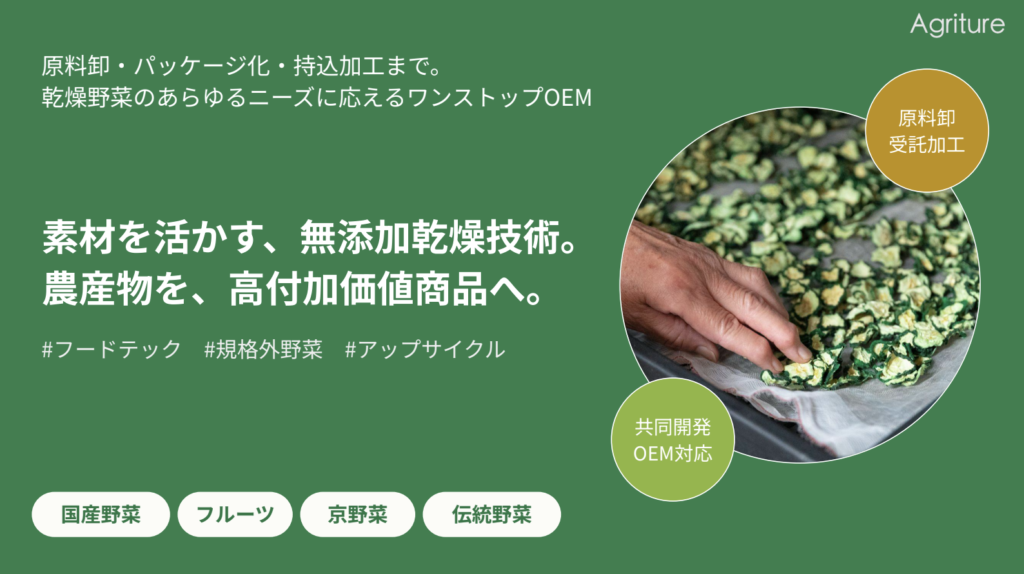
- OEM available from small lots of 10 kg
- Drying of brought-in raw materials also possible
- Support from processing to filling in one place
FOR BUSINESS
乾燥野菜のOEM・受託加工を承ります
国産の野菜・果物の乾燥、100メッシュ相当までの粉砕、10g以上の小袋充填までをお受けしています。小ロットの試作から量産までご相談ください。寄せられた相談の実例は OEM・卸のご相談 に掲載しています。
乾燥品の賞味期限は、出荷日から6ヶ月程度を目安にご案内しています。
FAQ
How large is the minimum lot for commercial fruit powder?
For ready-made products, many manufacturers let you buy from 1 kg, and for a fully original OEM formulation, 10-50 kg is the minimum line. When prototyping with your own raw material, having 50-100 kg of raw material is generally enough to proceed with a prototype.
What should I choose for strawberry powder?
If you want to make the most of vivid red color and acidity, FD (freeze-drying); if you blend it into baked-good batter with butter and egg, vacuum drying and hot-air drying also become options. Because FD has a high per-kg price, considering other production methods for uses where color isn't the star keeps costs down.
How can I tell additive-free fruit powder?
Check the raw-material labeling. If only the fruit name is listed, like "strawberry," it's additive-free. If other components are listed like "strawberry, dextrin," additives for improving flowability are included. When using it as the raw material for baby food or clean-label products, make additive-free a mandatory requirement.
Can you powder fruit I've grown myself?
対応可能なメーカーが増えています。Agritureは長野県のワンズデイリー(葉取らずりんご)、京丹後のdry-pear(二十世紀梨)、京都市右京区(柚子)など、地域の果物原料を持ち込んでの乾燥・パウダー化の実績があります。原料量・乾燥条件・粒度・包装形態を事前に打ち合わせれば、小ロットから試作が可能です。
Should I choose domestic or foreign?
If you're aiming for differentiation products or clean-label appeal, domestic; if you prioritize large-volume supply and cost, foreign. On the ground, a two-axis approach of "foreign for staples with cost priority, domestic for the differentiation line" is common. We recommend using them differently to match the product concept.
Summary
For commercial fruit powder, the efficient approach is to organize your own requirements on five axes—production method, particle size, presence of additives, certification, and minimum lot—and choose a manufacturer that fits the application. A staged approach of trying a ready-made product first, then moving to an original formulation or bring-your-own processing as needed, reduces failures.
Based in Kyoto, Agriture carries out contract processing and commercial wholesale of dried fruit, fruit powder, and vegetable powder. Our latest fruit-related prototypes—京都産柚子パウダー・domestic kiwi・domestic lemon slices・Okinawa-grown dried fruit and others—are on the news page updated regularly on. For consultations on OEM or bring-your-own processing, Agriture's page on Food OEM no Madoguchi.
Download the OEM contract processing materials
We will send the materials to your email address based on the information you provide.
The commercial vegetable-powder lineup is Agriture's vegetable powder list available for viewing here.
If you are considering product development with off-spec or your own farm's vegetables:From planning to processing, materials, package printing and novelties, you can consult us through a single point of contact. → Learn more about one-stop product development
- Contract Manufacturing Guide for Vegetable Powder Filling | Quality Control and Optimal Package Selection
- 7 Criteria for Judging a Commercial Dried Fruit Supplier
Author of this article
Related articles
-
 Original coffee marketing strategy | Ways to grow sales
 -
 ベジタリアンとは?国の規格が分けている4つの区分と食べられないもの
 -
 長ねぎと白ねぎは同じもの?ねぎの種類と呼び名を国の資料で確かめる
 -
 柚子の種類は何種類あるのか、公の資料で名前が残る系統を数えた
 -
 ゆずの時期は年に二度、青ゆずは7月から黄ゆずは10月から
 -
 ゆずの産地は高知が半分を占め、二位は徳島から愛媛に変わった
 -
 Preventing Food OEM Failures: Common Failure Cases and Countermeasures for Success
 -
 How to find a food OEM | How to efficiently find the best manufacturing partner