
How to start a shichimi OEM | A dried-vegetable maker explains domestic chili peppers and local shichimi

Summary of this article
A dried-vegetable maker explains how to start a shichimi OEM. We've compiled the practical side of commercializing shichimi togarashi—blend design for local shichimi that makes use of domestic chili and Kyoto vegetables, small-lot development, and the ordering flow.
You want to make your own brand's shichimi togarashi, or turn regional ingredients into a local shichimi product. That's where a shichimi OEM (contract manufacturing) comes in. Still, many staff hesitate at the first step, unsure "what kinds of blends can be made" and "whether small lots are possible."
On this page, from the standpoint of a maker producing dried vegetables, we organize with a practical eye the basics of shichimi OEM, how to think about blends, design using dried vegetables and regional ingredients, how to start with small lots, and how to proceed with consultation.
TOC
What is a shichimi OEM
OEM refers to manufacturing products sold under another company's brand. With a shichimi OEM, you leave everything to the maker—blend design of the chili and aromatics, production, filling into small pouches or jars, and packaging—so you can focus on planning and sales. A merit is being able to start with almost no capital investment.
The basics of shichimi togarashi
Shichimi togarashi is a seasoning that pairs chili as the lead with aromatics such as sansho, sesame, aonori, and dried citrus peel. What you put in and in what proportion determines its individuality of heat and aroma. That blends differ by region and shop is the fun of shichimi.
- Chili: the lead that forms the base of the heat
- Sansho: a tingling aroma and stimulation
- Sesame / aonori: nuttiness and flavor
- Dried citrus peel / yuzu peel: citrus aroma
Cases where a shichimi OEM fits
It suits companies wanting their own brand of shichimi, shops wanting an original shichimi for the tabletop, and businesses planning souvenirs that make use of regional ingredients. It's also used when developing a private brand (PB).
FOR BUSINESS
乾燥野菜のOEM・受託加工を承ります
国産の野菜・果物の乾燥、100メッシュ相当までの粉砕、10g以上の小袋充填までをお受けしています。小ロットの試作から量産までご相談ください。寄せられた相談の実例は OEM・卸のご相談 に掲載しています。
乾燥品の賞味期限は、出荷日から6ヶ月程度を目安にご案内しています。
How to think about shichimi blends
Shichimi's individuality is determined by the balance of heat and aroma. How much you play up the lead chili, and what aromatics you pair with it, shift the product's direction.
The balance of heat and aroma
The blend changes depending on whether you bring the heat to the fore or make the aroma stand out. Grinding chili coarsely makes the heat and texture pronounced; grinding it fine makes it blend into dishes. Sansho Playing up sansho or yuzu peel finishes it as a refined, fragrant shichimi.
| Direction | Ingredient to feature | Suitable use |
|---|---|---|
| Heat-focused | More chili, coarse grind | Udon, hot pot, meat dishes |
| Emphasizing aroma | Sansho / yuzu peel | Soba, clear soups, refined Japanese cuisine |
| Local type | Regional dried vegetables / aromatics | Souvenirs, brand products |
Using domestic chili and Kyoto vegetables
Chili's heat and aroma change by growing region and variety. We also dry-process Kyoto vegetables such as Fushimi togarashi and purple chili pepper, usable in shichimi-making that makes the most of domestic ingredients. Because we dry slowly at low temperature, the chili's vivid red and the sansho's aroma are less likely to fly off (from Agriture's experience). A maker that handles ingredients from the raw-material stage can also adjust the grind to match the heat and aroma. For contract processing of dried vegetables themselves, Dried vegetable OEM and contract processing.
- How much to play up the lead chili
- The grind (coarse to bring out stimulation / fine to blend into dishes)
- Combinations of aromatics that add aroma and texture
- Whether to add regional chili or dried vegetables
We have materials available to help you understand dried processing OEM
Agriture OEM, flexibly handling everything from small lots to large lots
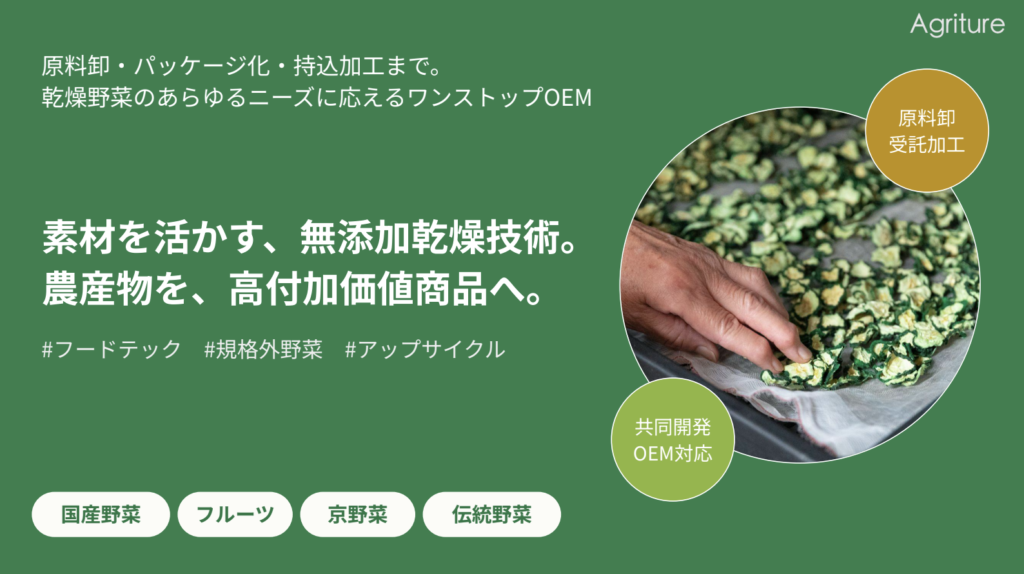
- OEM available from small lots of 10 kg
- Drying of brought-in raw materials also possible
- Support from processing to filling in one place
Shichimi OEM made with dried vegetables and local ingredients
Shichimi using regional ingredients is a field often consulted about as souvenirs or brand products. For a maker that handles dried vegetables from the raw-material stage, it's an area easy to leverage regional ingredients and where our strengths come alive.
Create a story with local ingredients
By drying and adding regional chili, vegetables, and citrus peel, you can finish a shichimi unique to that land. As a tourist-spot souvenir or a regional-brand product, you can plan a piece with story. Depending on ingredient choice, you can bring out individuality nowhere else has.
Make use of off-spec vegetables
Off-spec vegetables and chili with irregular shapes that don't usually distribute well can, when dried and ground, be used as shichimi ingredients. Balancing food-loss reduction with product uniqueness is an element easy to appeal to at the planning stage. The same ingredients can also extend to Furikake OEM and Spice OEM、seasoning OEM.
The aromatics that make up shichimi and blends by dish
Shichimi togarashi, as its name suggests, is made by combining several aromatics. Which aromatic in what amount determines the individuality of heat and aroma. Knowing the roles of representative aromatics makes blend consultations smoother.
Main aromatics used in shichimi
With chili as the lead, you combine aromatics that carry aroma and texture. There's no fixed set of seven; the ingredients change by region and shop. Adding regional dried vegetables here lets you bring out individuality nowhere else has.
| Garnish | Role | Flavor characteristics |
|---|---|---|
| Chili pepper | The base of heat | A sharp stimulation |
| Sansho | Aroma and stimulation | A tingling coolness |
| Sesame | Toastiness | Adds nuttiness and richness |
| Aonori / green shiso | Flavor and color | A seaside or Japanese aroma |
| Dried citrus peel / yuzu peel | Citrus aroma | A refreshing aftertaste |
| Hemp seed and poppy seed | Texture | A popping bite |
Blends matched to dishes
Even the same shichimi suits different blends depending on the dish it accompanies. Deciding the intended use before designing yields a shichimi that enhances the dish.
| Dish | Suitable blend direction |
|---|---|
| Udon / soba | Aroma-forward, playing up sansho and yuzu |
| Hot pot / soups | Solid heat, with more chili |
| Yakitori / meat dishes | Emphasis on nuttiness, with more sesame |
| Tempura / fried foods | Light, a blend that pairs easily with salt |
Starting a shichimi OEM with small lots
For first-time product development, making a large volume right away is a big source of anxiety. The realistic approach is to prototype with a small lot first, then move to mass production while watching the response.
How to think about the minimum lot
The minimum lot for a shichimi OEM varies by product and form. Mass-producing finished goods is on the order of thousands of pouches or bottles, whereas processing the raw-material dried vegetables can, depending on the item, be handled from a small lot of 100g. Thinking of finished-goods and raw-material lots separately keeps you from misreading the quote. For example, you could start small by first grinding just a small amount of raw material to your original blend and hand-filling it yourself. Despite the name shichimi ("seven flavors"), you don't have to stick to seven; you can also make blends with more ingredients, like eight-flavor or ten-flavor.
Things to decide before consulting
To advance the consultation smoothly, organizing your requirements in advance helps. The clearer your requirements, the more concrete the manufacturer’s proposals become and the faster development proceeds.
- The direction you're aiming for (heat-focused, aroma-focused, local type)
- Whether there's a regional ingredient you want to use
- The form (small pouch, jar, refill)
- The desired lot and budget guide
The shichimi individuality only Agriture can bring out
For shichimi, the finish changes with how well you can retain the color and aroma of the chili and aromatics. From our position of handling dried vegetables from the raw-material stage, we can support shichimi-making that makes the most of ingredients' individuality.
In fact, for a Nara Miwa-somen cooperative, we have a track record of finely powdering Yamato-vegetable purple chili while keeping it a vivid purple (from Agriture's experience). Low-temperature drying that doesn't drive off the color, and particle-size adjustment, shape a shichimi's appearance and aroma.
- Low-temperature drying to retain the color and aroma of chili and aromatics
- Fine powdering to adjust to a mouthfeel that blends into dishes
- Kyoto vegetables and heirloom-vegetable chili (Fushimi togarashi, etc.) can be used as raw materials
- Adding value to off-spec chili and citrus peel, tying into food-loss reduction
Projects you could plan
- A "local shichimi" starring regional chili
- A "mottainai shichimi" making use of off-spec ingredients
- A "fragrant shichimi" using yuzu, sudachi, or Kyotango pear peel in place of dried citrus peel
- Limited packaging matched to a tourist site's landmarks or events
We have materials available to help you understand dried processing OEM
Agriture OEM, flexibly handling everything from small lots to large lots
- OEM available from small lots of 10 kg
- Drying of brought-in raw materials also possible
- Support from processing to filling in one place
FOR BUSINESS
乾燥野菜のOEM・受託加工を承ります
国産の野菜・果物の乾燥、100メッシュ相当までの粉砕、10g以上の小袋充填までをお受けしています。小ロットの試作から量産までご相談ください。寄せられた相談の実例は OEM・卸のご相談 に掲載しています。
乾燥品の賞味期限は、出荷日から6ヶ月程度を目安にご案内しています。
Frequently asked questions
Summary: differentiate with a shichimi OEM that makes use of regional ingredients
A shichimi OEM is a way to plan and sell an original shichimi togarashi without owning your own equipment. Decide the heat and aroma direction, and by growing it from small-lot prototypes, you can advance to commercialization while holding down risk.
Shichimi made with regional dried vegetables or chili especially makes it easy to bring out story as a souvenir or brand product—a field where the strength of a maker able to make it consistently from the raw material comes alive. If you're thinking about commercializing a shichimi, first organize the direction you're aiming for and the ingredients you want to use, and consult us.
Download the OEM contract processing materials
We will send the materials to your email address based on the information you provide.
If you are considering product development with off-spec or your own farm's vegetables:From planning to processing, materials, package printing and novelties, you can consult us through a single point of contact. → Learn more about one-stop product development
- What is seasoning OEM? A dried-vegetable maker explains small-lot development
- What is spice OEM? Development of original mixed spices made with dried vegetables and small-lot manufacturing
Author of this article
Related articles
-
 Original coffee marketing strategy | Ways to grow sales
 -
 ベジタリアンとは?国の規格が分けている4つの区分と食べられないもの
 -
 長ねぎと白ねぎは同じもの?ねぎの種類と呼び名を国の資料で確かめる
 -
 柚子の種類は何種類あるのか、公の資料で名前が残る系統を数えた
 -
 ゆずの時期は年に二度、青ゆずは7月から黄ゆずは10月から
 -
 ゆずの産地は高知が半分を占め、二位は徳島から愛媛に変わった
 -
 Preventing Food OEM Failures: Common Failure Cases and Countermeasures for Success
 -
 How to find a food OEM | How to efficiently find the best manufacturing partner