
What Is Small-Lot Package Printing? Methods, Costs, and Tips for Submitting Data in Small Quantities

Summary of this article
From the basics of what small-lot package printing is, to the kinds you can print such as gift boxes, paper boxes, bags, and labels, a comparison of on-demand and offset methods, the practical side of ordering—submission data, dielines, samples, and minimum lots—and tips for holding down costs. We also explain how to advance the printing and filling of food bags and small pouches together in small lots.
In new-product prototypes, test sales, and novelties, there are many situations where you want to make just a small amount of original packaging. Printing used to require a large lot, but with the spread of on-demand printing, you can now make original packaging even in small lots.
This article organizes everything from the basics of what small-lot package printing is, to the kinds of packaging you can print, the differences in printing methods, how to proceed with ordering, and tips for holding down costs. For how to proceed when you want to make food bags and small pouches with printing and filling together in small lots, Small-pouch filling OEM service page you can also consult us at.
TOC
What is small-lot package printing?
Small-lot package printing refers to originally printing and producing packaging such as gift boxes and bags from a small quantity. Conventional printing required making a plate, and a certain volume of orders was premised on recovering the plate cost as an initial expense. Because on-demand and digital printing don't use plates, initial costs are less likely to arise, and even small quantities from tens to hundreds of units are easy to order. The per-unit price is higher than mass production, but the advantage of small-lot printing is being able to start from a small quantity while holding down initial costs.
Being able to make it from a small quantity makes it easy to use in situations where you don't want to hold inventory—new-product prototypes, test sales, event novelties, and gifts. It's also a method well-suited to a step-by-step approach of moving to full mass production after seeing the market response.
Kinds of packaging you can print in small lots
Packaging that supports small-lot printing ranges widely, from boxes to bags. We've organized the representative kinds and their features.
| Type | Features | Main use |
|---|---|---|
| Gift boxes / rigid boxes | Easy to give a premium feel. Assembled from a dieline | Paper boxes (caramel box, N-style, etc.) |
| Easy to assemble and hold down cost | Sweets, supplements, daily goods | Bags / pouches (three-side seal, stand pouch) |
| Light and easy to hand out. Choose the material to match the contents | Powder, dried food, tea | Sticks / sachets |
| Can be portioned one serving at a time | Powdered drinks, seasonings | Labels / stickers |
| Stick onto an off-the-shelf container to easily make it original | Bottles, cans, off-the-shelf bags | Bottles, cans, off-the-shelf bags |
Depending on how far you go with originality, there are 3 ways to proceed. First, if you want to start easily, sticking an original label or sticker on an off-the-shelf container or bag has a small minimum lot and low cost. Next, custom-printed bags with a design printed on the bag itself let you express the brand's worldview, but the minimum lot and lead time grow larger. If you emphasize appearance for gifts, gift-box or paper-box printing fits. A step-by-step approach—labels at the prototype stage, custom printing for full rollout—is also effective.
Gift boxes and paper boxes offer abundant shape options—caramel box, auto-lock bottom, one-touch bottom, N-style, sleeve, and more. On the other hand, bags and pouches that hold powder or dried food directly need to be considered together with not just printing but the material that protects the contents and ease of filling. For the full picture of packaging forms and materials, Kinds of food packaging.
FOR BUSINESS
乾燥野菜のOEM・受託加工を承ります
国産の野菜・果物の乾燥、100メッシュ相当までの粉砕、10g以上の小袋充填までをお受けしています。小ロットの試作から量産までご相談ください。寄せられた相談の実例は OEM・卸のご相談 に掲載しています。
乾燥品の賞味期限は、出荷日から6ヶ月程度を目安にご案内しています。
Adjust the finish with paper stock and surface treatment
For boxes and paper packaging, the paper type and surface treatment change the finished impression. By choosing the thickness and texture of paperboard such as coated board or card stock, and adding PP lamination, foil stamping, matte varnish, or the like to the surface, you can produce a premium feel and brand worldview. Because treatments often carry optional costs, narrowing to the treatments you need in small lots holds down cost. Deciding after checking the texture with a sample prevents mismatches with the imagined finish.
Differences in printing methods and their fit for small lots
Package printing methods split broadly into methods that don't use plates and methods that do. The fit differs by order quantity. We've compared the two representative methods.
| Method | Suitable quantity | Plate cost | Design swap-out | Compatibility with food bags |
|---|---|---|---|---|
| On-demand / digital printing | Small quantity (small lot) | Not needed | Prone | Suits small-lot prototypes and test sales |
| Offset / gravure printing | Large quantity (mass production) | Needed | Not prone | Suits bags for confirmed mass production |
On-demand / digital printing
A method that prints directly from data without making a plate. Because there's no plate cost, the per-unit cost is easy to hold down even in small quantities, suiting small-lot and many-variety printing. Being able to make several designs a little at a time just by swapping the data is another advantage.
Offset / gravure printing
A method that makes a plate and prints in large volume. Because a plate cost is incurred, it's pricier in small lots, but the more the quantity increases, the lower the per-unit cost, and it also excels in color reproducibility. Positioning it as the method to switch to once mass production is decided makes it easier to understand. Testing in small lots first, then moving to a plate-based method for mass production after seeing the response, lets you proceed without waste.
How to proceed with ordering small-lot printing
To advance small-lot printing smoothly, the preparation of submission data and specs is the key. We've organized the flow to keep in mind before ordering.
- Submission data: create in a specified format such as Illustrator. Many print companies provide templates
- Dieline / size: for boxes, make it to the dieline. Often, if you tell them the size, they'll create the dieline
- Sample: before the real run, confirm the finish and texture with a blank sample or paper-stock sample
- Minimum lot / lead time: because minimum lot and lead time differ by kind, confirm in advance
For food packaging in particular, correctly reflecting the food labeling—ingredient names, content volume, best-before date, allergens—in the print data is essential. Securing the labeling space before deciding the design prevents the trouble of remaking it later.
We have prepared materials that explain small-pouch filling
Agriture, flexibly handling everything from small lots to large lots
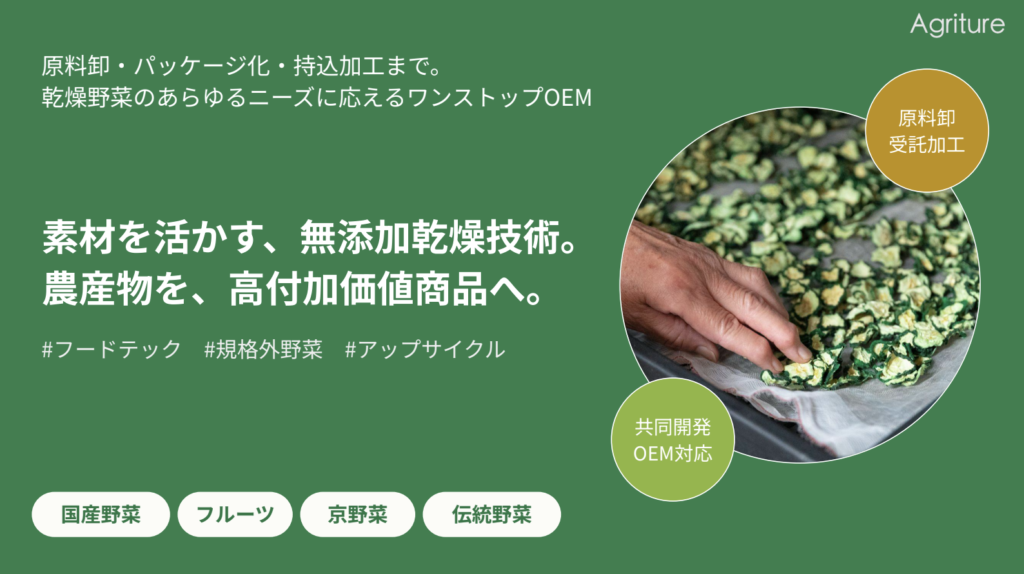
- Small-bag filling from 500 bags
- Tea and coffee also supported
- Sealing carried out in a single seamless flow
Merits and cautions of printing in small lots
Benefits
- Can be started with low initial cost, holding down the risk of holding inventory
- Because you can make just the amount you need, it suits prototypes and test sales
- You can swap designs and try many varieties a little at a time
Points to note
- The per-unit price tends to be higher than mass production
- The minimum lot and lead time change by the shape and treatment you choose
- For food, you also need to balance labeling and protection of the contents
Using small-lot printing while understanding its merit of small-quantity testing and its tendency toward higher unit prices lets you advance commercialization without strain. Knowing in advance the quantity guideline for switching to mass production makes cost judgments easier.
Food bags and small pouches—do printing and filling together in small lots
Box printing can be commissioned to a print company, but for powder and dried-food bags, you need to consider up to the filling step of packing the contents into the printed bag. Arranging printing and filling separately tends to create losses in back-and-forth and lead time. Furthermore, with food, nailing down the production-side conditions too—the minimum lot fillable, the best-before-date setting, and the bag material matched to the contents—together with the print design leaves no backtracking.
Agriture fills powder, granules, dried ingredients, and the like into small pouches just as much as needed, and can propose packaging materials such as sticks, three-side seals, and pillow bags—including whether to print and the design. Because we handle everything at one company—from raw-material procurement to filling, best-before-date printing, and packing—there's no hassle of arranging printing and production separately. We also support the approach of starting from a small lot for prototypes and test sales, then expanding to mass production after seeing the response. For details of the filling process, A complete guide to choosing filling-processing OEM; for the stick type, How to choose stick-filling OEM foods please also see. If you want to choose eco-conscious materials, Sustainable packaging is also available for your consideration.
We have prepared materials that explain small-pouch filling
Agriture, flexibly handling everything from small lots to large lots
- Small-bag filling from 500 bags
- Tea and coffee also supported
- Sealing carried out in a single seamless flow
FOR BUSINESS
乾燥野菜のOEM・受託加工を承ります
国産の野菜・果物の乾燥、100メッシュ相当までの粉砕、10g以上の小袋充填までをお受けしています。小ロットの試作から量産までご相談ください。寄せられた相談の実例は OEM・卸のご相談 に掲載しています。
乾燥品の賞味期限は、出荷日から6ヶ月程度を目安にご案内しています。
FAQ
Summary
Small-lot package printing, thanks to the spread of on-demand and digital printing, is a way to make original packaging from a small quantity. It supports a wide range—from gift boxes and paper boxes to bags, pouches, and labels—and suits prototypes, test sales, and novelties. In ordering, the keys are submission data and dielines, sample confirmation, and confirming minimum lot and lead time. Food bags and small pouches in particular need to be considered together with not just printing but the protection and filling of the contents and food labeling, so making use of a setup that can advance printing and filling together in small lots lets you commercialize while holding down the hassle.
Recommended reading
- What Are the Types of Food Packaging? From Bag Shape and Film Material to Function and How to Choose Explained
- 5 Points for Selecting Packaging Materials | The Best Fit for Your Filling Method and Product Characteristics
- What Is Sustainable Packaging? Types of Materials, Benefits, and Tips for Small-Lot Adoption
- The Complete Guide to Choosing a Filling OEM | Points for Selecting a Contractor Without Regret
- How to choose stick-filling OEM food | 8 points to avoid failure with small-lot support
Download the small-pouch filling materials
We will send the materials to your email address based on the information you provide.
If you are considering product development with off-spec or your own farm's vegetables:From planning to processing, materials, package printing and novelties, you can consult us through a single point of contact. → Learn more about one-stop product development
- What Is Sustainable Packaging? Types of Materials, Benefits, and Tips for Small-Lot Adoption
- What Is a Tea Bag OEM? How to Choose the Shape, Material, and Contents, and the Small-Lot Ordering Flow
Author of this article
Related articles
-
 Original coffee marketing strategy | Ways to grow sales
 -
 ベジタリアンとは?国の規格が分けている4つの区分と食べられないもの
 -
 長ねぎと白ねぎは同じもの?ねぎの種類と呼び名を国の資料で確かめる
 -
 柚子の種類は何種類あるのか、公の資料で名前が残る系統を数えた
 -
 ゆずの時期は年に二度、青ゆずは7月から黄ゆずは10月から
 -
 ゆずの産地は高知が半分を占め、二位は徳島から愛媛に変わった
 -
 Preventing Food OEM Failures: Common Failure Cases and Countermeasures for Success
 -
 How to find a food OEM | How to efficiently find the best manufacturing partner