
How to choose stick-filling OEM food | 8 points to avoid failure with small-lot support

Summary of this article
We organize the basic specifications of stick-filling OEM, filling-machine selection by contents, countermeasures for seal defects, use by industry, and the line between Agriture in-house and partner factories. It covers small lots, packaging light-blocking, and staged operation of original printing.
Stick-filling OEM is a filling form suited to providing single-use, small-volume products (supplements, soup bases, smoothies, protein, coffee, and the like) in individual packages in small amounts. Pre-measured and easy to open, with high portability, it pairs well with uses such as office stocking, subscription boxes, and promotional novelties, and adoption is increasing in the new product lines of D2C businesses and food manufacturers.
In this article, for businesses considering food stick-filling OEM, we organize the judgment axes unique to sticks (differences among powder, granule, and liquid / bag width and length / seal-defect patterns), checkpoints to avoid failure, use by industry, and Agriture’s small-lot support. We summarize the overall picture of filling OEM on the Small-pouch filling OEM service page.

TOC
The basics of stick-filling OEM
Stick filling is a method of individually packaging about 1–10 g of powder, granule, or liquid in a long, narrow small pouch. Pre-measured and easy to open, with high portability, it is characterized by also easily securing a design area for brand appeal. It is adopted in a wide range of categories—powdered soup, coffee, smoothies, protein, supplements, sports-drink bases, and more.
Main specifications of stick packaging
| Item | Details |
|---|---|
| Volume | 1–10 g (powder, granule), 10–30 ml (liquid) |
| Shape | Width 15–30 mm × length 80–150 mm is common |
| Packaging form | Three-side seal, four-side seal, back seal |
| Material | Aluminum laminate, PET/PE/nylon composite |
| Use | Supplements, soup, beverages, seasonings, promotional items |
| Convenience | Pre-measured, portable, single-use, hygienic |
The finished width is decided within the filling machine’s supported range, to match the content amount and the daily number of units produced. Because each unit is small, the effects of weighing error and powder pinching are prone to appear, and the filling-machine selection and nailing down of seal conditions described below govern the quality.
Filling-machine selection by contents
| Contents | Recommended filling machine | Points to note |
|---|---|---|
| Powder (powder, supplement raw material) | Screw type, auger type | Moisture-absorption and static-electricity measures, seal defects from powder pinching |
| Granule (instant coffee, etc.) | Volumetric type, screw type | Blocking, weighing variation |
| Liquid (dressing, syrup) | Piston type | Leakage, seal strength, a nozzle suited to the viscosity |
| Viscous (gel, jelly) | Viscosity-supporting piston type | Filling temperature, heat resistance of the seal layer |
The most accident-prone thing in stick filling is powder pinching at the seal part of powders. Agreeing at the specification-document stage on a static-elimination and dust-removal mechanism and securing an appropriate seal width, though it looks like a detour, is sure.
Differences between stick filling and other filling forms
Among the many individual packages, stick filling is a form specialized in “single-use, long and narrow, small-volume.” Even for the same portioning, the filling machine, packaging, minimum lot, and unit price change compared with sachet (flat pouch), stand pouch, and vertical pillow. Choosing the form starting from the product’s single-use amount and how it’s sold makes the downstream quote less prone to wobbling.
Comparison table by form
| Form | Volume per use | Main filling machine | Minimum-lot guide | Suitable contents and uses |
|---|---|---|---|---|
| Stick | 1〜10g/10〜30ml | Stick-dedicated filling machine (screw, piston) | 1,000–5,000 units (dedicated packaging) | One supplement dose, powdered soup, portable beverage, novelty |
| Flat pouch and sachet (flat small pouch) | 1〜30g | General-purpose three-side seal machine | From 500 bags (stock flat bags) | Portioning of seasonings, dried vegetables, and samples |
| Stand pouch | 20g〜1kg | Nozzle type, auger type | From 500 bags (stock pouches) | Storefront D2C, gifts, staple products bought repeatedly |
| Vertical pillow | 5〜100g | Vertical form-fill-seal machine | From several thousand pouches | Mass production of snacks and granules, large-volume bags |
*The minimum lot of "from 500 bags" in the table is a guide for Agriture's operation with stock bags. For each format, using original printed packaging requires a separate packaging lot (from several thousand pieces).
The point that sticks are long and narrow and can be handed out one at a time greatly differs from flat pouches (sachets) even with the same three-side seal. Because a dedicated filling machine and dedicated packaging are used, the minimum lot tends to be higher than other forms. Conversely, the portability of being pre-measured and handed out one at a time is a strength no other form has, and the more the product is one where you want to sell “one dose” of a supplement or powdered beverage, the more the effect shows. If you just want to test from a small amount, ready-made flat pouches (sachets) and stand pouches are forms that make it easier to hold down initial costs.
Cases where you choose a stick, and cases where you avoid it
- Choose: when single-use portability is the star (one dose of protein, powdered soup, supplements), or novelties where distribution efficiency matters
- If unsure: for staple products used repeatedly, or products you want to display standing on the shelf, a stand pouch is advantageous
- Avoid: for test sales of only a few dozen units, a ready-made flat pouch (sachet) is lower cost than a stick that requires a dedicated packaging lot
If you anticipate standing display or repeat sales, How to realize stand-pouch filling in small lots, and for choosing packaging materials, Points for selecting packaging materials—please also consider these. For how to choose the overall filling form, we organize it at Small-bag filling OEM service.
FOR BUSINESS
乾燥野菜のOEM・受託加工を承ります
国産の野菜・果物の乾燥、100メッシュ相当までの粉砕、10g以上の小袋充填までをお受けしています。小ロットの試作から量産までご相談ください。寄せられた相談の実例は OEM・卸のご相談 に掲載しています。
乾燥品の賞味期限は、出荷日から6ヶ月程度を目安にご案内しています。
8 points to avoid failure
We organize, in order from minimum lot to raw-material support, the perspectives for reducing failure in selecting a stick-filling OEM.
① Minimum-lot support
- Because stick filling machines require changeover, at many manufacturers a minimum of 1,000–5,000 units
- For D2C test sales, search for an OEM that can handle from a few hundred units, or consider label changes based on ready-made products
- Comparing on the total including changeover fees makes the real cost of small lots easier to see
② Weighing accuracy and characteristics of the contents
- Because the content amount per unit is small, the tolerance of weight error is narrow
- Choose the filling machine to match the powder’s flowability, static electricity, and moisture absorption
- For fine powders and additive-free formulations, consult in detail on machine selection
③ Freedom of package design
- Sticks are small in size and the design area is limited
- Clarify the priority of brand logo, product name, ingredient labeling, and allergen labeling
- Decide early whether to differentiate with ready-made product + seal label or to print originally
④ Quality certification and inspection system
- Manufacturing at a HACCP / FSSC 22000 / GMP-certified factory is required for major transactions, export, and supplements
- Confirm the presence of metal detectors, X-ray inspection, and weight checkers
- Procedures and records for allergen-changeover cleaning (when multiple items on the same line)
⑤ Delivery date and lead time
- Stick filling is prone to lengthened lead time due to competition for operating slots
- Secure a margin of 2–3 months counting back from the sales start date
- Allow an additional month for ordering original packaging
⑥ Outer-packaging and boxing design
- Sticks are rarely sold in individual packaging alone; they are combined with boxing, zipper bags, and cartons
- Design down to the number of units in the outer packaging (10-count, 30-count, etc.) and the opening experience
- The optimal number of units changes for subscription, gift, and commercial use
⑦ Packaging light-blocking and barrier properties
- Dried vegetable powder and supplement raw materials easily deteriorate with light, oxygen, and moisture, and transparent film is unsuitable
- Aluminum laminate (PET/AL/PE) has a high balance of light-blocking, barrier, and seal properties, and is the standard for products with a long shelf life
- When using a transparent window for design emphasis, set the best-before date shorter, or design so the individual-package outer packaging supplements the light-blocking
⑧ Raw-material bring-in and blend support
- Confirm whether your own-developed formulation can be run through stick filling
- Agriture also supports An OEM service that can make original blends from over 30 kinds of dried vegetables we provide
- Integrated support of blend formulation + stick filling shortens the process
We have prepared materials that explain small-pouch filling
Agriture, flexibly handling everything from small lots to large lots
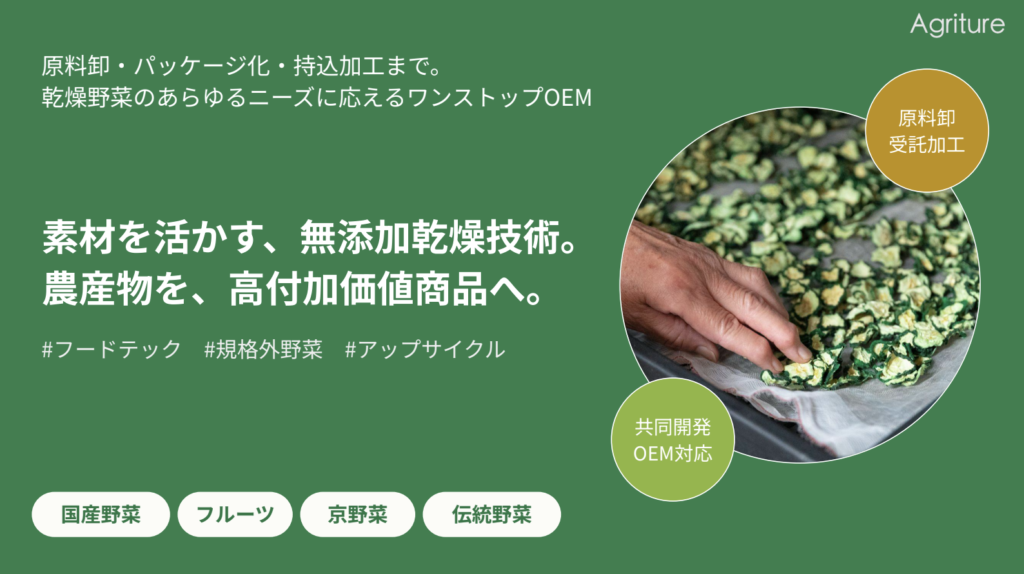
- Small-bag filling from 500 bags
- Tea and coffee also supported
- Sealing carried out in a single seamless flow
Common seal defects and countermeasures
The defects prone to occur in stick filling are three patterns: powder pinching, insufficient seal temperature, and overheating. Knowing where they’re prone to occur narrows down the confirmation items during prototyping.
Representative defects and prevention measures
| Defect | Cause | Prevention measure |
|---|---|---|
| Powder pinching at the seal part | Powder adheres to the seal surface | Dust-removal blowing, seal-width expansion, suction mechanism |
| Insufficient seal strength | Inappropriate balance of temperature, pressure, and time | Verify temperature conditions at 3 levels in prototyping, sampling leak inspection |
| Bag deformation from overheating | Temperature setting too high | Adjust within the heat-resistance temperature of the seal layer |
| Weight variation | Lot differences in powder flowability | Raw-material lot management, full inspection with a weight checker |
| Print misalignment and gaps | Insufficient tension in film feeding | Management of film winding form, maintenance of the printing machine |
Use patterns by industry
The requirements demanded of stick filling differ by industry. We have organized representative use patterns.
Use table by industry
| Industry | Main use | Point to prioritize |
|---|---|---|
| Supplements and functional foods | Individually packaging one dose of functional raw material | Component retention, certification, weighing accuracy |
| Instant beverages | Coffee, smoothies, protein | Dissolvability, flavor retention, portability |
| Soups and powdered dashi | One stick per cup makes soup | Umami retention, coloring, blend uniformity |
| Seasonings and dressings | Single-use portioning | Leakage countermeasures, seal strength |
| Baby food and nursing-care food | Individual packaging by age in months / per meal | Additive-free, allergen management |
| Office benefits | One stick in cup noodles for vegetable replenishment | Keeping quality, portability, cost |
| Novelties and promotions | Samples and for distribution | Distribution efficiency, brand appeal |
Use in office-oriented services
- The one the Kai Group and Agriture roll out, Office Yaoya (office greengrocer) is an example of benefit B2B2C
- Individually packaging dried vegetable powder into sticks, added to cup noodles and soup for vegetable replenishment
- Adoption is spreading as a new outlet in the context of health management and benefits
Agriture’s filling support
While carrying out contract processing of dried vegetables, vegetable powder, and dried fruit, Agriture supports businesses’ launches with small-pouch and stick filling. Stick filling is a hybrid type that makes use of partner factories, with Agriture handling raw materials and formulation design and supplementing processes that require certification and high-speed filling at partners.
The line between in-house support and partner support
| Category | Supported processes | Minimum-lot guide |
|---|---|---|
| Agriture (in-house) | Raw material sourcing, blend design, commercial bulk bags, and small-pouch filling (flat pouches, stand pouches, etc.) | From 500 bags |
| Partner factory | Mass production on dedicated stick-filling machines, manufactured under FSSC 22000 and GMP certification | From 1,000 sticks |
Processes completed in-house at Agriture
- Raw material intake, inspection, and storage
- Drying, milling, and blending (customizable from a lineup of 30-plus varieties)
- Filling of commercial bulk bags and small pouches (From 500 bags supported)
- Issuance of specifications, certificates of origin, and lot management
Processes handled by a partner factory for stick filling
- Mass production on dedicated stick-filling machines
- Manufacturing at FSSC 22000 / GMP certified factories (supplements and export projects)
- X-ray inspection and high-precision microbial testing
Information to share when you consult us
- Product concept, target, sales channels
- Fill weight per stick, expected lot volume, and number of sticks per outer package
- Packaging concept (stock-based or original)
- Quality requirements (certifications and inspection items)
- Schedule worked back from your planned launch date
Cost estimates and how the quotation process works
Stick-filling costs break down into initial costs (packaging plate fees, setup fees, prototyping fees) and per-unit processing costs. Because each stick is small, the same total weight means more units, so setup and inspection carry more weight than with other packaging formats. Separating out these variables before you order keeps comparisons between manufacturers consistent.
Variables specific to sticks that drive unit cost
- State of the contents (powder, granule, liquid, or paste) and fill volume per stick: this changes the filling machine and dosing accuracy required
- Pouch width and length and packaging construction (clear film / aluminum laminate): directly tied to packaging unit cost and plate fees
- Number of sticks per outer package (10-count, 30-count) and whether it is printed: box cost and printing cost rise and fall accordingly
- Inspection requirements (metal detection, X-ray, microbial): using a certified line raises the unit cost
We summarize typical per-stick price ranges in the FAQ at the end of this article. Concrete tactics for keeping initial costs down are laid out in Practical techniques for cutting the initial costs of OEM filling.
How to request a quotation
- Content samples (specifying powder, granule, or liquid) and expected lot volume
- Fill weight per stick, number of sticks per outer package, and packaging concept (stock-based or original)
- Quality requirements (certifications and inspections) and your desired delivery date worked back from the launch date
Lining up these conditions before you inquire lets you compare quotes from several companies on the same footing. Our checklist for making a request is in How to request a filling quotation.
We have prepared materials that explain small-pouch filling
Agriture, flexibly handling everything from small lots to large lots
- Small-bag filling from 500 bags
- Tea and coffee also supported
- Sealing carried out in a single seamless flow
FOR BUSINESS
乾燥野菜のOEM・受託加工を承ります
国産の野菜・果物の乾燥、100メッシュ相当までの粉砕、10g以上の小袋充填までをお受けしています。小ロットの試作から量産までご相談ください。寄せられた相談の実例は OEM・卸のご相談 に掲載しています。
乾燥品の賞味期限は、出荷日から6ヶ月程度を目安にご案内しています。
FAQ
Summary
Stick-filling OEM is widely adopted for uses where individual packaging is convenient, such as supplements, beverages, soups, seasonings, baby food, and office services. To avoid pitfalls, the key points are the eight items of minimum lot, dosing accuracy, design freedom, certifications, lead time, outer packaging, packaging barrier properties, and raw material handling, plus choosing the right filling machine for powder, liquid, or paste and preventing seal defects in advance.
Agriture's Small-bag filling OEM service runs a hybrid operation combining small lots from 500 bags with stick filling at partner factories. For inquiries about stick filling or blend formulations, Agriture's page on Food OEM no Madoguchi.
Download the small-pouch filling materials
We will send the materials to your email address based on the information you provide.
If you are considering product development with off-spec or your own farm's vegetables:From planning to processing, materials, package printing and novelties, you can consult us through a single point of contact. → Learn more about one-stop product development
- 6 Practical Techniques to Cut the Initial Costs of OEM Filling | Start Smart with Small-Lot Support
- 5 Points for Selecting Packaging Materials | The Best Fit for Your Filling Method and Product Characteristics
Author of this article
Related articles
-
 Original coffee marketing strategy | Ways to grow sales
 -
 ベジタリアンとは?国の規格が分けている4つの区分と食べられないもの
 -
 長ねぎと白ねぎは同じもの?ねぎの種類と呼び名を国の資料で確かめる
 -
 柚子の種類は何種類あるのか、公の資料で名前が残る系統を数えた
 -
 ゆずの時期は年に二度、青ゆずは7月から黄ゆずは10月から
 -
 ゆずの産地は高知が半分を占め、二位は徳島から愛媛に変わった
 -
 Preventing Food OEM Failures: Common Failure Cases and Countermeasures for Success
 -
 How to find a food OEM | How to efficiently find the best manufacturing partner