
How to Achieve Stand Pouch Filling in Small Lots | Tips for Cost Reduction and Quality Control

Summary of this article
This guide explains how to achieve small-lot stand-up pouch filling: the 5 filling steps, 3 factors that get in the way of small lots (changeovers, packaging lots and labor costs), 5 practical cost-saving techniques (stock pouches + label stickers, common pouches + swappable labels, choosing manufacturers that handle small lots, phased launches, made-to-order production), quality control checks (weighing accuracy, seal integrity, foreign matter, lot control, certifications), and format variations (clear, aluminum, zipper, spout, windowed). It also introduces Agriture's small-bag filling from 500 bags, OYAOYA and a Nippon Paper Crecia giveaway case.
Stand-pouch filling is a packaging form widely adopted in food small-lot D2C, gifts, and novelties. Because it stands up on its own for easy display, is resealable with a zipper, and offers wide options—clear, aluminum, custom design—it suits food businesses wanting to launch a brand product from a small quantity. That said, because stand-pouch filling involves equipment cost, packaging-material lots, and labor hours, realizing it in small lots requires concrete know-how.
This article explains, for food manufacturers, D2C brands, and regional cooperatives wanting to realize food stand-pouch filling in small lots, everything from the basic process, suitability by content type, practical cost-reduction techniques, quality control, form selection, and choosing an OEM partner. For the full picture of Agriture's filling OEM service, Small-pouch filling OEM service page.

TOC
The basics of stand-pouch filling
A stand pouch is a flexible packaging bag that stands up on its own by having a gusset at the bottom. It has variants such as zippered, clear-window, aluminum-laminated, and spouted, and in the food field it's used widely from powder and granules to liquids. Filling consists of the 5 steps "weigh → fill → seal → inspect → pack," and the filling machine and management items used change with the physical properties of the contents.
Why stand pouches are chosen
- They stand up on shelves and in-store, giving high visibility in display
- Zippered ones can be resealed after opening (good consumer experience)
- Lighter in weight and volume than bottles or cans, lowering logistics cost
- High design freedom—printing, labels, clear windows, and the like
- Aluminum deposition secures barrier properties while balancing design
Suitability by content type and management items
| Contents | Suitable stand pouch | Cautions when filling |
|---|---|---|
| Powder (vegetable powder, soup base) | Aluminum-laminated, zippered | Moisture-absorption and static-electricity countermeasures, screw-type filling machine |
| Granule (granola, furikake) | Clear-window, aluminum-deposited | Weighing variation, catching in the seal area |
| Liquid (sauce, tare) | Spouted, retort pouch | Leakage, seal strength, spout precision |
| Paste (jam, dip) | Spouted, thick pouch | A filling nozzle matched to the viscosity, amount of enclosed air |
| Dried chips / slices | Clear-window, strength-focused | Pressure resistance, scuffing, ratio of bag size to content volume |
Even the same stand pouch changes in filling machine, packaging-material thickness, and seal conditions by contents. Sending a content sample to the maker before prototyping speeds up the machine-suitability judgment.
The difficulty of small-lot filling and how to solve it
Many OEM makers premise large lots for reasons of production efficiency, and it's common that small-lot requests won't be accepted. To realize it in small lots, you need to overcome 3 constraints: equipment operation, packaging-material lots, and worker assignment.
The 3 factors that block small-lot production
| Behind Japan being chosen as the "first in Asia" are the following factors. | Reason | The direction of the solution |
|---|---|---|
| Filling-machine changeover | 1–2 hours for machine cleaning and adjustment, lowering the operating rate | Shorten changeover time with off-the-shelf pouches + general-purpose filling machines |
| Minimum order lot for packaging material | Original-printed pouches require a minimum of 3,000–5,000 sheets | Handle it with off-the-shelf pouch + sticker label |
| Worker shift | At minimum, one day's labor cost is incurred fixed | Bundle multiple projects to fill up daily operation |
How we run filling from 500 bags
- Stock common-spec off-the-shelf aluminum-laminated pouches
- Differentiate original printing with a sticker label
- Bundle changeover with other filling projects the same day to secure operating efficiency
- Adopted for D2C test sales, crowdfunding rewards, and novelty projects
Agriture also handles Small-bag filling service from 500 bags we provide this setup.
FOR BUSINESS
乾燥野菜のOEM・受託加工を承ります
国産の野菜・果物の乾燥、100メッシュ相当までの粉砕、10g以上の小袋充填までをお受けしています。小ロットの試作から量産までご相談ください。寄せられた相談の実例は OEM・卸のご相談 に掲載しています。
乾燥品の賞味期限は、出荷日から6ヶ月程度を目安にご案内しています。
5 practical cost-reduction techniques
We organize concrete practical techniques for holding down the unit price in small lots. Deciding early which to adopt, to match the product concept and sales plan, makes budgeting easier.
The 5 moves for cost reduction
| Technique | Effect | Points to note |
|---|---|---|
| Off-the-shelf pouch + sticker label | Packaging-material lot possible from 10–100 sheets, design changes easy | Differentiation tends to weaken. Reinforce with the label |
| Common pouch, swap-out label | Packaging can be standardized even as SKUs increase | Rule-making for inventory management is essential |
| Name a small-lot-capable maker | Select a supplier who can handle from 10 pouches | Unit price is 2–3× per kg vs. large lots |
| Phased introduction of outer and individual packaging | Individual packaging only at first, add outer packaging as sales grow | Judge the need for outer packaging via display testing |
| Build-to-order + pre-order sales | Lot consolidation possible with zero inventory risk | Agree on lead time and manage customer expectations |
Cost guide (small lot)
- Off-the-shelf pouch: 10–80 yen per sheet (varies by capacity and material)
- Sticker-label printing: 1,000–10,000 yen for 100–500 sheets
- Filling processing fee: 20–200 yen per bag (varies by lot and form)
- Minimum lot: from 500 bags (Small-bag filling OEM service)
We have prepared materials that explain small-pouch filling
Agriture, flexibly handling everything from small lots to large lots
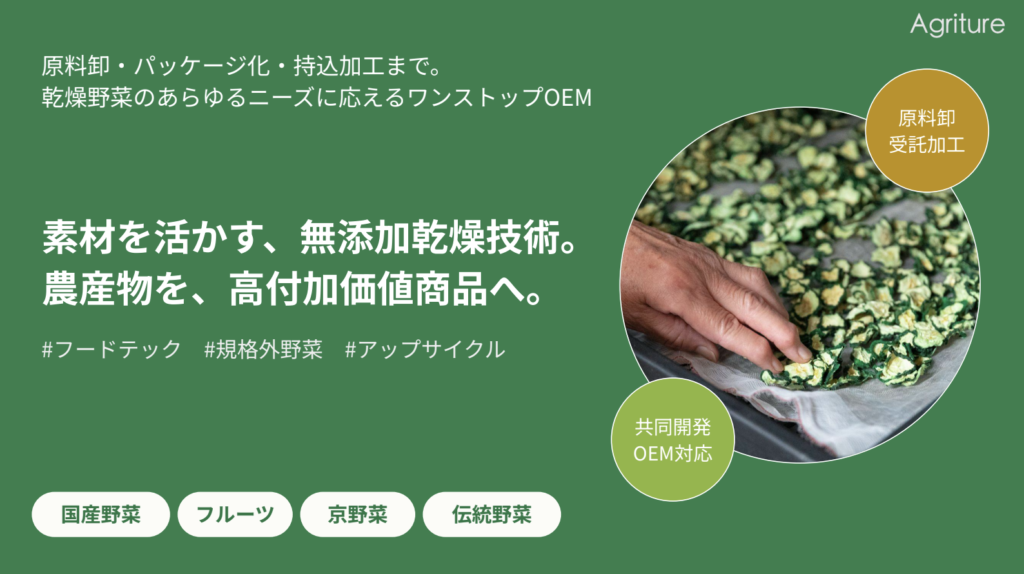
- Small-bag filling from 500 bags
- Tea and coffee also supported
- Sealing carried out in a single seamless flow
Key quality-control checks
Quality can't be compromised even in small lots. For food especially, weighing accuracy, seal integrity, and foreign-matter contamination must be reliably guaranteed.
Essential management items
| Item | Means of management |
|---|---|
| Weighing accuracy | Full inspection with a weight checker, agree on the allowable weighing-error range in the spec sheet |
| Seal integrity | Pass criteria for seal temperature, pressing time, and seal width; periodic sampling inspection |
| Foreign-matter contamination | Metal detector, X-ray inspection device, workwear that prevents hair contamination |
| Lot management | Display of production date and lot number, traceability records |
| Best-before date | Date setting matched to the contents' characteristics, confirmation of print quality |
| Certified factory | Acquisition status of HACCP, FSSC22000, GMP, and the like |
Additional checks by content type
- Powder: moisture rate, standard plate count, particle-size distribution
- Liquid: viscosity, pH, confirmation of filling temperature
- Chips / slices: breakage rate, shape uniformity
- Allergen management: changeover cleaning procedures and records
Selecting the stand-pouch form
Stand pouches have multiple variants. Choosing to match the contents' characteristics, sales channel, and brand image can greatly change how a product looks, even with the same contents.
Characteristics by Form
| Form | Features | Well-suited products |
|---|---|---|
| Clear pouch | High visibility of the contents | Dried fruit, granola, powders whose color pops |
| Aluminum-laminated pouch | High barrier against light, oxygen, and moisture | Vegetable powder, functional foods, coffee beans |
| Zippered pouch | Resealable, good usability | Seasonings and dry foods used regularly |
| Spouted pouch | For liquids and pastes, easy to pour | Sauces, pastes, beverages |
| Window pouch | A clear window on aluminum laminate, balancing barrier and visibility | Gift products, high-value-added foods |
Capacity and size guide
- Samples / novelties: 20–50g
- Trial purchase / small size: 100–200g
- Standard size: 200–500g
- Commercial / family size: 500g–1kg
Agriture's filling track record
Agriture develops small-lot stand-pouch filling services centered on contract processing of dried vegetables and vegetable powder. We introduce project types that serve as references.
Case 1: A small-lot project starting from 500 bags
- Target: D2C test sales, crowdfunding rewards, novelties
- Packaging material: off-the-shelf aluminum-laminated pouch + sticker label
- Contents: vegetable powder, dried fruit, blended seasonings
- Lead time: around 2 weeks from order if using off-the-shelf packaging
Example ②: Off-spec-vegetable D2C small lot (OYAOYA)
- Target: D2C upcycling off-spec vegetables from northern Kyoto
- Filling form: an 8-item dried-vegetable set individually packed in stand pouches
- Sales channel: own EC OYAOYA, expanding overseas (Germany, US, Hong Kong, Taiwan)
Example ③: A prize pack for a major campaign
- Client: Nippon Paper Crecia "Action for Smile" campaign
- Content: adopted the OYAOYA 8-item set as a prize
- Filling form: small-pouch stand-pouch individual packaging + gift-box outer packaging
Project details are published in Nippon Paper Crecia collaboration page.
How to choose an OEM partner
When entrusting small-lot stand-pouch filling to a partner, choosing by their attitude toward small lots and operational flexibility—not just equipment capability—reduces failures.
Items to confirm
| Item to confirm | Details |
|---|---|
| Minimum lot | Whether small lots of 10–100 pouches are possible |
| Pouch procurement | Whether they have off-the-shelf products, arrange their own, or accept supplied ones |
| Sealing machine | Whether they have machines suited to the capacity and material |
| Inspection system | Presence of a weight checker and metal detector |
| Certification | Acquisition of HACCP, FSSC22000, and the like |
| Lead time | Lead times for prototype and mass production respectively |
| Customer-supplied raw material | Whether you can bring your own raw material and commission only the filling |
| Document issuance | Speed of issuing test reports and spec sheets |
We have prepared materials that explain small-pouch filling
Agriture, flexibly handling everything from small lots to large lots
- Small-bag filling from 500 bags
- Tea and coffee also supported
- Sealing carried out in a single seamless flow
FOR BUSINESS
乾燥野菜のOEM・受託加工を承ります
国産の野菜・果物の乾燥、100メッシュ相当までの粉砕、10g以上の小袋充填までをお受けしています。小ロットの試作から量産までご相談ください。寄せられた相談の実例は OEM・卸のご相談 に掲載しています。
乾燥品の賞味期限は、出荷日から6ヶ月程度を目安にご案内しています。
FAQ
Summary
To realize stand-pouch filling in small lots, the key points are three: off-the-shelf pouch + sticker label, naming a small-lot-capable maker, and quality control of weighing, sealing, and foreign matter. Choosing the filling machine to match suitability by content type (powder, liquid, paste, chips), and designing to raise the lot in stages from D2C test sales to mass production, works realistically.
Based in Kyoto, Agriture provides contract processing of dried vegetables and vegetable powder plus Small-bag filling OEM service. From small lots starting at 500 bags to processing client-supplied raw materials and packaging advice, Agriture's page on Food OEM no Madoguchi.
Download the small-pouch filling materials
We will send the materials to your email address based on the information you provide.
If you are considering product development with off-spec or your own farm's vegetables:From planning to processing, materials, package printing and novelties, you can consult us through a single point of contact. → Learn more about one-stop product development
- A complete explanation of how to request a filling quote | Necessary information and a comparison checklist
- Original coffee marketing strategy | Ways to grow sales
Author of this article
Related articles
-
 Original coffee marketing strategy | Ways to grow sales
 -
 ベジタリアンとは?国の規格が分けている4つの区分と食べられないもの
 -
 長ねぎと白ねぎは同じもの?ねぎの種類と呼び名を国の資料で確かめる
 -
 柚子の種類は何種類あるのか、公の資料で名前が残る系統を数えた
 -
 ゆずの時期は年に二度、青ゆずは7月から黄ゆずは10月から
 -
 ゆずの産地は高知が半分を占め、二位は徳島から愛媛に変わった
 -
 Preventing Food OEM Failures: Common Failure Cases and Countermeasures for Success
 -
 How to find a food OEM | How to efficiently find the best manufacturing partner