
A complete explanation of how to request a filling quote | Necessary information and a comparison checklist

Summary of this article
This guide covers how to request a quote for OEM filling: the six types of information needed (contents, volume, packaging, lot, lead time and quality requirements), points for comparing multiple companies (total cost, minimum lot, certifications, lead time, document support and response speed), the 7 steps and timeline for requesting quotes, and a checklist so you do not decide on price alone. It also introduces Agriture's small-bag filling service from 500 bags and quotes for processing client-supplied raw materials.
For a filling OEM quotation request, whether you can convey the required information without gaps or excess greatly changes the accuracy and speed of the quotation you get back. If you organize, in addition to raw material, capacity, format, lot, delivery time, and quality requirements, the filling conditions by powder/liquid/paste and the requirements for changeover cleaning, you can fairly compare competitive quotations from multiple manufacturers and shorten your product-development schedule.
This article organizes how to request a filling OEM quotation, from a checklist of required information to points for comparison and the flow of the request. For the full picture of Agriture's filling OEM, Small-pouch filling OEM service page.

TOC
Basics of the filling OEM quotation
A filling OEM quotation is determined by what, how much, in what format, by when, and to what quality you make it. If the information is vague, the manufacturer estimates conservatively, so the unit price rises or unnecessary options get added. Gathering and conveying the required information is the best way to get close to a fair price and fair delivery time.
Breakdown of costs included in a quotation
| Item | Details |
|---|---|
| Raw material cost | The purchase price of the contents (for customer-supplied material, only the processing fee) |
| Packaging material cost | Material costs such as pouches, stick bags, and bottles |
| Filling and processing fee | The process fees for weighing, filling, sealing, and inspection |
| Inspection cost | Lot inspection fees such as metal detection, X-ray, microbial testing, and residual pesticides |
| Setup cost | Fixed costs for machine cleaning and adjustment (incurred regardless of lot) |
| Changeover cleaning fee | The cleaning labor when allergens or contents change |
| Options such as nitrogen filling | The additional process fee when oxidation prevention is needed |
| Prototyping cost | The cost of samples and test filling |
| Documents and handling fees | Issuance fees for specification sheets, test result reports, and certificates of origin |
| Shipping cost | Delivery and storage fees |
Separating fixed costs and variable costs
- Fixed costs: setup, changeover cleaning, and inspection costs per lot (the smaller the lot, the higher the unit-price ratio)
- Variable costs: raw material, packaging, and filling process fees (which decrease with the number of lots)
- Decide in advance whether to lower costs by increasing lots in stages or to compare on a total including fixed costs
Information needed for a quotation request
Here we organize the information you should convey to the manufacturer when requesting a quotation, across six axes. Filling it in without leaving blanks before sending greatly improves the accuracy of the initial quotation.
The essential six axes
| Axis | Information to convey | Example |
|---|---|---|
| 1. Contents | The type, particle size, moisture, and properties of the raw material (moisture absorption, static electricity, viscosity) | Domestic vegetable powder (80 mesh, additive-free, 5% moisture) |
| 2. Capacity | The content per pouch and the allowable range of weight tolerance | 50g(±1g) |
| 3. Packaging | Format, material, size, printing | Aluminum-laminate stand pouch, 130×180 mm, with zipper |
| 4. Lot | Guidelines for prototype, initial mass production, and steady-state lots | Prototype 50 pouches, initial 1,000 pouches, 500 pouches per month |
| 5. Delivery time | The planned sales date and the timing needed | Delivery in early August for a September sales launch |
| 6. Quality requirements | Certifications, inspections, allowable criteria | HACCP-certified factory preferred, passage through a metal detector required |
Supplementary information specific to filling
- The distinction of powder/granule/liquid/viscous (the filling machine changes)
- The allowable range of weight tolerance (the smaller it is, the more a high-precision filling machine is needed)
- Whether nitrogen filling or gas replacement is needed (oxidation prevention)
- Requirements for allergen changeover cleaning (relates to the setup cost of factory operation)
- Setup differences by packaging shape (time differs for sticks, pouches, and bottles)
Information that improves accuracy if conveyed as supplements
- Sales channel (D2C, retail, gift, hometown tax donation, etc.)
- Requirements for label display (origin, allergens, nutritional components)
- Whether there is outer packaging (individual packaging only / individual packaging + gift box)
- Future SKU expansion (common operation of multiple items)
- A sense of budget (a guideline for the total)
FOR BUSINESS
乾燥野菜を業務用でお探しですか
国産の野菜・果物を乾燥し、必要に応じて粉砕してお出ししています。扱っている品目は100種前後で、規格は 乾燥品の一覧・パウダーの一覧 に掲載しています。
少量でのご購入は、姉妹ブランドの通販サイト OYAOYA で承っています。
Points for comparing multiple companies
When you take quotations from multiple manufacturers, choosing on price alone leads to failure. In practice, the standard is to compare comprehensively on the following axes.
A list of comparison axes
| Comparison axis | Details to confirm |
|---|---|
| Total and unit price | Cost per pouch, the rate of decrease by lot |
| Minimum lot | The minimum quantity for prototyping and mass production, and flexibility in increasing or decreasing |
| Equipment and machinery | The capacities, formats, particle sizes, and viscosities that can be handled |
| Quality and certification | Whether it is a factory that has obtained HACCP, FSSC 22000, GMP, etc. |
| Lead time | The lead time for prototyping and mass production |
| Document handling | The speed and scope of issuing specification sheets and test result reports |
| Attitude toward small lots | Whether they will take on consultations for 10-100 pouches |
| Customer-supplied raw material | Processing that handles bringing in one's own raw material |
| The person in charge's response speed | The time to the first reply, and the thoroughness of answers to questions |
Because it is often not just the difference in total but the difference in lead time that directly leads to lost sales opportunities, scoring and comparing on total + delivery time + response quality keeps things from wavering.
Checks to avoid deciding on price alone
- Whether the setup fee is included (the smaller the lot, the greater the weight of fixed costs)
- The scope of inspection fees (how far metal detection, X-ray, and microbial testing are standard)
- The scope covered by packaging material costs (whether custom printing costs are separate)
- The rate of unit-price decrease when increasing production (predictability when scaling to mass production)
- Risk compensation for delivery delays (penalties under the contract)
We have prepared materials that explain small-pouch filling
Agriture, flexibly handling everything from small lots to large lots
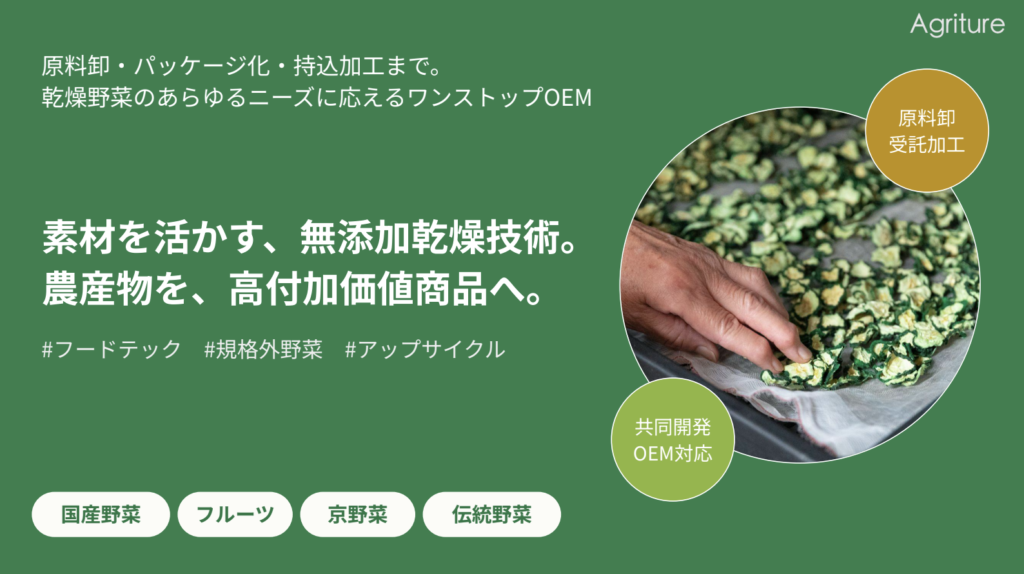
- Small-bag filling from 500 bags
- Tea and coffee also supported
- Sealing carried out in a single seamless flow
The flow of requesting a quotation
A standard quotation request takes an estimated total of about four to six weeks, from organizing requirements to prototyping and contract. The on-the-ground sense is about one week to the first reply, and an additional two to three weeks thereafter for sample prototyping and re-quotation.
The seven steps of the process
| Step | Details | Period guide |
|---|---|---|
| 1. Organize requirements | Compile the required information across the six axes and add supplementary information | 3–5 days |
| 2. Select manufacturers | Narrow down to three to five companies by small-lot handling, certification, and customer-supplied material | 3–5 days |
| 3. Send inquiries | Request from multiple companies at the same time with the same information | 1 day |
| 4. Receive the first reply | Receive proposals for quotations, questions, and sending samples | 3-7 days |
| 5. Compare and ask follow-up questions | Compare total, lot, delivery time, and quality side by side | 3–5 days |
| 6. Request samples and prototypes | Ask candidate manufacturers for prototypes | 1-3 weeks |
| 7. Final selection and contract | Final adjustment of conditions and conclusion of the contract | 3–5 days |
Notes when making an inquiry
- Sending the information compiled on a single sheet (PDF or spreadsheet) gets a faster reply
- Conveying that you are collecting competitive quotations makes it easier for the manufacturer to prepare and present conditions
- Three to five inquiries is easy to manage (too many makes comparison cumbersome)
- If an NDA (non-disclosure agreement) is needed, present it in advance
Agriture's quotation handling
Agriture provides contract processing of dried vegetables and vegetable powders, and Small-bag filling OEM service We present, including quotation handling for small-lot projects, with a transparent breakdown.
Types of projects we can handle
- Small-bag filling from 500 bags (for D2C, novelties, and crowdfunding)
- Integrated handling of processing plus filling for customer-supplied raw materials
- Original blend OEM from over 30 kinds of dried vegetables
- Aluminum-laminate, stand pouch, stick, and individual packaging formats
Advance preparation for a smooth quotation
- Compile the product concept, target, and sales channel on a single sheet
- Share the packaging image (reference products, design proposals)
- Convey the assumed quantities for the initial lot and steady-state lot
- Present a schedule working backward from the planned sales launch date
We have prepared materials that explain small-pouch filling
Agriture, flexibly handling everything from small lots to large lots
- Small-bag filling from 500 bags
- Tea and coffee also supported
- Sealing carried out in a single seamless flow
FOR BUSINESS
乾燥野菜を業務用でお探しですか
国産の野菜・果物を乾燥し、必要に応じて粉砕してお出ししています。扱っている品目は100種前後で、規格は 乾燥品の一覧・パウダーの一覧 に掲載しています。
少量でのご購入は、姉妹ブランドの通販サイト OYAOYA で承っています。
FAQ
Summary
A filling OEM quotation request starts with conveying, without gaps or excess, the required information across six axes (contents, capacity, packaging, lot, delivery time, quality requirements) and the supplementary information specific to filling (the distinction of powder/liquid/viscous, weight tolerance, nitrogen filling, changeover cleaning). In comparing multiple companies, looking comprehensively at not just price but minimum lot, quality certification, lead time, document handling, and the response quality of the person in charge reduces failures.
Agriture's Small-bag filling OEM service offers small lots from 500 bags, processing of client-supplied raw materials and issuance of a full set of documents. For quote inquiries, Agriture's page on Food OEM no Madoguchi feel free to reach out.
Download the small-pouch filling materials
We will send the materials to your email address based on the information you provide.
If you are considering product development with off-spec or your own farm's vegetables:From planning to processing, materials, package printing and novelties, you can consult us through a single point of contact. → Learn more about one-stop product development
- 5 Points for Selecting Packaging Materials | The Best Fit for Your Filling Method and Product Characteristics
- How to Achieve Stand Pouch Filling in Small Lots | Tips for Cost Reduction and Quality Control
Author of this article
Related articles
-
 Original coffee marketing strategy | Ways to grow sales
 -
 ベジタリアンとは?国の規格が分けている4つの区分と食べられないもの
 -
 長ねぎと白ねぎは同じもの?ねぎの種類と呼び名を国の資料で確かめる
 -
 柚子の種類は何種類あるのか、公の資料で名前が残る系統を数えた
 -
 ゆずの時期は年に二度、青ゆずは7月から黄ゆずは10月から
 -
 ゆずの産地は高知が半分を占め、二位は徳島から愛媛に変わった
 -
 Preventing Food OEM Failures: Common Failure Cases and Countermeasures for Success
 -
 How to find a food OEM | How to efficiently find the best manufacturing partner