
What Are the Types of Food Packaging? From Bag Shape and Film Material to Function and How to Choose Explained

Summary of this article
We organize the types of food packaging from three angles—“bag shape (form),” “film and material,” and “function.” This covers forms like three-side seal, stand-up pouch, and stick; materials like PET, aluminum, and nylon; functions like barrier properties and freshness retention; a quick-reference chart for choosing by food category; and the maker’s-eye decision criteria to keep in mind for small-lot prototyping.
Food packaging offers many options—not only differences in shape like three-side seal, stand-up pouch, and pillow bag, but also differences in material like PET, aluminum, and nylon, and in function like blocking oxygen and light. Even with the same contents, the packaging you choose changes shelf life, appearance, and cost, so understanding the types systematically makes product development go more smoothly.
This article organizes the types of food packaging from three angles—“bag shape (form),” “film and material,” and “function”—and covers how to choose by the category of the contents. The content is a general overview of food packaging, but since the frequency of deciding which bag to put powders, granules, and dried ingredients into is especially high in small-pouch-filling OEM, we supplement that perspective throughout. For how to proceed when you want to fill powders and dried ingredients into small pouches in small lots, Small-pouch filling OEM service page we also cover it in detail in.
TOC
What is food packaging? The 4 roles it serves
Food packaging is the process of wrapping food in a bag or container and delivering it to the consumer in a safe state. It’s not merely a vessel for holding the contents—it plays multiple roles at once, from quality retention to conveying information. Grasping what packaging exists for before choosing a type keeps your decision axis steady.
Retaining quality
The central role of food packaging is to keep the contents in the state they were shipped in. It protects deliciousness and safety by preventing oxidation from oxygen, fading from light, moisture uptake from humidity, and intrusion of external impact and microorganisms. Dried vegetables and powders in particular readily absorb moisture, so packaging that resists moisture is essential.
Making distribution and storage efficient
Packaging also plays a role in preventing damage during transport and making storage and display easier. Depending on the bag’s shape and strength, stackability changes, affecting logistics costs and shelf efficiency. Light, non-bulky flexible packaging is also chosen for its transport efficiency.
Enhancing ease of use
Usability—ease of opening, pouring, and resealing—is also a role packaging serves. Zippered bags and spouted pouches enhance the convenience of products not used up in one go. Forms like stick packaging, which portions out single servings, are also favored for portability.
Displaying information
Displaying information such as ingredient names, net content, best-before date, allergens, and storage method is also an important role packaging serves. You need to secure space to carry the consolidated labeling required by the Food Labeling Act while also achieving a design that conveys the brand’s world view. Ease of printing is a consideration in choosing the material.
FOR BUSINESS
乾燥野菜を業務用でお探しですか
国産の野菜・果物を乾燥し、必要に応じて粉砕してお出ししています。扱っている品目は100種前後で、規格は 乾燥品の一覧・パウダーの一覧 に掲載しています。
少量でのご購入は、姉妹ブランドの通販サイト OYAOYA で承っています。
Categories by packaging stage (individual, inner, outer)
Apart from the three angles of form, material, and function, packaging also has categories based on its positional relationship to the contents. Food packaging is divided into three stages—individual, inner, and outer—by how directly it touches the contents, and being aware of which stage you’re packaging clarifies the function required.
Individual packaging
Individual packaging directly touches each individual food item. Because it’s most closely tied to retaining the contents’ quality, barrier properties and heat-seal properties are emphasized. Stick packaging, three-side seal bags, and the like—the smallest unit the consumer picks up—fall into this category.
Inner packaging
Inner packaging is the intermediate packaging that bundles individually packaged products. It plays a cushioning role, protecting from moisture and impact, and includes decorative boxes and bundling bags. It also serves to group multiple individual packages into a sales unit.
Outer packaging
Outer packaging is the outermost packaging for transport and storage. Cardboard is the representative example, with emphasis on stacking, preventing damage during transport, and storage efficiency. Since it ties directly to logistics costs, designing size and strength is important.
Types and features of packaging forms (bag shapes)
When considering the type of food packaging, the first thing to decide is the “bag shape.” The form changes what contents can be filled, the appearance, and the cost. We’ve compiled representative forms and their suited contents. Note that vacuum and deep-draw are, strictly speaking, closer to packaging methods than “bag shapes,” but since they’re considered alongside forms in the field of selection, we cover them together here.
| Form | Features | Suited contents |
|---|---|---|
| Three-side seal bag | A flat bag with three sides heat-bonded. Low cost, suited to small lots | Powders, dried ingredients, small samples |
| Four-side seal bag | A flat bag sealed on four sides. Can also be made long and narrow into a stick shape | Granules, powders, single-serving portions |
| Gusseted back-seal bag (pillow) | A tubular bag bonded at the back. Easy to auto-fill | Snacks, tea leaves, light dried goods |
| Gusset bag | Has gussets on the sides or bottom to gain capacity | Coffee beans, large-volume powders |
| Stand pouch | Stands upright with a bottom gusset. Can add a zipper or spout | Liquids, pastes, products used repeatedly |
| Stick packaging | A long, narrow single-serving pack. Highly portable | Powdered drinks, seasonings, supplements |
| Zippered bag | Can be opened and closed, with excellent resealability | Dried goods and tea used a little at a time |
| Vacuum / deep-draw packaging | Air is removed for a tight fit. Strong at retaining freshness | Fresh produce, processed meat, frozen foods |
Three-side seal bags and four-side seal bags are flat forms that keep costs down easily and are widely used for prototyping and small-lot small-pouch filling. Stick packaging is a four-side seal made long and narrow, with the advantage of hygienically portioning out single servings. Stand-up pouches look good on the shelf, and combining them with a zipper or spout enhances convenience. Differences between forms are How to realize stand-pouch filling in small lots also explained in detail in.
The gusseted back-seal bag (pillow) is made by forming film into a tube and bonding it at the back, pairing well with horizontal and vertical automatic packaging machines and suited to products where production efficiency matters. Gusset bags have gussets on the sides or bottom, so they can hold more capacity with the same film area, and are used for coffee beans and large-volume powders. Vacuum and deep-draw packaging removes the air inside the bag to make it cling to the contents, so it’s chosen for products where freshness retention matters, such as fresh produce, processed meat, and frozen foods. At the shape-selection stage, considering the amount and use of the contents, the type of filling machine, and how it looks on the shelf together leads to a design with fewer do-overs.
We have prepared materials that explain small-pouch filling
Agriture, flexibly handling everything from small lots to large lots
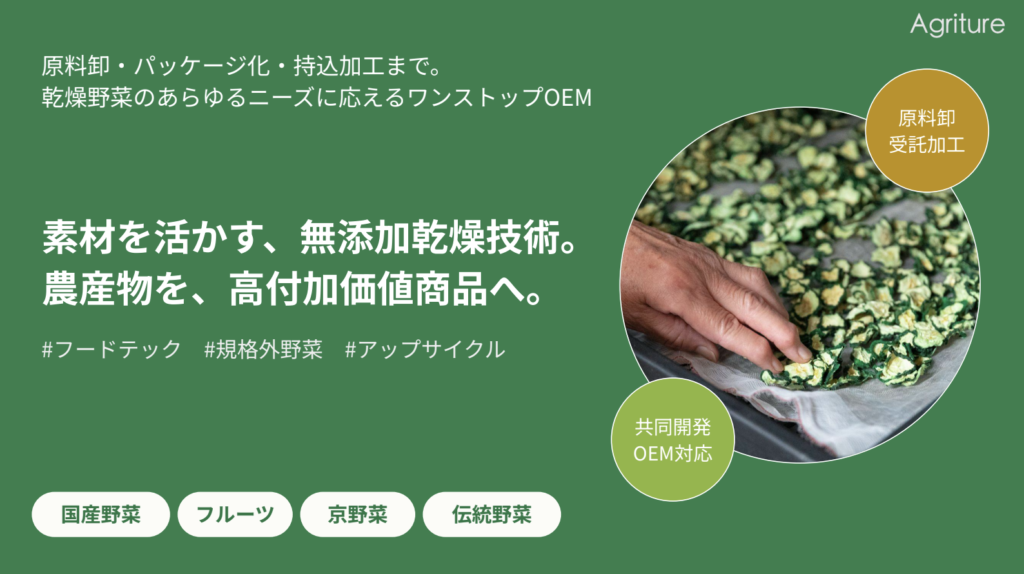
- Small-bag filling from 500 bags
- Tea and coffee also supported
- Sealing carried out in a single seamless flow
Types of film and material used in packaging
Once the bag shape is decided, the material comes next. Food-packaging film is mainly light, easy-to-process plastic-based materials, combined with aluminum or paper as the application requires. It rarely stands alone as a single type; it’s generally used as a multi-layer laminate of several materials bonded together. Here we organize the characteristics and applications of representative materials.
| Material (abbreviation) | Characteristics | Main use |
|---|---|---|
| PET (polyester) | Excellent strength, heat resistance, and transparency; serves as the printing base | Outer layer / printed face |
| OPP / CPP (polypropylene) | Clear with high moisture resistance. CPP has excellent heat-seal properties | Clear bag / seal layer |
| Nylon (ONy) | Strong against puncture and impact, with gas-barrier properties too | Intermediate layer for vacuum and freezing |
| LDPE / LLDPE (polyethylene) | Soft and easy to heat-seal. Used on the inside of the bag | Sealant layer |
| Aluminum foil / aluminum vapor deposition | High barrier that lets almost no light, oxygen, or moisture through | Powders and dried goods that need light blocking |
| Paper | Conveys eco-consciousness and texture. Combined with film | Outer packaging / brand presentation |
A multi-layer laminate is designed by stacking, for example, easy-to-print PET on the outside, aluminum or nylon with barrier properties in the middle, and heat-sealable polyethylene on the inside. For dried vegetables and powders, for instance, an aluminum laminate (PET / aluminum / polyethylene) is often chosen with an emphasis on light blocking and moisture resistance. When you want a clear look, you decide the layer structure by balancing the desired function and design—for example, using a transparent vapor-deposited film instead of aluminum. Regarding the compatibility of materials and filling machines, 5 points for selecting packaging materials.
When choosing a material, whether you want to show the contents is also a consideration. Aluminum foil and aluminum vapor deposition let almost no light through, so they’re strong for protecting easily fading dried goods and powders, but the contents become invisible. When you want to show the product’s color, a transparent vapor-deposited film that retains some clarity while keeping barrier properties is an option. Transparent PET and OPP films look great, but on their own they readily let oxygen and moisture through, so for long-shelf-life products they need to be combined with other layers to compensate. It’s realistic to narrow down the material from both the contents’ storability and the brand’s presentation.
Choosing packaging by function: mechanisms that protect the contents
Even with the same shape and material, the optimal combination changes with the function you seek. Identifying the contents’ degradation factors and choosing packaging by working backward from the function that prevents them is the trick to avoiding failure.
Barrier properties (blocking oxygen, light, moisture)
The performance of preventing oxidation, fading, and moisture uptake is called barrier properties. The three representative ones are a gas barrier that resists oxygen, light blocking that shuts out light, and moisture resistance that prevents humidity. For contents weak to oxidation and moisture uptake—dried vegetables, powders, coffee—you secure high barrier properties with an aluminum laminate or transparent vapor-deposited film.
Heat resistance and cold resistance
Products heat-sterilized like retort need heat resistance, and frozen foods need cold resistance that won’t crack at low temperatures. Confirm the film’s heat- and cold-resistant temperatures to match the contents’ manufacturing process and distribution temperature. Insufficient heat resistance deforms the bag during sterilization, and insufficient cold resistance causes the bag to crack during freezing.
Heat-seal properties
Heat-seal properties are what’s needed for the process of closing the bag mouth with heat. The inside of the bag uses a layer that melts and bonds with heat, such as polyethylene or CPP. When filling powder, powder caught in the seal causes sealing defects, so it needs to be confirmed including compatibility with the filling machine.
Techniques for retaining freshness (oxygen absorbers, gas replacement, vacuum)
In addition to the packaging itself, there are techniques for conditioning the environment inside the bag. Here we organize three representative methods and the foods each suits.
- Oxygen absorber: enclosed in the bag to remove oxygen. Suited to dried goods and baked sweets where you want to curb oxidation, oil degradation, and mold
- Gas-replacement packaging: replaces the air with a gas such as nitrogen. Suited to snacks and fresh produce you don’t want to crush
- Vacuum packaging: removes air to make it cling to the contents. Suited to contents you want cling to, such as processed meat and frozen foods
All of these only take effect when combined with high-barrier packaging that resists oxygen. Considering freshness-retention techniques as a set with material selection leads to a design with no excess or shortfall. For measures against degradation during storage, Best-before dates and storage of commercial dried vegetables.
The safety and labeling rules required of food packaging
Food packaging must satisfy not only function and design but also rules related to safety. The more directly the packaging touches the contents, the more the material’s safety is in question.
The positive-list system for utensils and containers/packaging
For utensils and containers/packaging that touch food, a positive-list system is established that permits using only substances whose safety has been confirmed. The scope is organized around synthetic resins, and it’s important to confirm with the material maker or contractor whether the packaging materials you use conform to this system.
Food labeling and space for consolidated labeling
Packaging must display ingredient names, net content, best-before date, storage method, allergens, and the like in a prescribed format. Since the displayable space changes with the bag’s shape and area, securing the consolidated-labeling frame before deciding the design prevents the trouble of remaking it later. Note also that for small individual packages, the area for carrying labeling is limited.
Quick-reference chart for choosing packaging by food category
This is a quick-reference chart combining the forms, materials, and functions covered so far by the category of the contents. In actual product design, you use these combinations as a starting point and layer on conditions like lot, sales channel, and design to reach the final decision.
| Category of contents | Suited format | Suited material | Function to emphasize |
|---|---|---|---|
| Dried vegetables, dried goods | Three-side seal, zippered | Aluminum laminate | Moisture resistance, light blocking |
| Powders | Three-side seal, stick | Aluminum laminate, transparent deposition | Moisture resistance, airtightness |
| Tea leaves, herbs | Gusseted (pillow), three-side seal | Aluminum deposition, transparent deposition | Light shielding, aroma retention |
| Liquids, pastes | Stand pouch, spouted | Nylon-based laminate | Strength, airtightness |
| Frozen foods | Pillow, deep-draw | Nylon-containing film | Cold resistance, impact resistance |
| Retort foods | Vacuum, stand pouch | Heat-resistant laminate | Heat resistance, gas barrier |
For dried vegetables and powders, how well you curb moisture absorption and fading is the key to preserving quality. The flow is to base it on aluminum laminate, which resists humidity and light, then choose zip-top for products used repeatedly, or stick or a small three-side seal bag for portioning out one serving at a time. Tea leaves and herbs also emphasize aroma retention so the scent doesn’t escape, so a light-shielding material suits them.
For liquids and pastes, the stand pouch—which stands on its own, shows well on the shelf, and can take a pour spout—is the standard, with strength secured by a puncture-resistant nylon-based laminate. Frozen foods require cold resistance that won’t crack at low temperatures, and retort foods require heat resistance that withstands heating, so the priorities of material selection change. Even with the same “bag,” the best answer changes greatly when the contents change, so treat the quick-reference chart as merely a starting point and adjust it to match your product’s shelf life, distribution temperature, and sales channel.
The Maker’s-Eye Judgment Criteria Seen from Lot and Filling
Once commercialization is the premise, beyond compatibility with the contents, the “ease of making” perspective can’t be left out. You can narrow down to a realistic form from the anticipated production quantity and the state of the contents.
- Suited to prototypes and promotional samples: a three-side seal bag if you want to reliably finish a small amount. Easy to handle and keeps initial costs down
- Suited to mass production: the gusseted bag (pillow), which pairs well with automatic packaging machines and is easy to run in continuous production, has the advantage
- Point to watch with powder: because powder caught in the seal area causes seal failure, choose a form easy to clean the seal surface or a structure where powder doesn’t stick
Whatever the form, considering production quantity and filling method together leads you to a choice that can be made on the floor without strain.
The Steps for Choosing Food Packaging and Environmental Considerations
Food packaging comes in many types, but if you narrow it down by following the steps, you won’t get lost. The basic flow is to start from the contents’ characteristics and layer on conditions in the order of function, form, material, and lot.
Steps to Narrow Down by Working Backward from the Contents
First, confirm whether the contents are powder, liquid, or dried food, and identify which they’re weak to—oxidation, moisture absorption, light, or temperature. Next, decide the needed function (moisture resistance, light shielding, heat resistance, etc.) and select the material that satisfies it. Decide the form from the use and sales channel, and the lot from inventory risk and cost. Thinking in this order leads you to packaging that’s neither over-spec nor short.
Environmentally Conscious Packaging Options
Care for the environment has become an angle you can’t ignore when choosing packaging. There are three main options:
- Mono-material: Make it from a single material rather than bonding several, to make recycling easier
- Paperization: Replace part of the film with paper to reduce plastic use
- Biomass materials: Use plant-derived raw materials to curb the use of fossil resources
There are aspects where recyclability and barrier properties are hard to reconcile. It’s good to choose a specification that’s neither over nor under, matched to the product’s shelf life and sales channel.
When You Want to Try Packaging in Small Lots or Prototypes
For prototyping a new product, distributing samples, or test sales, there are many situations where you want to try the packaging in a small amount first rather than ordering a large quantity all at once. At Agriture, we handle small-bag filling—filling just the needed amount of powders, granules, dried ingredients, and the like into small bags—from small lots, and we can propose forms suited to the use, such as stick, three-side seal, four-side seal, and pillow bags. Because we provide one-stop support—from procuring packaging materials like aluminum and transparent film to printing best-before dates and packing—it’s easy to proceed even with a first commercialization. For the big picture of the filling process, see A complete guide to choosing filling-processing OEM.
We have prepared materials that explain small-pouch filling
Agriture, flexibly handling everything from small lots to large lots
- Small-bag filling from 500 bags
- Tea and coffee also supported
- Sealing carried out in a single seamless flow
FOR BUSINESS
乾燥野菜を業務用でお探しですか
国産の野菜・果物を乾燥し、必要に応じて粉砕してお出ししています。扱っている品目は100種前後で、規格は 乾燥品の一覧・パウダーの一覧 に掲載しています。
少量でのご購入は、姉妹ブランドの通販サイト OYAOYA で承っています。
FAQ
Summary
The types of food packaging become clearer when organized from three angles—“bag shape (form),” “film/material,” and “function.” The basic way to choose is to work backward from the contents’ characteristics: for dried vegetables and powders, prioritize moisture resistance and light shielding and make aluminum laminate the core; for liquids and pastes, look first at strength and airtightness and choose a stand pouch. For frozen, cold resistance is the starting point of judgment; for retort, heat resistance. When you want to try packaging in small lots, using a service that fills just the needed amount into small bags lets you move commercialization forward without carrying inventory risk.
Recommended reading
- 5 Points for Selecting Packaging Materials | The Best Fit for Your Filling Method and Product Characteristics
- The Complete Guide to Choosing a Filling OEM | Points for Selecting a Contractor Without Regret
- How to Choose Stick-Filled OEM Foods: 7 Points for Small-Lot Success That Won’t Fail
- How to Achieve Stand Pouch Filling in Small Lots | Tips for Cost Reduction and Quality Control
- Best-Before Dates and Storage of Commercial Dried Vegetables: Aluminum Pouches, Color-Fading Countermeasures, and How to Spot Deterioration
Download the small-pouch filling materials
We will send the materials to your email address based on the information you provide.
If you are considering product development with off-spec or your own farm's vegetables:From planning to processing, materials, package printing and novelties, you can consult us through a single point of contact. → Learn more about one-stop product development
- Dried Fruit Price Ranges: Types Available at Supermarkets and Online, and How to Choose by Volume
- What Is Sustainable Packaging? Types of Materials, Benefits, and Tips for Small-Lot Adoption
Author of this article
Related articles
-
 Original coffee marketing strategy | Ways to grow sales
 -
 ベジタリアンとは?国の規格が分けている4つの区分と食べられないもの
 -
 長ねぎと白ねぎは同じもの?ねぎの種類と呼び名を国の資料で確かめる
 -
 柚子の種類は何種類あるのか、公の資料で名前が残る系統を数えた
 -
 ゆずの時期は年に二度、青ゆずは7月から黄ゆずは10月から
 -
 ゆずの産地は高知が半分を占め、二位は徳島から愛媛に変わった
 -
 Preventing Food OEM Failures: Common Failure Cases and Countermeasures for Success
 -
 How to find a food OEM | How to efficiently find the best manufacturing partner