
Best-Before Dates and Storage of Commercial Dried Vegetables: Aluminum Pouches, Color-Fading Countermeasures, and How to Spot Deterioration

Summary of this article
On setting best-before dates for dried vegetables, we explain the measurement of water activity Aw 0.20–0.50, monthly calibration work, and the 3-sample sampling rule. We cover room-temperature conversion using an acceleration factor of 5 in a 40°C/75% RH accelerated test, judgment criteria such as color difference within ΔE 3.0 and sensory evaluation, the calculation method applying a safety factor of 0.7–0.8, and the practical points of determining factors from packaging barrier properties and distribution temperature management.
The best-before date of commercial dried vegetables in reality degrades greatly with storage conditions, not only with the period shown on the package. Even the same lot from the same maker degrades in color, aroma, and texture at completely different speeds between stock kept in an aluminum pouch in a cool, dark place and stock left in a simple bag in the kitchen. This article organizes, for restaurants, food factories, and OEM buyers, the causes of storage degradation, how to use aluminum bags and oxygen absorbers, how to spot fading and moisture clumping, and the practical setting of best-before dates for commercial OEM.

We have materials available to help you understand dried processing OEM
Agriture OEM, flexibly handling everything from small lots to large lots
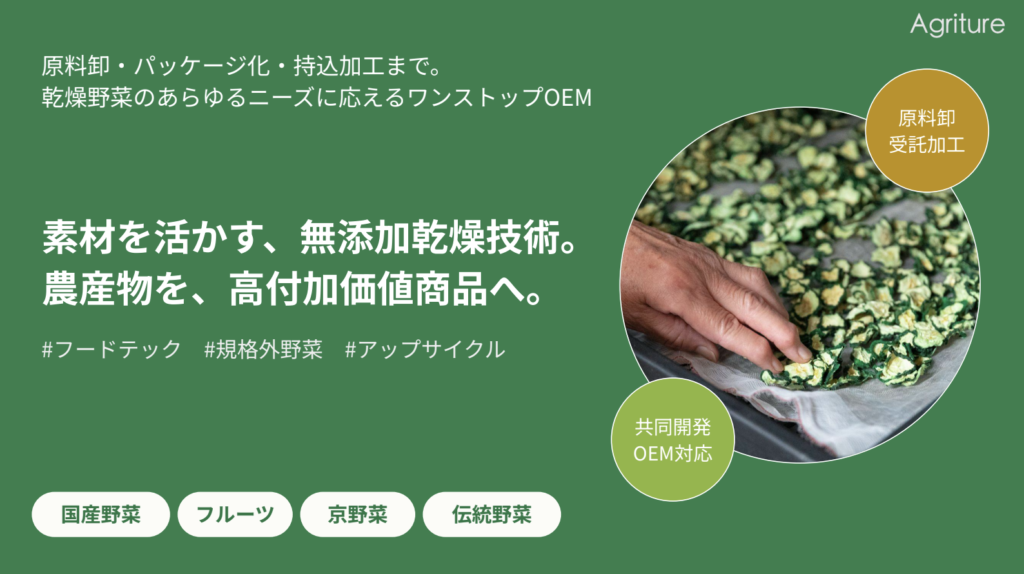
- OEM available from small lots of 10 kg
- Drying of brought-in raw materials also possible
- Support from processing to filling in one place
TOC
The guideline best-before date for dried vegetables and the fact that they "degrade with storage"
The best-before date of commercial dried vegetables from the production date 6–12 months is generally. However, this is the period when properly stored, and under high heat, humidity, or direct sunlight, pigments, flavor, and texture degrade rapidly, sometimes becoming "unusable" in half the period.
⚠️ A common misconception
It's not "the best-before date is 12 months, so I can comfortably use it for a year."If storage conditions are poor, it degrades before the labeled date. If any of fading, moisture clumping, mold, or insect damage appears, it's unusable even within the date.
3 causes of degradation with storage conditions
Degradation of dried vegetables progresses under 3 conditions: light, oxygen, and moisture. Mismanaging even one greatly lowers quality even within the best-before date.
| Cause of degradation | Impact | Main countermeasure |
|---|---|---|
| Light (UV / direct sunlight) | Pigment breakdown, fading, loss of aroma | Light-blocking bag, aluminum pouch, dark-place storage |
| Oxygen (oxidation) | Oxidation of fats, discoloration, flavor degradation | Oxygen absorber, gas replacement, vacuum packaging |
| Moisture (absorption) | Moisture clumping, mold, microbial risk | Desiccant, sealing, low-humidity environment |
Factoring in temperature (high heat accelerates chemical reactions) and insect damage (storage-site hygiene) makes it even more complex. In restaurants and food factories, storage rules that build these conditions into the operational flow are essential.
FOR BUSINESS
乾燥野菜のOEM・受託加工を承ります
国産の野菜・果物の乾燥、100メッシュ相当までの粉砕、10g以上の小袋充填までをお受けしています。小ロットの試作から量産までご相談ください。寄せられた相談の実例は OEM・卸のご相談 に掲載しています。
乾燥品の賞味期限は、出荷日から6ヶ月程度を目安にご案内しています。
How to choose aluminum bags and oxygen absorbers, and their effect
For commercial dried vegetables, the combination that best preserves quality is an aluminum pouch + oxygen absorber. PE bags (polyethylene) and kraft bags have low initial cost, but degradation is faster due to the transmission of light and oxygen.
| Packaging material | Light blocking | Oxygen blocking | Notes |
|---|---|---|---|
| Aluminum pouch | ◎ | ◎ | The commercial standard / somewhat higher unit price |
| Metallized film (aluminum-deposited) | ◯ | ◯ | Light, mid-cost |
| PE bag (clear, polyethylene) | × | △ | For short-term storage / inexpensive |
| Kraft bag | △ | × | Light, low-cost / for short-term, dry environments |
Adding an oxygen absorber (such as Ageless) inside keeps the oxygen concentration at 0.1% or below, greatly slowing fat oxidation and pigment degradation. For long-storage items and products needing fade prevention (color-rich vegetables like Spinach,・beets,・Tomato), an aluminum pouch + oxygen absorber is nearly essential.
💡 Using oxygen absorbers vs. gas replacement
Oxygen absorbers are handy for small lots and individual packaging. Gas replacement (nitrogen replacement) is used for large-volume commercial work, with cost efficiency and batch processing as merits. Vacuum packaging risks crushing the texture, so it's unsuitable for dried vegetables.
How to spot fading and degradation signs
Whether commercial dried vegetables you've sourced have degraded is checked along 3 axes: appearance, feel, and smell. Even within the date, stop using them if any of the following signs appear.
Fading (pigment fading / discoloration)
If vivid green spinach turns brown, red tomato turns brownish, or the red-purple of beets turns gray, it's a sign that pigment breakdown from UV or oxygen has progressed. Because fading links with flavor degradation, the color-appeal and visual merits for cooking are almost entirely lost. In commercial use, it's a fatal degradation because it affects the "visual impression."
Moisture clumping (dried vegetables have hardened together)
If dried vegetables are clumping into masses inside the bag, it's evidence that moisture absorption has progressed. Once they no longer crumble loosely, the risk of mold and microbes rises sharply. If moisture clumping is visible, it's safest to judge them unusable even right after purchase.
Mold / insect damage / off-odor
If you find any of white, green, or black spots (mold), small insects or their traces, or a nose-catching off-odor (oxidized smell, moldy smell, oily smell), they're unusable in both commercial and home use. Review your storage-site hygiene management and temperature/humidity records.
Handling after opening in commercial use
The moment you open the package, the degradation speed jumps. When sourced in large commercial bags (5–10kg), how you design the period from opening to using up is the key to maintaining quality.
- Portioned storage: right after opening, portion into 1-day to 1-week amounts and reseal the unused portion with an oxygen absorber
- Refrigerated storage: in a hot, humid kitchen environment, secure dedicated space in the refrigerator
- Double wrap + zip bag: simple, but practical for short-term operation
- Note the opening date: write the opening date and sourcing date on the bag, and enforce first-in, first-out
- Seasonal response: take extra care from the rainy season through summer. Store under a dehumidifier or air-conditioned environment
Protect quality with lot management and first-in, first-out
In commercial use, multiple lots are often stored at once, so building a lot-management + first-in, first-out (FIFO) system prevents quality trouble.
- Record the production date, sourcing date, and best-before date at intake (shelf label or management sheet)
- Arrange shelves with old at the front, new at the back, and use from the front
- Take stock quarterly and visually confirm remaining quantity and dates
- Redirect long-standing inventory you can't use up to consumption menus early
Setting best-before dates for commercial OEM (accelerated testing and water activity)
When you as an OEM buyer set your own product's best-before date, water activity (Aw) and accelerated testing are the basis. If you're going to label "12 months from production" on the package, you need to be able to show the grounds in a spec sheet.
- Water activity (Aw): dried vegetables suppress microbial activity at Aw 0.6 or below. 0.5–0.6 is a common target value
- Accelerated testing: store at higher-than-normal temperature (35°C, 40°C, etc.) and calculate the actual date from the quality-degradation speed
- Safety factor: it's common to take 70–80% of the test result as the actual best-before date (a safety buffer)
- Real-time testing: beyond accelerated testing, periodic confirmation under actual storage conditions is also recommended
When selling as an OEM product, the practical basics are to share the basis for the best-before-date setting with the supplier (the dried-vegetable maker) and obtain the spec sheet and test data.
We have materials available to help you understand dried processing OEM
Agriture OEM, flexibly handling everything from small lots to large lots
- OEM available from small lots of 10 kg
- Drying of brought-in raw materials also possible
- Support from processing to filling in one place
FOR BUSINESS
乾燥野菜のOEM・受託加工を承ります
国産の野菜・果物の乾燥、100メッシュ相当までの粉砕、10g以上の小袋充填までをお受けしています。小ロットの試作から量産までご相談ください。寄せられた相談の実例は OEM・卸のご相談 に掲載しています。
乾燥品の賞味期限は、出荷日から6ヶ月程度を目安にご案内しています。
FAQ
Can dried vegetables past their best-before date be used?
The best-before date is the "date for eating at its best," and being past it doesn't mean it's immediately inedible, but the color, aroma, and texture are likely degraded. In commercial use, using expired product is not recommended. If any of fading, moisture clumping, or off-odor is present, it's unusable even within the date.
How much difference is there between an aluminum pouch and a regular PE bag?
It depends on conditions, but for long-term storage, an aluminum pouch + oxygen absorber clearly gives higher retention of pigment, flavor, and nutrients. Vegetables that fade easily (spinach, beets, tomato) especially warrant aluminum. For commercial storage of six months or more, the difference in packaging material greatly affects usability.
How soon after opening should I use it up?
The guide is 2 weeks to 1 month. You can extend it by resealing with an oxygen absorber and storing portioned in the refrigerator or a cool, dark place. From the rainy season through summer, moisture-absorption risk rises, so using it up sooner than usual is safer.
How can I prevent fading in commercial use?
The basic set of three is aluminum pouch + oxygen absorber + light-blocking storage. Spinach, Komatsuna, beets, and tomato in particular have pigments sensitive to UV and oxygen, so moving them to a light-blocking environment right after sourcing is important. Fading is fatal in commercial use because it undermines the color appeal of dishes.
A partner asked for the basis of the best-before-date setting. What should I prepare?
Obtain from the supplier and present a spec sheet compiling the water-activity (Aw) measurement data, accelerated-test results, and the safety-factor setting logic. Agriture handles the issuance of food spec sheets and best-before-date bases. For details, the commercial dried-vegetable page Please consult us.
Summary | The best-before date is determined by storage
Three-line summary
- The best-before date of dried vegetables is 6–12 months, but they degrade greatly with storage conditions.
- With the set of three—aluminum pouch + oxygen absorber + light-blocking storage—prevent fading, moisture clumping, and oxidation
- For commercial OEM, set the best-before date via water activity + accelerated testing and present the basis in a spec sheet
The quality of commercial dried vegetables is determined not by the package's date label but by the storage environment. Building an operation of aluminum pouch, oxygen absorber, light blocking, temperature/humidity management, and first-in, first-out, and having a system to spot signs of fading and moisture clumping early, is the shortcut to maximizing raw-material value. For the specs and best-before-date basis of Agriture's commercial dried vegetables,[Commercial] Dried vegetables | Domestic dried-goods ingredients available for viewing here.
Download the OEM contract processing materials
We will send the materials to your email address based on the information you provide.
Recommended reading
→ [Commercial] Dried vegetables | Domestic dried-goods ingredients
→ 7 Criteria for Judging a Commercial Dried Vegetable Supplier
→ How to Rehydrate Dried Vegetables: Tips for Commercial and Restaurant Use
If you are considering product development with off-spec or your own farm's vegetables:From planning to processing, materials, package printing and novelties, you can consult us through a single point of contact. → Learn more about one-stop product development
- Dried Vegetable Raw Materials for Convenience Store Bento: Techniques for Color, Texture, and Cost Improvement
- Practical Guide to Importing Dried Vegetables: Tariffs, HS Codes, and Quarantine Explained
Author of this article
Related articles
-
 7 Criteria for Judging a Commercial Dried Vegetable Supplier
 -
How to Rehydrate Dried Vegetables: Tips for Commercial and Restaurant Use
-
Dried Vegetable Price Ranges: Supermarket and Online Guidelines and How to Choose by Volume
-
Raw Material Risk Management for Food Manufacturers and How to Use Dried Vegetables
-
HACCP Compliance in Food Processing: A Practical Guide to the Necessity by Processing Form and Use
-
Selection Criteria and Quality Requirements for Dried Vegetable Raw Materials for Pharmaceuticals and Health Foods
-
Custom Processing of Dried Vegetables: A Guide to Cut Shape, Blending, and Moisture Content
-
How to Choose Dried Vegetable Kayaku for Instant Noodles: Rehydration Performance and Quality Standards