
How to Read a Dried Vegetable Quality Specification: A Quick-Reference Table of Standards for Water Activity, Color Difference, Particle Size, and Additive-Free Status

Summary of this article
How to read a dried-vegetable quality specification sheet: we explain the inspection items such as water activity (Aw 0.6 or below), moisture content (5–10%), color difference (ΔE 5.0 or below), particle size mesh, standard plate count (100,000 or below), coliform negative, and pesticide residues. We cover the difference between water activity and moisture content, recommended particle sizes by use (powder 80–200 mesh, ingredients 3–10mm), and a checklist of 5 points to confirm when purchasing.
TOC
What are dried-vegetable quality specifications? Why you need to know how to read them
When you source dried vegetables as a commercial ingredient, product quality hinges greatly on whether you can correctly read the figures on the quality specification (spec) sheet the manufacturer provides. Water activity, color difference, particle size, microbial test values—at a glance they look like technical numbers, but once you understand what each means and its standard, the precision of your ingredient selection improves dramatically.
When a quality specification sheet is needed
A quality specification sheet is needed in every situation involving dried vegetables—ingredient selection for OEM production, the prototype stage of a new product, comparing the quality of existing suppliers, and providing quality proof to business partners. In particular, Commercial dried vegetables transactions almost never happen without a spec sheet.
Main inspection items
| Inspection item | Unit | Typical standard | Meaning |
|---|---|---|---|
| Water activity (Aw) | 0〜1.0 | 0.6 or below | Moisture level at which microbes cannot grow |
| Moisture content | % | 5〜10% | Proportion of water in the product |
| Color difference (ΔE) | Figure | ΔE 5.0 or below | Difference from the reference color. The smaller, the more uniform |
| Particle size | Mesh / mm | Depends on use | Particle size after grinding |
| Total viable bacterial count | cfu/g | 100,000 or below | Indicator of hygiene condition |
| Coliform bacteria | Negative / positive | Negative | Presence of fecal contamination |
| Pesticide residues | ppm | Below standard values | Food Sanitation Act standards |
💡 Latest trends (2025–2026)
Since HACCP became mandatory, the spec-sheet standards demanded by food manufacturers' procurement teams have risen steadily. Water activity (Aw), microbial testing, and pesticide residues in particular are trending toward more frequent testing and more items, and whether the spec sheet carries recent test results (within the past year) has become a practical checkpoint.
How to read water activity (Aw) and its standards
What is water activity
Water activity (Aw) is an indicator showing the proportion of free water in food. It is expressed on a scale of 0 to 1.0, and the lower the value, the harder it is for microbes to grow. For dried vegetables, an Aw of 0.6 or below means the risk of mold and bacterial growth is extremely low, allowing long-term storage at room temperature.
The difference from moisture content
The difference between "moisture content" and "water activity" is easily confused. Moisture content is a simple figure showing the proportion of water in the product (%), whereas water activity shows the proportion of "free water" available to microbes. Even at the same 10% moisture content, products high in sugar or salt have lower water activity, so shelf stability differs. In dried-vegetable quality control, always check water activity, not just moisture content.
FOR BUSINESS
乾燥野菜を業務用でお探しですか
国産の野菜・果物を乾燥し、必要に応じて粉砕してお出ししています。扱っている品目は100種前後で、規格は 乾燥品の一覧・パウダーの一覧 に掲載しています。
少量でのご購入は、姉妹ブランドの通販サイト OYAOYA で承っています。
How water activity is measured and points to note
Water activity is measured with a dedicated instrument (a water activity meter). The basic method is to place the sample in a sealed container and wait until it reaches equilibrium at a constant temperature before measuring. Because the measurement environment's temperature affects the result, measuring under constant conditions around 25°C is recommended. Confirming the measurement conditions along with the Aw value your supplier provides gives added peace of mind.
Color difference (ΔE) and particle-size standards
The meaning of color difference (ΔE) and how to read it
Color difference is a value measured in the Lab color space, expressing the difference from a reference sample as ΔE (delta E). The smaller the ΔE, the more uniform the color and the more stable the visual quality. As a guide, at ΔE 3.0 or below the difference is barely perceptible to the eye, while above 5.0 the color difference becomes clearly visible. Dried vegetables change color easily depending on drying conditions (temperature and time), and variation can occur even within the same lot. Contract processing it is important to agree on the acceptable ΔE range in advance.
How to choose particle size (mesh)
Particle size is an indicator of the size of ground dried vegetables, expressed in mesh number or millimeters. The higher the mesh number, the finer the particles.
| Use | Recommended particle size | Examples |
|---|---|---|
| Powder (to dissolve) | 80–200 mesh | Smoothies, green juice, baby food |
| Fine grain (to knead in) | 20–60 mesh | Pasta dough, bread dough, udon |
| Diced (as ingredients) | 3〜10mm | Soups, salads, seasoning packets for cup noodles |
| Sliced (to show) | 10〜30mm | Toppings, tea, gift products |
Vegetable powder when used as such, 80–200 mesh is common. Particle-size selection is a key factor that determines the texture and appearance of the finished product, so we recommend comparing several particle sizes at the prototype stage.
Microbial testing and pesticide-residue standards
Standard values for standard plate count and coliforms
Microbial testing is the most basic item in food hygiene management. The standard plate count is expressed as the number of bacteria per gram of product (cfu/g), and for dried vegetables the common standard is 100,000 cfu/g or below. Coliforms are required to be "negative." Exceeding the standard indicates a possible problem in the hygiene management of the raw material or in the drying process.
Key points of pesticide-residue testing
Even for domestically grown dried vegetables, pesticide-residue testing is essential. Under the positive-list system of the Food Sanitation Act, products cannot be distributed if pesticides exceeding the standard values are detected. In particular, dry processing when the moisture is removed and the weight drops, the pesticide concentration per unit weight becomes higher than in the fresh state. Because pesticide management at the raw-material stage determines product safety, always ask suppliers for a pesticide-residue test report.
Additional testing for imported raw materials
When sourcing dried vegetables produced overseas, in addition to pesticide-residue testing to domestic standards, you should also check test results for heavy metals (lead and cadmium) and sulfur dioxide (sometimes used as a bleaching agent). Agriture, which handles domestically grown raw materials,ensures traceability of cultivation history from the raw-material stage.
Quality specification checklist | 5 points to confirm when purchasing
We have summarized into 5 points the things to check on the quality specification sheet when purchasing dried vegetables.
- Is water activity 0.6 or below: the basic condition for long-term storage and safety
- Is microbial testing within standard values: standard plate count 100,000 or below, coliforms negative
- Is the acceptable color-difference range specified: essential for managing lot-to-lot variation
- Does the particle size match the use: powder use and ingredient use differ greatly
- Is there a pesticide-residue test report: especially important because dried products are concentrated
Checking these items in advance helps prevent trouble after purchase. If anything is unclear, a domestic dried-vegetable manufacturer like Agriture can support you from reading the spec sheet through to ingredient selection.
FOR BUSINESS
乾燥野菜を業務用でお探しですか
国産の野菜・果物を乾燥し、必要に応じて粉砕してお出ししています。扱っている品目は100種前後で、規格は 乾燥品の一覧・パウダーの一覧 に掲載しています。
少量でのご購入は、姉妹ブランドの通販サイト OYAOYA で承っています。
Frequently asked questions (FAQ)
Summary | Read the quality specs to select the best dried-vegetable ingredient
Three-line summary
- Read a quality specification sheet along 5 axes: water activity (Aw), color difference (ΔE), particle size, microbes, and pesticide residues
- Water activity 0.6 or below plus standard plate count 100,000 cfu/g or below is the industry guide for dried vegetables
- Always confirm on the spec sheet whether additives or glucose are present (directly tied to label claims and functional claims)
You can read a dried-vegetable quality specification sheet by covering 5 items: water activity, color difference, particle size, microbial testing, and pesticide residues. Understanding these figures correctly lets you select ingredients suited to your use and optimize both product quality and cost.
Agriture welcomes inquiries about domestic dried-vegetable quality specifications. If you have trouble reading a spec sheet or selecting ingredients, feel free to get in touch.
We have materials available to help you understand dried processing OEM
Agriture OEM, flexibly handling everything from small lots to large lots
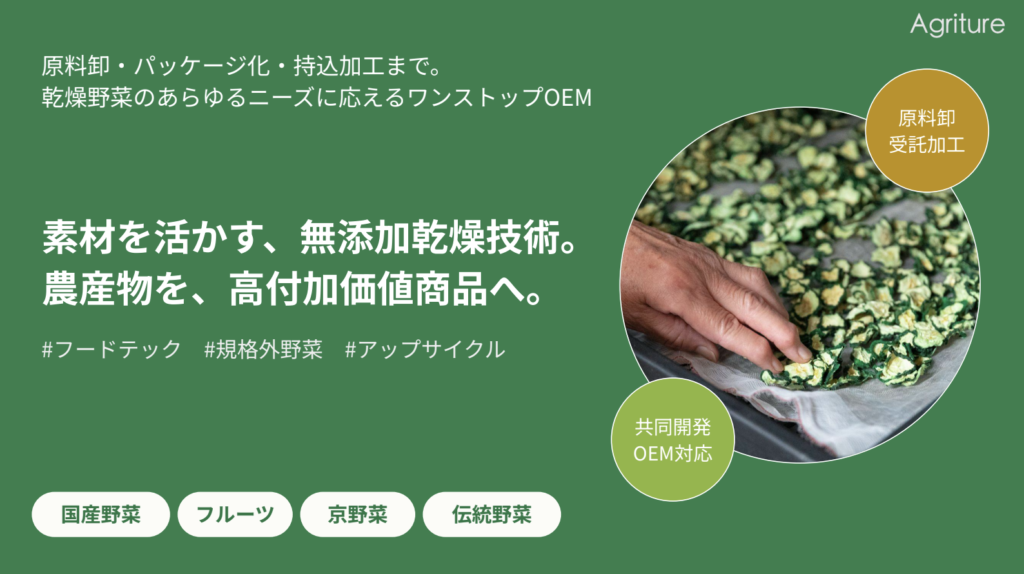
- OEM available from small lots of 10 kg
- Drying of brought-in raw materials also possible
- Support from processing to filling in one place
Download the OEM contract processing materials
We will send the materials to your email address based on the information you provide.
If you are considering product development with off-spec or your own farm's vegetables:From planning to processing, materials, package printing and novelties, you can consult us through a single point of contact. → Learn more about one-stop product development
- Rules for Labeling the Origin of Raw Materials in Processed Foods: 4 Labeling Methods and Penalties for Violations
- The Difference Between Domestic and Chinese Dried Vegetables: Quality and Cost Comparison and Practical Uses
Author of this article
Related articles
-
 7 Criteria for Judging a Commercial Dried Vegetable Supplier
 -
How to Rehydrate Dried Vegetables: Tips for Commercial and Restaurant Use
-
Dried Vegetable Price Ranges: Supermarket and Online Guidelines and How to Choose by Volume
-
Raw Material Risk Management for Food Manufacturers and How to Use Dried Vegetables
-
HACCP Compliance in Food Processing: A Practical Guide to the Necessity by Processing Form and Use
-
Selection Criteria and Quality Requirements for Dried Vegetable Raw Materials for Pharmaceuticals and Health Foods
-
Custom Processing of Dried Vegetables: A Guide to Cut Shape, Blending, and Moisture Content
-
How to Choose Dried Vegetable Kayaku for Instant Noodles: Rehydration Performance and Quality Standards