
HACCP Compliance in Food Processing: A Practical Guide to the Necessity by Processing Form and Use

Summary of this article
For HACCP compliance in dried-vegetable manufacturing, we explain the concrete application of the 7 principles and 12 procedures, and biological, chemical, and physical hazards such as heat-resistant bacteria, residual pesticides, and metal fragments. We also cover CCP settings in practical terms—water activity managed at 0.6 or below in the drying process, a metal-detector Fe φ1.0 mm detection standard, wash-water chlorine concentration of 100-200 ppm—and the certification levels demanded by clients, such as FSSC 22000 and ISO 22000.
HACCP compliance in food processing is not of the same importance across every processing form and application. It's essential for products with zero-tolerance risk such as toddler food, nursing-care food, and retort products, but for processing with low water activity and low microbial risk such as simple drying and powdering, there are cases where HACCP certification isn't essential. What a food manufacturer's procurement staff should really look at is not "whether HACCP is obtained" but a quality-assurance system suited to the processing form and application, contained in burdock and cocoa.
This article organizes the necessity of HACCP in food processing using a matrix of processing form × application, covering the criteria for judging which applications require HACCP and which don't, alternative quality-assurance systems, and a supplier-audit checklist—practical matters from the buyer's viewpoint.

We have materials available to help you understand dried processing OEM
Agriture OEM, flexibly handling everything from small lots to large lots
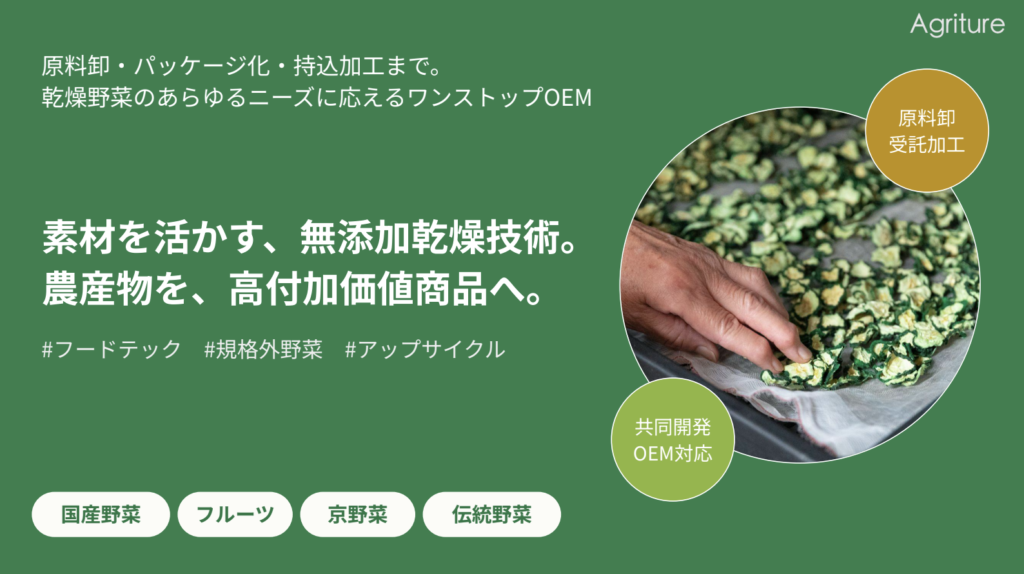
- OEM available from small lots of 10 kg
- Drying of brought-in raw materials also possible
- Support from processing to filling in one place
TOC
The background to why HACCP is required in food processing
In June 2021, HACCP became fully mandatory, and all businesses handling food came to be required to comply with HACCP according to their scale. However, "mandatory" and "certification required" are separate matters.
- Hygiene management in line with HACCP: mandatory for all businesses (small businesses use a simplified version that "incorporates the HACCP approach")
- HACCP certification: obtained through a third-party certification body. Increasingly required as a client condition
- ISO 22000, FSSC 22000: more comprehensive food-safety-management certifications that encompass HACCP
What matters for procurement staff is judging where the level of assurance needed for your own product's application lies.
💡 What is HACCP? (a recap)
HACCP (Hazard Analysis and Critical Control Point) is a hygiene-management method that ensures safety by analyzing the hazards (biological, chemical, physical) that can arise at each step from raw-material receipt through shipment, and continuously monitoring and recording the especially important steps (CCPs: critical control points). It originated when NASA in the US developed it to ensure the safety of space food, and it's now the global baseline for food-safety management. In Japan, it became mandatory for all businesses in June 2021.
Map of HACCP necessity that changes by processing form × application
HACCP necessity changes on two axes: processing form (water activity, process risk) and application (target consumer, distribution). Use the map below to first confirm which zone your product falls in.
| Processing form / application | HACCP necessity | Reason |
|---|---|---|
| Toddler food, weaning food, baby food | 🔴 Essential | Weak immunity, zero tolerance |
| Hospital meals, nursing-care food | 🔴 Essential | For those with weakened immunity or needing treatment |
| Retort, frozen prepared dishes | 🔴 Essential | The heat-sterilization step is the lifeline of quality |
| Paste, purée | 🟡 High | High moisture, microbial growth risk |
| Extracts, dashi (liquid) | 🟡 High | Contamination risk when liquid or concentrated |
| Frozen vegetables, frozen processing | 🟡 Medium | Freezing-temperature management, post-thaw risk |
| Filling and portioning steps | 🟡 Medium | Foreign-matter contamination, cross-contamination |
| Powder | 🟡 Medium | Dust, allergen cross-contact |
| Simple drying (dried vegetables only) | 🟡 Medium | Water activity is low and microbial risk is low, but the practical work of foreign-matter contamination and allergen management is still required |
💡 A commonly misunderstood point
What matters is not "whether HACCP certification exists" but whether processing and record-keeping in line with HACCP are being carried out. Rather than judging by the certificate alone, confirming that day-to-day production records, CCP monitoring, and hygiene-management practice are traceable is the axis for judging stable transactions.
FOR BUSINESS
乾燥野菜を業務用でお探しですか
国産の野菜・果物を乾燥し、必要に応じて粉砕してお出ししています。扱っている品目は100種前後で、規格は 乾燥品の一覧・パウダーの一覧 に掲載しています。
少量でのご購入は、姉妹ブランドの通販サイト OYAOYA で承っています。
Applications where HACCP is especially important, and practical points
For the three applications with high HACCP necessity, the audit requirements before starting transactions become stricter. We organize the points procurement staff should confirm with particular focus.
Toddler food, weaning food, baby food
Because the target is infants with weak immunity, the acceptable risk is essentially zero. Microbial standards are often set stricter than for ordinary food. A system that can record raw-material residual pesticides, metal detection, and foreign-matter countermeasures at each step is essential.
- HACCP certification (mandatory plus obtaining certification is effectively required)
- Raw-material residual-pesticide testing (whether domestic or foreign)
- Allergen management (contamination measures for all 28 items)
- Metal-detection sensitivity (high sensitivity for both iron and SUS)
- For additive-free and domestic appeal, having test evidence in order
Hospital meals, nursing-care food
Because those with weakened immunity or needing treatment consume it, food-poisoning risk directly leads to health harm. Certification in one of HACCP, ISO 22000, or FSSC 22000 is often presented as a procurement requirement.
Retort, frozen prepared dishes, heat-cooked products
Temperature and time records of the heat-sterilization step are the lifeline of quality. Temperature management as a CCP, the cooling step, and container sterilization must be rigorously controlled. This is a field where manufacturers who hold FSSC 22000 in addition to HACCP certification tend to be chosen.
Processing with medium-to-low HACCP necessity, and points to confirm for in-line operation
For processing such as simple drying and powdering processing with low water activity and low microbial risk, there are cases where HACCP certification isn't essential. As an alternative, quality-assurance systems like the following function in practice.
| Quality-assurance element | Details to confirm |
|---|---|
| Water activity (Aw) management | Microbial activity suppressed at 0.6 or below / measurement records per lot |
| Moisture-content measurement | 10-15% as a guide / lot records |
| Food spec sheet | Basis for raw materials, nutrition, allergens, and best-before date |
| Pesticide residue testing | Periodic testing 1-2 times a year plus evidence retention |
| Microbial testing | Periodic testing of aerobic plate count, mold, and yeast |
| Allergen management | Changeover procedure for lines shared with nuts and wheat |
| Metal detection | Sensitivity settings and lot records |
Small and mid-size manufacturers handling only simple drying can build a transaction track record even without HACCP certification. If your product's application is in the "HACCP not essential" zone, confirming an alternative quality-assurance system lets you broaden your pool of suppliers with good price, lot flexibility, and nimbleness.
Supplier-audit checklist (buyer's viewpoint)
When procurement staff audit supplier candidates, they confirm across documents, records, and the site—three aspects. It's a list for gauging the depth of practice, not just whether HACCP certification exists.
10 items to confirm on the document side
- Certification of HACCP, ISO 22000, FSSC 22000 (if obtained)
- HACCP plan (documentation of the 7 principles and 12 procedures)
- Food specification sheet (raw materials, components, allergens, Aw, basis for best-before date)
- Residual-pesticide test results (testing body, items, detected values)
- Microbial test results (aerobic plate count, E. coli, mold and yeast)
- Allergen management manual
- Hazard analysis table (biological, chemical, physical)
- CCP list and control criteria
- Hygiene management plan (5S, employee training)
- Emergency response manual (foreign-matter contamination, recall)
10 items to confirm on the record side
- Raw-material receipt records (origin, lot, test results)
- Production daily reports (temperature, time, blend amount records)
- CCP monitoring records (per lot)
- Metal-detector sensitivity-test records (at start and end of work)
- Cleaning and washing records (per line, per shift)
- Employee health-check records
- Entry/exit and changing records
- Allergen changeover cleaning records
- Pre-shipment inspection records (weight, packaging, printing)
- Traceability (which lot went to which client)
10 items to confirm on the site side
- Flow design (one-way flow of raw material → processing → packaging → shipment)
- Foreign-matter contamination prevention (insect control, rodent control, glass management)
- Metal-detector placement and sensitivity
- Temperature and humidity management (raw-material warehouse, product warehouse)
- Employee grooming, hand washing, changing
- Allergen-dedicated line or on-site verification of cleaning procedures
- Segregated management of raw materials, work-in-progress, and products
- Waste management
- Evidence of periodic pest control
- Operation of corrective and preventive actions
💡 The real point to look at in an audit
The HACCP certificate is the entrance. Confirming on-site whether the production records for a single lot are traceable reveals the depth of quality management. Because there are not a few manufacturers with an impressive certificate but practice that hasn't caught up, judging with the three-part set of documents, records, and site is the iron rule.
Quality-trouble cases and countermeasures
We organize the troubles that tend to happen in the food-processing industry and the points buyers should confirm in advance. Looking at it case by case makes the points to check concrete.
Case 1 | Insufficient metal-detector sensitivity
Situation: A complaint of metal-fragment contamination arose with a shipped product. Cause: The metal-detector sensitivity was left at the standard for a past lot, and with new packaging material (aluminum) false detections occurred frequently → so the sensitivity had been lowered. Countermeasure: Reset sensitivity per packaging spec. Record test-piece testing at the start and end of work.
Case 2 | Inadequate allergen changeover cleaning
Situation: A nut-containing product → an allergen-free product were produced consecutively on the same line, and residue was detected. Cause: A cleaning procedure existed, but it was being shortcut in practice. Countermeasure: Have a third party check the changeover-cleaning checklist. Turn it into evidence with sample testing of the wash water.
FOR BUSINESS
乾燥野菜を業務用でお探しですか
国産の野菜・果物を乾燥し、必要に応じて粉砕してお出ししています。扱っている品目は100種前後で、規格は 乾燥品の一覧・パウダーの一覧 に掲載しています。
少量でのご購入は、姉妹ブランドの通販サイト OYAOYA で承っています。
Case 3 | Missing drying-temperature records
Situation: A client requested issuance of a specification sheet, but the drying-temperature records for a specific lot were missing even though within the retention period. Cause: The recording system was handwritten, and the storage method depended on the individual. Countermeasure: Switch to an automatic recording system. Duplicate the backup system.
We have materials available to help you understand dried processing OEM
Agriture OEM, flexibly handling everything from small lots to large lots
- OEM available from small lots of 10 kg
- Drying of brought-in raw materials also possible
- Support from processing to filling in one place
FAQ
Can't I do business with a manufacturer that doesn't have HACCP certification?
It depends on the application. In zero-tolerance areas like toddler food, nursing-care food, and retort, it's effectively essential, but for processing with low microbial risk like simple drying and powdering, there are cases that can be handled with an alternative quality-assurance system even without HACCP certification. Judge by which zone your product's application falls in.
What's the difference between HACCP and ISO 22000 / FSSC 22000?
HACCP is a food-hygiene-management method and set of principles, ISO 22000 is an international standard for food-safety management that encompasses it, and FSSC 22000 is a certification that adds prerequisite programs to ISO 22000. Necessity differs by application and client requirements, and major food manufacturers often list FSSC 22000 as a requirement.
Is HACCP certification unnecessary if it's only simple drying?
After the mandate, hygiene management in line with HACCP is required, but obtaining third-party certification isn't essential. Because water activity (Aw) is low and microbial risk is low, there are many manufacturers building a transaction track record with alternative quality assurance (specification sheets, periodic testing, moisture-content management).
How far should a supplier audit be carried out?
Confirm across three aspects: documents, records, and the site. For documents, the specification sheet and certification; for records, the most recent 1-3 lots; for the site, on-site confirmation of flow, foreign-matter countermeasures, and temperature/humidity management. Depending on transaction scale, all items the first time and a periodic audit once a year thereafter is practical.
What should I look at in the quality-assurance system of a manufacturer without HACCP certification?
Confirm the food specification sheet, residual-pesticide testing, microbial testing, water-activity records, allergen-management procedures, and metal-detection records. If these are in order, it's material for judging that practical-level quality management is in place even without third-party certification.
Summary | Work backward from the application to determine HACCP necessity
Three-line summary
- HACCP necessity is decided by the "processing form × application" matrix. It's not uniform
- Toddler food, nursing-care food, and retort are essential. Simple drying and powdering are medium-to-low. Confirm whether operation in line with HACCP is being carried out
- A buyer's-viewpoint audit checking 30 items across the three aspects of documents, records, and site is practical
For HACCP compliance in food processing, the practical royal road is to first decide the level of assurance needed for your own product's application and judge by cross-referencing it with the processing form. Rather than looking only superficially at whether HACCP certification exists, confirming both the traceability of records and the practical level on the site leads to stable transactions.
Agriture's commercial dried-vegetable lineup (the simple-drying domain where HACCP is not essential) can be[Commercial] Dried vegetables | Domestic dried-goods ingredients viewed on the page. For needs in the certification-essential domain, we can also consult including operation with partner factories.
Download the OEM contract processing materials
We will send the materials to your email address based on the information you provide.
Recommended reading
→ [Commercial] Dried vegetables | Domestic dried-goods ingredients
→ 7 Criteria for Judging a Commercial Dried Vegetable Supplier
→ Raw Material Risk Management for Food Manufacturers and How to Use Dried Vegetables
If you are considering product development with off-spec or your own farm's vegetables:From planning to processing, materials, package printing and novelties, you can consult us through a single point of contact. → Learn more about one-stop product development
- Raw Material Risk Management for Food Manufacturers and How to Use Dried Vegetables
- Selection Criteria and Quality Requirements for Dried Vegetable Raw Materials for Pharmaceuticals and Health Foods
Author of this article
Related articles
-
 7 Criteria for Judging a Commercial Dried Vegetable Supplier
 -
How to Rehydrate Dried Vegetables: Tips for Commercial and Restaurant Use
-
Dried Vegetable Price Ranges: Supermarket and Online Guidelines and How to Choose by Volume
-
Raw Material Risk Management for Food Manufacturers and How to Use Dried Vegetables
-
Selection Criteria and Quality Requirements for Dried Vegetable Raw Materials for Pharmaceuticals and Health Foods
-
Custom Processing of Dried Vegetables: A Guide to Cut Shape, Blending, and Moisture Content
-
How to Choose Dried Vegetable Kayaku for Instant Noodles: Rehydration Performance and Quality Standards
-
Dried Vegetable Raw Materials for Convenience Store Bento: Techniques for Color, Texture, and Cost Improvement