
The Difference Between Domestic and Chinese Dried Vegetables: Quality and Cost Comparison and Practical Uses

Summary of this article
As a comparison of domestic vs. Chinese dried vegetables, we explain the price gap—3,000-5,000 yen per kg domestic vs. 1,000-2,000 yen Chinese, a 2-3x difference—along with seven axes such as traceability, quality stability, and consumer image. We introduce concretely the reality of residual-pesticide risk, the domestic edge in BtoC appeal, the rationale for using Chinese product in BtoB commercial use, Southeast Asian product as a third option, and a 5-step risk-management process.
Commercial dried vegetables divide into types along three axes: Quality, cost, and supply stability differ greatly between domestic and Chinese. Chinese product has the edge on distribution volume and price; domestic has the edge on safety, brand appeal, and specification-sheet support. Depending on your product's application and sales channel, which you choose changes the cost, complaint rate, and how far your channels can spread.
This article is for restaurants, food factories, and OEM buyers, comparing the differences between domestic and Chinese dried vegetables on seven items, and organizing the reality of residual-pesticide risk, how to use each by business type, and the risk-management practices for adopting Chinese product.

We have materials available to help you understand dried processing OEM
Agriture OEM, flexibly handling everything from small lots to large lots
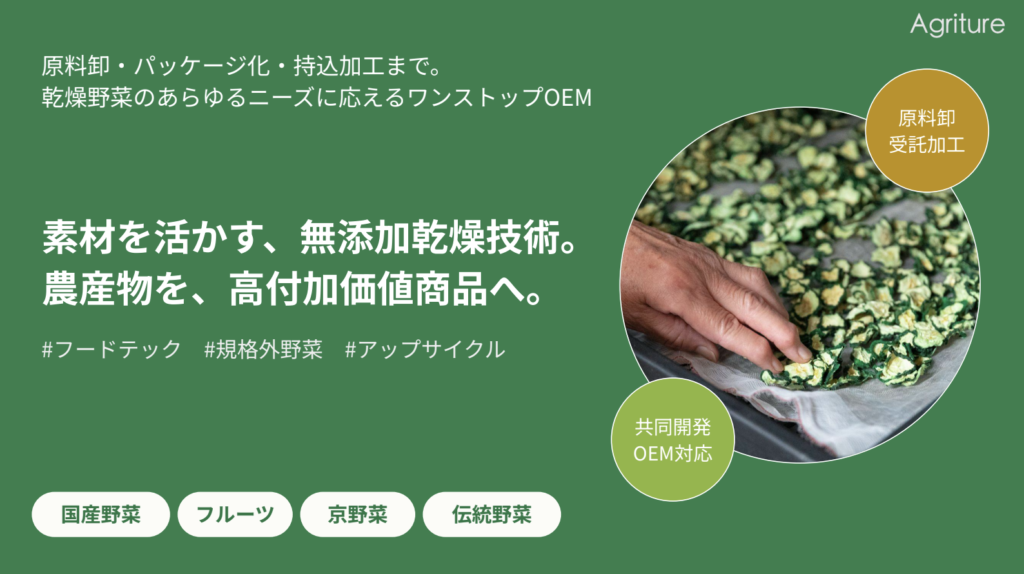
- OEM available from small lots of 10 kg
- Drying of brought-in raw materials also possible
- Support from processing to filling in one place
TOC
The differences between domestic and Chinese dried vegetables
Commercial dried vegetables are distributed with domestic and foreign (China, Taiwan, Vietnam, etc.) product coexisting. Chinese product tends to be priced lower than domestic thanks to differences in raw-material output, processing-plant scale, and labor cost. Domestic, on the other hand, has an edge in residual-pesticide standard management, specification-sheet support, and brand appeal, and use is diverging by application—ingredients for dishes, miso soup, and bento, furikake, stockpile and preserved food, frozen food, and more.
Compared on seven items | An at-a-glance table of cost, quality, and safety
The table below compares domestic and Chinese on the seven items purchasing staff actually use as decision criteria. Which you prioritize changes the choice.
| Item | Domestically grown | Chinese |
|---|---|---|
| Price | High (2-5x Chinese) | Low |
| Supply stability | Varies with season and output | Stable year-round, large-volume supply |
| Abundance of items | Rare items are limited | Abundant (onion, cabbage, etc.) |
| Reliability on residual pesticides | High (domestic standards) | Needs checking (varies by origin and trading company) |
| Specification sheets, test evidence | Tend to be well prepared | Depends on the supplier |
| Brand appeal | Strong (origin, additive-free, domestic labeling) | Weak (mainly cost appeal) |
| Lot support | Small-lot consultation available | Mainly large lots |
💡 A tip for deciding
"Domestic vs. Chinese" isn't an either-or; decide by the product's price range, target customer, and specification-sheet requirement level. Many manufacturers go with a two-line setup—premium line = domestic, standard line = Chinese.
FOR BUSINESS
乾燥野菜を業務用でお探しですか
国産の野菜・果物を乾燥し、必要に応じて粉砕してお出ししています。扱っている品目は100種前後で、規格は 乾燥品の一覧・パウダーの一覧 に掲載しています。
少量でのご購入は、姉妹ブランドの通販サイト OYAOYA で承っています。
The reality of residual-pesticide risk and testing
Residual-pesticide risk exists for both domestic and Chinese, but because Japan's standard values and testing system are robust, domestic carries lower practical risk. When using Chinese product, quarantine inspection at import and domestic re-testing become the effective safety guarantee.
- Quarantine at import: Monitoring inspections and order inspections track the violation rate. Items and origins with many violations become priority-inspection targets
- Domestic re-testing: It's the industry standard for importers, wholesalers, and processing manufacturers to run their own residual-pesticide tests
- Organic: Domestic JAS Organic is available. For Chinese product, JAS Organic certification becomes harder to obtain
- Origin-falsification risk: Confirm on the specification sheet whether the "domestic" label on the packaging means the full raw-material amount or a partial mix
How to use each by business type (restaurant, food factory, OEM)
The optimal origin choice clearly changes with business type and application. Below are guides to representative usage patterns.
| Business type / application | Recommended origin | Reason |
|---|---|---|
| Ryotei, kappo, high-end restaurants | Domestically grown | Quality and brand appeal are everything |
| Bento and prepared-food factories (large consumption) | Mainly Chinese + partly domestic | Cost priority, stable year-round supply |
| Furikake / mixed-rice seasoning | Domestic (major vegetables) | Label-driven appeal / additive-free design |
| Miso soup and instant soup ingredients | Hybrid (domestic + Chinese-grown) | Use by grade |
| Stockpiling / emergency food | Mainly Chinese-grown | Bulk sourcing / long-term storage cost |
| Frozen-food makers | Use both depending on application | Choose origin by product line |
| Baby food / nursing-care food | Domestically grown | Safety and spec-sheet compliance are essential |
| Gifts / hometown tax donations | Domestically grown | Origin and story-driven appeal |
5 steps to manage risk when using Chinese-grown produce
If you adopt Chinese-grown produce for cost and supply stability, you need practical risk management across the whole chain—from sourcing to delivery to customer support.
- ① Confirm that import quarantine inspection passed (link inspection results to lot numbers)
- ② Conduct your own residual-pesticide and microbial re-testing within Japan
- ③ Audit supplier factories (importer / processing plant) at least once a year
- ④ Obtain and retain a certificate of analysis and spec sheet for each lot
- ⑤ Spread risk across multiple suppliers (avoid relying on a single company)
Agriture's position | Committed to 100% domestic
Based in Kyoto and Kyotango, Agriture supplies mainly domestically grown dried vegetables for commercial use. We do not handle Chinese-grown produce; by sourcing directly from contract farms and partner growing regions, we fix the growing region, variety, and processing conditions,which ensures spec-sheet compliance and consistent quality. Even in product development that combines meat and other ingredients, we can make the domestic-origin story a strength.
Unit prices run higher than the Chinese-grown produce distributed through supermarkets and mass retailers, but domestic vegetables are chosen for uses where the “domestic” label delivers value beyond its cost—branded products, PB development, baby food, hometown tax donations, and more. You can view the full lineup of commercial dried vegetables on the[Commercial] Dried vegetables | Domestic dried-goods ingredients page.
We have materials available to help you understand dried processing OEM
Agriture OEM, flexibly handling everything from small lots to large lots
- OEM available from small lots of 10 kg
- Drying of brought-in raw materials also possible
- Support from processing to filling in one place
FOR BUSINESS
乾燥野菜を業務用でお探しですか
国産の野菜・果物を乾燥し、必要に応じて粉砕してお出ししています。扱っている品目は100種前後で、規格は 乾燥品の一覧・パウダーの一覧 に掲載しています。
少量でのご購入は、姉妹ブランドの通販サイト OYAOYA で承っています。
FAQ
How big is the price gap between domestic and Chinese-grown produce?
The gap runs 2 to 5 times depending on the item. For example, dried Onion runs around 2,000 yen per kg for Chinese-grown against a range of 8,000–10,000 yen for domestic. The gap varies widely with the item's rarity and whether it ships directly from a contract farm.
How can you identify a safe Chinese-grown supplier?
Check whether import-quarantine lots passed, whether domestic re-testing is in place, and whether the supplier has a factory-audit track record. The practical approach is to obtain residual-pesticide test reports and evaluate the supplier's quality-assurance system against multiple indicators.
What should you watch for when using domestic and Chinese-grown produce together?
If you make origin claims on the label such as “uses domestic produce,” there are legal rules on the proportion of domestic ingredients, the parts used, and how they are labeled. Review the Consumer Affairs Agency and JAS guidelines in light of the Food Labeling Act and the Act against Unjustifiable Premiums and Misleading Representations.
Can you make small-lot prototypes of domestic dried vegetables?
Agriture handles small-lot prototyping of domestic dried vegetables from 100 g. We can discuss uses ranging from stockpiling, cooking, and miso soup ingredients to additive-free OEM.
Where can you get organic dried vegetables?
Domestic JAS-certified organic dried vegetables can be sourced through contract farms and JAS-organic-certified plants. Because organic JAS certification is harder to obtain for Chinese-grown produce, domestic produce is easier to work with in practice.
Summary | Choose origin by application and sales channel
Three-line summary
- Domestic wins on brand appeal, safety, and spec-sheet compliance; Chinese-grown wins on cost and supply stability
- Choose origin by business model and sales channel. The rule of thumb: domestic for high-price products, mainly Chinese-grown with some domestic for high-volume consumption
- Manage the risk of Chinese-grown produce with a three-part set: import quarantine, domestic re-testing, and factory audits
Choosing where dried vegetables come from is not an either/or between domestic and Chinese-grown; working backward from the product's price range and sales channel is the standard practice. Agriture's domestic dried-vegetable lineup is[Commercial] Dried vegetables | Domestic dried-goods ingredients available for viewing here.
Download the OEM contract processing materials
We will send the materials to your email address based on the information you provide.
Recommended reading
→ [Commercial] Dried vegetables | Domestic dried-goods ingredients
→ 7 Criteria for Judging a Commercial Dried Vegetable Supplier
→ Practical Guide to Importing Dried Vegetables: Tariffs, HS Codes, and Quarantine Explained
If you are considering product development with off-spec or your own farm's vegetables:From planning to processing, materials, package printing and novelties, you can consult us through a single point of contact. → Learn more about one-stop product development
- How to Read a Dried Vegetable Quality Specification: A Quick-Reference Table of Standards for Water Activity, Color Difference, Particle Size, and Additive-Free Status
- Benefits and Uses of Introducing Dried Vegetables for School and Company Cafeterias
Author of this article
Related articles
-
 7 Criteria for Judging a Commercial Dried Vegetable Supplier
 -
How to Rehydrate Dried Vegetables: Tips for Commercial and Restaurant Use
-
Dried Vegetable Price Ranges: Supermarket and Online Guidelines and How to Choose by Volume
-
Raw Material Risk Management for Food Manufacturers and How to Use Dried Vegetables
-
HACCP Compliance in Food Processing: A Practical Guide to the Necessity by Processing Form and Use
-
Selection Criteria and Quality Requirements for Dried Vegetable Raw Materials for Pharmaceuticals and Health Foods
-
Custom Processing of Dried Vegetables: A Guide to Cut Shape, Blending, and Moisture Content
-
How to Choose Dried Vegetable Kayaku for Instant Noodles: Rehydration Performance and Quality Standards